
About a month ago, a group of friends and I were planning a get-together, when the spot we’d been eyeing started to feel a little pricey. You know how a group chat deflates when the exciting plan you’ve been hyping each other up about might not happen — that “well, I guess we’ll try again next month” energy?
Yeah, that.
That’s when someone said: “Man, if only one of us had a pool for a hangout.”
Before the thought even finished landing, I was out my back door, filming my yard: “I don’t have a pool, but I’ve got this wonderfully whimsical splash pad — we can hang here!”
Instant relief.
Everybody lit right back up. We were going to make it happen.
I felt like a hero. I was the yes. And that’s exactly where it started to cost me.
Here’s where we’re going:
• The splash pad brunch that quietly ate my whole Sunday
• The two-part body signal that maps the “no” you buried — relief, then resentment
• Why your honest voice was never rude — it’s load-bearing
“So what should we eat?”
Well, I love hosting, I love being in the heart of a party, and I love me some food — your girl’s from New Orleans. So I said, I’ve got it taken care of: homemade beignets, mimosas, cinnamon rolls, fruit, a little protein. Perfect.
Then: “what time?”
That’s when it got sticky. The brunch was a Sunday, and everyone had a different church service time. Brunch arrival started ping-ponging — 10 am, then noon, then 11 am, then 2 pm. At one point brunch was sounding a lot more like early dinner. And for every single suggestion, my reply stayed the same: “Sure, that works. Y’all can come anytime.”
And for the most part, I meant it.
But over the next week, my own brunch at my own house went from something I was genuinely excited about to something I just wanted over with. Days before it happened, I was already thinking: I can’t wait for Monday.
I’d accommodated every single person except me — and except my own family, who, last I checked, also live in the house.
Nobody trapped me into an all-day event at my own house. I did that, with a smile and one “no worries” at a time.
I kept handing over my day and calling it hospitality.
That’s Good Girl Ghosting™ in its most polite, covered-dish, Sunday-best form.
We’ve been taught that a good woman keeps the peace. She’s easygoing, kind, thoughtful. And somewhere along the way, all of that quietly came to mean: swallow the honest thing, soften it, edit, be accommodating, put yourself last.
So that’s what we do — for years — until one day someone asks what you actually think, and you realize you’re not totally sure anymore.
You’re Julia Roberts in Runaway Bride, not knowing how you like your eggs.
That’s not a character flaw. That’s data. You’ve swallowed the honest thing so many times you lost the thread of it — but your body kept the receipts. Every stinking one.
THE MAP: RELIEF, THEN RESENTMENT
Here’s how you find the honest thing you buried.
You follow the relief, then the resentment.
You say yes, and there’s a flash of relief that the awkwardness is over — you’re the hero. Then an hour later, or a day later…sometimes a few minutes later…the slow burn: the resentment.
That two-part combo is a treasure map. The relief is the old pattern working exactly the way it was trained to work. The resentment is the honest thing knocking to get out.
And there are actually two kinds of relief. The first is the one I felt when everyone lit back up and I was the hero.
It feels amazing — it feels like being seen.
But it’s the people-pleasing sugar high: you disappearing, dressed up as generosity.
You’re being seen for the costume, not for you.
The second relief lives on the far side of the honest thing — and that one hits completely different.
The Holy No creates margin.
And the Spark — your joy, your aliveness, the dreams you keep saying you’ll get to later — the Spark needs the space.
Every yes you didn’t mean is taking up room where your joy could go. Because every no is a yes pointed somewhere else — there’s no such thing as a free-floating no. When I said yes to pushing that brunch into an all-day thing, I was saying no to my family’s Sunday. It might not feel like a choice you’re making, but it’s a choice getting made for you — usually by whoever’s asking the loudest or looks the most disappointed.
YOUR VOICE IS LOAD-BEARING
This isn’t just a feelings thing.
A psychologist named Dana Crowley Jack spent years studying women who chronically silence themselves, and she found that the swallowed voice isn’t only frustrating — it’s linked to depression. Your “nice” that swallows your real answer is never free. Take your voice out from under your life and something real starts to sag.
(And Midlife Sisters, we know the sting of ‘the sag.’)
Here’s the key to actually saying the thing.
A Harvard researcher, Alison Wood Brooks, studies what happens right before something scary — a speech, a hard conversation, a no.
When our heart pounds, most of us try to force ourselves to calm down. Her research found that rarely works (duh); your body’s already revved and you can’t slam those brakes. But do you know what does work? Reappraisal.
You take that same racing heart and rename it — out loud, because saying it out loud matters. Anxiety and excitement are almost identical in the body; the only difference is the story you tell about it.
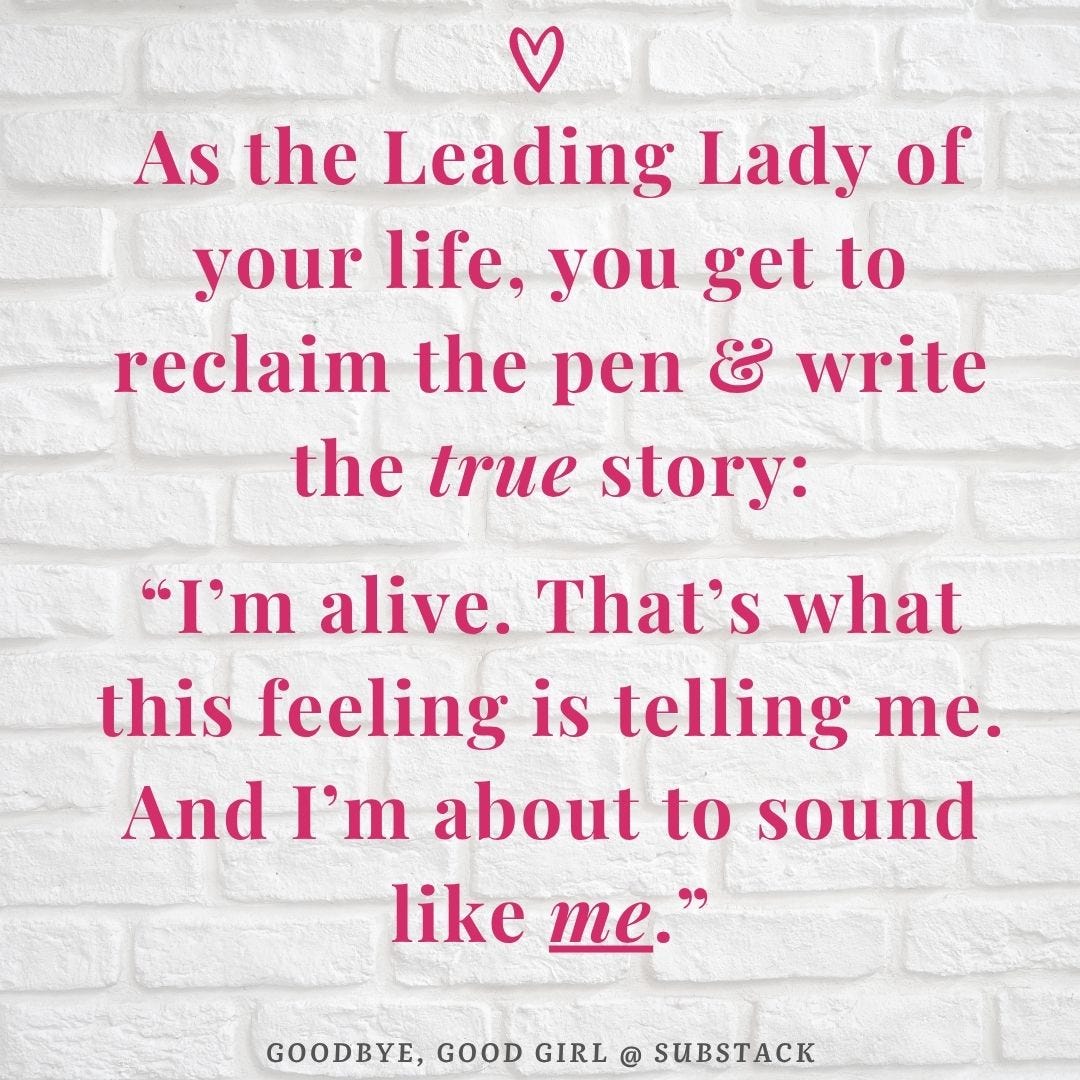
So when you go to say your Holy No and your whole body lights up, that’s not a warning. That’s aliveness. As the Leading Lady of your life, you get to reclaim the pen and write the true story, saying: “I’m alive, that’s what this feeling is telling me, and I’m about to sound like me.”
On the episode, I tell the story of the very first time my body made the no for me — a full-blown panic attack in a church parking lot at 26, because I could not make myself say the word out loud. I couldn’t admit how much I needed and even wanted to say it. I ignored all my body’s signals until I simply couldn’t anymore.
Hold that memory up next to the splash pad brunch, where this time there was no parking lot and no panic — just a three-day catch and a two-line text: “Come at 11, we’ll call it noon, and my family gets their house back around two.”
The panic attack became a pause.
The disappearing became an internally whispered, finally.
(That whole story’s in the episode — press play.)
If you can feel that slow burn in your own life right now, you’re in the right place. The words for the next “no” land here every week.
A BOUNDARY ISN’T THE OPPOSITE OF LOVE
The real fear — the one I lived inside for decades — is that if I say the no, it’ll cost me the relationship. She’ll be hurt. They’ll think I’ve changed, that I’m difficult.
So here are the two things that finally set me free.
First: a boundary isn’t the opposite of love. It’s the shape love takes when it plans to last.
And here’s the part the good-girl code skips right over — the most loving person in history wasn’t infinitely available. Jesus withdrew from crowds who still needed things. He slept through the storm. He asked for space in the garden. Love had a bedtime. So if perfect love, if Jesus, kept boundaries, then your boundary isn’t a character flaw you need to pray away.
The martyr burns out and calls it holiness. The Holy No stays in the room for the long haul — and that, sweet sister, is the more loving option. It’s just not the one we were trained to pick.
Second: when you hold your no, you make room for someone else to stand up. Because I jumped in so fast with “we can do it here,” nobody else in the chat ever got the chance to offer their yes. My quick yes didn’t just cost me — it quietly robbed the room of everyone else’s.
Sometimes the most generous thing you can do is leave one beat of silence and let someone else’s yes rise up to fill it.
JOY NUGGET
Your true voice was never rude. It’s the most freeing sound in the world.
You don’t have to earn your voice back — it’s already yours.
You just get to stop giving it away.
YOUR PINKIE-TOE STEP
No hard conversations required yet.
This week, just catch one relief-then-resentment.
Notice the yes.
Notice the flash of relief.
And when the slow burn shows up a day later, instead of scolding yourself, get curious: what was the honest thing I swallowed there?
You don’t have to say it to a single soul. Just name it to yourself. Noticing is the first act of joyful rebellion.
Playful Prompt
For this letter, I thought I’d include some goodness I’ve created.
Choose Your Adventure, friends, by clicking the link in the title:
Are You A Good Girl Ghost? Quiz - fun, maybe a bit of an ouch, but I leave you with goodness, I promise
My Free Rebel Joy Card Deck - Seven print-and-keep cards with quick and easy play prompts.
And here’s one: Kitchen-Floor Rebellion. Put on the song that was YOURS before you were anyone’s wife or mom. Dance one whole song like the windows are painted shut and the house is empty. Bonus joy if someone walks in and you don’t stop!
Before you go — reply or drop it in the comments: what’s one “sure, that works” you said this week that you didn’t quite mean?
You don’t have to fix it. Just name it. I read every one.
Welcome to the Rebellion. We’ve saved you a seat.
P.S. Part 1 in this series is finding the honest thing. Part 2 hands you the actual words — the Holy No Script Bank — so the short, kind, guilt-free no comes out of your mouth without the whole paragraph of over-explaining tacked on. Subscribe so it lands in your feed the second it drops.
Comments
Nothing yet. Say the first thing.
Sign in to join the conversation.