
This is a longform Restoration Obscura feature.
If you are receiving this article in your inbox, your email client may clip or truncate the content due to its length. You can always read the complete version directly on Restoration Obscura, where the full text is presented without interruption.
Restoration Obscura articles are written works intended to be read as text. Substack may automatically generate an AI-based audio narration of this article within the Substack app. Pronunciations of certain place names, personal names, and historical references in these auto-generated narrations may be inaccurate. The written version should be considered the authoritative source.
For twenty-six years a company named for lead processed uranium beside an Albany commercial strip, and the dust reached the homes and businesses around it.
Central Avenue in Colonie is a four-lane commercial strip like a thousand others: fast food, tire shops, strip plazas, the ordinary traffic of a suburb four miles northwest of downtown Albany. At number 1130, on eleven fenced acres near the Albany line, sits a parcel that went back into private hands in January 2023 for a small fraction of what had been spent on it. For nearly forty years before that sale the federal government owned it and could not release it, because the ground and the buildings on it were contaminated. A company called National Lead had spent twenty-six years on that corner turning uranium into hardware, and the work had left the plant, the grounds, and the neighborhood around them salted with radioactive dust. The contaminant of greatest concern, despite the name over the gate, was depleted uranium.
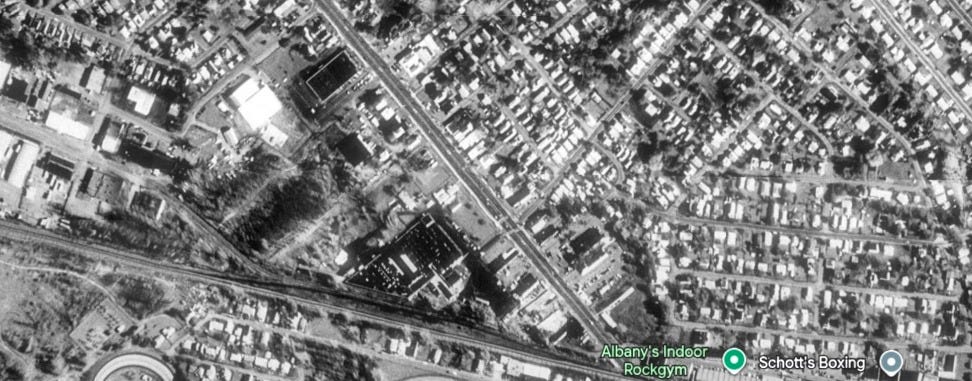
Above: Satellite imagery from May 7, 2026
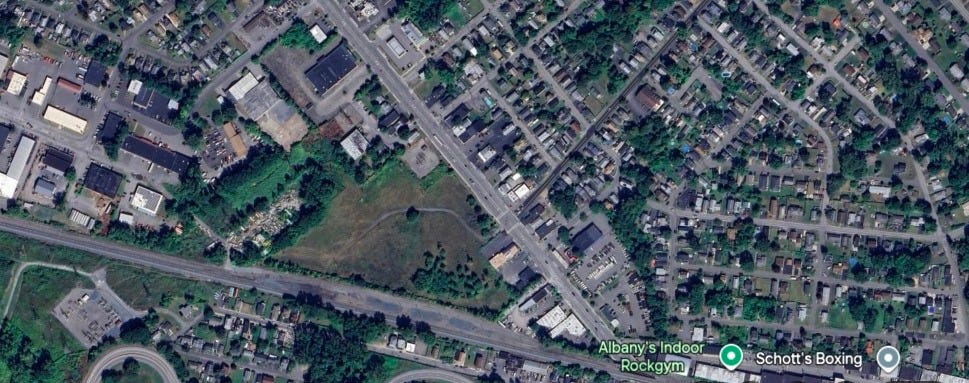
Below: Satellite imagery from September 10, 2025
Images: Google Earth
The site had other lives first. In 1923 the Embossing Company built a plant there to turn out wood products and children’s toys. In 1927 the Magnus Metal Company converted it to a brass foundry casting railroad parts. In 1937 National Lead Industries bought the works for electroplating and took an adjacent lot that included part of a small body of water called Patroon Lake. For two decades the plant did ordinary metal work on an ordinary industrial corner, close enough to houses that the neighbors could hear it run.
In 1958 the work changed. Under license from the Atomic Energy Commission and the State of New York, National Lead began fabricating components from uranium and thorium. The change was licensed and legal and, in the climate of the late 1950s, barely remarkable. The country was standing up an atomic economy in a hurry and needed shops that could handle the metal. The plant handled enriched uranium as well, into the early 1970s, and its output in those years went to the reactor and fuel side of the program rather than to warheads. When the AEC contract ended in 1968, the plant found a second life in a different corner of the same complex. Its largest customer became the Department of Defense, and its principal material became depleted uranium, the dense and faintly radioactive metal left behind when natural uranium is stripped of the isotope that bombs and reactors want.
The atomic complex ran as a chain: uranium mined from the ground, milled into concentrate, refined, and enriched to raise the share of the rare fissile isotope for fuel and weapons. Enrichment yields two streams, the enriched product and a far larger volume of depleted uranium, the tailings. Colonie worked the tail of that chain, the fabrication end, where refined and depleted metal is machined into parts. The region knows the atomic age mostly through its consequences: the fallout, the test sites, the downwind. Colonie is the atomic age from the manufacturing end.
Depleted uranium is prized for one property above all, its weight. It runs nearly twice as dense as lead, which makes it useful for punching through armor and for balancing the moving surfaces of aircraft. The Colonie plant reduced depleted uranium tetrafluoride to metal and machined it into three kinds of thing: radiation shielding, counterweights for aircraft, and armor-piercing projectiles. The counterweights were balance weights tucked into the control surfaces and wings of large aircraft, where dense metal earns its place. The projectiles were the penetrator cores of anti-armor rounds, dense enough to drive through steel and sharpen themselves as they went, the ordnance a later generation would come to know from the Gulf War. Both sent National Lead’s uranium far from Colonie, into airliners overhead and into the ammunition of a military that would fire depleted uranium by the ton in Iraq.
Comments
Nothing yet. Say the first thing.
Sign in to join the conversation.