
Author’s Note
This is a longform Restoration Obscura feature.
If you are receiving this article in your inbox, your email client may clip or truncate the content due to its length. You can always read the complete version directly on Restoration Obscura, where the full text is presented without interruption.
Restoration Obscura articles are written works intended to be read as text. Substack may automatically generate an AI-based audio narration of this article within the Substack app. Pronunciations of certain place names, personal names, and historical references in these auto-generated narrations may be inaccurate. The written version should be considered the authoritative source.
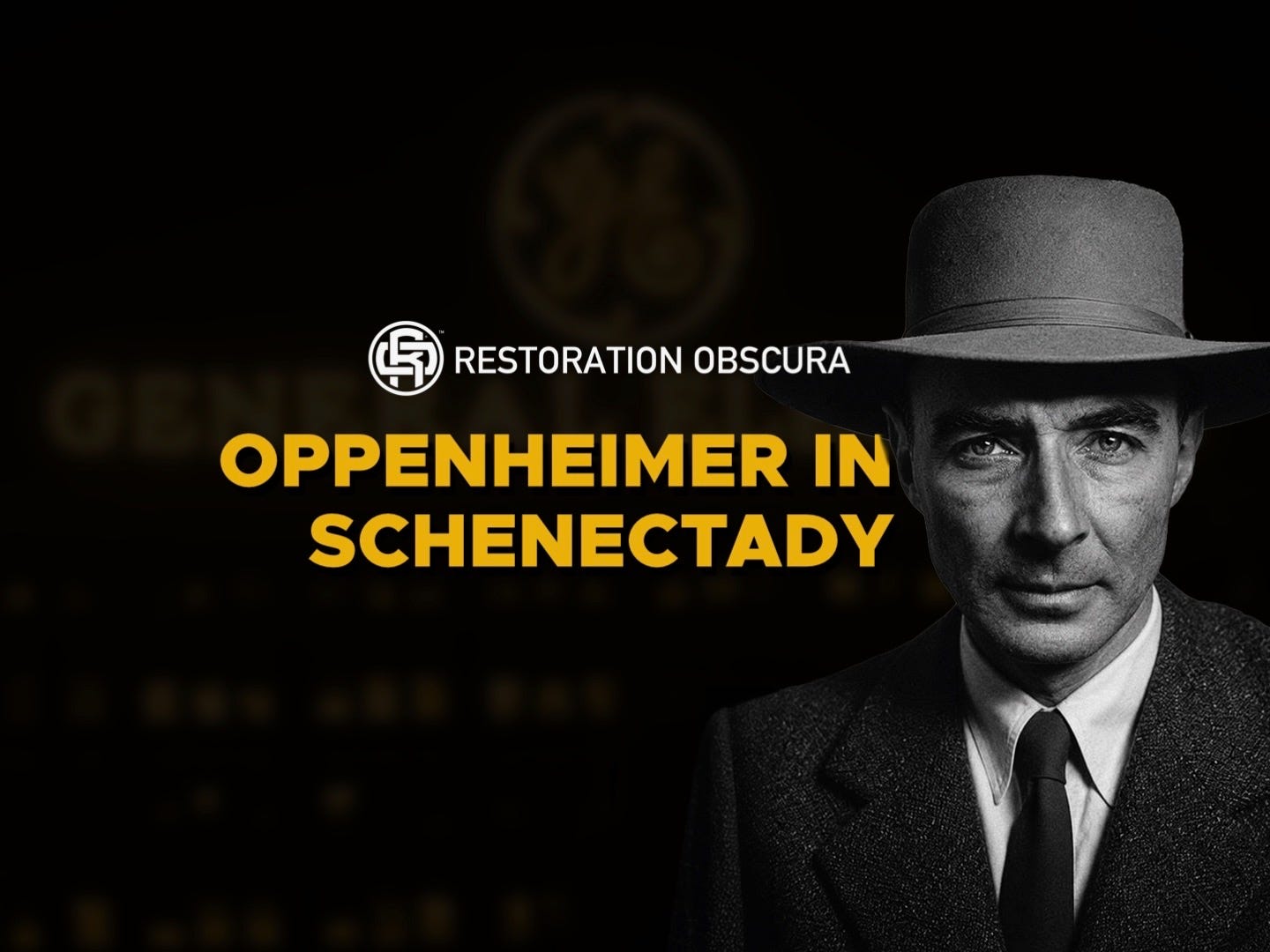
The two men most identified with the atomic bomb both reached the New Mexico desert from the Capital region of New York. Leslie Groves, the general who directed the whole enterprise, was born in Albany. Robert Oppenheimer, the physicist who designed the weapon, took one of his first seats at a government bomb table in a laboratory office in Schenectady, forty-six days before Pearl Harbor. The region already carries a documented record of where the atomic age came to rest: the fallout that fell as rain on Troy in 1953, the uranium buried under Central Avenue in Colonie. The age also began, in part, here for the United States, in one meeting and one birth, and both have stayed nearly invisible outside a few county historical societies.
The meeting opened on October 21, 1941, in the office of William Coolidge, director of the General Electric Research Laboratory in Schenectady. Coolidge, a physical chemist, served as vice chair of a small federal body, the National Academy of Sciences committee on uranium, chaired by the University of Chicago physicist Arthur Compton and assembled that April at the request of Vannevar Bush, President Roosevelt’s science advisor. Compton’s committee had gathered twice before and filed two reports. The Schenectady session was meant to be its last, and the members arrived with a blunt charge: to estimate the cost of an atomic bomb, the years required to build one, and the destruction a single one would deliver.
The setting was no accident. GE had opened the research laboratory in 1900 as the first industrial research operation in the country, and by 1941 the place carried a nickname its publicists were glad to encourage, the House of Magic. Coolidge was no figurehead. He had drawn tungsten into the ductile filament that made the modern light bulb practical and built the X-ray tube that still bears his name, and he ran a laboratory whose scientists had already won Nobel Prizes; Irving Langmuir had taken the chemistry prize in 1932 for work done in those buildings. Many of the lab’s men lived a few blocks away in the GE Realty Plot, a planned enclave of large houses east of Union College, a company town for the people paid to invent the company’s future.
The lab’s nuclear credentials were real. Under Coolidge’s direction GE had built experience in nuclear physics, enough that the company had offered Compton to construct an experimental reactor for producing plutonium. Two of Coolidge’s own scientists, Kenneth Kingdon and Herbert Pollock, joined the sessions, and both would soon leave Schenectady for Manhattan Project work at Ernest Lawrence’s radiation laboratory in Berkeley.
The members felt a new urgency, arrived only weeks earlier. On September 21, the British physicist Mark Oliphant had come to Berkeley to tell Lawrence what British scientists had concluded: a bomb stood within near-term reach rather than at some theoretical distance, and Germany might already be pursuing one. Oliphant carried the same message north to Coolidge in Schenectady. Britain, fighting for survival, needed the United States in the race, and needed it soon.
Lawrence answered by pulling a colleague into these secret conversations who, by the ordinary rules, had no place in them. Robert Oppenheimer, a theoretical physicist at Berkeley, held no security clearance. Lawrence seated him at the Oliphant briefing anyway, and then, judging that the committee wanted a mind of Oppenheimer’s reach, pressed Compton to bring him to Schenectady as an “invited consultant.” The man who would later command Los Alamos entered high-level bomb work on Lawrence’s say-so, in a GE office, and against protocol.
Coolidge booked the members rooms at the Mohawk Club, a short walk from the plant gates. Over the sessions that followed, a table of chemists, engineers, and physicists set out to price a weapon no one had yet built and to estimate, before the fact, how thoroughly one might destroy a city. The least settled reputation at that table belonged to the consultant who was not supposed to be there. Within six weeks, Franklin Roosevelt would read the conclusion they reached in Schenectady.
Comments
Nothing yet. Say the first thing.
Sign in to join the conversation.