
Quote of the week:
“You’ve probably got a feeling of déjà vu, don’t you? You’ve probably got that, but don’t have that. Because this time we’re going to do it, right? We’re going to do it.”
Prime Minister Andy Burnham, speaking about his intention to ‘fix’ the adult social care system, 29 July 2026
Happy fiscal devo day to all of our readers who celebrate (most of you, I imagine?).
Here at Re:State, we are giving two very hearty cheers in response to the Government’s devolution announcements this morning. Here’s why – and what it would take for the Burnham administration to secure that elusive third cheer.
First, we have to acknowledge that as recently as November, there had not been so much as a hint that any kind of fiscal devolution could be on the way. Many thought that this could be a barrier that would never be broken.
Then we had the promise of a tourism levy: a foot in the door. Then in March, the previous Chancellor Rachel Reeves promised “a roadmap for future fiscal devolution” for this year’s Budget.
And today, we have the Prime Minister standing up to promise not just the “enhanced” business rates retention that was under discussion, but a plan for local allocation of a share of income tax. This will be a very significant step: incentivising local growth policies and building the autonomy for innovation and local tailoring of approach in each place.
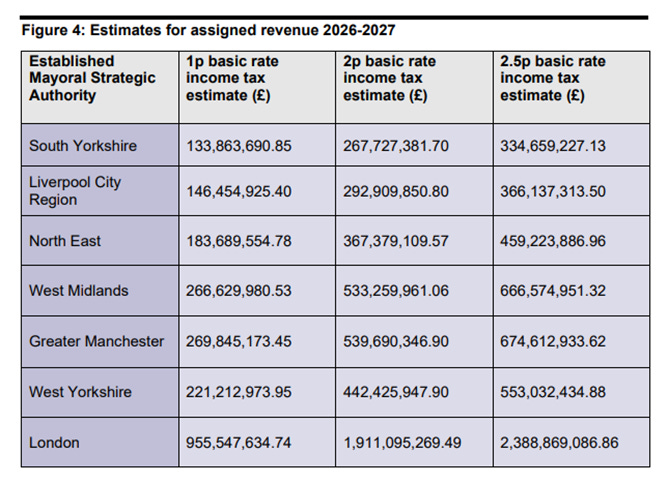
Most promisingly, there is a clear sense that the goal is to, in the words of this morning’s Politico Playbook, “ultimately wean councils off existing Whitehall grants” rather than supplement them. This puts Re:State’s own proposals firmly into the frame. Last month, we published Taxing for take-off, setting out a model for income tax retention (2.5p from the basic rate) which would allow the wholesale replacement of Integrated Settlements: an elegant way to finally cut the purse strings and give strategic authorities real budgetary flexibility. We will have to wait for the Budget for any sense that this is the path that Government is choosing to take.
Also announced today is a strengthened version of the existing commitment – inherited from the Starmer and Rayner era – of “devolution by default”. The trailed promise of a “local first” approach, driven by No 10 North, is incredibly welcome.
It’s worth reading this underpinning policy statement issued today by the Cabinet Office. The “rewiring” announced today will mean establishing strategic authority chief executives as accounting officers - something Re:State has called for in a succession of papers. It will also involve moving toward “a smaller and more strategic Civil Service”, and “taking a serious look at whether individual arm’s length body responsibilities and funding should be transferred to local leaders”.
In our paper Building No 10 North we advocated for the Manchester hub to take on precisely this kind of role, and for the systematic consideration of arms-length bodies to determine which of their powers should be held at regional scales. In Devolve by default, we set out a framework for how to ensure that Whitehall departments are expected to justify which powers should be held centrally rather than devolved. In our recent paper Capital at risk, we went even further, setting out how this principle could be enshrined as a “reserved powers” model similar to that enjoyed by Scotland and Wales – where Whitehall must define the powers it wants to retain, and everything else can fall within the competence of subnational government.
So what in heaven could explain that missing cheer?
First, we think it is important that income tax retention is seen as a milestone on the way to genuine tax-raising powers. This will become a new frontier in the policy debate – but let’s put a marker down now about what real full-fat fiscal devolution looks like.
Second, we don’t think that the existing structure of strategic authorities is going to be able to take on fiscal devolution and make a success of it. Never mind the gaps on the map where parts of England don’t yet have a regional tier. Some of the strategic authorities that do exist or are about to come online are not peers to Greater Manchester or the West Midlands. We have argued that a process of settling formal pan-regional geographies – and running some decisions and services at that scale – will ultimately be required. That is doubly true for fiscal devolution, where the size of the tax base is at issue.
Third, fiscal devolution will need to come with a presumption of autonomy in order to benefit places. That’s the nature of devolution. In some places, greater flexibility will be used to reprioritise investment. In others, it could be used to establish economic incentives. It’s a bit worrying to hear Louise Haigh say that these powers are “not intended” to create tax rebates for residents – because in the end, agree or not, devolution should be about local decisions, not central government tramlines.
But let’s worry about this stuff tomorrow. Today is fiscal devo day.
Read Listen of the week:
I can’t think of anything better than our CEO, Charlie Pickles, exploring all the issues and questions surrounding devolution policy on the excellent Whitehall Sources podcast. It’s a tour-de-force and not to be missed.
Until next time,
Simon
Director of Policy and Research

It’s been another busy week for Re:State!
On Tuesday, we published Devolution revolution in partnership with Groundwork Research. To mark the launch of the paper, our Director of Policy and Research and co-author of the paper, Dr Simon Kaye, explored on our Substack why the next phase of devolution must be much more radical than the last.
Also on Tuesday, The Telegraph reported that the Government is considering our proposal for a mandatory social insurance model to fund care costs as part of the Prime Minister’s plans to fast-track the Casey Commission. The proposal is set out in our April report, Beyond caring.
On Wednesday, Politico’s London Playbook newsletter covered both Devolution Revolution and Beyond caring, with The Sun also reporting on our work amid the Government’s renewed focus on social care.
Joe Hill wrote a Re:Act on Wednesday arguing that the Government should reform public procurement to make it more accessible to British companies, following Chancellor John Healey’s commitment to ‘buy British on a scale never seen before’.
On Wednesday evening, our Chief Executive, Charlotte Pickles, appeared on The World Tonight to discuss the social care funding crisis, unpacking our proposal for a Later Life Care Fund.
On Thursday, Senior Researcher, Alex Walker, was quoted in The Times on the Government’s proposals for fiscal devolution. The Times also covered our work on social care.
Also on Thursday, The i Paper covered our proposed model for fiscal devolution and quoted Alex in its reporting on plans to give regional mayors a share of income tax.
Our paper outlining this model, Taxing for take-off, was featured in The Guardian and BBC News. Meanwhile, Prospect covered Devolution revolution in a piece written by Chris Curtis and Tracy Brabin, who co-authored the foreword to the paper. They made the case for a more ambitious approach to devolution.
On Friday morning, Taxing for take-off, which offers a practical blueprint for England’s transition to fiscal devolution, was featured in Politico’s London Playbook newsletter.
Our proposed model for funding later-life social care was also covered by The i Paper on Friday.
And to round off the week, Charlotte joined the Whitehall Sources podcast to give her assessment of Andy Burnham’s first weeks in government.

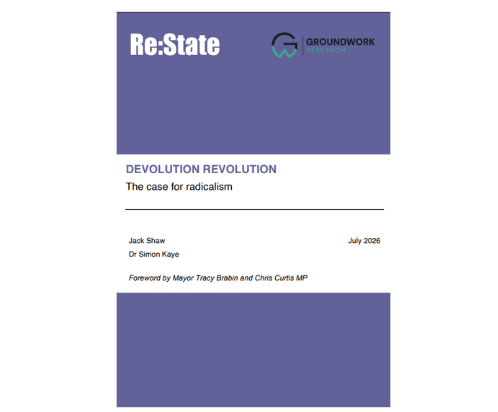
On Tuesday, we published Devolution revolution: the case for radicalism, in partnership with Groundwork Research.
Over the past decade, mayors and strategic authorities have shown that they can attract investment, improve transport, convene public services and provide visible leadership for their places. But these achievements have been secured within a system that remains partial, fragmented and heavily dependent on Whitehall. Devolution’s central problem is not that it has gone too far, but that it has not yet gone far enough. With a joint foreword from Chris Curtis MP an Tracy Brabin, the Mayor of West Yorkshire, this paper sets out ten priorities for a Government with significant interest in achieving a more decentralised State, and makes the case for strategic authorities to become stewards of their local public services. Devolution revolution is a special publication, co-authored by Dr Simon Kaye and Jack Shaw of Groundwork Research.
No posts
Comments
Nothing yet. Say the first thing.
Sign in to join the conversation.