
Aloha, we’re back! It’s been a few weeks since we last recorded — we’ve been busy. This week we’re skipping the news cycle to catch up instead: a chaotic candidate event at Old Airport, why asking politicians to commit to something on paper caused some internal disagreement, a psychology term that explains why we let our favorite politicians get away with things, and a full walkthrough of what’s sitting in your primary ballot envelope right now.
The last three weeks left Tina Marie and Martina exhausted. Last Sunday, the Democratic Party of Hawai’i County and Kona Indivisible teamed up for an event at the Old Airport pavilion — officially a celebration of 250 years of America, but really a chance to get primary candidates in front of voters before the August 8 election. There’s a lot riding on this cycle: four of nine seats on the Hawai’i County Council are turning over, plus a full slate of contested state races.
There was a band, tables full of candidate materials, and weeks of unglamorous prep behind it — logistics calls, building the stage schedule, making sure every candidate showed up and knew when they were on. Tina Marie says her body basically shuts down after every event like this, and Martina admits the collaboration with the Democratic Party wasn’t always smooth. “Sometimes they’re on the ball,” she says, “and sometimes it feels like I’m trying to drag them into the modern times.”
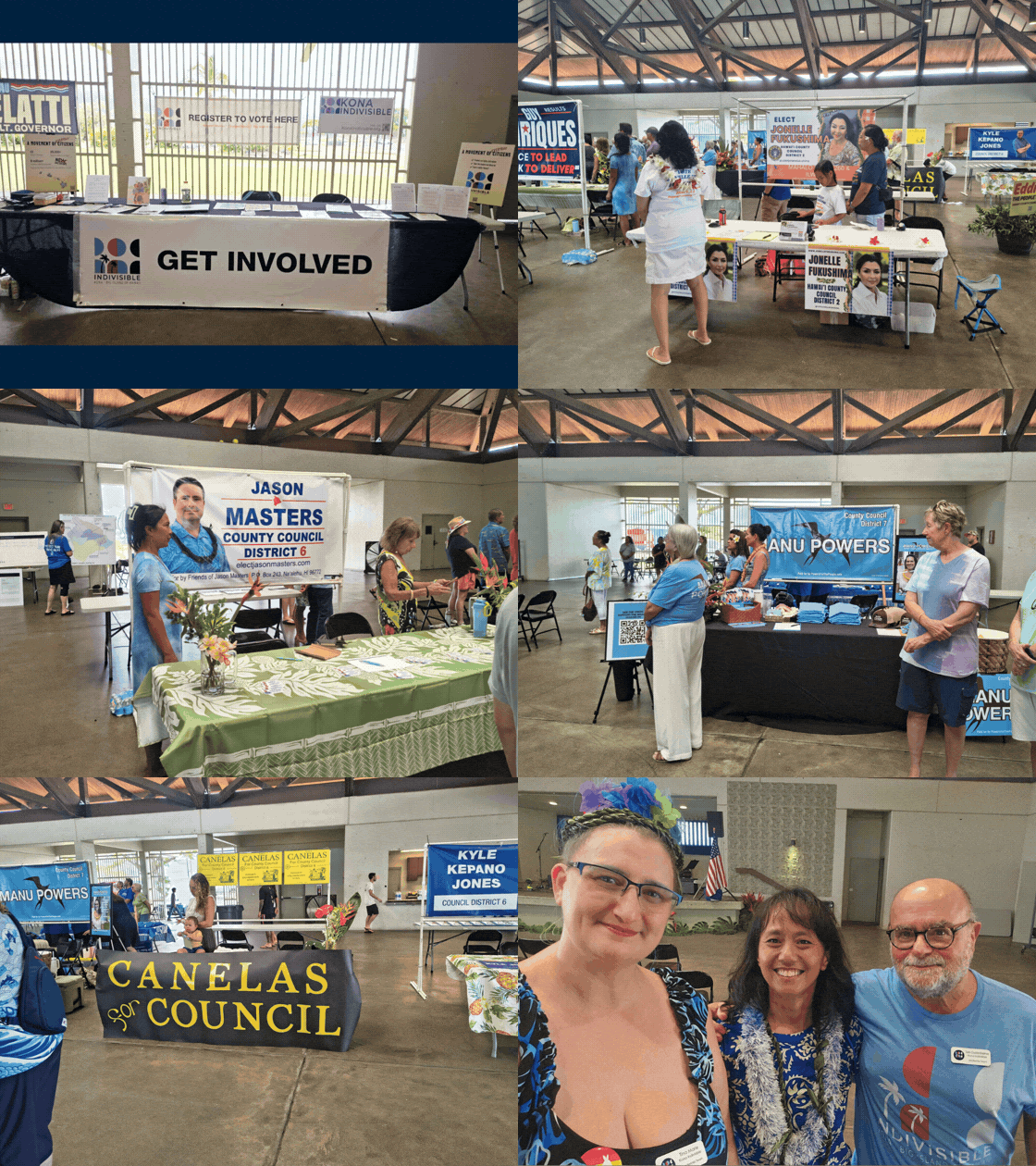
Hear directly from the candidates who showed up — watch the interviews
It was Martina’s first real event in the political arena, and it taught her something: politics is local. Of federal, state, and county government, it’s the county council where a handful of races can flip almost half the body — which is exactly why events like this matter.
Only one candidate at the whole event was willing to say, out loud, that we’re living under a fascist federal government — and that stuck with Martina. She’s used to hearing that caring about this makes her “just a liberal” or “just a Democrat.” Her answer: she’s fighting for something specific, liberal democracy, where individual rights come before whoever happens to be holding power. That’s not partisan — it’s the Bill of Rights — and right now she feels like that idea is being turned on its head.
With the primary approaching, her point is simple: in a state as blue as Hawai’i, winning the primary basically decides who represents the state in Washington. So it matters, a lot, who gets through.
Here’s a question without a clean answer: how do you catch a bad actor before they climb all the way up the ladder? Tina Marie and Martina bring up Tulsi Gabbard — who rose through Hawai’i’s Democratic Party before resigning as Director of National Intelligence — alongside Joe Manchin, Kyrsten Sinema, and John Fetterman as examples of politicians who drifted right after winning office under a Democratic label.
Their attempt at an answer: a pledge. The statewide Women’s Caucus and Stonewall Caucus pledge had already done something similar and landed 60 candidate signatures on a commitment to protect women’s rights and LGBTQIA+ rights. So Kona Indivisible built a local version, asking candidates to reaffirm their commitment to human rights. It’s not an endorsement — that got voted down at the state convention — just a public record of who said yes, meant to give voters a baseline to hold candidates to later.
What’s actually in the KIND Pledge: Before candidates even get to the pledge itself, KIND lays out the standards it’s judging them against — personal integrity, no dark money from Super PACs, government transparency and accountability, protecting Hawaiʻi’s all-mail voting system, affordability and workers’ rights, immigrant and community safety (including opposing local police cooperation with federal immigration enforcement and any new detention centers), climate and environmental justice, and honoring the Spirit of Aloha and Native Hawaiian communities as required by the state constitution.
The pledge language itself asks candidates to commit to five things: naming and fighting the current federal administration’s undermining of the Constitution and rule of law; defending Hawaiʻi’s autonomy against federal overreach; treating equal treatment under the law — voting rights, bodily autonomy, who you love, gender identity — as non-negotiable; recognizing that the state’s wealth is built by workers, not corporate boards; and supporting a safety net for people who can’t get by on their own. It closes with a specific commitment to LGBTQ+ people, particularly transgender people, and to women.
The pushback was real. Some argued candidates could just sign it and lie anyway. Others said it was divisive, badly timed, or clashed with the Democratic Party’s “big tent” self-image. Tina Marie’s response: doing nothing, with zero accountability, is part of how the country ended up with a second Trump term. She’s also blunt about the big tent argument — it doesn’t hold up when people at the state convention admitted to voting for Trump. “If I go to a Democratic convention, I don’t expect to see anybody there that voted for Trump,” she says. “That’s not my kuleana.”
This is the part of the episode where the hosts stop softening things. Tina Marie draws a direct comparison between people who voted for Trump and how people in Germany viewed Hitler’s supporters, pointing to ICE raids, military-style operations on apartment buildings, overcrowded detention centers, and reports of abuse and neglect. Her bottom line: she can’t sit across from someone who voted for that and treat it as a normal difference of opinion. “No is a full sentence,” Martina agrees.
Heads up: this part of the episode is direct and unfiltered, including strong language and frank discussion of ICE detention conditions.
Tina Marie did some digging and came back with a term for something they’d both been circling: the halo effect — when your overall good impression of someone makes you excuse, minimize, or simply not notice their bad behavior. There’s a flip side too, the horn effect, where one bad thing someone does makes you assume they’re bad all around.
Martina ties it to something bigger: how we generalize from a single interaction to an entire group. Tina Marie brings it back down to earth with Congresswoman Jill Tokuda, who she genuinely likes and thinks has been great — then poses the question: what if Tokuda ever went soft on ICE or police accountability? Would the party actually call her out, or would her track record buy her a pass? Tina Marie’s answer is clear: “I value politicians doing the right thing versus developing a relationship.”
Martina adds her own version from her ocean recreation work — the “Moana effect,” where people assume manta rays are swimming up to them personally (thanks, Disney) instead of just chasing the light. Same instinct, she says: we reach for the flattering story instead of the plain, true one.
Martina’s been sitting with something she heard on the Shrinking Trump podcast — a guest’s take on why the Democratic Party has such a persistent branding problem. The idea: picture the country as a household, and the two parties as parents. One parent, the GOP, has gone off the rails. The other parent, the Democratic Party, still isn’t equipped to actually protect anyone from that. It’s a primal thing — we want mom and dad to keep us safe — and Martina thinks the party keeps underestimating how much damage it does every time it can’t deliver.
Tina Marie extends the metaphor further: it’s like staying in a marriage with an abusive partner out of habit, while the kids just watch it happen. “What about the kids?” she asks. Martina, now with firsthand experience at both the state and county level of the party, says she’s not trying to dismantle it — a functioning party matters — she just wants far more people inside it pushing for the clarity and accountability voters are asking for.
The episode closes with the hosts opening their ballots live and walking through every piece of paper in the envelope. If you’re voting by mail for the first time, or just want a refresher, here’s what to know:
The return envelope says “Primary” on the front, your name and address on the back.
Your signature is everything. Whether you mail it or use a drop box, your signature has to match what’s on file with your state ID or driver’s license — the same one you used to register. If it doesn’t match, your ballot’s invalid.
No stamp needed. The return envelope is pre-paid.
Drop boxes are secure and marked — look for the brown, secured boxes if you’re cutting it close to the deadline. Find a voter service center or drop box near you.
There’s an instructions insert. Worth actually reading.
Hawai’i primaries are party-specific. You pick one ballot — Democratic, Republican, Green, Libertarian, or nonpartisan. No mixing.
Check the back. County Council and Office of Hawaiian Affairs races are often listed there and easy to miss.
Fill the bubbles in completely; don’t cross anything out. A mistake invalidates the ballot — if that happens, head to an election office (open roughly 7–10 days before the election) and fill one out in person instead.
It’s anonymous. Nothing on the actual ballot ties back to your name — only the outer envelope is checked for a valid signature.
Deadline to return your ballot: August 8.
Congressional District 1: Jarrett Keohokalole, to replace Ed Case
Lieutenant Governor: Della Au Belatti — noted for refusing dark money under Act 11, unlike her opponent, who’s backed by a super PAC funded through dark money
“Resist with joy. Go from showing up to shaping policy.” — Tina Marie
💬 Before You Go | Take our Visionaire Questionnaire.
Here at Resist with Joy, we take the future very seriously. So our research department spent their entire lives developing a highly sophisticated, scientifically calibrated system for understanding someone’s vision for our world ahead. After multiple peer reviews, revisions, and at least one whiteboard diagram that made us feel incredibly intelligent, we’ve discovered the perfect formula: a simple 5-question survey. We want to hear what concerns you, what gives you hope, and what joy looks like for you right now. Take the Visionaire Questionnaire here.
Resist with Joy is a podcast about civic education, grassroots organizing, and joyful resistance. Real voices, including engaged citizens, experts, and politicians, to help build the wall against authoritarianism, one joyful action at a time.
New episodes drop weekly. Interviews with neighbors doing the work are coming very soon. Subscribe, share, and if this episode moved you, leave us a review.
Subscribe | Like | Share
🌴 Aloha until next time.
Comments
Nothing yet. Say the first thing.
Sign in to join the conversation.