
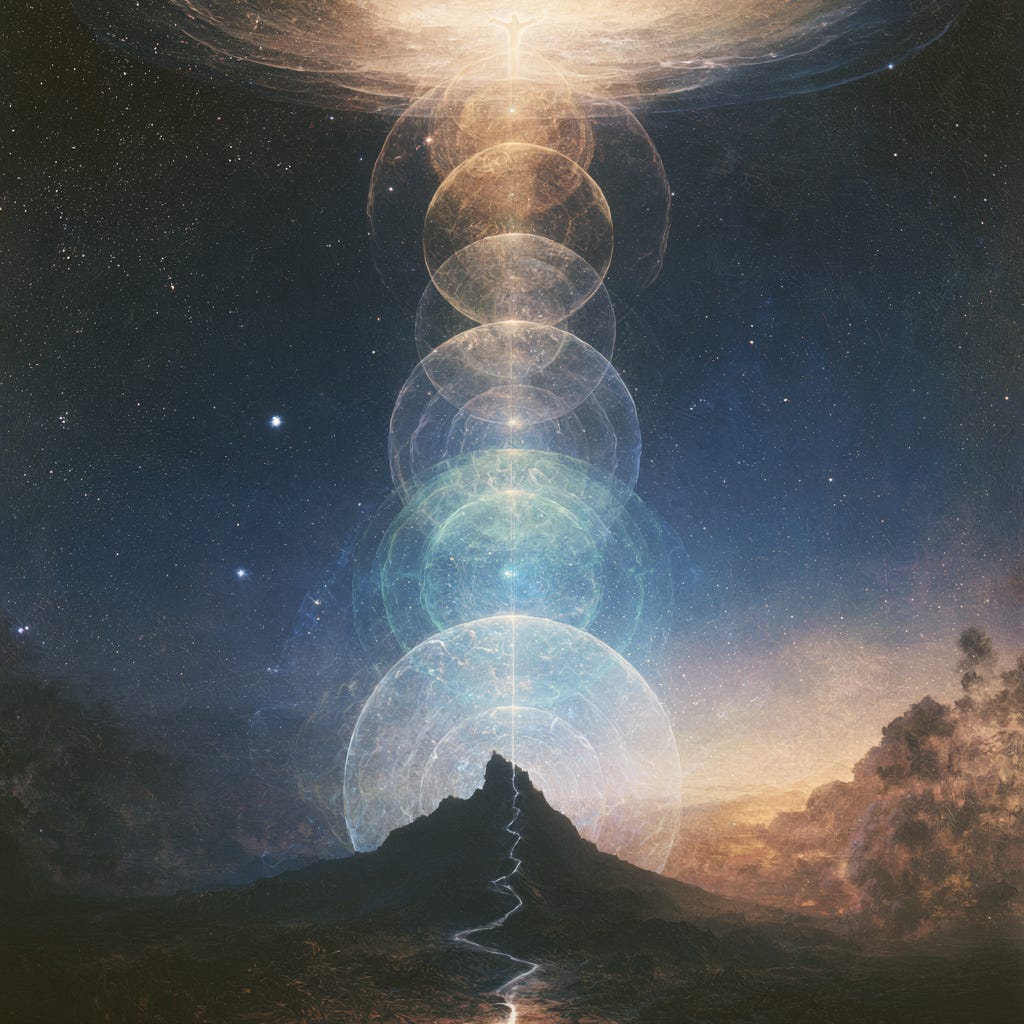
Paul was caught up to the third heaven. He did not have to explain what that meant. His Corinthian readers already knew.
At 2 Corinthians 12:2 (KJV), Paul writes: “I knew a man in Christ above fourteen years ago, (whether in the body, I cannot tell; or whether out of the body, I cannot tell: God knoweth;) such an one caught up to the third heaven.” He is describing himself. He references the third heaven with no defining explanation — because his first-century Judaic-Christian readers had a shared architecture in mind. That architecture was Second Temple sevenfold-heavens cosmology, preserved in First Enoch, the Testament of Levi, the Ascension of Isaiah, and 2 Enoch — texts widely read across the Judaic and early-Christian world, treated as canonical in Ethiopian Orthodox Christianity, and cited directly by Jude at Jude 14 (KJV).
Yesterday’s Convergence 1 · Cosmic Scale walked seven load-bearing sevenfold Cosmic-Scale registers — planetary jurisdictions, precessional Ages, Days of Genesis 1, Heavens, Big Dipper stars, Pleiades, and one fivefold corroborative recurring pattern. This dispatch takes the Seven Heavens register alone and walks it at depth: the theological coherence with orthodox Trinitarian doctrine, the cross-cultural preservation across Islamic and other Abrahamic and non-Abrahamic traditions, and the juxtaposition with the traditional three-heavens model Robert D. Luginbill affirms at Ichthys.com. Neither model displaces the other — the three-heavens architecture is the canonical minimum Scripture explicitly asserts; the seven-heavens architecture is the fuller Second Temple substrate Paul presupposed when he referenced the third heaven without explanation.
“For I am persuaded, that neither death, nor life, nor angels, nor principalities, nor powers, nor things present, nor things to come, nor height, nor depth, nor any other creature, shall be able to separate us from the love of God, which is in Christ Jesus our Lord” — Romans 8:38-39 (KJV). The Preemption Lock holds. The architecture is real. The Sons and Daughters of Issachar move in the times they now understand.
Below is the full read for those going deep. Or take the Milk Minute and share it with someone who needs a doorway. SDG · Maranatha.
Book 2 · The Cosmic Clock · Cosmic Scale Standalone Deep-Dive · Bridge Between Convergence 1 (Sat Aug 15) and Convergence 2 · Redemptive Scale (Tue Aug 18) · Integrates into Volume 2 First Digital Edition (FDE) launching September 3-4 as concluding Part VII
Convergence 1 catalogued six sevenfold Cosmic-Scale registers plus one fivefold corroborative pattern. Today’s Sunday dispatch takes one of those six — the Seven Heavens register — and walks it as standalone deep-dive, developing the theological coherence, the cross-cultural preservation, and the juxtaposition with the traditional three-heavens model. Tomorrow (Monday) may carry a parallel treatment of another Cosmic-Scale register (Big Dipper or Pleiades); Tuesday deploys Convergence 2 · Redemptive Scale — walking the seven Covenants, seven Dispensations, and seven Noahide Universal Laws.
The Seven Heavens architecture is load-bearing because it is the invisible-cosmological framework Christ ascended through (Ephesians 4:10 KJV — “He that descended is the same also that ascended up far above all heavens”), Paul was caught up into (2 Corinthians 12:2 KJV), John’s Patmos vision opens onto (Revelation 4:1 KJV — “a door was opened in heaven”), and the closing hour walks toward at the new heavens and new earth (Revelation 21:1 KJV). Reader accessibility to the full architecture matters for reading Scripture rightly.
At 2 Corinthians 12:2-4 (KJV), Paul recounts what may be the most personally significant vision of his apostolic career:
I knew a man in Christ above fourteen years ago, (whether in the body, I cannot tell; or whether out of the body, I cannot tell: God knoweth;) such an one caught up to the third heaven. And I knew such a man, (whether in the body, or out of the body, I cannot tell: God knoweth;) How that he was caught up into paradise, and heard unspeakable words, which it is not lawful for a man to utter.
Two structural observations the plain reader may not immediately catch. First: Paul distinguishes “the third heaven” from “paradise” as two different aspects of the same destination. He was caught up to the third heaven AND caught up into paradise. In Second Temple architecture, paradise is a specific region within the heavens — where the tree of life resides (a detail 2 Enoch preserves). This dispatch will return to the tree-of-life register below. Second: Paul references “the third heaven” with no defining explanation. He does not write “the third of what I mean by heaven”; he writes “the third heaven” as if the referent is obvious to his Corinthian readers. This is the load-bearing observation for the entire Seven Heavens architecture: Paul presupposes a shared cosmological framework in which “the third heaven” carries specific meaning.
That framework was Second Temple sevenfold-heavens cosmology. Not universal across every first-century Jewish sect — Sadducees held simpler cosmological schemes — but widely enough distributed across the Pharisaic, Essene, and early-Christian communities that Paul could reference it without gloss. The framework has direct textual foundation across four Second Temple sources: First Enoch (chapters 20-36 walk the seven heavens with angelic-jurisdictional detail); the Testament of Levi (chapters 2-3 walk Levi’s ascent through three heavens with awareness of higher tiers); the Ascension of Isaiah (chapters 6-11 walk Isaiah’s ascent through all seven heavens to the throne room); and 2 Enoch (Slavonic Enoch) (chapters 3-22 walk Enoch’s tour of all seven heavens with detailed content per tier).
These are not obscure texts. First Enoch is cited directly at Jude 14-15 (KJV) — “And Enoch also, the seventh from Adam, prophesied of these, saying, Behold, the Lord cometh with ten thousands of his saints, To execute judgment upon all...” — which quotes 1 Enoch 1:9 verbatim. The New Testament author of Jude treats First Enoch as prophetic authority. First Enoch is canonical in the Ethiopian Orthodox Tewahedo Church, has been continuously preserved in Ethiopic since at least the fourth century AD, and was recovered by James Bruce in 1773 for Western scholarship. Fragments have since been found among the Dead Sea Scrolls at Qumran, confirming First Enoch’s circulation in Second Temple Judea.
When Paul writes “the third heaven,” he references the third tier of a seven-tier architecture his readers took as given. The historical case is well-established. Modern Reformed scholarship (Michael S. Heiser prominently, and others working the Divine Council framework) has extensively documented the Second Temple cosmological substrate Paul and the New Testament authors operated within.
The Second Temple architecture is not merely “seven layers” as generic count. Each of the seven heavens carries specific content, jurisdictional office, and inhabitant class per the received texts. The composite picture across First Enoch, Testament of Levi, Ascension of Isaiah, and 2 Enoch reads approximately as follows (with variations across the sources that this dispatch does not force into false unity):
First Heaven (Shamayim proper) — the firmament immediately above the earth; the atmospheric register where clouds move and birds fly; the celestial luminaries (Sun, Moon, stars) inscribed at Day 4 of Genesis 1 operate in view here.
Second Heaven — per 1 Enoch and 2 Enoch, the register where fallen angels are held under judgment awaiting the final assize (the Watchers of Genesis 6 KJV read through the 1 Enoch expansion); a kind of celestial prison.
Third Heaven — paradise; contains the tree of life; the register Paul was caught up into per 2 Corinthians 12:2-4 (KJV) with the tree-of-life detail preserved from 2 Enoch chapter 8; the register John identifies at Revelation 2:7 (KJV) where the overcoming Ephesian saints will “eat of the tree of life, which is in the midst of the paradise of God.”
Fourth Heaven — the register of the celestial orbits at higher-order administration; the seat of certain angelic hierarchies governing time and season.
Fifth Heaven — the register of the Watcher-angels (in some sources, a subset held in judgment; in others, the operational headquarters of the archangelic order).
Sixth Heaven — the register of the higher archangels who administer the affairs of the entire angelic host.
Seventh Heaven — the throne of God; the highest tier; the Kavod (the manifest divine glory) resides here; the destination Isaiah reaches at Isaiah 6:1 (KJV) — “I saw also the Lord sitting upon a throne, high and lifted up, and his train filled the temple” — and John opens onto at Revelation 4:1-2 (KJV) — “I looked, and, behold, a door was opened in heaven ... and, behold, a throne was set in heaven, and one sat on the throne.”
The count and content vary somewhat across the sources — First Enoch’s schema differs in detail from 2 Enoch’s; Testament of Levi is more compressed; Ascension of Isaiah gives the fullest tour — but the shared architecture is seven tiers with God’s throne at the seventh (or highest) and the ascending observer encountering distinct angelic-jurisdictional content at each tier.
The Tree of Life’s Four Addresses Across Salvation History
The Third Heaven paradise register carries a specific detail worth unfolding on its own: the Tree of Life walks four locational-registers across the covenant timeline — one tree, four addresses across salvation history:
Eden 1 · Genesis 2 — Tree of Life originally IN the garden (accessible to Adam and Eve before the Fall)
Post-Fall · Genesis 3:24 — Sealed off by cherubim with flaming sword; removed from earth’s access
Intermediate state · present hour — Preserved in the third heaven paradise per Second Temple architecture; Paul caught up into it (2 Cor 12:2-4 KJV); Rev 2:7 KJV places it “in the midst of the paradise of God”; the overcoming Ephesians will eat of it in the current heavenly register
Eden 7 · Revelation 22:2 — Returns to earth WITH the New Jerusalem descending from heaven; twelve fruits, healing of the nations, at the eternal terminus
The canonical treatment at Two Trees in the Midst of the Garden anchors the Genesis 2 origin and Revelation 22 eternal state — the alpha-and-omega bracket. This Seven Heavens dispatch names the intermediate register (where the tree is right now during the present hour). Volume 5 Eden 7 walks the final return to earth. Complementary, not conflicting. The third heaven paradise is the tree’s present address between the garden it was removed from and the New Jerusalem it will descend within.
This is the architecture Paul references at 2 Corinthians 12:2. This is the architecture Christ ascended through per Ephesians 4:10 (KJV) — “He that descended is the same also that ascended up far above all heavens, that he might fill all things.” This is the architecture John’s Patmos vision opens onto at Revelation 4:1 (KJV). The seven-heavens framework is not extra-biblical speculation; it is the cosmological substrate the canonical New Testament authors presupposed and referenced.
The medieval Christian tradition preserved the tiered-heavens architecture at literary register through Dante Alighieri’s Paradiso (1300 AD). Dante’s Ptolemaic cosmological map — nine concentric spheres surrounding Earth, with seven planetary spheres, the Fixed Stars, the Primum Mobile, and finally the Empyrean as the dwelling place of God beyond all physical space — walks the same tiered-heavens architecture Second Temple Judaism preserved. Where Second Temple architecture terminates at the seventh heaven (throne of God), Dante’s architecture terminates at the Empyrean (God’s throne) above nine ascending spheres. Different tier-counts, same architectural principle: tiered ascending heavens with God’s throne at the highest tier and ordered creation between. Volume 5’s Grand Finale treatment at The Poet and the Planets · Dante’s Paradiso and the Seven Planetary Domains walks Dante’s cosmological map at length as literary-witness at Tier B Christian medieval register, held at L3 integrative framework layer.
Not every Christian tradition operates the Seven Heavens architecture. The more common Reformed and Evangelical framework is the three-heavens model — one canonical anchor of which is Robert D. Luginbill’s Coming Tribulation and Satanic Rebellion series at Ichthys.com, which this office has drawn on as Tier A canonical orthodox theological anchor across Volume 5 and Volume 2 substrate.
Luginbill’s position is clear and directly documented in his exegetical materials on the Waters Above, the Firmament, and the Genesis Gap. The three-heavens model as Luginbill develops it:
First heaven: the earth’s sky and atmosphere (the register of birds and weather).
Second heaven: the spatial universe beyond the atmosphere (the register of stars, planets, galaxies — what modern science calls “outer space”).
Third heaven: God’s dwelling place beyond the “waters above” — the register Paul references at 2 Corinthians 12:2 (KJV) as the destination he was caught up into.
Luginbill’s exegetical framing is precise. He writes that the first and second heavens together are called shamayim in Hebrew (the “dual” form of the word), constituting the visible firmament. The third heaven is separated from the first two by the “waters above” (Genesis 1:7 KJV) — the universal barrier that structures the divine judgment/covenant architecture Genesis 1’s second day inaugurated. Luginbill treats the “third heaven” designation as “geographic rather than temporal” — meaning it names a spatial location in the divine architecture, not a hierarchical rank of authority.
Critically, Luginbill affirms both the unified-heaven reading of certain scriptural passages AND the three-heavens reading of others. In his own words: “Embracing the truth of one (i.e., of only the unified heaven or of only the three heavens) while denying the other is incorrect and leads to confusion about what the Bible actually says.”
Luginbill’s three-heavens model is orthodox, biblically grounded, and canonically defensible. This office receives it as sound teaching from a Tier A theological anchor. The question is not whether Luginbill’s three-heavens model is correct — it is. The question is whether it is exhaustive of the cosmological architecture Scripture actually references, or whether it names the canonical MINIMUM while additional Second Temple architecture (the seven-heavens framework) captures fuller granularity Paul and his readers took as background.
The three-heavens model and the seven-heavens model are not contradictory. They are the same architecture at different granularity.
Consider the map. Luginbill’s three heavens run: atmosphere (1) → spatial universe (2) → God’s throne beyond waters above (3). The Second Temple seven heavens run: firmament (1) → fallen-angel-holding region (2) → paradise / tree of life (3) → celestial orbits (4) → Watcher-headquarters (5) → higher archangelic order (6) → God’s throne (7). Correspondences visible at once:
Luginbill 1 (atmosphere) ↔ Second Temple 1 (firmament). Same register. The visible sky where birds fly. Both models name the same first tier.
Luginbill 2 (spatial universe) ↔ Second Temple 1 (firmament) inclusive-extension, or ↔ Second Temple 4 (celestial orbits). Reasonable ambiguity here; Luginbill treats “outer space” as a distinct register between atmosphere and God’s throne, while Second Temple architecture puts more differentiation between the visible sky and the throne room.
Luginbill 3 (God’s throne) ↔ Second Temple 7 (God’s throne). Both models terminate at the same destination — the throne of God.
Paul’s “third heaven” (paradise, per 2 Corinthians 12:2-4 KJV) ↔ Luginbill 3 (God’s throne) OR Second Temple 3 (paradise/tree of life). Here the models diverge: Luginbill takes Paul’s third heaven as the highest tier (God’s throne = paradise); Second Temple architecture takes Paul’s third heaven as one of the middle tiers (paradise is heaven 3 of 7, with higher tiers above it toward the throne at heaven 7).
The deep theological question is not “how many heavens” but “where is paradise.” If paradise IS God’s throne (Luginbill), then three heavens is exhaustive. If paradise is a distinct region below God’s throne (Second Temple architecture), then more tiers exist above paradise, and the seven-heavens count is at minimum defensible.
This office’s judgment: both readings are consistent with the canonical text. The three-heavens model captures what Scripture explicitly asserts and cannot be reduced without loss. The seven-heavens model captures the fuller architecture Second Temple Judaism preserved as background substrate — cited directly by New Testament authors (Jude 14-15 KJV quoting 1 Enoch verbatim), presupposed by Paul without gloss (2 Corinthians 12:2 KJV), and preserved as canonical in Ethiopian Orthodox Christianity for two millennia. Neither model displaces the other. The Berean reader can affirm the three-heavens canonical minimum AND the seven-heavens Second Temple substrate as complementary architectures at different granularity — the way a road map and a topographical survey both describe the same terrain at different resolution.
The counterfeit at THIS specific register is any framework that INSISTS on rigid closure at either count — three-heavens-only or seven-heavens-only exclusivity. Both are honest models operating at different resolution. The Berean discipline is to hold both without forcing false contradiction.
The Second Temple sevenfold-heavens architecture did not remain confined to Second Temple Judaism. It propagated across multiple civilizations at multiple registers — some carrying it faithfully, others inverting or corrupting it, but the sevenfold count itself preserved across independent traditions.
Islamic Tradition · The Isra and Mi’raj. Islam adopted the seven-heavens architecture directly. The Quran affirms seven heavens repeatedly (Quran 65:12 — “Allah is He Who created seven heavens and of the earth the like of them”; Quran 67:3, 71:15, and multiple other passages). The most detailed Islamic development of the architecture is the account of Isra and Mi’raj — Muhammad’s night-journey ascent through seven heavens, each heaven encountering a prior biblical prophet: Adam in the first heaven, Jesus (Isa) and John the Baptist (Yahya) in the second, Joseph in the third, Enoch (Idris) in the fourth, Aaron in the fifth, Moses in the sixth, and Abraham in the seventh. The Islamic architecture preserves the same sevenfold tier count as Second Temple Judaism, populates each heaven with prior prophets rather than angelic classes, and terminates at God’s throne (referred to in Islamic theology as the Arsh).
From the Berean framework, the Islamic seven-heavens is inverted-inheritance — the same original Second Temple cosmological substrate, preserved through Judaic-Christian-Islamic transmission across the seventh-century AD hinge, with the specific content of each tier reframed at Islamic register. The count is preserved; the theological framing diverges.
Hindu Tradition · Sapta Loka. Hindu cosmology preserves a sevenfold upper-worlds architecture across the Puranic and Vedantic literatures: Bhu-loka (earth), Bhuvar-loka (atmosphere), Svar-loka (heavens of the gods), Mahar-loka (great world), Jana-loka (world of purified beings), Tapa-loka (world of ascetics), Satya-loka (world of ultimate truth). Seven upper worlds; seven ascending tiers. The parallel with Second Temple architecture is not coincidental — from a Berean framework reading, this is pre-Babel cosmological inheritance preserved across independent civilizational transmission, per the Deuteronomy 32:8-9 archon-allocation framework Volume 5 Post 4 walks.
Zoroastrian Tradition. Pre-Islamic Persian cosmology carried multi-tier heavens architecture — the specific count of seven appears in various Zoroastrian and Zurvanite texts describing ascending spheres of celestial authority. Zoroastrianism likely influenced Second Temple Judaic thought during the Persian imperial period (539-332 BC), which correlates with the historical window when the sevenfold-heavens architecture becomes prominent in Judaic apocalyptic literature.
Mayan Tradition. Pre-Columbian Mayan cosmology preserves a thirteen-tier heavens architecture with seven upper tiers and additional lower tiers — the specific sevenfold count for the upper-heavens register visible across Mayan codices and glyphic material.
Egyptian Tradition. Ancient Egyptian cosmology preserves a multi-tier celestial architecture (the seven gates/regions of the Duat) traversed by the deceased in the Book of the Dead material — sevenfold-gates register attested across dynastic funerary literature.
The cross-cultural universality of the sevenfold-heavens architecture is striking. Independent civilizations across the Mediterranean, Persia, Central Asia, India, Mesoamerica, and Egypt all preserve some form of sevenfold ascending celestial architecture. From a Berean framework, this cross-cultural preservation testifies to a common cosmological inheritance predating Babel — the original knowledge dispersed at the linguistic-and-national partition of Genesis 11 and preserved across the seventy-nation archon-allocation of Deuteronomy 32:8-9 in variously corrupted forms. The pagan pantheons remember what Babel dispersed. The seven-heavens architecture is one of the load-bearing pieces of cosmological knowledge the memory-preservation carries.
One notable variant · Norse Nine Worlds. Norse cosmology preserves a nine-world architecture (Asgard, Vanaheim, Alfheim, Midgard, Nidavellir, Jotunheim, Muspelheim, Niflheim, Helheim) rather than seven. The nine-world variant is one of the departures from the sevenfold-preservation pattern — possibly reflecting the specific archon-allocation for the Germanic-Norse civilizational sphere, possibly reflecting later syncretic elaboration. The Berean does not need to force every tradition into the seven count; the pattern is that the sevenfold architecture is preserved widely enough to constitute independent-witness corroboration, not that every civilization carries it identically.
Three counterfeit apparatuses target the seven-heavens architecture at different registers:
Counterfeit One · Materialist Reduction. Modern materialist cosmology (from Enlightenment-era deism through nineteenth-century positivism through contemporary scientific naturalism) reduces “heaven” to a single physical universe — the observable cosmos of galaxies and dark matter — with no invisible tiers above, no angelic hierarchies, no throne of God. Under materialist reduction, Paul’s “third heaven” becomes literary metaphor; the Second Temple architecture becomes ancient pseudo-cosmology; the sevenfold count becomes numerology of no ontological significance. This counterfeit displaces the Real by declaring the invisible architecture does not exist. Its most sophisticated contemporary form is naturalistic-scientific consensus that treats cosmology as exhaustively describable by physical measurement.
Counterfeit Two · Theosophical Manufacture. Modern esoteric-mystical traditions — from Helena Blavatsky’s Theosophical Society (1875) through the Alice Bailey / Lucis Trust movement through contemporary New Age hierarchical-plane frameworks — manufacture parallel seven-plane architectures that displace the Second Temple heavens with counterfeit ascending planes populated by “Ascended Masters,” “Cosmic Christs,” and hierarchical archon-beings unrelated to the biblical angelic order. The counterfeit manufactures a plausible-looking sevenfold architecture with pagan and Hindu-inheritance content, then presents it as spiritual advancement material for the credulous. This counterfeit displaces the Real by manufacturing counterfeit-Real that looks similar enough to deceive. The Umberto Eco Foucault’s Pendulum diagnostic mechanism operates here at its purest register.
Counterfeit Three · Gnostic Distortion. Ancient Gnostic cosmologies (Sethian, Valentinian, and later syncretic developments) also affirmed multi-tier heavens architecture but inverted the biblical reading: the Gnostic scheme placed the true God in a distant Pleroma above the heavens, with the visible cosmos itself understood as the fallen creation of a defective Demiurge (identified in some Gnostic frameworks with the biblical Yahweh). Under Gnostic distortion, the seven-heavens architecture becomes evidence of cosmic imprisonment rather than divine ordered creation; the ascent through the heavens becomes escape from the material realm rather than movement through the ordered tiers of a good creation. This counterfeit displaces the Real by inverting the theological valence of the same architectural map. Contemporary Gnostic-adjacent frameworks (some strands of process theology, Emergent-Christian syncretism, transhumanist-consciousness-upload apparatuses) carry inherited Gnostic distortions of the seven-heavens architecture at various registers.
The Berean reads the Second Temple architecture through the canonical biblical frame — the seven heavens as the ordered good creation of the one God whose throne resides in the highest tier, from which He rules the whole architecture He inscribed. The materialist reduction denies the architecture; the theosophical manufacture counterfeits it; the Gnostic distortion inverts it. The Real McCoy is the sevenfold ordered heavens of a good Creator with His throne at the seventh (or highest) tier, and each intervening tier populated with the angelic administration Scripture and Second Temple literature both attest.
Tuesday’s dispatch (August 18) opens Convergence 2 · Redemptive Scale — walking The Seven Covenants:
Adamic → Noahic → Abrahamic → Mosaic → Davidic → New → Everlasting
The seven Dispensations:
Innocence → Conscience → Human Government → Promise → Law → Grace → Kingdom
Per Luginbill’s Coming Tribulation framework), and the seven Noahide Universal Laws (per divine-council reading of the post-Flood Gentile-covenant substrate).
The bridge from Cosmic Scale (Convergence 1) through Seven Heavens deep-dive (today) to Redemptive Scale (Tuesday) is architectural: the Signature-Source who inscribed the sevenfold Cosmic-Scale architecture — including the seven-tiered heavens Paul was caught up into — is the same Signature-Source who inscribes the sevenfold redemptive-history architecture across covenants, dispensations, and universal laws. The Maker signs at Cosmic Scale in the invisible tiered heavens above the firmament. The Maker signs at Redemptive Scale in the tiered covenants across time. The same signature; different scales. Convergence 2 walks the redemptive-history register with the same sevenfold discipline this dispatch has walked the cosmic-architecture register.
The eschatological terminus of the entire heavens architecture — the new heavens and new earth of Revelation 21:1 (KJV), New Jerusalem descending from God out of heaven per Revelation 21:2 (KJV), the tabernacle of God with men per Revelation 21:3 (KJV), no more curse and no more sea per Revelation 22:3 and Revelation 21:1 (KJV) — is walked at length in the Volume 5 Eden Sequence dispatch Eden 7 · New Heavens, New Earth, New Jerusalem — The Architecture of Eternity. Where the seven-heavens architecture today’s dispatch develops names the invisible tiered structure of the current created cosmological order, Eden 7 walks the permanent terminal state — the new heavens architecture that supersedes and completes the current architecture at the closing of the closing hour.
Tonight — Sunday evening — face west after sundown. Venus continues her walk east of the Sun at near-maximum elongation (yesterday’s peak still visible; magnitude −3.9, brighter than every star). She walks now toward September 1-3 Venus-Spica conjunction (the Bright and Morning Star embracing Virgo’s brightest star), then September 18 greatest brilliancy (magnitude −4.4). The Cosmic-Scale signature Convergence 1 walked continues sky-writing across the six-week Elul-through-Yom-Kippur arc.
Matthew 24:36 (KJV) sets the discipline: “But of that day and hour knoweth no man, no, not the angels of heaven, but my Father only.” Season, not hour. This office does not read the seven-heavens architecture to compute the return date. This office reads the architecture to notice the season the sky and the Scripture both open — and to move.
1 Chronicles 12:32 (KJV): the tribe of Issachar carried men “which had understanding of the times, to know what Israel ought to do.” Understanding of the times is the diagnostic register. Knowing what Israel ought to do is the apostolic action-register. Diagnostic clarity is not the endpoint. Diagnostic clarity is the commissioning. The Sons and Daughters of Issachar who receive the seven-heavens architecture are commissioned to walk it — to read Paul’s third-heaven reference with its full Second Temple substrate visible, to receive Luginbill’s three-heavens model as canonical minimum without contradiction, to name the counterfeits at their three registers (materialist reduction, theosophical manufacture, Gnostic distortion), and to move in the times they now understand.
The apparatus of interpretation — whether it reads the seven-heavens architecture as pagan numerology, as New Age hierarchical-plane material, as Gnostic-inverted cosmic-prison map, as materialist metaphor, or through denominational proof-texting that forces false closure at either three or seven — cannot separate the imago Dei bearer under Christ from the covenant established at the Cross. The Preemption Lock installs:
For I am persuaded, that neither death, nor life, nor angels, nor principalities, nor powers, nor things present, nor things to come, nor height, nor depth, nor any other creature, shall be able to separate us from the love of God, which is in Christ Jesus our Lord. — Romans 8:38-39 (KJV)
The seven-tiered heavens Paul was caught up into are the same seven-tiered heavens Christ ascended through, John’s Patmos vision opens onto, and the closing hour walks toward at the new heavens and new earth. The Berean reads the architecture as Providence-inscribed and refuses every counterfeit that tries to displace it.
“Ani L’dodi V’dodi Li” — I am my beloved’s, and my beloved is mine. Song of Solomon 6:3 (KJV).
The seven heavens hold. The three-heavens minimum holds. Both stand. The Bride prepares.
Season, not hour. Signature, not counterfeit. Convergence 2 · Redemptive Scale deploys Tuesday.
Scripture (KJV). Genesis 1:6-8; Genesis 6:1-4; Genesis 11:1-9; Genesis 28:12; Deuteronomy 10:14; Deuteronomy 32:8-9; 1 Kings 8:27; Nehemiah 9:6; Job 22:14; Psalm 148:4; Isaiah 6:1; 1 Chronicles 12:32; Song of Solomon 6:3; Matthew 24:36; John 3:13; John 14:2; Romans 8:38-39; 2 Corinthians 12:2-4; Ephesians 4:10; Jude 14-15; Revelation 2:7; Revelation 4:1-2; Revelation 21:1.
Second Temple canonical-adjacent texts.
First Enoch (also 1 Enoch or Ethiopic Enoch), chapters 20-36 — sevenfold-heavens architecture with angelic-jurisdictional detail; canonical in Ethiopian Orthodox Tewahedo Church; cited directly at Jude 14-15 KJV; Qumran Dead Sea Scrolls fragments confirm first-century circulation.
2 Enoch (Slavonic Enoch), chapters 3-22 — Enoch’s tour of seven heavens with detailed content per tier including the paradise-tree-of-life register in the third heaven that Paul references at 2 Corinthians 12:2-4.
Testament of Levi, chapters 2-3 — Levi’s ascent through three heavens with awareness of higher tiers above.
Ascension of Isaiah, chapters 6-11 — Isaiah’s fullest tour of all seven heavens to the throne room.
Tier A canonical orthodox theological anchor · Three-Heavens Model.
Robert D. Luginbill, The Waters Above, the Firmament, and the Genesis Gap, Ichthys.com — direct exegetical treatment of the three-heavens model; the “geographic rather than temporal” framing; the affirmation that both unified-heaven and three-heavens readings hold without contradiction. Direct quotation: “Embracing the truth of one (i.e., of only the unified heaven or of only the three heavens) while denying the other is incorrect and leads to confusion about what the Bible actually says.”
Robert D. Luginbill, The Coming Tribulation series; The Satanic Rebellion five-part series, Ichthys.com — Genesis Gap framework carrying the three-heavens cosmological architecture across the broader BOW-referenced substrate.
Tier A canonical orthodox theological anchor · Divine Council and Second Temple Substrate.
Michael S. Heiser, The Unseen Realm: Recovering the Supernatural Worldview of the Bible (Lexham Press, 2015) — Second Temple divine-council reading; angelic-hierarchical architecture; Paul’s Second Temple substrate.
Michael S. Heiser, Reversing Hermon: Enoch, the Watchers, and the Forgotten Mission of Jesus Christ (Defender Publishing, 2017) — First Enoch reception across the New Testament including the seven-heavens architecture and the Watcher-tradition Jude 14-15 KJV references.
Islamic tradition · Comparative preservation.
The Quran, chapters 65:12, 67:3, 71:15 — sevenfold-heavens architecture affirmed across multiple passages.
Hadith and Islamic tradition · Isra and Mi’raj (Night Journey and Ascent) — Muhammad’s ascent through seven heavens with sequential encounter of prior biblical prophets at each tier; Sahih al-Bukhari and Sahih Muslim canonical traditions.
Hindu tradition · Sapta Loka. Puranic and Vedantic literatures — sevenfold upper-worlds architecture (Bhu-loka → Bhuvar-loka → Svar-loka → Mahar-loka → Jana-loka → Tapa-loka → Satya-loka).
Immediate predecessor dispatch (Cosmic Scale substrate).
Resilienciero, The Sevenfold Signature at Cosmic Scale — Convergence-of-Sevens · Convergence 1 · August 15, 2026; six sevenfold Cosmic-Scale registers cataloged including the Seven Heavens register today’s dispatch develops at depth.
Convergence-of-Sevens series canonical.
Resilienciero, The Sevenfold Signature Written Into the Cosmic Clock — Convergence 0 · Overview · August 14, 2026 · sequence-opening meta-frame; Real McCoy vs Counterfeit governing frame.
Foundational Mazzaroth substrate · Weekend Special Edition trilogy.
Resilienciero, God’s Wheel in the Heavens — The Mazzaroth · The Original Gospel in the Stars — Weekend Special Edition · Part 2 of 3 · foundational Mazzaroth Gospel-in-the-Stars architecture that the entire Volume 2 Cosmic Clock rests on; the twelve constellations proclaiming the Gospel from Virgo (the virgin birth) to Leo (the conquering King); the cosmic-architectural context within which the Seven Heavens register operates.
Volume 5 Eden Sequence and Grand Finale substrate.
Resilienciero, Eden 7 · New Heavens, New Earth, New Jerusalem — The Architecture of Eternity — Volume 5 Blog 18 · Phase 4 Eden Sequence · April 26, 2026 · eschatological consummation of the heavens architecture in New Jerusalem; “no more sea” jurisdictional declaration; Kavod as tangible personally-present glory of God; the terminal state that the current seven-heavens architecture walks toward.
Resilienciero, The Poet and the Planets · Dante’s Paradiso and the Seven Planetary Domains — Volume 5 Blog 20 · Grand Finale Part 1 of 3 · Dante Trilogy · April 26, 2026 · Dante’s Paradiso as prophetic map of tiered heavens architecture: nine ascending Ptolemaic spheres (seven planetary spheres + Fixed Stars + Primum Mobile) terminating at the Empyrean as God’s throne beyond all physical space; parallel-witness to the Second Temple seven-heavens architecture at Christian medieval literary register. Held at L3 integrative framework layer.
Foundational disclosure. Resilienciero, The Master and the Machine — July 9, 2026 · AI-mediation disclosure framework.
Forward. Tuesday August 18 · Convergence 2 · Redemptive Scale — Seven Covenants (Adamic → Everlasting) · Seven Dispensations (Innocence → Kingdom per Luginbill’s framework) · Seven Noahide Universal Laws · Real McCoy vs Counterfeit at redemptive-history register.
Even so, come, Lord Jesus. Maranatha.
Stephen J. Latham, PhD | R3 Publishing LLC resilienciero.substack.com · r3ready.com · r3library.app SDG · Maranatha.
AI Disclosure. AI-mediation disclosure established in The Master and the Machine (July 9, 2026); this dispatch continues at Tool-Under-Servant register with the pen-author fully responsible under the Berean floor of Acts 17:11.
© 2026 R3 Publishing, LLC. All rights reserved.
No posts
Comments
Nothing yet. Say the first thing.
Sign in to join the conversation.