
We are days away from the 250th anniversary of the founding of the United States of America. I’m a proud first-generation American and a mom, and both of those identities have me thinking a lot about the founding of this country and the promises it offered.
Just yesterday, my stomach was in knots awaiting the Supreme Court’s decision on birthright citizenship, a right that was enshrined in the 14th amendment to the Constitution and reinforced by the very same court 128 years ago. How could I be so nervous about the possibility of settled law being struck down? In 2026, how could I not? And the final verdict, a 6-3 ruling in favor of the Constitution is not something to feel great about.
As a woman of color and the daughter of refugees, I see every day how little precedence and process matters when it comes to our rights and dignity. And as an advocate for women and girls, I also understand that some fights are never really finished.
The rights of women, especially mothers, in this country has been one of those fights.
When I was creating The Motherhood Lectures and tracing the flashpoints in our history where American motherhood was deliberately built to break us, I couldn’t stop thinking about one woman, a mother of four, writing from a farmhouse in colonial Massachusetts, months before the country she helped to build even existed. Her name was Abigail Adams, and she may be the OG mom who first saw the con.
Let’s go back 250 years ago, because her story in today’s timeline would be the subject of summer’s hottest article in New York magazine.
It’s early 1776. John Adams was hundreds of miles from home in Philadelphia, sitting in the Second Continental Congress, cooking up the plans for what would become America. He’d been there since May of 1775. Back in Massachusetts, Abigail was running the farm alone, raising their children, fending off a smallpox epidemic, and, because she was a bonafide badass, also managing to correspond with her husband almost weekly about everything from troop movements to the price of corn.
John and Abigail wrote to each other constantly during this separation, and their letters are some of the richest historical documents we have from the founding era. John respected her enormously (he once called her a “stateswoman”) and he valued her opinions. Abigail had a lot of them. She was self-educated (women weren’t allowed in universities), read voraciously, and clearly had a pulse on what women and mothers in the colonies were experiencing.

In March, ten months into Congress’s session and four months before independence would be declared, Abigail sent John the letter that would become her most famous:
“I long to hear that you have declared an independency — and by the way in the new Code of Laws which I suppose it will be necessary for you to make I desire you would Remember the Ladies, and be more generous and favourable to them than your ancestors. Do not put such unlimited power into the hands of the Husbands. Remember all Men would be tyrants if they could…If particular care and attention is not paid to the Ladies we are determined to foment a Rebellion, and will not hold ourselves bound by any Laws in which we have no voice, or Representation.”
Abigail knew the exact words to drop to trigger a colonial male mind. Tyrant. Rebellion. Representation. And it got her husband’s attention.
John, who, again, viewed her as her intellectual equal, replied to her message eleven days later:
“As to your extraordinary Code of Laws, I cannot but laugh. We have been told that our Struggle has loosened the bands of Government everywhere… that Indians slighted their Guardians and Negroes grew insolent to their Masters. But your Letter was the first Intimation that another Tribe more numerous and powerful than all the rest were grown discontented. This is rather too coarse a Compliment but you are so saucy, I wont blot it out.
…We know better than to repeal our Masculine systems... rather than give up this, which would completely subject Us to the Despotism of the Petticoat…”
Allow me to translate to modern English: “LOL. You’re a silly goose. No way.”
Abigail may have been John’s equal when it came to intelligence, but there was no way he could make her or any women equal in the eyes of the laws they were drafting. The founding fathers were all of the same opinion: women’s exclusion in the new Republic was part of the plan.
Sitting here in June 2026, I can’t help but wonder how differently things would have been if young America had actually been subject to the dreaded “Despotism of the Petticoat.” Instead, we were – as Abigail warned – “bound by laws in which we have no voice or representation.” We still are today.
250 years later, women are still fighting for their suffrage to be treated as settled law. The Trump administration’s SAVE Act, already passed by the House, would target a married woman’s right to freely vote. And far-right voices demand we go a step further, calling for household voting: one vote per family, and it’s the man who casts the ballot.
250 years later, women are still fighting against “...such unlimited power [in] the hands of the husbands,” vis a vis the right to leave a marriage, and the right to survive leaving. The Heritage Foundation is pushing to eliminate no-fault divorce, while many states already require divorcing couples to live together until proceedings finalize; both leave women dangerously trapped. The consequences of refusing to protect women could not have been made more clear through the tragic murder of Cerina Fairfax. 250 years later, women are still fighting for their own personhood, bodily autonomy and safety. After 50 years of being the law of the land, Roe v. Wade was erased in a blink with the swipe of a pen. Today, in the 16 states that have banned abortion, mothers are nearly
250 years later, and America is still no country for mothers. Motherhood here is broken by design. It’s a feature, not a bug, and we’ve been getting conned since the ink dried on the Constitution.
So, this Fourth of July, when the fireworks go off and we toast our nation’s birthday, please, please remember the ladies.
And ladies, there’s still time to foment that rebellion, once and for all, for liberty and justice for all.
Meanwhile, on the American Motherhood Tour…
CHICAGO brought the heat. 🔥
Wow. What a night for No Country for Mothers. Thank you to everyone who joined us for a powerful screening and for showing what it looks like when a community comes together to support mothers.

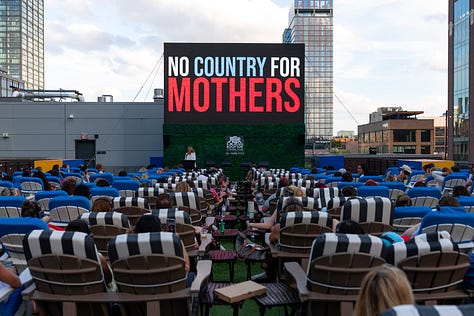
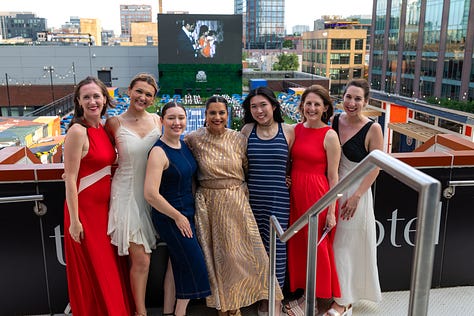
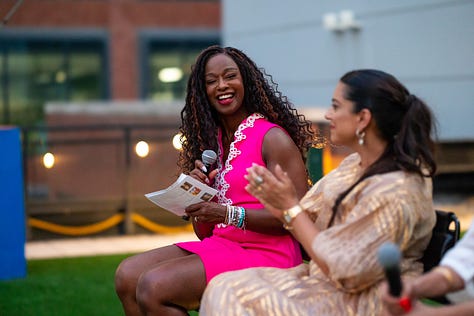

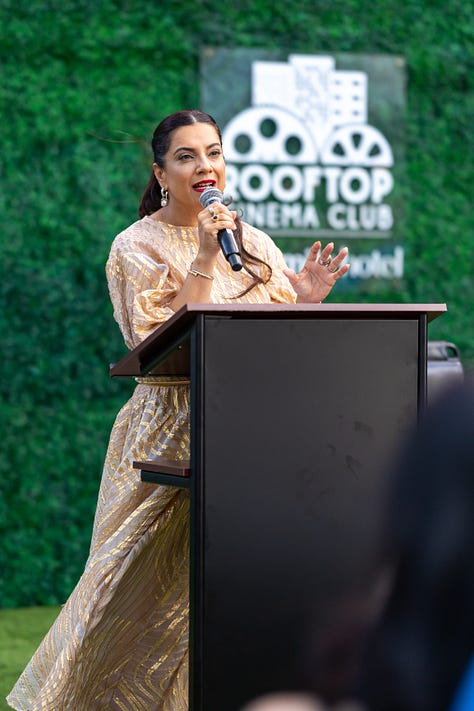
None of it would have been possible without some powerhouse women who I have to thank: Illinois First Lady MK Pritzker, director Raeshem Nijhon of Culture House , University of Arkansas Professor Angie Maxwell, and our fabulous moderator, NBC Chicago’s Regina Waldroup. And of course, the amazing Moms First team!
We’re just getting started. Next stops: Washington, D.C. → San Francisco, plus community screenings across the country.
Sign up to host your own screening or find one near you.
In case you missed it….
If you didn’t get a chance to watch my Substack Live conversation with Shannon Watts , be sure to check the replay. It was a fire chat.
Last week’s Heres the Thing
Michelle Obama’s Me Era
·
Jun 24

Last week, Michelle and Barack Obama sat down for a joint interview with Good Morning America at the Obama Presidential Center which just opened its doors for the first time.
No posts
Comments
Nothing yet. Say the first thing.
Sign in to join the conversation.