
But first, let me (re)introduce myself.
I’ve had an influx of new subscribers recently and I want to make sure I can give you all a proper welcome. And if you’ve been following me for a while now, thank you for being here. You’ll want to read this one, too.
I’m Reshma Saujani. I’m the founder of Girls Who Code, the founder and CEO of Moms First, executive producer of No Country for Mothers, wife to Nihal, and mom to Shaan, Sai, and a Bernedoodle named Steve.
I write about motherhood, women and work, midlife, AI, history, cons that keep us down, and news stories that need nuance.
I think we’d agree these are all conversations worth having, and yet, it’s hard to get this content seen. The algorithms (which are controlled by five billionaires, by the way), bury women’s voices and the stories that impact them the most.
But each week, here on Substack, I get my shovel out and try to dig us out of the latest deluge, one post at a time. The devil works hard, but a woman with something to say will work harder. And friends, I usually have something to say.
Writing is only one kind of shovel. Every so often, you need a bigger tool.
Back in 2020, in the middle of the pandemic, I took out a full-page ad in The New York Times calling for a Marshall Plan for Moms. The message was simple but radical: pay moms for the caregiving labor they have always done for free. Dozens of prominent women leaders, entrepreneurs and activists lent their signatures.
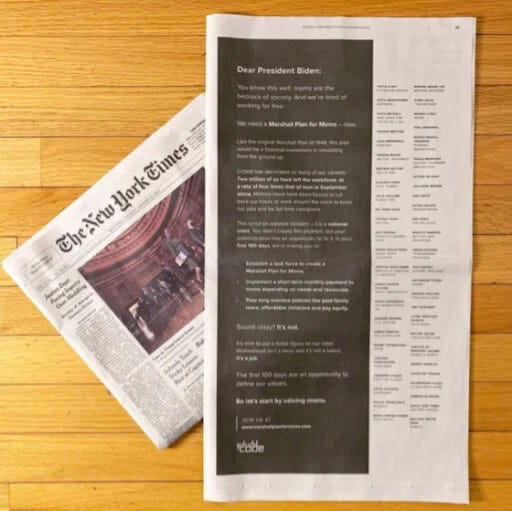
That ad sparked a movement. I built Moms First, originally called Marshall Plan for Moms, out of that fire. And in 2022, here in New York, City Council Member Jennifer Gutierrez sponsored the local law that created the Marshall Plan for Moms Task Force. Chaired by the NYC Commission on Gender Equity and Priya Nair, executive director of the commission, the Task Force brings together city agency leaders, advocates, and community leaders to study the systemic barriers facing working mothers, parents, and caregivers, and then issues real policy recommendations.
It’s the perfect example of how real change starts by showing up and demanding to be seen.
I’m proud to share a joint op-ed with Priya Nair on what the Task Force found after two years of listening to caregivers, and the road map required to build a city where every family thrives.
A special thank you to Priya for their leadership, and to every member of the Task Force for their invaluable work fighting for the families of New York CIty.
As New York City families prepare for the start of a new school year, many caregivers are once again facing the challenge of finding affordable, reliable childcare. For working parents, the return to school does not end the need for care — it simply shifts it to before- and after-school hours, school holidays, professional development days, and the inevitable gaps that families fill through grandparents, neighbors, friends, or paid providers.
For far too many families, especially low-income households, immigrants, Black and Brown New Yorkers, and families of children with disabilities, summer exposes the gaps in our childcare system more clearly than any other season. With nearly half a million children under five in New York City, and the average cost of childcare being over $25,000 annually, we know the current system is untenable and unsustainable.
This reality is one reason the NYC Commission on Gender Equity released the Marshall Plan for Moms Task Force report and recommendations. Developed over two years by childcare providers, parents, advocates, labor leaders, and policy experts, the report recognizes what caregivers have long known: Care work is essential infrastructure.
When childcare is unavailable or unaffordable, parents cannot work. When care workers are underpaid and providers struggle to stay afloat, families lose critical support systems. And when caregiving responsibilities fall disproportionately on women, economic inequality deepens.
Caregiving remains deeply gendered. Women, particularly women of color, continue to do most of the unpaid labor at home while also making up about 90% of the underpaid childcare workforce in NYC. But this is not simply a ‘women’s issue.’ It is an economic justice issue, public health issue, and a racial justice issue. And it’s one that affects anyone who helps sustain families and communities every day, like chosen family, neighbors, and grandparents.
The Marshall Plan for Moms Task Force’s recommendations offer a roadmap for building a childcare system that works for families year-round. The report calls for investments that support extended-hour care, drop-in childcare, summer programming, services for children with disabilities and special needs, and a well-supported childcare workforce.
These recommendations align with steps the administration is already taking. This year’s launch of free, full-day, and primarily year-round 2-K acknowledges what working families have long experienced: Patchwork childcare arrangements make every season, especially summer and back to school, stressful and unaffordable. Consistent, year-round care helps families maintain stability while ensuring children have opportunities to learn and thrive. In fact, full implementation of 2-K and 3-K would lift 12,000 New Yorkers — 4,100 of them children — out of poverty each year.
Caregiving and public health are deeply connected. We know that investments in maternal health, early childhood mental health, youth health services, and community-based care help strengthen families long before a crisis occurs.
The COVID-19 pandemic underscored how much our city depends on caregivers. Parents balanced work and caregiving responsibilities simultaneously. Childcare providers remained essential lifelines for families. Care workers kept communities functioning during one of the most difficult periods in our city’s history.
New York is now leading by treating caregiving not as a private burden, but as a shared public responsibility, and moreover, as the single greatest lever for influencing outcomes of our city’s economic and social wellbeing. Investing in childcare, care workers, and caregivers strengthens families, supports economic justice, improves public health, and advances gender and racial equity.
When we invest in caregivers, we invest in children, workers, businesses, and communities. We create a city where all New Yorkers — regardless of gender, income, race, immigration status, disability, parental status, or family structure — have the support they need to thrive.
As families prepare for the school year ahead, childcare remains one of the biggest challenges many will face. Building a city that works for children begins with building a childcare system that works for caregivers every day of the year.
Reshma Saujani, founder and CEO of Moms First (formerly Marshall Plan for Moms)
Priya Nair, executive director of the NYC Commission on Gender Equity.
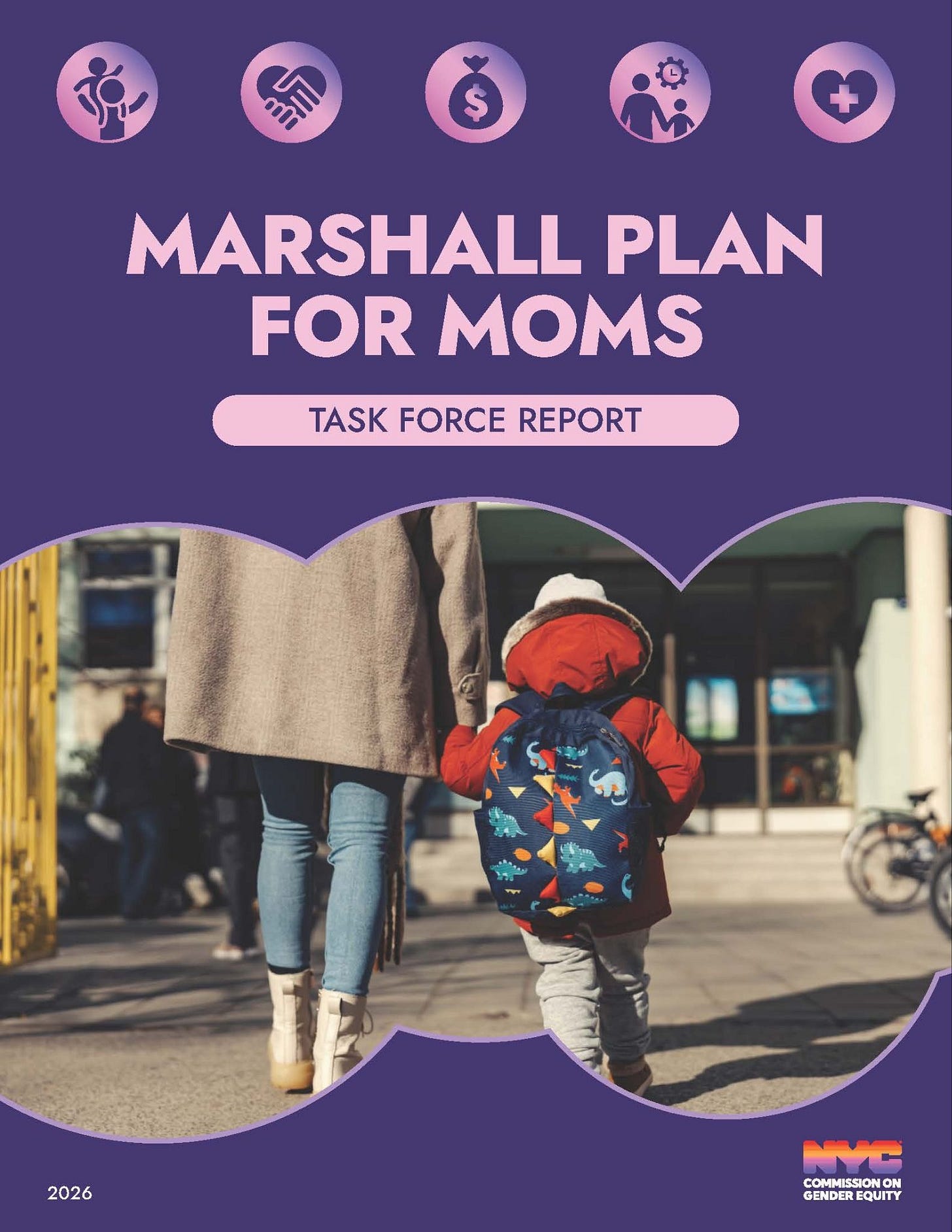
If we want a city where families can thrive, we must treat childcare as essential infrastructure.
Read the Marshall Plan for Moms recommendations and add your voice to the call for a childcare system that works for families and caregivers year-round.
Last week’s Here the Thing…
Thank you so much to everyone who took the time to read, comment, restack, and share last week’s piece on Lindsay Clancy.
It’s been a very raw and deeply moving experience talking with other women who feel the same way I do about our cultural response to this tragedy.
If you haven’t yet, you can read it here. Please keep the conversation going with others in your circle and community. We cannot bury our heads in the sand about what Lindsay experienced, and we sure as hell can’t allow it to happen to another mother.
No posts
Comments
Nothing yet. Say the first thing.
Sign in to join the conversation.