
May is Mental Health Awareness Month—a time to listen more closely, speak more openly, and reflect more deeply on the unseen battles many face every day. In the heart of our universities, one such battle often goes unnoticed: the mental health of faculty members.
While student well-being has rightly gained increased attention in recent years, the mental health of those teaching, researching, publishing, mentoring, and administrating in these institutions remains under-discussed. Yet, the toll of academia on mental health is quietly significant.
A recent qualitative study by Jacqueline M. Smith, Jennifer Smith, Alan McLuckie, Andrew C. H. Szeto, Peter Choate, Lauren K. Birks, Victoria F. Burns, and Katherine S. Bright shines a much-needed light on this issue. It explores how university faculty experience mental health challenges and the barriers they face in seeking help. Framed through Bronfenbrenner’s ecological systems theory, the research reveals how personal, institutional, and societal factors intersect to shape mental health outcomes in academia.
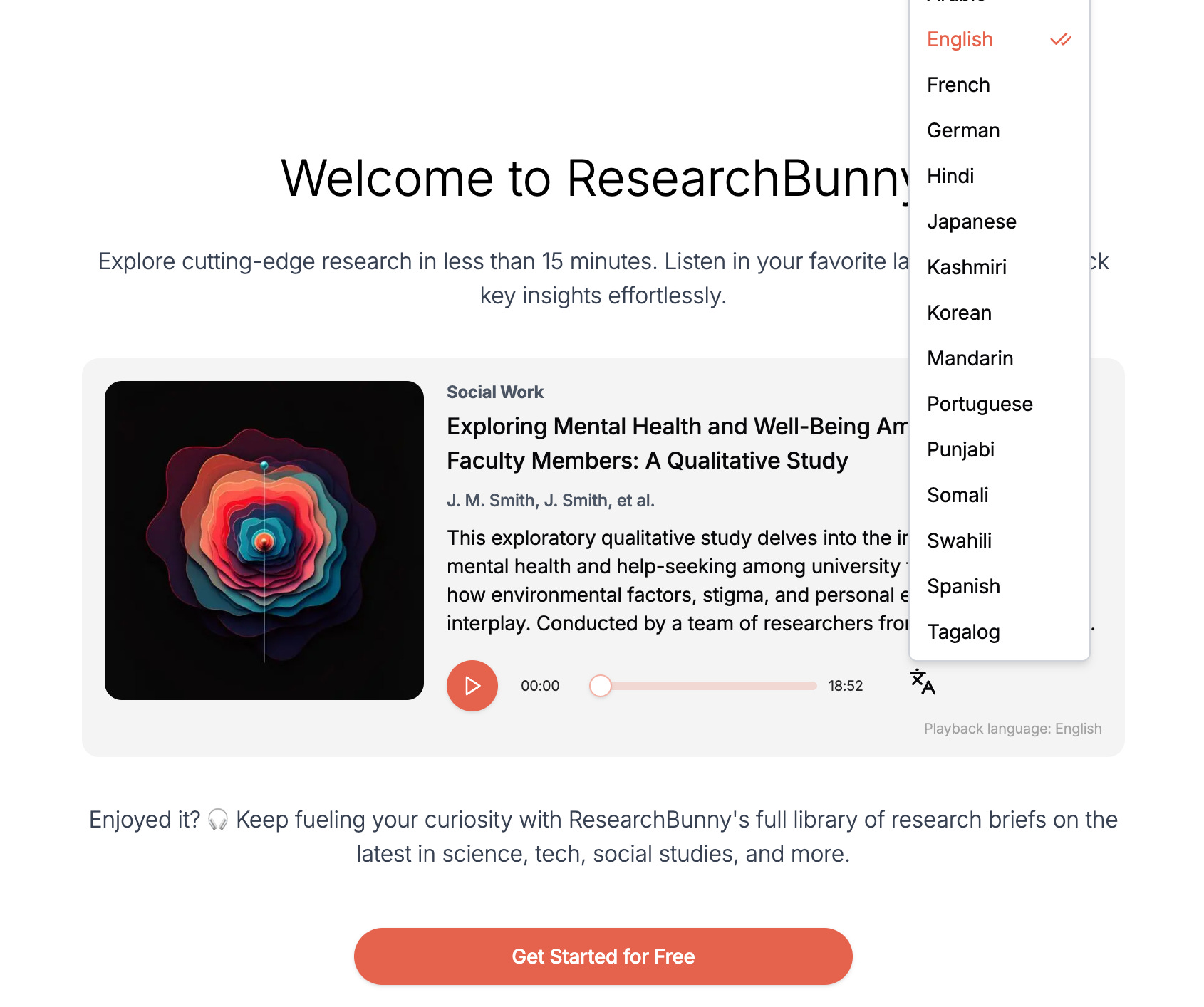
🎧 Prefer to listen? This summary to this research is available to listen to in over 12 languages via ResearchBunny.
Academia, by nature, is a pressure cooker. Long hours, publish-or-perish expectations, competitive grant funding, and an increasingly corporate culture create a perfect storm for stress and burnout.

When the COVID-19 pandemic hit, it didn’t create new problems—it magnified existing ones. Isolation increased, workloads doubled, and mental health took a hit.
Think of anyone who needs to read this; do share.
The study uncovered four key layers of influence:
Macrosystem (Academic Culture): Participants described a culture of individualism and hyper-competitiveness. Corporatisation and meritocratic ideals have not only normalised overwork—they’ve made seeking help feel like failure. That said, where communities of support and collegiality existed, they offered powerful protection.
Mesosystem (Leadership & Relationships): Leadership mattered—deeply. Some faculty encountered empathetic mentors and supervisors; others felt invisible or judged. A lack of clear expectations and emotional support from leadership often silenced conversations around mental health.
Microsystem (The Individual): On the personal front, ineffective coping mechanisms and self-stigmatisation were major hurdles. But where self-awareness, emotional resilience, and peer networks existed, they acted as crucial enablers of well-being and help-seeking.
Exosystem (Stigma): Stigma ran deep. Taking time off for mental health was viewed as a weakness, and disclosing mental illness felt risky. The invisibility of mental health struggles made them even harder to discuss, leaving many to cope in silence.
If there’s one takeaway, it’s this: mental health isn't just an individual concern—it's systemic.
To create truly supportive academic environments, universities must do more than offer services. They must challenge the very structures that perpetuate burnout and silence.
The study recommends:
Normalising mental health dialogue across departments and disciplines.
Training leadership to lead with empathy and openness.
Redesigning institutional policies to protect—not penalize—those seeking support.
Fostering peer networks, mentorship, and community care.
Yes, the study was small and localised. But its message echoes far and wide. The academic environment, while intellectually enriching, can be emotionally depleting—and no one should be expected to carry that weight alone.
If you do enjoy our posts,
As we mark Mental Health Awareness Month, let’s remember: faculty members are not just experts, educators, and researchers. They are humans—often struggling silently under systems that don’t fully see or support them.
So let’s advocate. Let’s listen. Let’s lead with compassion.
🎧 Listen to the full research breakdown on ResearchBunny — available in over 12 languages for broader accessibility.
Because if there’s any place that should understand complexity, nuance, and care—it’s our institutions of higher learning.
📢 Join us in making research truly global. Try out ResearchBunny’s multilingual feature today – it is free forever – and help us build a future where knowledge knows no boundaries!
Thanks for reading! Hope you enjoy the research roundup!
Comments
Nothing yet. Say the first thing.
Sign in to join the conversation.