
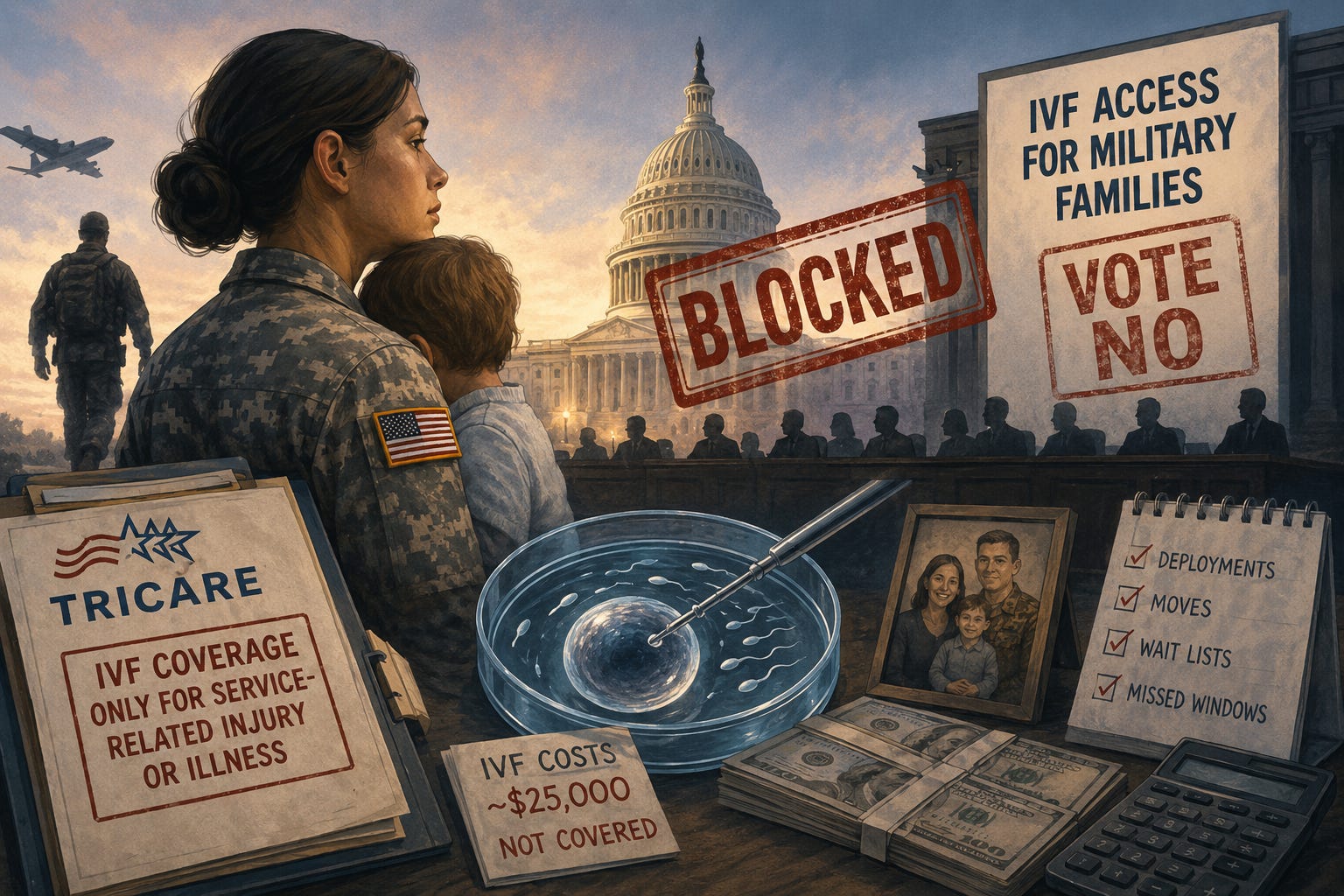
Members of the U.S. military can be deployed across the country or around the world, separated from their spouses for months at a time, exposed to physical and psychological trauma and asked to postpone ordinary parts of civilian life in service of the country.
But when many of those service members decide they want to have children, the health care system designed for military families may not pay for the fertility treatment they need.
That disparity is once again at the center of a fight over access to in vitro fertilization.
Sean Tipton, chief advocacy and policy officer for the American Society for Reproductive Medicine, said the basic problem is that active-duty military coverage for infertility remains extraordinarily narrow.
“The only real coverage active-duty military have is if their infertility is caused by a service-related injury,” Tipton told me. “So if a male soldier steps on an IED and it damages his genitalia, they can get treated. Any other cause is not covered.”
Then he put it more colorfully.
“It’d be like saying Tricare is only going to cover the flu if you can prove that you got exposed to it while you were having hand-to-hand combat with an enemy or something.”
For Tipton, the principle is much simpler: if the government promises health care to people who volunteer to serve in the military, fertility care should not be carved out of that promise.
Tipton said expanded fertility coverage has repeatedly come close to becoming reality.
Last year, he said, legislation containing broader military fertility benefits passed both the House and Senate by overwhelming margins before the provision was stripped during negotiations over the final bill.
Tipton blamed then-House Speaker Mike Johnson for intervening and removing the provision despite support in both chambers. He also pointed to the disconnect between that decision and President Donald Trump’s public embrace of IVF.
“President Trump, the self-proclaimed father of IVF, had nothing to say when the speaker contradicted his policy preferences,” Tipton said.
This year, Tipton said, the political environment became even less favorable, with Republican members of the Senate Armed Services Committee voting against another effort to expand military IVF coverage.
That has left Tipton increasingly skeptical of politicians who say they support IVF while opposing policies designed to make it affordable.
“Clearly, saying you support IVF is a cost-free lie you can throw on the American people,” he said. “I think it’s important that voters look at what their elected officials actually do.”
Dr. Ginny Ryan, a reproductive endocrinologist who has worked with veterans and testified before Congress on veterans’ issues, said military service can create reproductive risks that do not fit neatly into existing insurance rules.
Ryan said veterans can experience infertility connected to military sexual trauma, sexually transmitted infections, PTSD and medications used to treat PTSD. Some medications can affect sperm counts. Sexually transmitted infections can result in tubal disease. Trauma can also contribute to sexual dysfunction and problems with intimacy.
Women serving in the military face another problem: time.
Ryan said women frequently postpone starting families while on active duty because military service can make pregnancy and parenting difficult. By the time some leave the service and begin trying to conceive, they are confronting age-related infertility.
The system can then require veterans to establish a connection between their infertility and their military service.
Ryan described one patient who had been raped while serving in the military, contracted chlamydia and later developed tubal infertility. Because she had not been trying to become pregnant during her military service, the tubal disease was not already established as a service-connected disability.
To qualify for certain IVF benefits, Ryan said, the woman would have to establish a medical nexus connecting the assault, infection and later infertility.
“It’s a long road and a difficult one,” Ryan said.
Age-related infertility is even harder to fit into that system. There is no straightforward disability designation for a woman who delayed motherhood during military service and then developed fertility problems later.
And in reproductive medicine, delays matter.
Ryan said fertility declines significantly with age and miscarriage risk rises. In just two days of seeing VA patients shortly before our interview, she said roughly half were older than 41.
For military families without coverage, the alternative can be financially punishing.
Ryan estimated that an IVF cycle can cost around $25,000 when embryo genetic testing is involved, plus potentially several thousand dollars for medication. Egg freezing may cost roughly $11,000 to $12,000.
Treatment often has to be paid for upfront.
Patients may turn to credit cards, relatives, savings or charitable grants.
“Sometimes people just can’t afford it at all,” Ryan said.
Military families also face logistical barriers that civilians may not.
They move frequently. A patient can establish care with a fertility clinic, begin testing and then be transferred somewhere else, forcing the family to start again with another provider and another waiting list.
Deployments can separate couples during the precise window when fertility treatment needs to occur.
Some military installations are also far from fertility centers, and Ryan said relatively few community clinics may accept the insurance arrangements used to provide some veterans’ care.
The congressional debate increasingly turns on embryos.
Some abortion opponents object to aspects of IVF because doctors often fertilize multiple eggs even though not every resulting embryo will ultimately be transferred.
Tipton argues that this objection collides with a basic biological fact: human reproduction is inefficient.
“The fact is, human beings are inefficient reproducers,” he said. “Whether it is in nature or in medically assisted reproduction, there are way more sperm, way more eggs and more fertilized eggs than ever become children.”
Then he added one of the interview's most memorable lines.
“If you got an objection to the fact that not all fertilized eggs are capable of developing into children, you need to take that up with either God or evolution, depending on what you believe in. But that is the empirical reality.”
Ryan explained what that means clinically.
An IVF cycle does not begin with one egg and reliably end with one baby.
A younger patient might produce 10 eggs during retrieval. Perhaps eight are mature. Only around three-quarters may fertilize successfully. Roughly half of those embryos may continue developing to the stage where they can be frozen or transferred.
Even then, an embryo transfer does not guarantee a live birth.
“The whole benefit to IVF is to start with more eggs to eventually get us to the point of a live birth as efficiently as possible,” Ryan said.
That natural attrition is why doctors resist proposals that would allow them to fertilize only one egg at a time.
Tipton compared attempts to legislate around that biology to trying to prohibit a natural phenomenon.
“That’s like saying I’m going to pass a law to ban lightning,” he said. “You can pass such a law, it’s not going to happen.”
He warned that restricting doctors to fertilizing one egg at a time would mean more procedures, lower efficiency and dramatically reduced chances of success.
“When politicians want to impose their ill-informed views on medicine, it doesn’t work and will lead to bad outcomes,” Tipton said.
Ryan agreed.
Patients with moral or religious concerns about creating additional embryos can already discuss alternatives with their doctors, including freezing unfertilized eggs. But freezing and thawing eggs is not perfectly efficient. Some eggs do not survive, and those that do may not fertilize.
Trying to proceed one egg at a time would therefore make treatment slower, more expensive and less successful.
“At the end of the day,” Ryan said, “you may not end up with an embryo to transfer.”
She described the process as “frustrating for the patient, time-consuming and expensive for everybody involved.”
Not every embryo created through IVF becomes a child, but Ryan emphasized that this is not simply a matter of physicians or patients choosing to destroy embryos.
About half of fertilized embryos may naturally stop developing before reaching the point when they can be transferred or frozen.
Families who still have frozen embryos after completing treatment have several options. Some eventually use them. Some donate embryos to research. Some donate them to another person or couple. Some choose to discard them.
Patients generally do not enter IVF hoping to produce embryos they will never use, Ryan said. They are trying to create enough viable embryos to have the number of children they hope for.
Tipton was far less restrained when discussing proposals to treat fertilized eggs as legally equivalent to born children.
“This idea that a fertilized egg and a baby are the same thing is a ridiculous political fiction,” he said, “and if somebody has trouble believing that, I would suggest they go and try to change the diaper on a fertilized egg. They’re going to find that’s a very different experience than changing a diaper on a baby.”
Ryan focused on the consequences for medical practice.
If every fertilized egg carried the legal status of a person, she said, conventional IVF could become extraordinarily difficult to provide affordably and successfully. That would be especially problematic when families use IVF and genetic testing to avoid passing serious inherited diseases to their children.
It could also change the legal risks faced by the people working inside fertility laboratories.
Embryos sometimes stop developing. Some do not survive freezing and thawing. Rarely, embryos can be lost during microscopic handling despite the best efforts of trained professionals.
Ryan said one of the greatest fears among physicians and embryologists is that they could potentially be “charged with murder” for events that occur despite proper medical practice and extraordinary care.
That possibility, she said, could have a profound chilling effect on fertility medicine.
Tipton also pointed to a political irony.
Members of Congress themselves have access to insurance plans that include IVF coverage because they obtain coverage through the District of Columbia’s Affordable Care Act exchange, where infertility coverage is mandated.
“Every member of Congress has access by law to IVF if they need it,” Tipton said.
He argued that lawmakers who enjoy that benefit are nevertheless denying similar access to active-duty service members.
Ryan expressed the same frustration from the physician’s perspective.
Asked what she would want members of Congress to hear, she said the most important voices are those of veterans themselves.
She imagined a veteran asking lawmakers a simple question:
“Why do I deserve less of a chance for a family than you with your coverage in Congress?”
Tipton argues that Congress is not the only actor that can change the policy.
“They could do it. They could do it right now,” he said of the Trump administration.
Tipton said he does not believe congressional approval is necessary for the administration to broaden fertility benefits for federal employees and military personnel.
“The Trump administration could, at the stroke of a pen, ensure that all federal employees, including our military, have access to appropriate care,” he said. “They have chosen not to do that.”
That assertion deserves particular scrutiny as the political fight continues. If the administration agrees that it has such authority, the dispute is not simply about whether Congress can pass expanded coverage. It is also about whether the White House is willing to use its existing authority.
Both Ryan and Tipton said there is also a military readiness and retention argument for expanding fertility coverage.
The United States spends enormous sums training service members for highly specialized jobs. If staying in the military makes it harder to build a family, inadequate fertility benefits can become another reason to leave.
Ryan suggested that the military could go even further by counseling service members early about reproductive risks and providing opportunities to freeze eggs or sperm before age, deployments or service-related exposures make starting families more difficult.
She described that as an investment that could aid recruitment and retention while also simply doing right by service members.
Tipton agrees that there is a readiness argument.
But he thinks there is a better one.
“You say you’re going to take care of these people’s medical needs, so you damn well ought to do it,” he said.
“I think it’s a moral argument more than a military readiness argument.”
That may ultimately be the clearest way to understand the fight.
The debate over military IVF is not only about fertility medicine, embryos, insurance mandates or congressional procedure.
It is also about what the country owes the people it asks to serve — and whether reproductive health counts as health care when those service members decide they want to build families of their own.
No posts
Comments
Nothing yet. Say the first thing.
Sign in to join the conversation.