
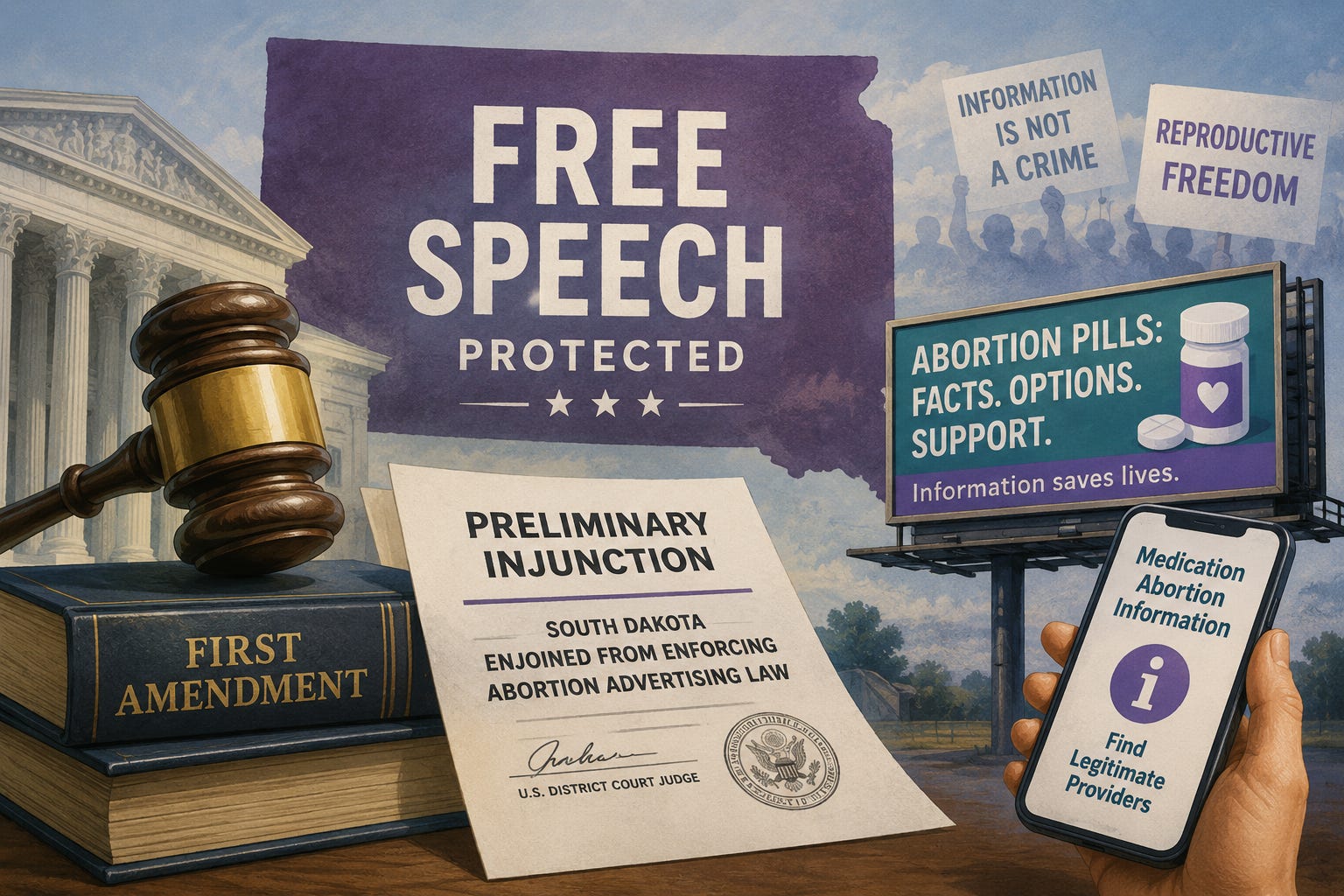
A federal judge has temporarily blocked South Dakota from enforcing a new law that would have made it a felony to advertise medication abortion, handing reproductive rights advocates an early First Amendment victory in one of the nation’s closely watched post-Dobbs legal battles.
The ruling stems from a dispute between South Dakota and Mayday Health, a nonprofit that provides information about medication abortion and directs users to legitimate providers. According to a statement from Mayday Health Executive Director Leo Raisner provided to Repro Rights Now, the conflict began after the organization purchased gas station advertisements in South Dakota last year that discussed abortion pills.
State officials challenged those advertisements, and the parties ultimately reached a settlement in which Mayday agreed to remove them. But the dispute did not end there.
South Dakota lawmakers later enacted a new law, scheduled to take effect in July, that would make advertising abortion pills a felony. According to Raisner, legislators specifically referenced Mayday’s advertisements while advancing the legislation.
Mayday then filed suit in federal court, arguing that the law violated the First Amendment by criminalizing the dissemination of lawful health information.
During the court proceedings, Raisner said he testified that Mayday does not provide abortions, prescribe medication, or distribute abortion pills. Instead, he said the organization publishes information and connects people with legitimate providers, activities it contends are protected speech under the First Amendment.
The federal judge agreed, at least for now, issuing a preliminary injunction that prevents South Dakota from enforcing the law while the litigation proceeds.
The decision represents more than a victory for one organization. It raises broader questions about how far states can go in restricting speech related to abortion after Dobbs. While states have gained significant authority to regulate abortion itself, courts continue to grapple with whether governments can also prohibit organizations from sharing truthful information about legal medical services available elsewhere.
The case could have implications beyond South Dakota. If courts continue to recognize constitutional protections for organizations that publish information about medication abortion, the ruling may influence future challenges involving online advertising, websites, telehealth services, and interstate communications about reproductive health care.
The litigation is still in its early stages, and South Dakota could appeal the preliminary injunction. Even so, the decision signals that First Amendment claims may become an increasingly important front in the nation’s ongoing abortion battles, shifting some of the legal debate from access to care toward the constitutional limits on government regulation of speech.
For organizations that provide reproductive health information nationwide, the case may serve as an early test of whether states can criminalize speech about abortion without violating constitutional protections. As the lawsuit moves forward, it is likely to be closely watched by advocates, state officials, and constitutional scholars alike.
No posts
Comments
Nothing yet. Say the first thing.
Sign in to join the conversation.