
Listen to the conversation:
0:00
-1:08:30
Read the synthesis:
🌿 Field Dialogue #5 — Obuntu Comes Home - Regrowing the Web of Relations a Wetland Once Held Together
In Kampala’s Kiwaatule suburb, a community is rebuilding the capacity to listen to a wetland - and giving her a seat in the decisions that shape her future.
Kiwaatule sits on the edge of Kampala, wrapped around a wetland called Nalubaaga that is 70 to 80 percent built over. A regenerative development cooperative is forming in which the wetland herself holds shares, with voting rights weighted by land rather than money, her perspective carried into the room by people trained to listen and reflect her experience rather than speak for her. Getting to that point took many months of dialogues, most of which never mentioned governance at all.
In this fifth Field Dialogue, we spoke with Abdul Semakula, founder of Regenar Development Initiative, about the process behind that cooperative - the long listening that preceded it, the fears it had to move through, the mechanics of a governance structure built on land rather than capital, and what it takes, in practice, for a wetland to participate in a decision.
What follows is the shape of a process still very much becoming.
Before any of this, Abdul was a web developer, building websites and software for small and medium businesses, at one point exporting that work to Europe and the Middle East. From there he moved into civic innovation, building citizen-state platforms for transparency and accountability, then into social innovation supporting women out of poverty, then into climate innovation aiming at moving more money faster toward grassroots climate action. Across each shift ran the same discomfort - always working on symptoms, never quite reaching the root.
A 2023 course in regenerative development and design asked participants to imagine a place in a regenerative future state. What came back was Kiwaatule, the Kampala suburb where he lives - not as an abstraction, but as a specific, reciprocal relation: a nearly-extinct wetland restored in a way that enhanced the well-being of the people living around it, while their presence in turn enhanced the health of the wetland. The image held enough charge to become a question rather than a daydream - what would it take to create space for the neighbourhood itself to co-create that vision, and to coordinate the resources needed to bring it into being?
What Kiwaatule used to mean.
Abdul embarked on a Storying Place process to understand Kiwaatule’s essence and potential. The name, Kiwatuule, carries its own history. Before the colonial mind translated it as an estate - something to extract from and own - it referred to a plentiful bioregion, a place bounded by natural contours rather than property lines. A king is said to have stood on one hill and looked across to Kiwaatule on the far horizon, struck by its richness, which came from the abundance of a wetland that once flowed some 80 miles into a wider ecosystem, eventually reaching the River Nile. People who once lived there describe the place, in the dialogues that later gathered these stories, as evoking drummings of joy - not only the wetland’s abundance, but the communal life that abundance made possible: welcome extended to distant neighbourhoods, shared ritual, collective work as the ordinary texture of life.
What it has become.
Urban pressure has since built over most of that wetland on its city-facing edge, and continues to erode what remains on its rural side as Kampala expands outward. A recent government wetland atlas counts more than thirty wetlands across Uganda facing a similar fate. The loss here is not only ecological. What has gone alongside the water is a set of relations - fragmented not just into plots of land, but into fragmented trust and fragmented responsibility.
The cultural diagnosis underneath this work does not start with carbon. It starts with a listening crisis - the sense that colonialism’s deepest damage was not the land it took, but the capacity for ‘being in right relationship’ it displaced. Newly independent leaders, after the British departure, largely looked outward rather than inward, inheriting colonial governance systems built on extraction rather than restoring what had existed before - a pattern that now runs through education, economy, and social life almost invisibly, simply as how things are done.
Obutaka.
At the centre of what was lost is a word: Obutaka, from obu (a plurality of life) and taka (land) - a land-sourced sense of ancestry, belonging, and agency, but also a deeper calling to care for life in one’s place. Not “I own this land,” but “I belong to this land, responsible for the life here.” Obutaka sits inside a wider system of five cultural commons, recovered slowly through years of listening:
Emitala - bioregions, not surveyed plots, as the primary way to organise social consciousness and behaviour, with rivers, hills, wetlands, and forests as boundaries rather than money;
Emiziro - a totemic system weaving humans into kinship with all life, connecting clans to specific animals, plants, and elements they are responsible for protecting. Abdul’s own clan, Semakula, carries the pangolin - an animal trafficked more than almost any other, yet also a keystone species that aerates soil and regulates ant populations, known for that as Guardian of the Forest;
Obutaka itself, awakened by that kinship - the land-sourced belonging named above;
Obuwanika - the ongoing practice of collective stewarding, caring for land as a source of life rather than a resource to extract; and
Obuntu - the interdependence of all life, into which everything above nests.
Obuntu, not Ubuntu.
Abdul contrasts this with the Western democratic ideal of government of the people, for the people, by the people - people, people, people, as he puts it, a frame that stops at the edge of the human. Obuntu starts from a wider premise: that the more-than-human already has a stake in how a place governs itself, long before any cooperative charter tries to formalise it. It is also worth being precise that Obuntu is not simply a variant of the more widely known southern African Ubuntu, even though the two are, at root, the same word across related Bantu languages.
Ubuntu has taken on a particular set of meanings as it has travelled into global and Western usage, often flattened into something close to a synonym for humanity. Obuntu, as practiced here, reaches further than that: a spiritual twinning between the self and the whole, where the more-than-human is not an addition to community but already inside it.
Nested within it is a second concept, roughly the quality of one’s relation - not only with other humans, but with land, animals, plants, and water in a given place. That relation is currently in decline, and part of what this work is trying to rebuild under present conditions, rather than simply revive as it once was.
Long before there were gatherings, charters, or governance structures, there was listening - and Abdul is careful to keep these distinct. The earliest phase, starting around 2023 and 2024, made no mention of Obutaka at all. People were simply invited to share what they valued, what they cared about, and the life they dreamed of with all life in the place they lived in.
Sweet, sour, and the fruit exercise.
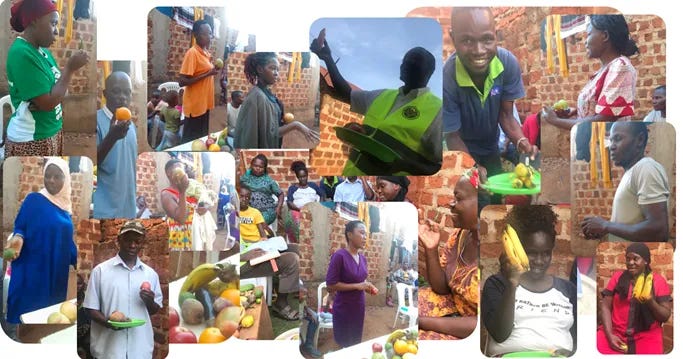
The method was deliberately sensory. People chose a fruit and told a story of a good day in the place - what made it sweet. On a hard day, they reached for something sour, a chili, and named what had been difficult. Asked about their dreams for the place, they picked a handful of fruits and described the life they imagined. The purpose was not data collection. It was to reconnect people with a felt sense of belonging to where they lived, and to let a different way of relating to development begin to surface on its own.
What the dreams revealed.
Two things became clear. First, that the absence of any space for collective dreaming left people pursuing individual visions in competition with each other - fragmented, even when, underneath, most people wanted something similar. Second, that listening to the land and the culture together, not only to people, surfaced something unexpected: seen from inside this listening, the climate crisis did not look like a carbon problem. It looked like a relational one - relations between people and nature, between communities and their ecosystems, between an economic system that treats nature as an externality and the living world it depends on.
Nine relations.
The cultural commons became a kind of mirror for everything gathered over those months, and nine relations surfaced as having once been held with care in Kiwaatule and now broken - among them, the relation between residents and waste, between residents and the wetland, between youth and purpose or income, between residents and culture. These became less a diagnosis to hand back to the community than an invitation - opportunities to practice collective decision-making again, to rebuild stewardship muscles.
Somewhere inside the listening, a category of people was conspicuously absent from the group dialogues: the landowners themselves. One-on-one conversations followed instead, walking each of them through an even deeper imagining process since they had more time - what do you love about this place, and what is preventing it from reaching its potential? The answer, consistently, came from the landowners themselves: the way we govern the land. The way we relate to it. In a fragmented way.
Three fears.
Of roughly forty landowners engaged this way, all but three - 92 percent - agreed to move toward collective stewardship, and even those three said they would join once the initiative’s benefits were demonstrated. That is not a story of easy consensus. Three distinct fears surfaced repeatedly.
A neighbourhood fear - each landowner willing to pool land, but uncertain whether their neighbour was equally willing, a small cloud of mutual mistrust that mostly dissolved once people were brought into the same room.
A financial fear - landowners who had watched banks seize land after failed loans, wanting assurance they would be the ones negotiating with any future investor, not sidelined by one.
And a political fear - sharpened by an upcoming World Bank-funded flood-control project, which some landowners initially mistook this work for, assuming it meant government involvement and the risk of land seizure.
Turning fear into purpose.
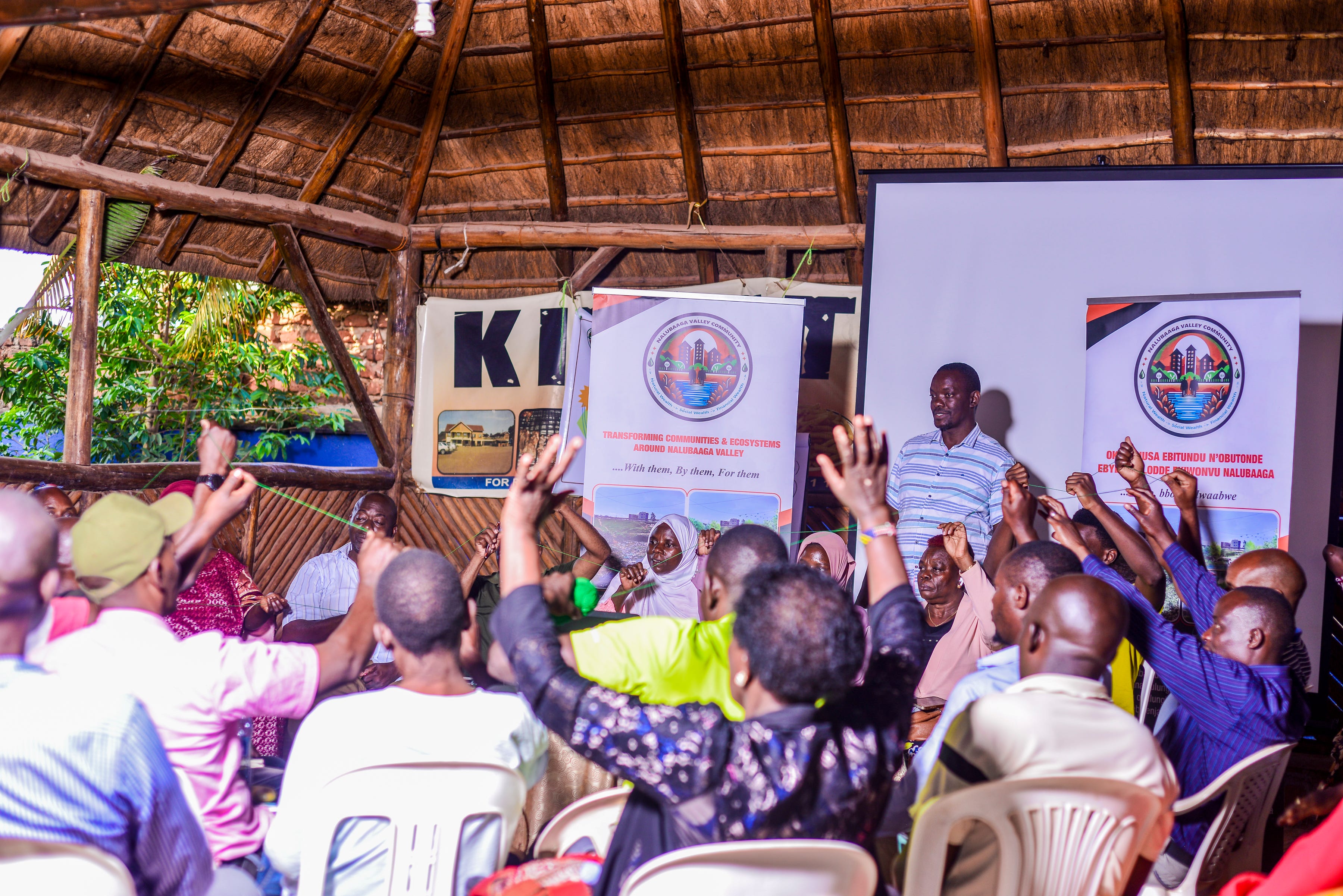
At a gathering called the Conference of Landstewards, these fears became the material for a specific exercise: landowners wrote down what they were afraid of, then worked in groups to transform those fears into a shared purpose. What emerged from that room was trust the landowners recognised as their own, not manufactured from outside - along with early ideas for how to act on it. They nominated a committee across gender, age, and landscape to steer the process.
Out of that trust, the committee with guidance from Abdul’s team came up with a governance charter for what is now called the Nalubaaga Valley Community - a cooperative structure treating residents, the wetland, and the local economy as a single interdependent system, in which the wetland participates in decisions rather than being merely protected by them.
Why it isn’t registered yet.
The charter exists, and landowners have signed it, but formal registration as a cooperative is pending on two specific legal obstacles:
Cooperative law does not yet recognise a non-human entity as a decision-maker.
And it does not recognise land, rather than money, as the basis for voting shares - which is precisely the mechanism this structure depends on: one decimal of land equals one share, and one share equals one decision-making unit.
The wetland herself holds shares in this system too, sized to whatever land she still occupies, much of which has already been encroached upon.
Why land, not capital.
The choice is deliberate. A transactional system of governance measures voice by what you own. This one is built to measure something closer to responsiveness to Obutaka - to what the place itself is calling a person toward - which is why each decision-making unit functions less as a vote in the conventional sense than as a response offered with heart and spirit.
How a wetland actually participates.
This is the question with no ready-made answer, and Abdul treats it as a live philosophical and practical learning experience rather than a solved one. The frame is not representation but reflection - the wetland is not lacking a voice; she is continuously communicating, and what has been missing is attention rather than expression. The practice built around this is called attuning to the intelligence of the wetland.
For the first relation now being activated - between residents and waste - six people, three local and three from outside the community, walked the wetland together, observing and sensing what she seemed to be communicating about that relation. Some wrote letters in her voice. Others wrote poems. These will be read aloud and be used to design an experiential session at the next stage of gathering, feeding directly into the community’s decision. During orientation for this first group, someone mentioned that there are people locally who can do this work in an even more direct way - communicating with plants - a capacity Abdul had already searched for elsewhere without success. The next iteration of the attuning process hopes to invite them in.
The governance process holding all of this together is the Obutaka Gathering Cycle, moving through four stages for each of the nine relations in turn: knowledge gathering, kin gathering, decision gathering, and action gathering.
Knowledge gathering draws on several streams at once for a single relation - what the attuning process reveals, what precolonial indigenous practice can recover (there was, notably, no concept of waste before colonial contact), what current policy says, and what future generations might need, gathered in one instance by inviting children aged twelve to seventeen to map which species around the wetland are still holding on, which have already left because of a damaged relation, and which could plausibly return if it were healed.
Kin gathering is where what the attuning process surfaced is actually experienced by the landowners together, in deliberation. The name draws on the root of Buganda itself - one of Uganda’s traditional kingdoms (Uganda, the country, is named after it), covering the region Kampala and Kiwaatule sit within. And whose language, Luganda, carries the words running through this whole process. Buganda breaks down to nda, the womb, and ganda, what comes from it - kinship, in a sense that has always extended, in this culture’s totemic tradition, to plants, animals, birds, insects, and water alongside people. So, Buganda is the bringing together of what belongs together.
Decision gathering is where the land-based voting mechanism is applied directly - where, for instance, a decision to fund composting at a cost of twenty thousand dollars gets translated, through a specific formula (built on bioregional health), into credible, fundable Units of Caring the community itself has authorised and issued.
Action gathering follows implementation with shared reflection - not resourcing as an endpoint, but as one turn in an ongoing relationship.
The first gathering to run through this full cycle at scale took place on Easter Monday 2026, when landowners prioritised the nine relations together and experienced, for many for the first time, a wetland making decisions alongside them.
The units now generated through decision gathering are called Obuntu Resets - and the name signals something more than a funding mechanism. It began, almost by accident, with a handful of colleagues who proposed to offer a few thousand dollars to prototype governance using quadratic funding. These offers were refused because something felt off about putting money in the basket first - about letting even well-intentioned money set the centre of gravity for the room.
So the offer was set aside, and the relation to be healed went into the basket instead. Only once that was in place was money invited back in - relationships in the basket, not money in the basket. Money, held this way, stops dominating outcomes through the narrow, reductionist metrics it usually imposes.
A learning journey.
External funders are now being invited into a Funders Learning Journey - a year-long, co-creative process to build, together, an experimental fund provisionally called the Obwanika (Stewardship) Fund. Each month activates a different relation, and each month becomes an opportunity both to listen to the wetland’s intelligence and to practice a different agreement between money and life.
The questions this journey is designed to sit with are still genuinely open - what governance structures would let a funder actually listen to a wetland’s intelligence and respond to it, what it would mean to enlarge a narrow definition of value to hold other forms of wealth and impact. And what would it take for attuning to a living ecosystem to become a real source of governance intelligence, shaping how communities make meaning, how they decide, what institutions enable, and how resources move. The aim, ultimately, is to weave land, stewardship, money, livelihoods and wellbeing into one living governance system.
Kiwaatule was never meant to be the endpoint. The question is: given her essence, what is this place called to feed into the world? As the Obuntu Living Drum - the place whose example is meant to be heard, and answered, elsewhere - Kiwaatule is inviting others to prototype a new process: a discipline of design - relational design - that brings people in a place together to make sense of it collectively, decision by decision, with the surrounding ecosystem participating in this rather than being observed from the outside; and with resources able to flow in ways that nourish that healing, rather than directing it from a distance, building the self-healing capacity of our bioregions.
A next step, still early, has a working name: Activating Bioregional Consciousness. There are people in the US, Italy, the UK, and elsewhere who sense that their own place holds this same kind of potential, but have no clear entry point into it. The intention is not to export what has worked in Kiwaatule as a template, but to build the learning field and the financial infrastructure that could let each place discover its own unique process - regenerating from within its own particular culture, rather than adopting someone else’s best practice.
Regenar’s ongoing work, including the Funders Learning Journey, can be followed at regenar.org and through Abdul’s writing at relandingwithobuntu.substack.com.
The Co-creation with the More-than-Human sandbox is a collaboration between The Repatterning Collective and Kincentric Leadership.
If you’d like to receive announcements of our popular monthly online learning sessions, which use live dialogue & discussion to explore different approaches and praxes for meaningful co-creation with the more-than-human (natural) world, then register here for the sandbox’s mailing list.
To receive syntheses of Learning Sessions and Field Dialogues in your inbox, subscribe below.
We donate our time and energy to this sandbox. If you value this space, consider co-funding this work by leaving us a tip.
Comments
Nothing yet. Say the first thing.
Sign in to join the conversation.