
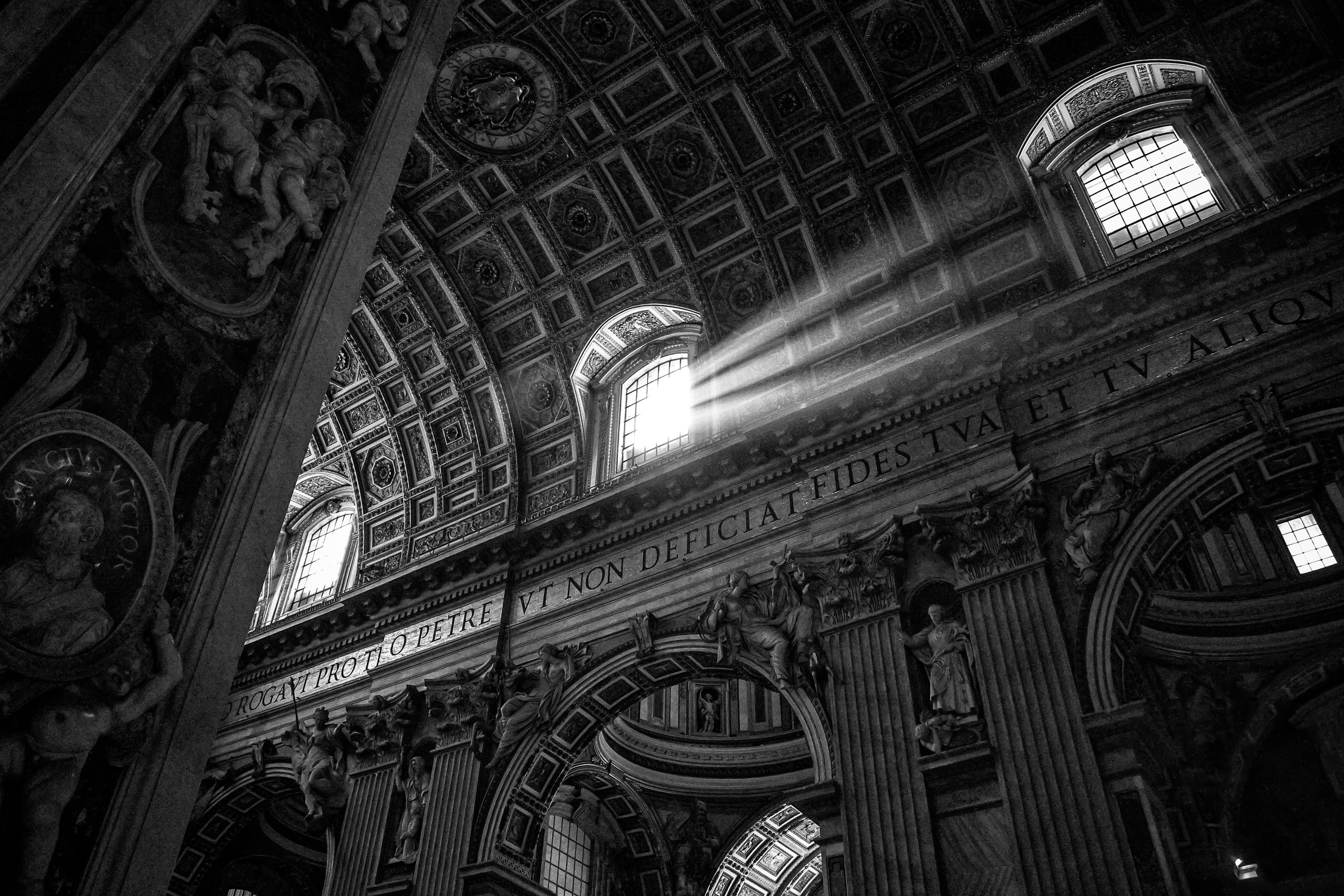
The cathedral lived in the master mason’s mind.
He arrived before sunrise on a day just like today, almost a thousand years ago. He crossed a muddy square littered with chips of limestone and oak shavings. A rough sketch of the cathedral sat in a leather satchel under his arm. It was not a blueprint in the modern sense. Instead, it was a collection of drawings, measurements, and geometric rules.
The building he was making sat between his ears, each eave, each buttress, each wall plotted to perfection in his imagination.
Around him, dozens of craftsmen were already at work. Stonecutters sat on low benches shaping blocks with iron chisels. Carpenters assembled wooden scaffolding while laborers hauled carts of stone from a nearby quarry. The cathedral would take generations to finish. Most of the men working that morning knew they would never see the completed building. Even the master mason wouldn’t see the end of his work, the cathedral opening to crowds of worshipers on its first day of use. All he knew was that the day was new and there was work to be done.
The day’s planning happened in the lodge, a simple wooden structure beside the construction site. The master mason gathered his foremen and reviewed the work. One crew would raise a section of wall and another would carve capitals for columns. A third would shape stones for an arch that might not be assembled for months. Every task had to fit into a larger geometric plan. There was always one mason, the creative one, whose job it was to carve gargoyles, jokes in stone that would last long after they were all gone.
Measurement was done with tools that seem simple today. Masons used ropes marked at regular intervals, wooden rods of standard lengths, plumb bobs, squares, and compasses. Geometry was their language. Many proportions came from circles, triangles, and squares. A rope staked out a foundation while a knotted string told the apprentice how long to cut a piece of wood. With even these simple tools, the master mason was able to draw the cathedral around him like a queen bee in her geometric hive.
The construction itself was a slow process of stacking, lifting, and fitting. Massive stones were raised using treadwheel cranes. A worker walked inside a giant wooden wheel, much like a hamster wheel, turning a drum that wound up a rope. Blocks weighing several tons rose into the air one careful foot at a time.
Each stone was cut before it reached the wall. Masons carved templates from wood and used them to shape individual blocks. A stone arch might contain dozens of uniquely shaped pieces, each one fitting only a specific position. The builders understood that the strength of the structure came from the way forces moved through the stone. They had no modern engineering formulas, but centuries of experience taught them what worked and what failed.
At midday, the bells rang. The workers ate bread, cheese, and ale. Then they returned to work. The cathedral rose slowly, sometimes only a few feet each year.
As evening approached, the master mason walked the site one last time. He checked the alignment of walls with a plumb line. He inspected newly carved stones. He studied the growing skeleton of the church against the darkening sky. Then he rolled up his drawings and headed home.
The next morning would look much the same. For years. Decades. Centuries.
And for centuries, that stone mason’s skill and artistry created what exists around us today. Our buildings. Our homes. Our monuments.
And now, that world is about to change.
A builder’s life has been focused on hammers, nails, wood, and stone. Slowly but surely, computerized systems entered the work site, and contractors started tapping screens more than hammering. The result? A streamlined and almost seamless experience that melded the physical with the digital, that reduced waste, and that optimized for speed and quality. But what happens when you add AI to that mix? What does the world look like then?
I’m Jim Kolchin from iWallet, the premiere payments platform for home services. I was a contractor for a long time and, in a way, I still am. I’m fascinated by the things that are changing in our world and how drastically the industry has changed in the last few years. I want to create a record of that.
The master masons of old could never have imagined the world in which we’re now building. In this newsletter, I’ll explore the new AI tools and techniques being used by contractors and repair persons and how technology will connect the next generation of buildings, appliances, and installations. My goal is to share the brand new and show how it connects to the long traditions and techniques we all still depend upon.
The master mason still walks among us, the cathedral in his head. He is you and he is me. The only difference? Now that master mason has technology that can change the way we plan, build, and fix the world around us.
What would you like us to cover in RepairAI? What is top of mind for you when it comes to AI? Let me know by replying to this message and I get my team to research the future of construction through an AI lens.
No posts
Comments
Nothing yet. Say the first thing.
Sign in to join the conversation.