
~5 min
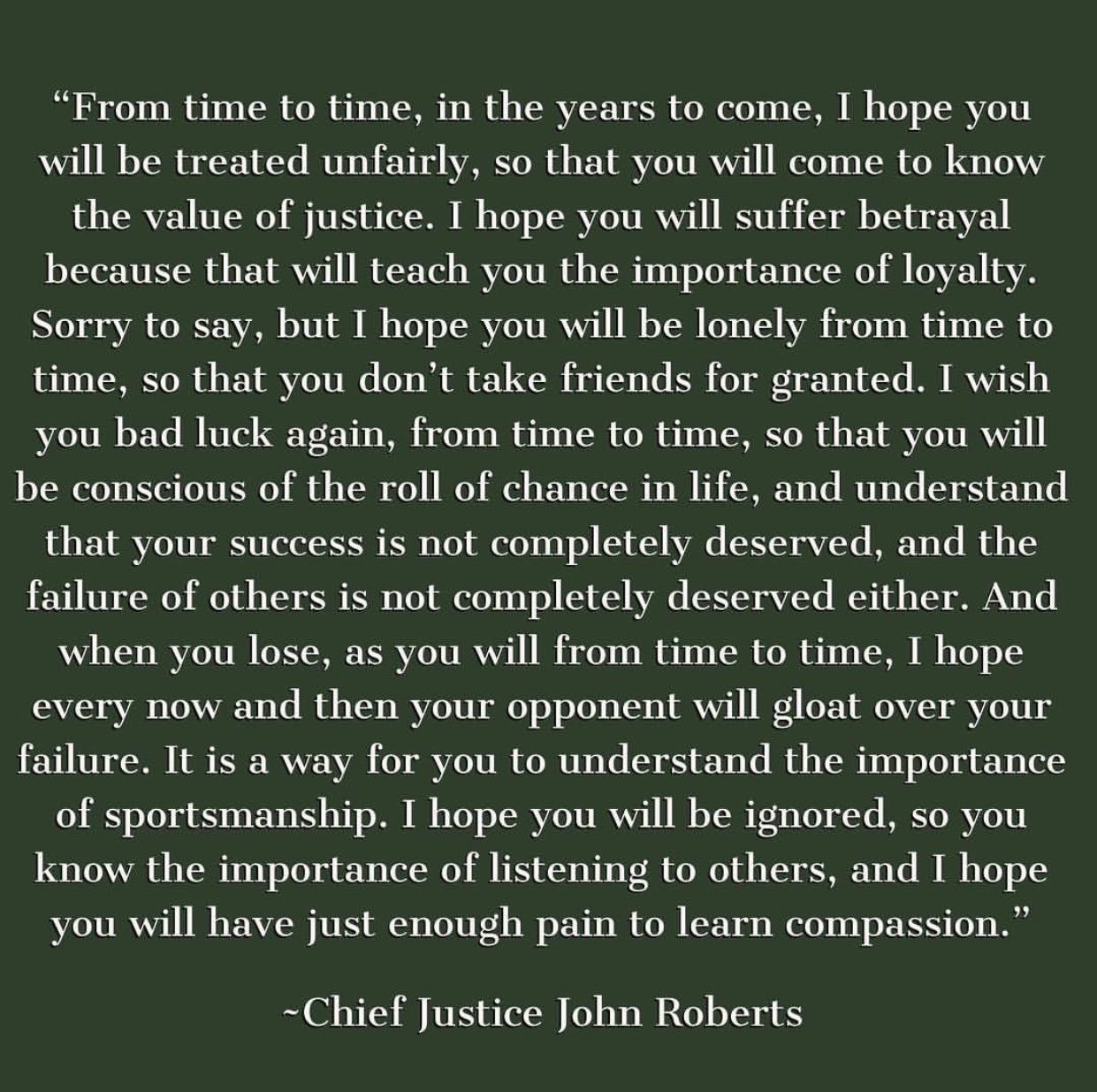
ONE WAY TO GROW IS TO EXPERIENCE A CRISIS. Informed through trauma, you then choose to rise or regress. The possibility of a different tomorrow begins here.
WE DON’T ALWAYS GET WHAT WE WANT but we always get what we choose.*
ON FAILURE:
I ENJOY LEARNING ABOUT LEADERSHIP FROM JOHN MAXWELL. I recently heard him speak on failure, a subject in which he has written multiple books, including his recent Return on Failure which I plan to read.
John tells the story of being invited to lunch with an old friend who arrived carrying a copy of John’s latest book, which validated and excited him. Exchanging pleasantries, they sat down and his friend opened the book to a certain chapter.
John, you copied this entire chapter from a sermon I gave and you didn’t mention my name once.
John was horrified, apologized, and scrambled to think of what could be done to correct this embarrassing failure to attribute.
Just as quickly, his friend said, “totally forgiven,” and moved on.
How many of your ideas (and mine) are actually someone else’s that you’ve cleverly co-opted without giving credit where credit is due? When that does happen, do you have enough humility to acknowledge it? If it was your idea that was plagiarized, do you have enough confidence to call it out and then “totally forgive?”
SHAI GILGOUS-ALEXANDER on failure.
ON DISRUPTION:
MY FRIEND GREG ALEXANDER founded Collective 54, the premier mastermind ecosystem for founders of boutique professional service agencies. He recently started writing a Substack on AI and boutiques. One recent post caught my attention on the disruption of marketing firms. I own all or part of four professional service boutiques, two of which are in the marketing space. As I’ve shared in NTL #78, #82 and #96 (to name the most recent), AI is a sea change moment for how work gets done and value is created. For the past 18 months, the firms I own have been making deep investments in preparation of a different future. The clients that these firms work with feel the same sense of urgency. We are all navigating the “how” together. Some days I wonder if we are moving fast enough only to see nearly everyone else behind us.
“The marketing agency that survives this is the one that competes on strategic thinking, brand architecture, and insight — not on execution. The ones still building their revenue around campaign management, social media posting, and customer engagement workflows are competing with a free platform agent (Meta). That is not a competition they will win.”
My Take: Marketing firms who execute won’t go away. Execution as the primary driver of value will.
ON TRUST:
IN NTL #95, I shared a definition of trust from the CEO of recruiting firm Korn Ferry. My friend Evan responded with this thoughtful take (which I edited lightly):
I want to gently push back on Gary Burnison’s definition of trust. He views trust as an incremental accumulation of experiences—effectively a ledger where you wait for enough data points to prove someone’s worth.
I look at it differently. I subscribe to the belief that true trust must be extended first, as an intuitive and vulnerable act, rather than an earned reward. If we wait for a flawless track record, we paralyze momentum and miss the exponential upside.
Here is how I think about grounding a trust-first framework:
1. The Power Law & the D.E. Shaw Paradox
When Jeff Bezos wanted to start Amazon, he took the idea to his boss at the time, David E. Shaw. Shaw listened to the pitch for an online bookstore, took a long walk with him in Central Park, and basically told him it was a good idea for someone who didn’t already have a great job, but that the risk here was foolish.
If Bezos or his early backers had waited for a linear track record of proven actions in e-commerce, Amazon wouldn’t exist. Trust is often intuitive, driven by social cues and intangibles that data can’t capture upfront. When you trust first, you accept the vulnerability of betrayal or failure, but you also open the door to the power law. In a power law distribution, a few outsized successes completely wash out the minor failures along the way. Waiting for certainty guarantees mediocrity; trusting first captures exponential upside.
2. The Science of Trust
From an evolutionary perspective, Burnison’s transactional view actually goes against how human cooperation developed. In game theory, the most effective long-term strategy for building cooperative systems isn’t rigid skepticism; it’s a variation of tit-for-tat that starts with cooperation. You extend trust first to signal the rules of engagement. Neurobiology shows that extending trust triggers oxytocin production in the receiver, which biologically predisposes them to act more trustworthily in return. Trust isn’t just a reaction to behavior; it is a catalyst for it.
3. The Scriptural Reality: Justification vs. Sanctification
As Christians, looking at trust through a purely transactional lens falls apart contextually. If we believe that people must rack up enough good deeds to be deemed trustworthy, we are operating under a system of works.
Scripture teaches that our justification—our being made right and “trustworthy” in the eyes of God—is imputed to us upfront through grace, not earned through a flawless track record. As Romans 5:8 reminds us, “God demonstrates his own love toward us, in that while we were still sinners, Christ died for us.” He trusted us with his grace first, while we were entirely unproven.
Sanctification—the slow, messy process of living out that truth—comes after. If God waited for our track record to match his investment, we’d still be waiting. Human relationships mimic this: we must extend trust as an act of grace first, accepting the risk of betrayal, rather than demanding a ledger of good deeds before we allow ourselves to be vulnerable.
If we don’t define trust as an upfront capital allocation of faith, we’re just running a risk-management audit on people.
I’m with Evan!
IN ORGANIZATIONS, TEAMS & RELATIONSHIPS:
Failure creates a moment of truth.
Disruption creates uncertainty.
Trust determines whether people stay engaged through both.
I spend my time building trust. I expect failure and am conditioned to respond to it. Disruption is a feature, not a bug, of capitalism. Most focus on the symptoms of failure or disruption. Trust is the differentiating variable.
Faith improves my life. Here is a verse I like from the Bible:
“For though the righteous fall seven times, they rise again, but the wicked stumble when calamity strikes.”
Proverbs 24:16
TWO QUOTES WORTH READING:
“The life you seek is hidden inside the discipline you avoid.”
— Epictetus, Discourses
“There is a choice you have to make in everything you do. So keep in mind that, in the end, the choice you make makes you.”
~IT IS NEVER TOO LATE TO TOTALLY FORGIVE, THOUGH WATCH OUT FOR AN INSTINCT TO DELAY~
*I love this quote, but John Maxwell deserves the credit. See? Proper attribution isn’t all that difficult, even when I could have conveniently let you believe I came up with it myself.
@renzistone33 on X, LinkedIn & Substack



Comments
Nothing yet. Say the first thing.
Sign in to join the conversation.