
An AI chip cannot compute on data it does not have in front of it. Memory is what holds that data and feeds it to the processor. Two dimensions matter: capacity, meaning how much fits, and bandwidth, meaning how fast it moves.
There are four types worth knowing, and they are not interchangeable.
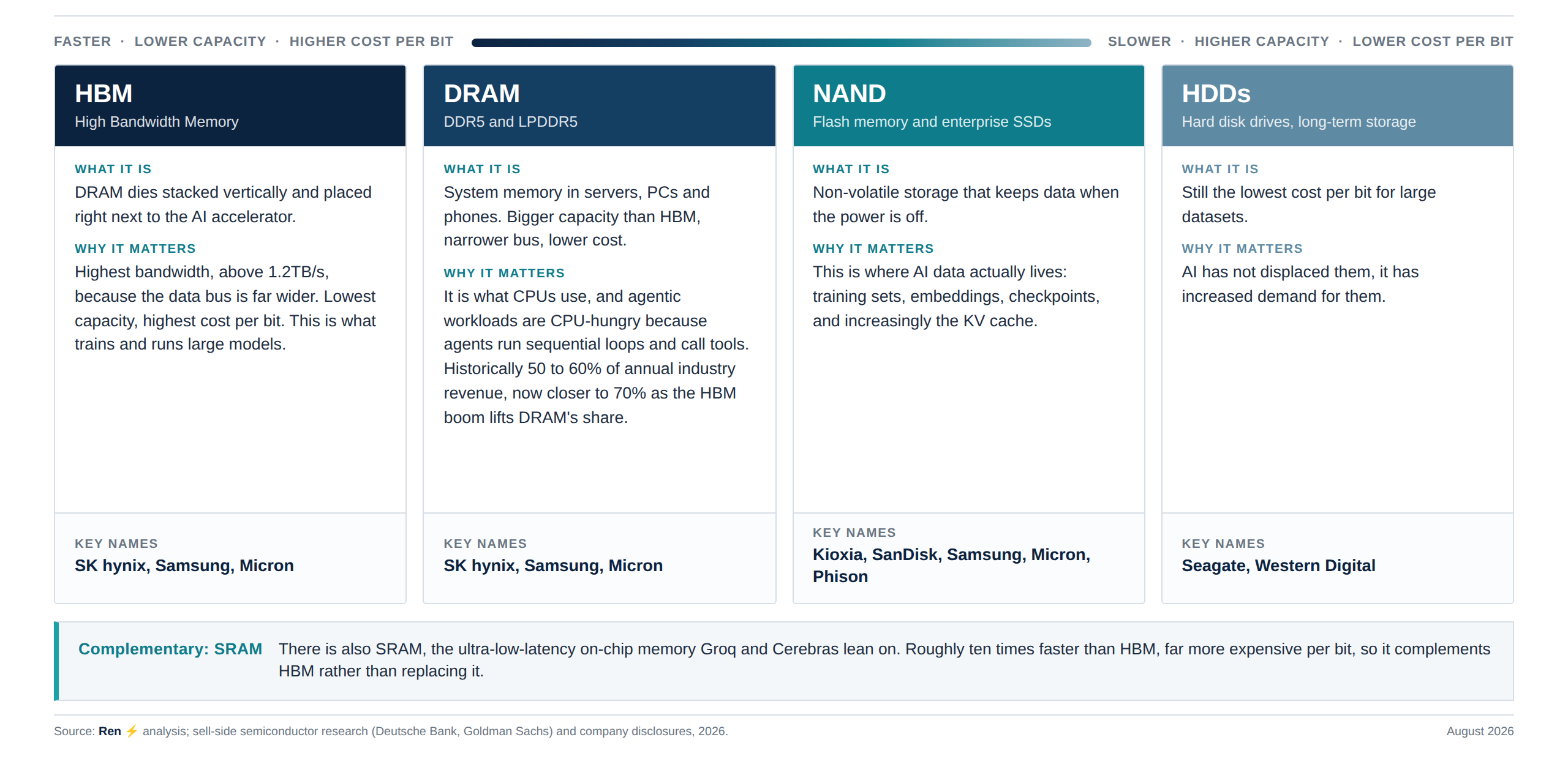
The industry calls it the memory wall. Past a point you cannot get more out of your compute unless you also expand memory bandwidth. Adding GPUs without adding memory just gives you idle silicon.
Three shifts made this acute in 2026:
Inference overtook training. Training is a burst. Inference runs forever, with growing context windows.
Agents replaced chatbots. An agent observes, plans, calls tools, and remembers. Longer sessions, parallel work, and a KV cache that has to be retained rather than recomputed. Hot KV cache sits in DRAM or HBM. Idle KV cache gets offloaded to NVMe and QLC enterprise SSDs. Every layer of the stack gets pulled at once.
Token volume is compounding. Goldman Sachs forecasts a 24x increase in token consumption by 2030, and the striking part is the mix: almost all of that growth is agent tokens, not chat tokens.
Memory fabs take two to three years to build. Most announced projects will not add meaningful HBM capacity before 2027.
Worse, HBM cannibalizes everything else. One additional bit of HBM takes roughly three times more silicon than standard DRAM, moving toward four with HBM4. Every wafer sent to HBM is a wafer that does not become DRAM for a car or a laptop. Clean room space is finite, so manufacturers are choosing what not to build.
Here is the number that makes the case better than any narrative. Bit supply growth, per Gartner and UBS estimates as of June 2026:
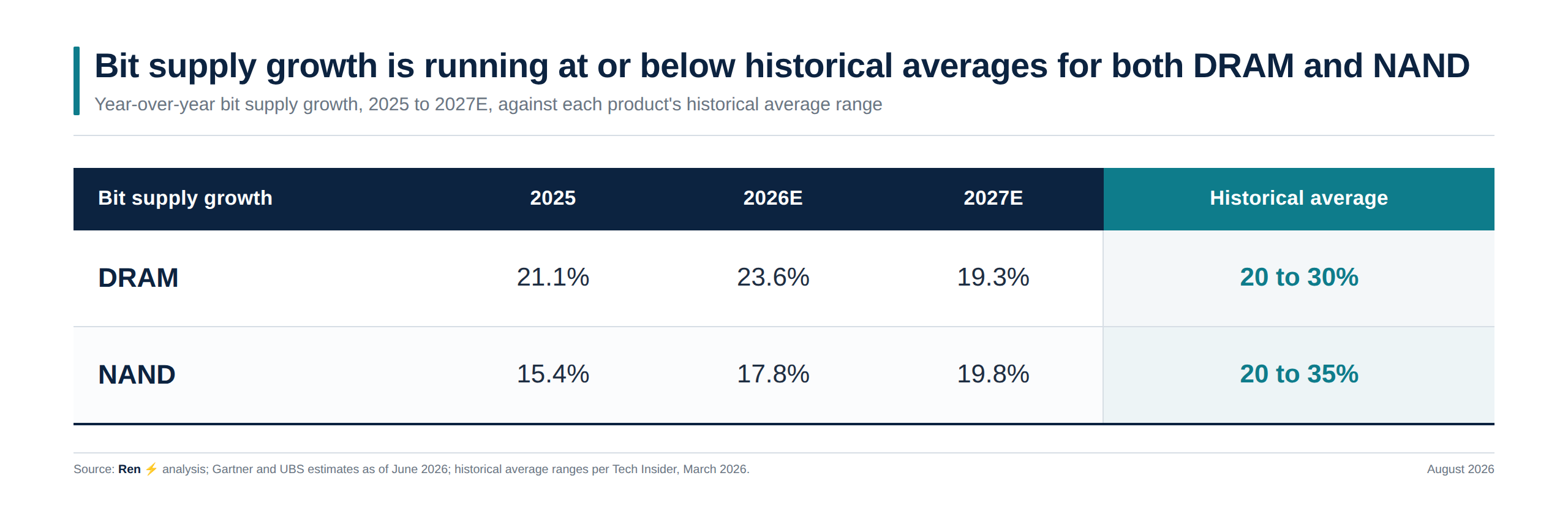
DRAM supply is running at the bottom of its own historical range. NAND supply is running below its historical range in every single year. That is not a cycle, that is a structural shortfall, and it is the strongest quantitative argument that NAND is the next leg rather than a story.
The rest of the evidence on the ground:
Micron has said it can serve only 50% to two thirds of what its key customers ask for, and calls the demand-supply gap the largest it has ever seen.
As of August, roughly 60% of big tech’s memory and AI substrate needs are being met. Unmet 2026 demand rolls into 2027, and 2027 into 2028.
Micron, Samsung and SK hynix have effectively sold out DRAM and HBM through 2027. NAND capacity for 2026 is sold out too.
Sell-side models put undersupply running into at least late 2027 or 2028, with real relief only after 2029.
Price is doing what price does. Spot DRAM is up roughly 793% and NAND roughly 442% year over year, per Bloomberg data as of June 2026 (measured on inSpectrum DDR5 1Gx16 and TLC 1TB). Standard DRAM contract prices were forecast to rise 58 to 63% quarter over quarter in Q2 2026, with NAND contracts up 70 to 75%.
The spillover is macro now. US PPI for electronic components ran +26.9% year over year in May, up from +5.9% in January. Lenovo, Dell and ASUS have flagged 15 to 20% price increases. Deutsche Bank models DRAM inflation as adding $150 to $300 to the price of a luxury vehicle and $400 to $600 for higher-autonomy models. Memory went from commodity to macro variable.
The demand is contracted, not hoped for. Hyperscaler capex commitments for 2026 total about $680B: Amazon $200B, Google $186B, Microsoft $157B, Meta $138B. NAND flash market revenue alone is forecast to go from $70B in 2025 to $147B in 2026 and $176B in 2027. Total memory revenue is forecast to roughly triple, from $216B in 2025 to about $750B in 2027.
Industry structure changed too. Enhanced long-term agreements now fix volume two to three years out of five, covering 60 to 70% of hyperscaler DRAM volumes, with take-or-pay clauses and prepayments. Lower profits at the peak, higher profits at the trough. That is the difference between a commodity cycle and an infrastructure annuity.
And the market still does not believe it. Forward P/E as of June 24, per Bloomberg: Samsung 4.9, SK hynix 5.7, Micron 7.2, Kioxia 7.5, SanDisk 9.5. The Nasdaq-100 sits at 22.9.
Two things I would not swallow whole. First, the widely circulated $12 trillion of cumulative AI funding capacity through 2031 is a Coatue estimate built on 10% annual EBITDA growth and 3x debt to EBITDA, with $2tn of it labelled sovereign funds, private credit and neoclouds. That is a capacity estimate, not committed money. Second, the same Tema deck cites Gartner’s 2027 memory revenue as both $748B and $758B on different pages. Small thing, but if a number moves $10B between two slides, use it as a direction, not a decimal.
The bear case is one sentence and it is the one that matters: if AI demand moderates even modestly, all that HBM and silicon capacity has to go somewhere, and the market can swing from severe shortage to oversupply fast. July 2026 was the preview. The Philadelphia Semiconductor Index fell 19% in the month, its worst since 2008.
Which brings us to the two funds.
Comments
Nothing yet. Say the first thing.
Sign in to join the conversation.