
From roughly $95 a year ago to about $693 today. Fiscal Q3 revenue of $808 million, non-GAAP operating margin at 32 percent, and a Q4 guide that puts the first billion-dollar quarter within reach. Market figures are a snapshot as of July 30, 2026, and this one moves fast.
Lumentum sits on Layer 7 of the AI buildout. Interconnect. The floor that decides whether ten thousand GPUs behave like one machine or like ten thousand very expensive space heaters.
Layer 7 is not one market, though, and that is where people get lost. It is the same problem solved three times, at three different distances. Here is where Lumentum’s products land on each one.

Inside the rack, chip to chip. Copper still owns this. When co-packaged optics changes that, the light has to be fed in from outside the package, and that is the piece Lumentum sells: CW and ultra-high-power lasers, not the optical engine itself. Management expects the crossover in late 2027. Revenue today is roughly zero, which makes it the biggest unmodeled line in this piece.
Rack to rack, inside the building. Where the money is, and also where the crowd is. The 800G and 1.6T pluggable transceivers, the modulated lasers inside them (EMLs and DMLs, which also go into plenty of competitors’ modules), and the optical circuit switches that reroute the fabric.
Building to building, across a city or an ocean floor. The oldest business and the steadiest one. Pump lasers, narrow linewidth lasers for data center interconnect, coherent components for long haul. In the March quarter pump lasers grew 80 percent year over year and narrow linewidth more than 120 percent. Nobody writes about this line. It compounds anyway.
Most companies on this floor pick one distance and defend it. Lumentum shows up at all three with the same object every time: a semiconductor laser grown on indium phosphide, sold as a bare chip, packaged into a module, or wired into a system. The distance changes, the customer changes, the margin changes. The thing underneath does not. That is why I file this as a light source company and not a module maker, and it is the reason the margins look the way they do.
On March 20, 2026, CEO Michael Hurlston said Lumentum is “under shipping the market” by 25 to 30 percent. Everything below follows from that one sentence.
Start with what it is today. Lumentum makes the lasers and the light-handling hardware that move data through modern networks. There is also a smaller industrial laser business, the kind that cuts and welds things in factories. San Jose, Nasdaq, ticker LITE.
The positioning matters because AI has run into a wall that has nothing to do with chips. Clusters got big enough that moving data between processors became harder than processing it, and at these speeds, moving data means light.
Now the odd part. Lumentum was spun out of JDS Uniphase in 2015, which means it walked out of the building carrying the optics business of the company that became shorthand for the dot-com collapse. For the next decade it was a deeply cyclical telecom components supplier, plus the VCSELs behind the face scanner in your phone, plus industrial lasers. It bought Oclaro, NeoPhotonics and Cloud Light along the way. As recently as fiscal 2024 it did $1.36 billion of revenue and lost $546 million.
So this is not a startup catching a wave. It is a decades-old manufacturing base that kept building indium phosphide capacity through a market that kept disappointing it, and then found itself holding the scarcest asset in AI infrastructure.
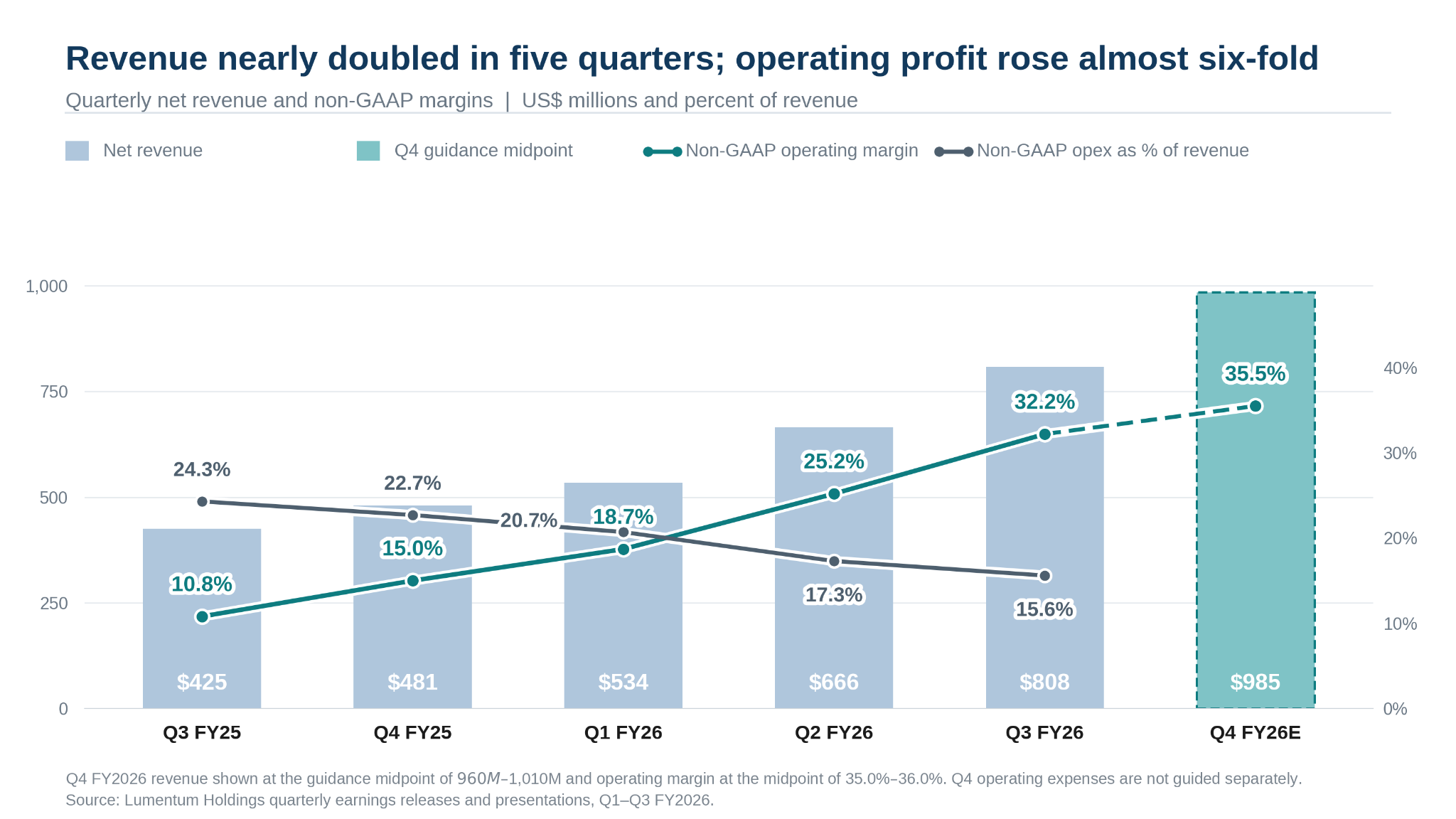
What happened next is not subtle. Quarterly revenue went $533.8 million, then $665.5 million, then $808.4 million. Up 58, then 66, then 90 percent year over year. On March 2, 2026, NVIDIA bought $2 billion of convertible preferred at $695.31 a share and committed to multi-year purchases of advanced laser components. Two weeks later Lumentum closed a multi-year, multi-billion-dollar optical circuit switch agreement with an existing hyperscaler. S&P 500 in March. Nasdaq-100 in May.
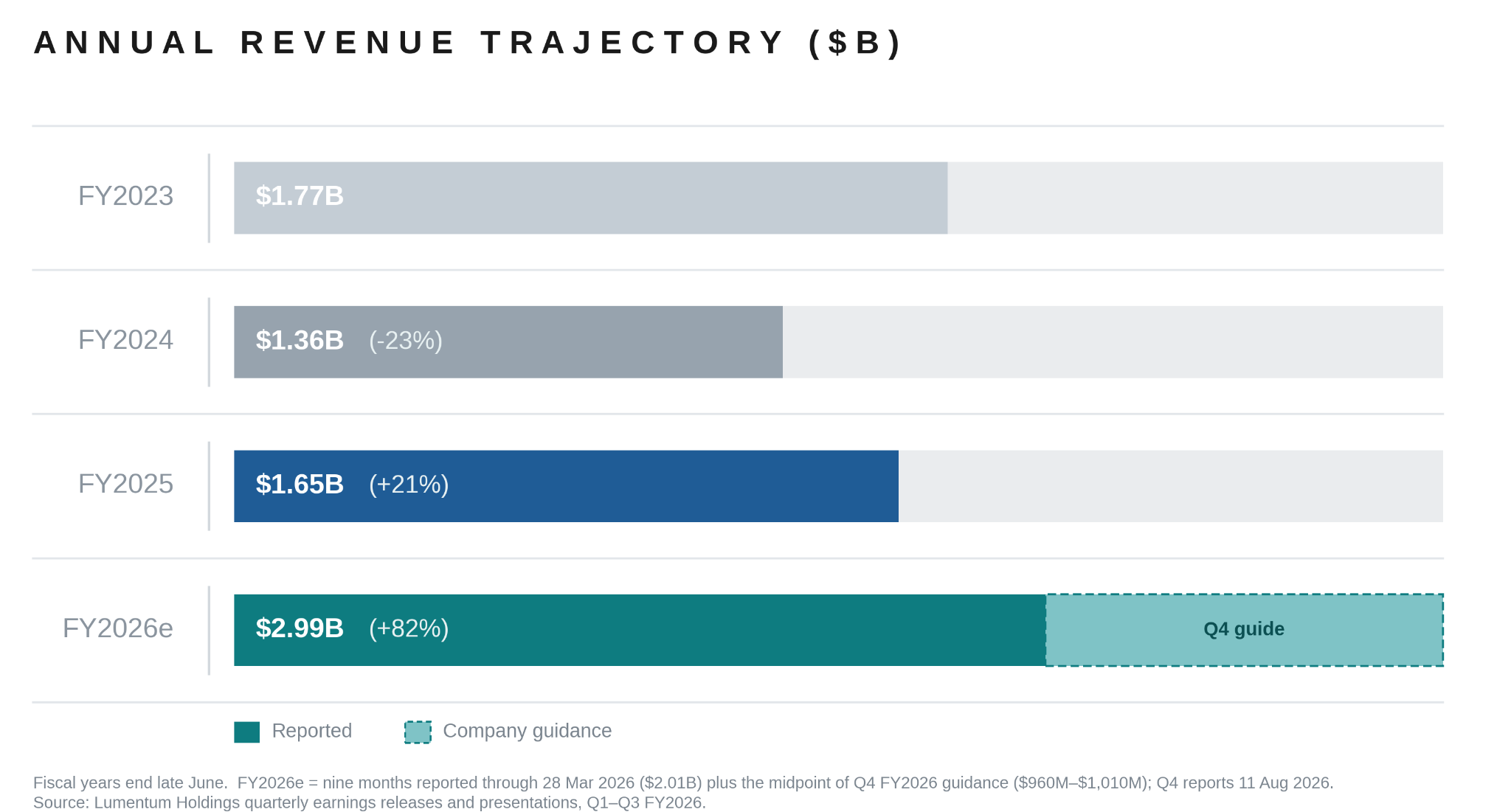
The old story is a rounding error now. 3D sensing, the iPhone business that used to drive this stock, is below 5 percent of revenue. The market has repriced accordingly: roughly $70 billion fully diluted today, against about $6 billion a year ago.
Worth sitting with for a second: NVIDIA paid $695.31 a share in March, and the stock is at $693 today. Whatever you conclude about the multiple, you are buying it at the price the most informed customer in the industry agreed to pay.SECTION 2 · FUNDAMENTALS
Two reporting buckets, and the difference between them is the difference between selling ingredients and selling meals.
Components: Laser chips, pump lasers, wavelength management, sold to companies that assemble them into something bigger.
Systems: Finished products sold to end customers: cloud transceivers, optical circuit switches, industrial lasers.
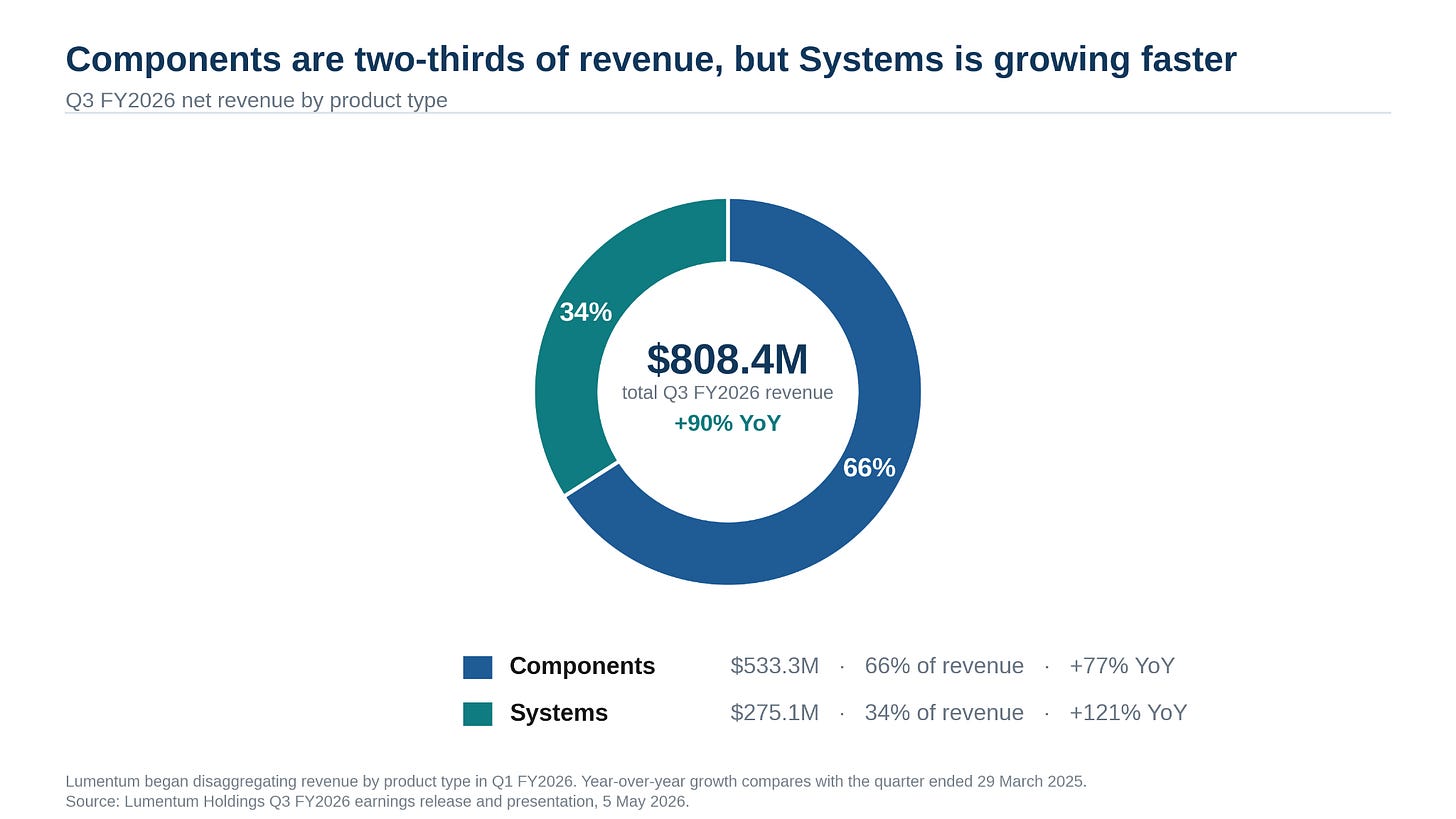
Underneath both, this is a manufacturing business. Lumentum owns indium phosphide fabs, the scarce asset in this industry, and it is increasingly dropping its own laser chips into its own transceivers instead of buying them from somebody else. That vertical integration is the margin story, and it is why Components matters more to my thesis than the faster-growing Systems line does.
Management’s framing has been consistent, and the numbers back it: this is a supply problem, not a demand problem. Capacity is effectively spoken for into 2027, and what caps any given quarter is how many wafers come out of the fabs, not how many customers call.

Three seats, each mapped to something this company specifically needs.
Michael Hurlston, CEO since February 2025, is the pivot itself. Seventeen years at Broadcom, then CEO of Finisar, which he sold to the company now called Coherent. He has sold optics into hyperscalers and he has run a semiconductor P&L, and that is the exact combination it takes to turn a telecom-era supplier into a merchant chip business. He also sold a company at the bottom of this cycle, so he knows what the turn looks like from the inside.
Wajid Ali, CFO, has the hardest job in the building. Roughly half the NVIDIA proceeds go to strategic capex, the rest to working capital and possible vertical-integration deals. Financing a multi-fab buildout without shredding the share count is the whole game, and as the financials show, the count is already moving.
Wupen Yuen, President of Global Business Units, owns the roadmap. EML output is up eight-fold since fiscal 2023 and the company has demonstrated 400G-per-lane optics. When supply is the binding constraint, whoever converts fab capacity into shippable product is the person actually setting revenue.
Hyperscalers and AI infrastructure builders. Some buy direct, some through the module makers and equipment vendors sitting in between. Lumentum does not name them, but the concentration is not in doubt: the same handful of companies funding the entire buildout are absorbing this output.
The commitments are unusually concrete for a component supplier. NVIDIA’s $2 billion investment came attached to a multi-year purchase commitment for advanced lasers. An existing hyperscaler signed a multi-year, multi-billion-dollar optical circuit switch agreement in March, against an OCS backlog already past $400 million. A separate multi-hundred-million-dollar co-packaged optics order is booked for delivery in the first half of 2027.
NVIDIA is the one to sit with, because it is now investor, customer, roadmap partner and anchor tenant of the new Greensboro fab, all at once. That is enormous validation and a real dependency in the same sentence. Both are true. NVIDIA made the point itself by putting an identical $2 billion into Coherent the same morning. It wants two qualified suppliers, not a favorite.
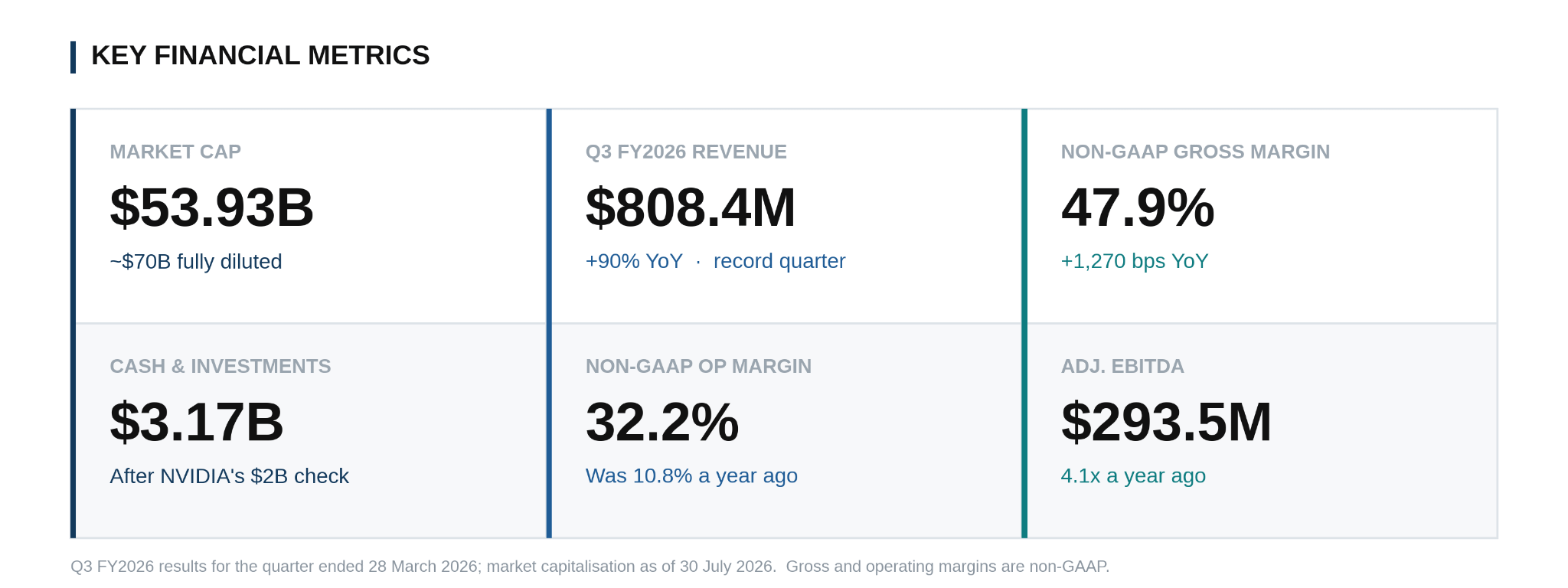
Two fiscal years ago this company lost $546 million. Last quarter it ran a 32 percent operating margin. That is the section in two sentences, but how it got there is the part worth your time.
Start with scale rather than growth rates. Nine months of fiscal 2026 produced $2.01 billion of revenue against $1.65 billion for all of fiscal 2025, and the June quarter alone is guided to $960 million to $1.01 billion, more than the company did in the entire first half of fiscal 2025.
Here is the arithmetic behind the margin story. Across those three quarters revenue rose 51 percent while non-GAAP operating expenses rose 14 percent, taking opex from 20.7 percent of revenue down to 15.6. The factories and the engineers were already paid for, so most of each new dollar drops through. Non-GAAP operating margin ran 10.8, 15.0, 18.7, 25.2 and 32.2 percent across five quarters, with 35 to 36 percent guided for Q4. Revenue did not quite double over that stretch. Operating profit rose almost six-fold.
That leverage has a price, and I would rather point at it than let you find it on your own. R&D fell to 9.7 percent of revenue from 12.9 percent two quarters earlier. Spending rose, it just rose far slower than sales. This is a company whose entire position depends on staying ahead on the roadmap, so some of today’s margin is tomorrow’s R&D going unspent.
Read the profit line carefully, because the headline figures are non-GAAP. Q3 GAAP net income was $144.2 million against $225.7 million non-GAAP, and the largest single bridge item is $46.8 million of stock compensation, a real cost paid in shares rather than cash. GAAP is improving fast, $4.2 million to $78.2 million to $144.2 million this year, though the middle figure was flattered by a one-time $27.5 million escrow settlement. The gap should keep closing on its own, since amortization of acquired intangibles is fixed near $34 million a quarter while revenue climbs.
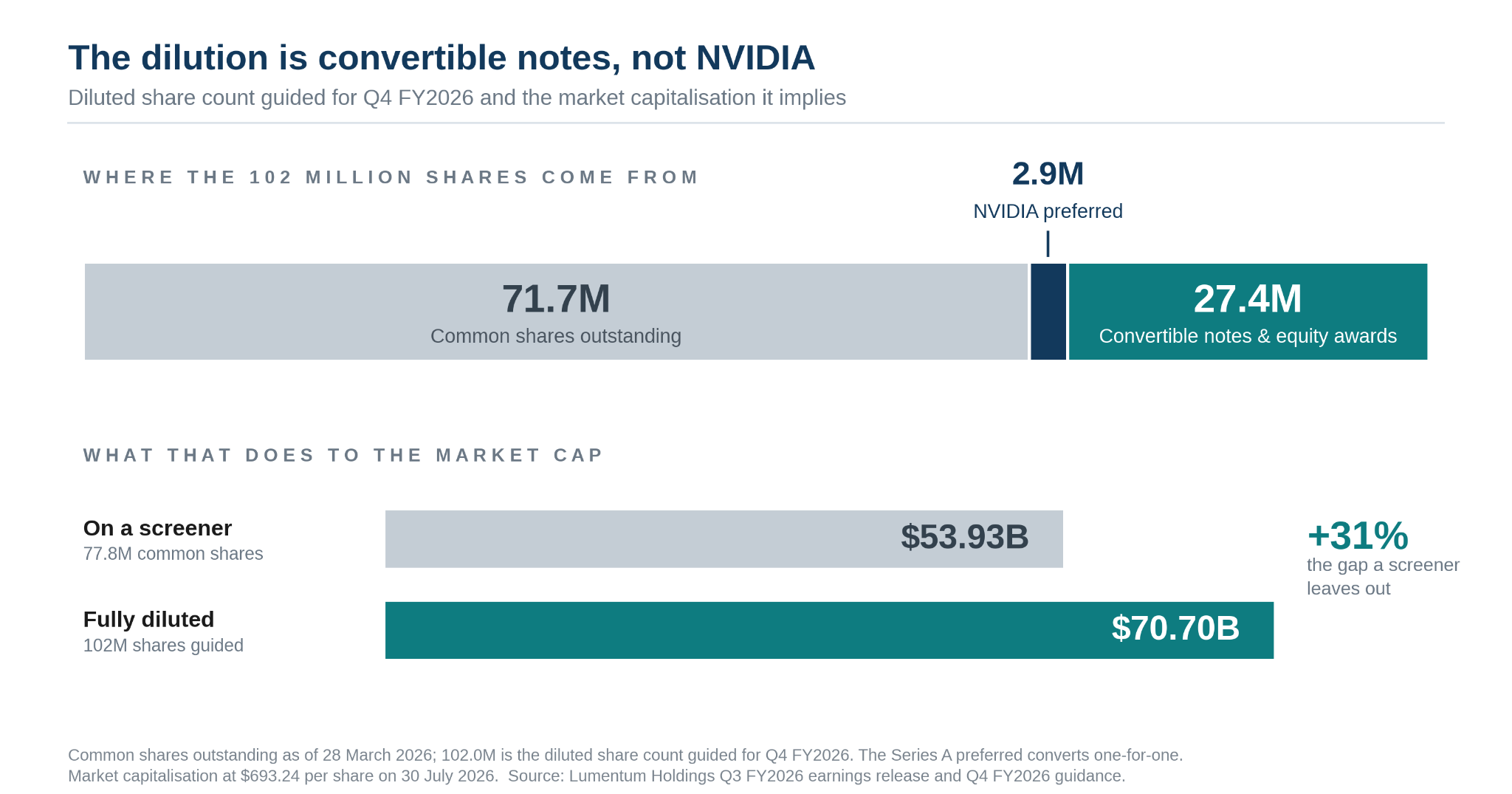
Which brings me to the number almost nobody discusses. Diluted shares went from 72.2 million a year ago to 95.2 million last quarter, guided to 102 million for Q4. The natural assumption is that NVIDIA caused it. It did not. The preferred is under 3 million shares. Almost all the rest is convertible notes issued when the stock traded at a fraction of today’s price, now deep in the money and sitting on the balance sheet as $3.24 billion of current debt.
So the $53.9 billion market cap on your screener is the common count. Fully diluted is nearer $70 billion. That is a 30 percent difference, and the bigger number is the one that belongs in every multiple you run.
Cash shows where the profit goes. There is $3.17 billion on hand after NVIDIA’s check, property, plant and equipment went from $726 million to $964 million in nine months, and consensus puts fiscal 2026 free cash flow near $209 million against $619 million of nine-month adjusted EBITDA. That is the tell. Earnings are converting into fabs, not into cash. It is the right call at this point in the cycle, and it is also the reason this will not be a cash-return story for years.
The number that matters most is wafers. Everything above is downstream of indium phosphide output: EML volume up eight-fold since fiscal 2023, capacity planned up another 50 percent through the end of calendar 2026, a fifth fab in Greensboro for 2028. When a company is under-shipping demand, revenue stops being a sales forecast and becomes a manufacturing schedule.
Bottom line: margins are expanding faster than revenue, and the balance sheet has been recapitalized by the most important customer in the industry. The question was never whether Lumentum grows. It is whether the fabs come online fast enough to turn demand into revenue before the cycle turns.
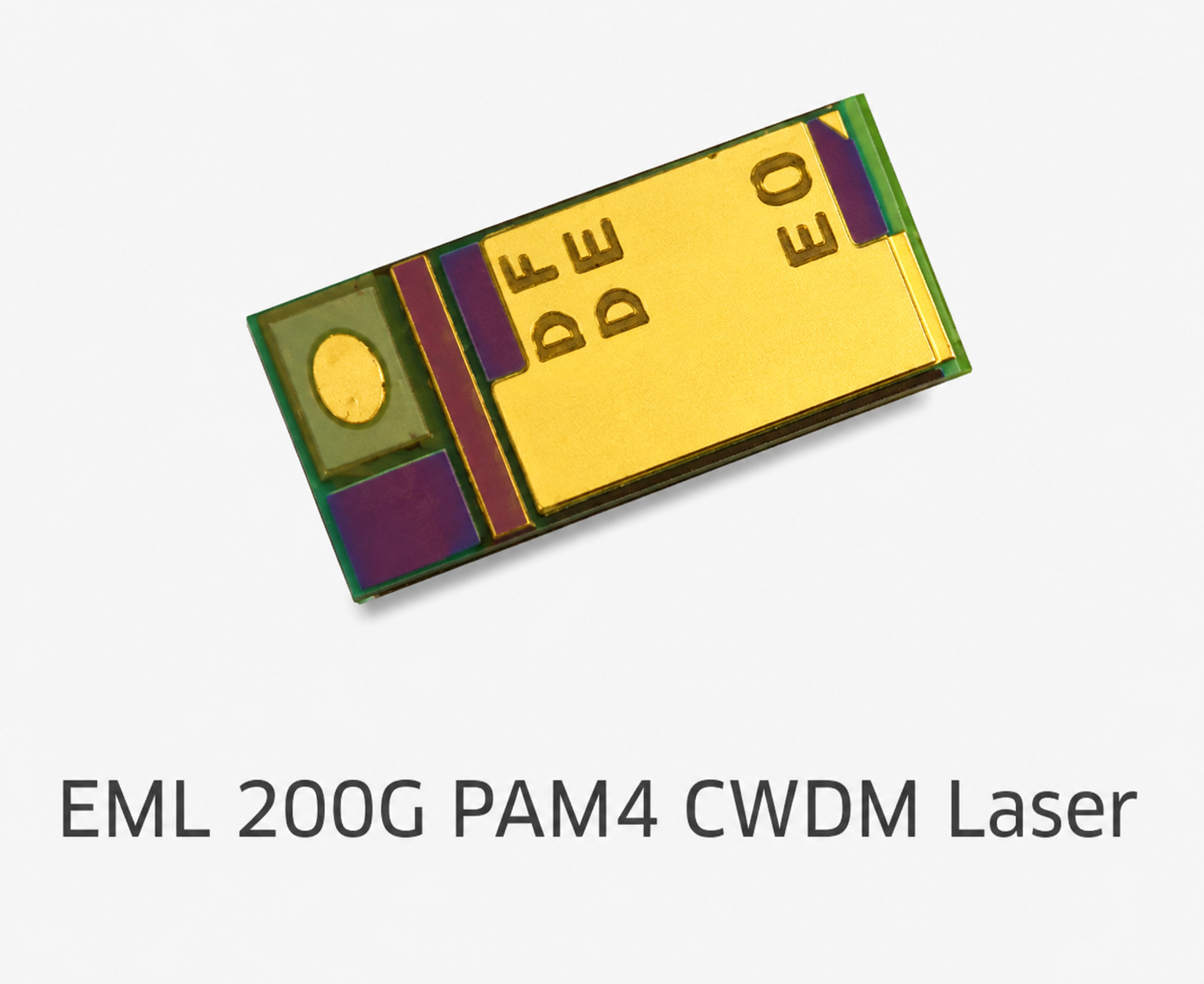
Start with the light. EML and CW laser chips are the source inside every transceiver, and this is where Lumentum is structurally advantaged. EML shipments doubled year over year in Q3, and 200G EML revenue more than doubled sequentially.
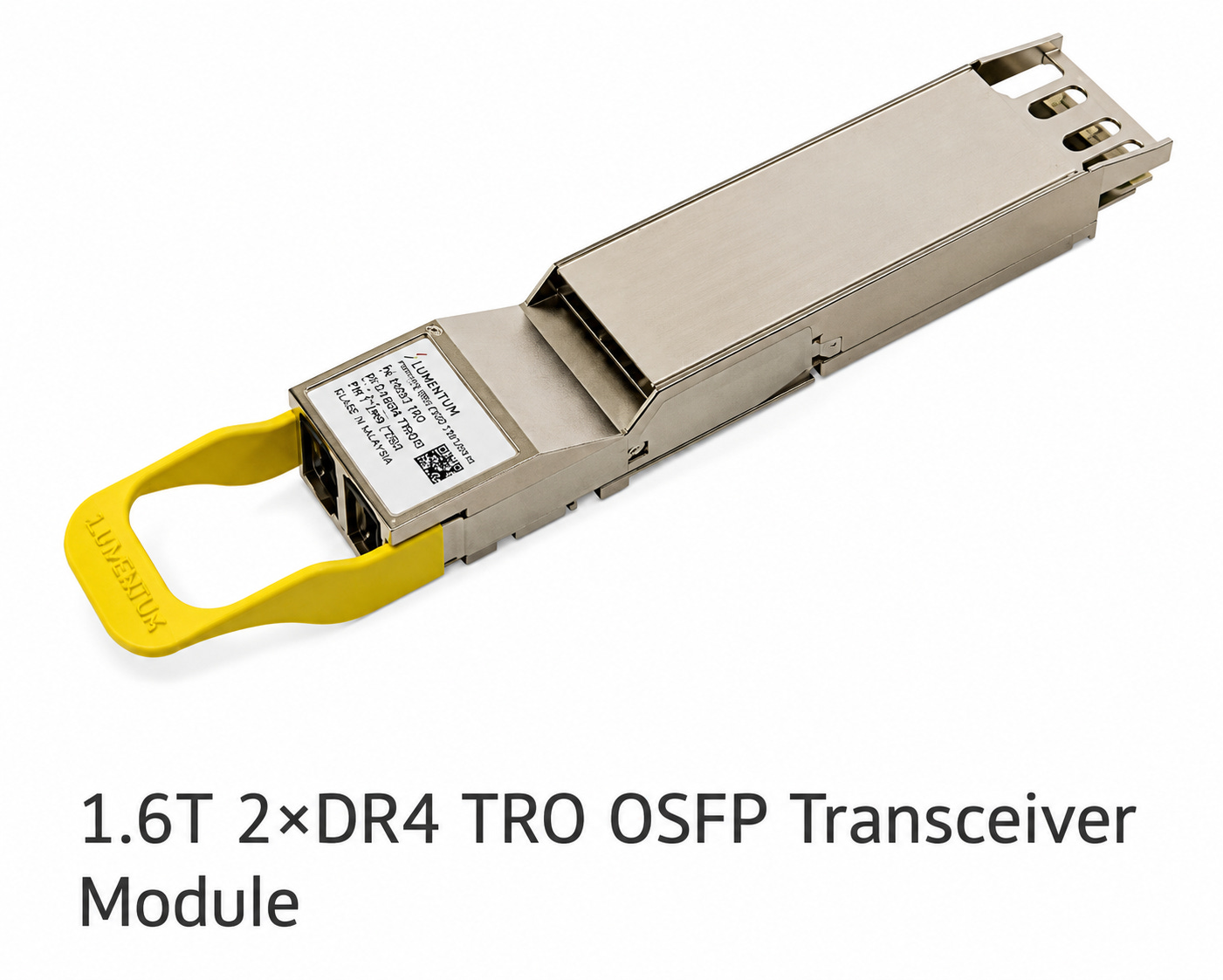
Cloud transceivers are the volume business and the crowded one. 800G and 1.6T modules sold to data center operators at structurally lower margins. Which is exactly why the 1.6T ramp matters more than the revenue attached to it. Lumentum is putting its own lasers inside its own modules at scale for the first time, and if that works, a commodity product starts carrying chip-level margin.
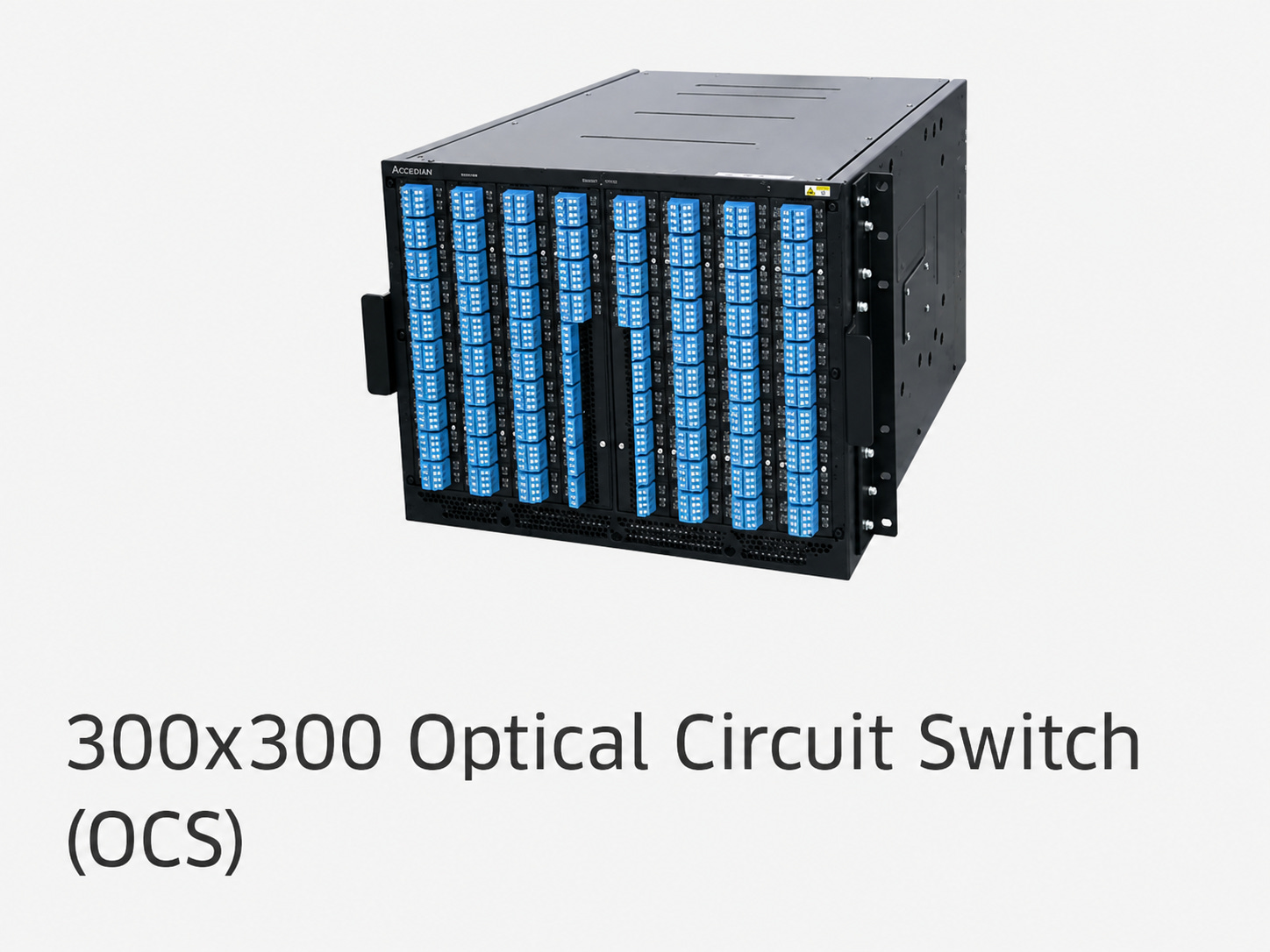
Optical circuit switches are the newest engine. Arrays of tiny tilting mirrors that steer light from one port to another without ever converting it to electricity, saving latency and a serious amount of power in buildings that are already fighting the grid. Backlog passed $400 million, a multi-year multi-billion-dollar agreement landed in March, roughly $400 million ships in the back half of this year, and management points toward a $1 billion run rate in 2027. It is also, in their own words, the tightest rope they are walking.
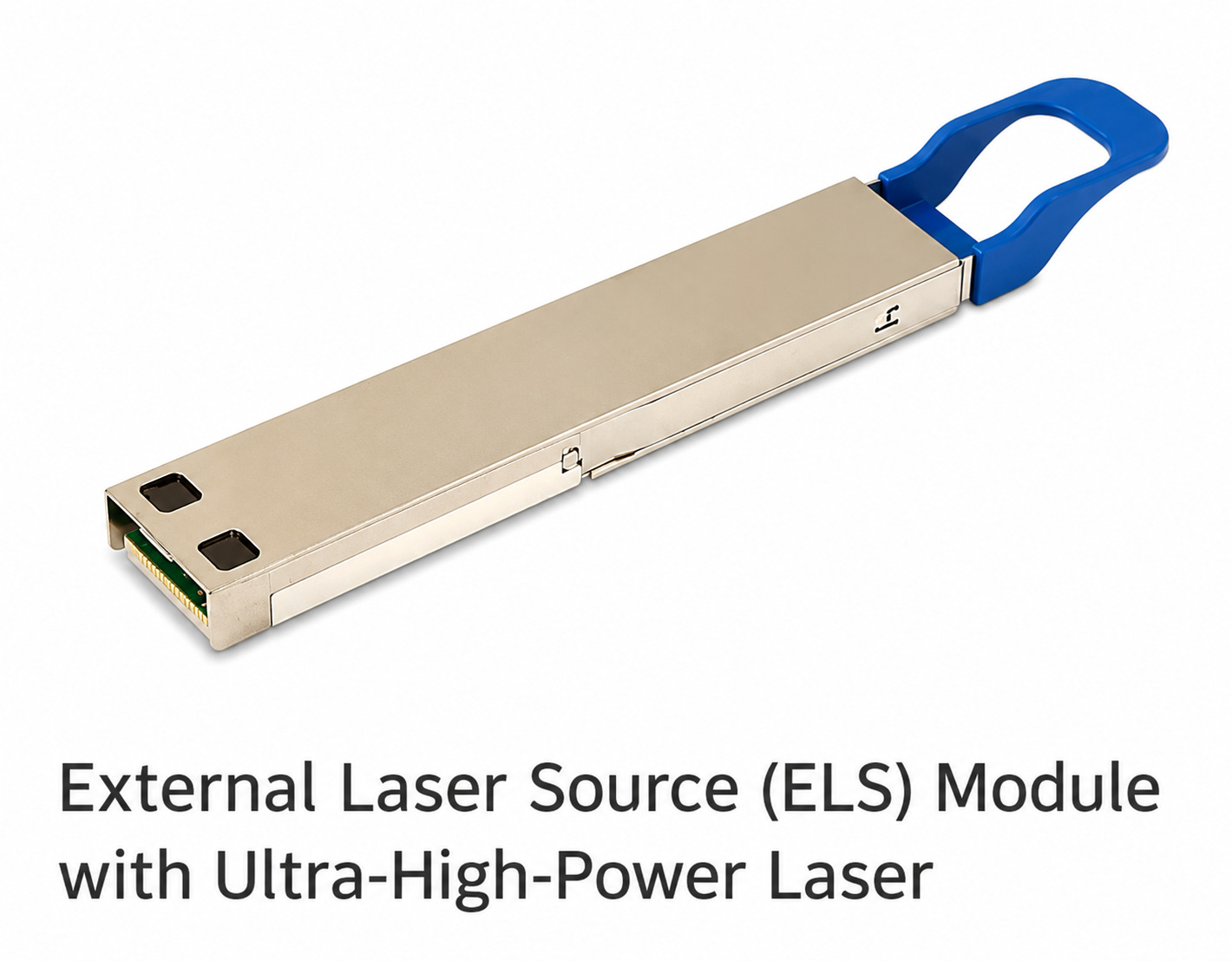
Ultra-high-power lasers for co-packaged optics are furthest out and possibly largest. CPO puts the optics right beside the switch chip, and that design needs light fed in from outside the package. Lumentum sells exactly that. Meaningful revenue is expected exiting 2026, with a multi-hundred-million-dollar order already booked for the first half of 2027.
Then the one with no revenue line at all. Inside a rack today, GPUs talk over copper. Management expects a hybrid setup from the second half of 2027, where anything longer than about three meters goes optical. Optics have never shipped inside a cluster at scale, so this is not a bigger slice of an existing market. It is a market that does not exist yet.
None of it happens without indium phosphide, the compound semiconductor these lasers are grown on. You cannot conjure a wafer fab, and the entire industry is competing for the same substrate supply. Lumentum’s answer has been to lock it down: a capacity reservation with AXT running through 2031, and a former Qorvo plant in Greensboro, North Carolina being converted into its fifth InP fab, targeted for 2028, with NVIDIA named as a customer.
Wafers reserved, capacity committed, customers signed, all years before the revenue arrives. Whoever secured substrate early owns the chokepoint.
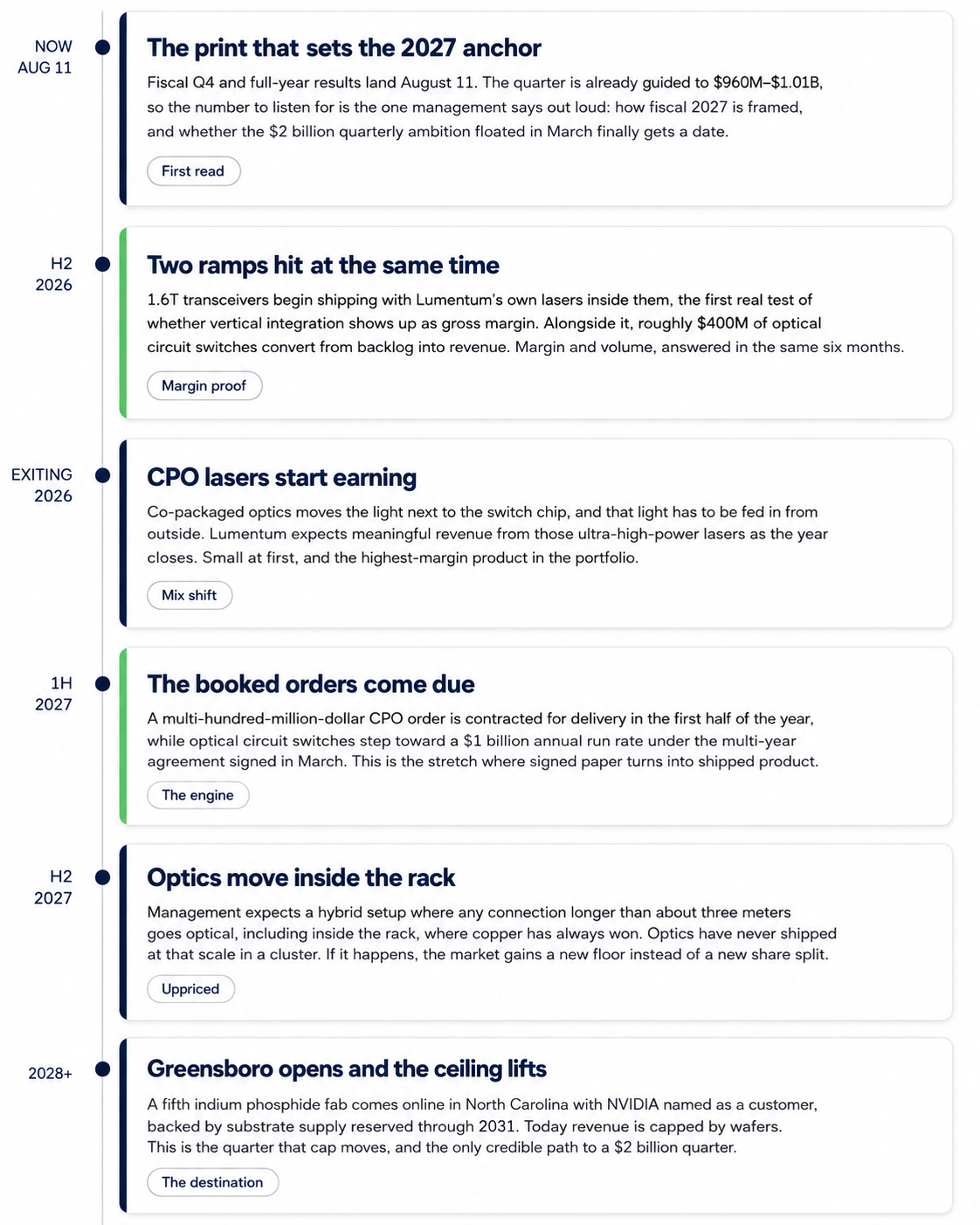
Lumentum’s catalysts share an unusual trait. Almost every one of them gets settled in a factory rather than in a sales meeting. The demand is already contracted. What is open is whether the company can build.
Each milestone below answers a different version of that question. Margin first: do its own lasers, inside its own modules, actually lift gross margin. Then volume: can it ship the switches it has already sold. Then the open-ended one, whether optics move inside the rack at all, which nobody has done at scale.
The order is the useful part, because the cheapest doubts retire first. Guidance for fiscal 2027 arrives in eleven days. The margin and volume questions both land over the two quarters after that. The one worth the most, and the one least visible in today’s price, does not resolve until deep into 2027.
Hyperscaler capital spending is the climate this stock lives in. Alphabet’s $195 to $205 billion capex guide for 2026 knocked the entire optics group down on free cash flow worries. A week later Microsoft held its own spending outlook and the same names ripped. Lumentum swung from down 9 percent to up 13 percent inside three sessions this week, without a word of company news. Own this and you own a leveraged bet on other companies’ budgets. Make peace with that or do not own it.
It sorts into three groups:
• Coherent is the one to beat. Larger, more diversified, scaling indium phosphide in Texas, and the recipient of an identical $2 billion NVIDIA investment on the same day. NVIDIA kept both relationships explicitly non-exclusive, which is the tell: these are the two qualified suppliers, being played against each other on purpose.
• The module tier is where the price pressure lives. Applied Optoelectronics, Fabrinet, InnoLight and Eoptolink compete on assembled transceivers, the layer with the most entrants and the strongest Chinese presence.
• The switch vendors are integrating optics themselves. Broadcom and its peers moving to co-packaged optics threatens pluggable modules directly, while creating demand for the external light sources Lumentum sells.
That last one is the nuance worth holding onto. Co-packaged optics is bearish for transceivers and bullish for laser chips, and Lumentum sells both. As optics move closer to the chip, the module shrinks and the light source grows. A pure module maker meets that transition as a threat. Lumentum meets it as a mix shift toward its best margin.
The sector bear case is one word: cyclicality. This industry burned investors in the 2001 telecom collapse and again in the 3D sensing hangover, and Lumentum’s own half-billion-dollar loss came only two fiscal years ago, with the same fabs and much of the same portfolio. Optics turns faster than its factories get built.
When a business runs this hot, the risks do not disappear. They just get easier to skip. So let us not.
1. Concentration, and a loop that funds itself. A handful of hyperscalers plus NVIDIA drive the demand, and NVIDIA is at once the largest strategic investor, a major customer and a co-development partner. Nothing improper in that, but part of what looks like independent demand is the supply chain financing itself, and that structure unwinds fast if the sponsor slows.
2. Supply is the governor, not demand. The constraints are electrical components, laser diodes and indium phosphide wafers. Under-shipping protects pricing today, and it also means any execution slip costs revenue that never comes back. The structural fix in Greensboro does not produce until 2028.
3. Dilution is not a footnote. Diluted shares are up about 40 percent year over year and guided to 102 million. Per-share growth is fighting a headwind that never shows up in the revenue line.
4. Valuation prices the ramp, not the results. At roughly 84 times consensus fiscal 2026 earnings, you are paying for 2027 and part of 2028 before either arrives.
5. Backlog language is looser than it sounds. A “multi-billion-dollar purchase commitment” is not contracted revenue with fixed volumes and fixed prices. Read it as serious intent backed by deposits, not as a receivable.
6. The volatility is structural. The stock sits about 37 percent below its May high after falling roughly a third peak to trough this summer, and leveraged long and inverse ETFs now trade on it. Much of this float is being rented, not owned.
Bear case in one sentence: you are paying more than 80 times this year’s earnings for a historically cyclical component supplier whose demand comes from a few customers, whose growth is gated by wafers and parts it does not fully control, and whose share count grew 40 percent in a year.
The counterweight is not small either. The constraint here is physics, not ambition. Copper stops working at these speeds and light does not, and the number of companies that can make an indium phosphide laser at volume is very close to two.
Lumentum’s market cap is $53.93 billion. On the 102 million diluted shares the company guides to, the equity is closer to $70 billion, roughly 23 times fiscal 2026 sales. Per share, at $693 the stock trades near 84 times consensus fiscal 2026 EPS of $8.23. Annualize the Q4 guide instead and it falls to 59 times. Use the fiscal 2027 consensus of $18.35 and it falls to 38.
All three are defensible, which tells you the argument is not really about the multiple you pick.
So here is my frame, with the assumptions stated out loud. EV/EBITDA is the better measure for a company pouring its profit into fabs, since it carries heavy depreciation and a balance sheet full of converts. Run it against fiscal 2028, not 2027, since a buyer twelve months from now is paying for the year in front of them. Build from the guided Q4 midpoint of $985 million: 14 percent quarterly growth puts fiscal 2027 at $5.5 billion, in line with consensus and exiting near $1.66 billion a quarter. Slow to 10 percent and fiscal 2028 is roughly $8.5 billion. Assume 105 million shares and net debt near zero.
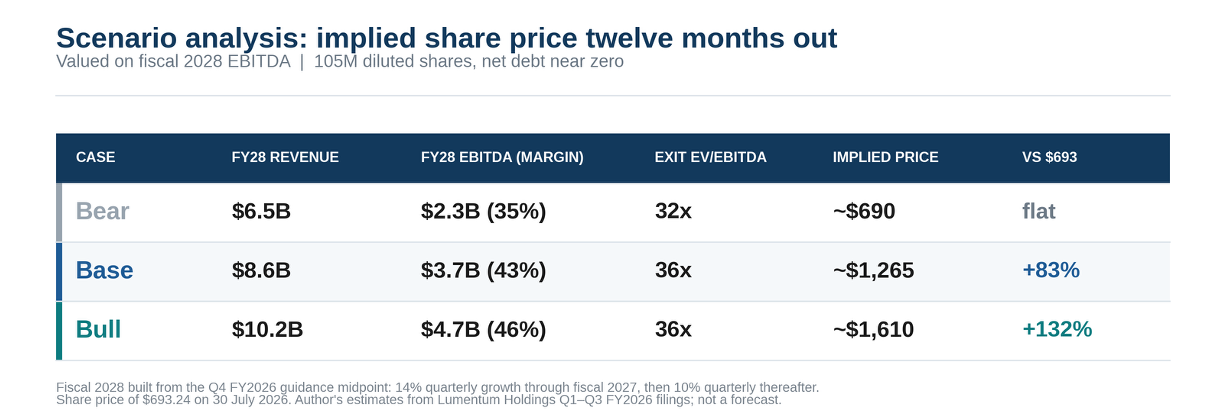
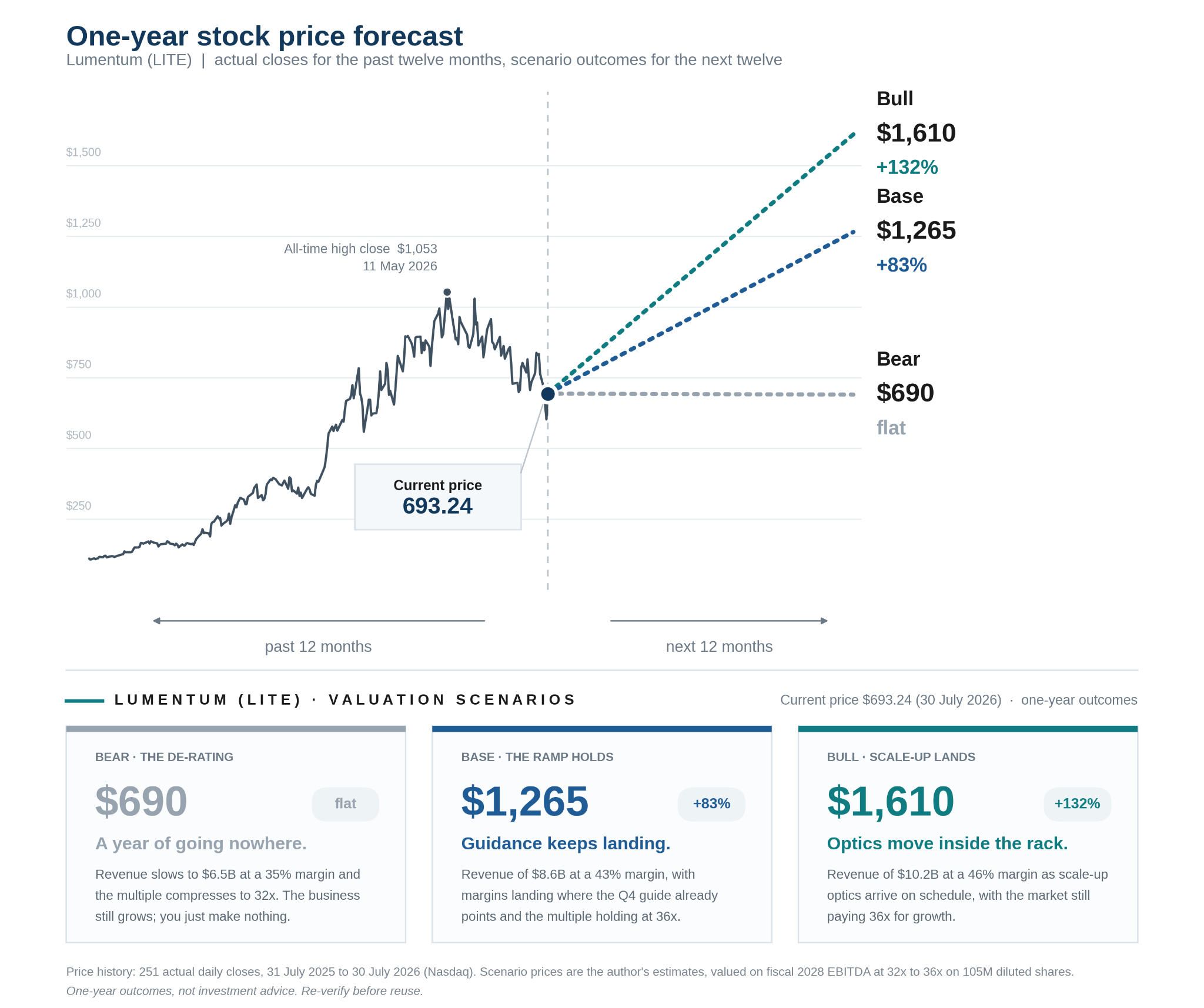
The differences across those rows are almost entirely operational. The bear is growth slowing to 18 percent with a few points of margin handed back, and you make nothing for a year. The base is the ramp continuing, with margins landing where the Q4 guide already points. The bull adds the scale-up transition arriving on time.
One input is doing more work than any revenue line, though. Every row holds the multiple above 30 times forward EBITDA, near where it trades today. Compress it to 18 times, which is what an optics downcycle has always done, and the bear is not flat, it is about $390, while the base falls to $635.
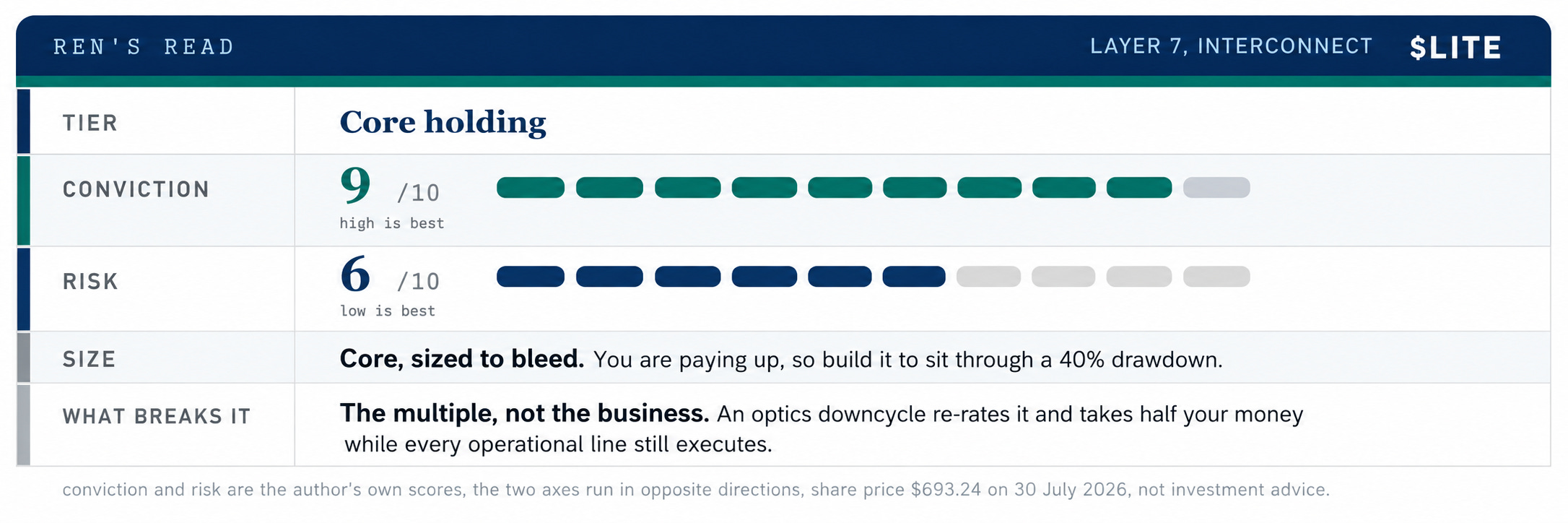
Read that one twice, because it is the actual risk. The business can be exactly right and the multiple can still take half your money. That is the part the table cannot show, and it is the part you size for.
The argument on this name was never about whether Lumentum grows. It is about what you pay for growth that has a cycle attached to it.
On July 26 Lumentum signed a capacity reservation agreement with AXT for indium phosphide wafer substrates, running through December 31, 2031, with two deposits of $43.5 million applied as credits against future purchases.
Why it matters. Guidance can be sandbagged. Backlog can be front-loaded. Cash sent to a supplier six years forward is not a talking point. A company that thought this was a 2027 phenomenon does not prepay for wafers through 2031. It also confirms where the real chokepoint sits, and it is not the module, or the switch, or even the laser. It is the crystal the laser is grown on.
The bear note. AXT manufactures in China, and indium sits on the list of materials that has already been used as trade leverage. Lumentum secured its supply and added a geopolitical seam with the same signature. Greensboro is the hedge against exactly that, and Greensboro is two years away.
On July 28, Lumentum fell about 9 percent, Coherent 11 percent, and Applied Optoelectronics 10 percent. No news from any of the three. The trigger was Alphabet’s capex number and the free cash flow question underneath it. On July 29 Microsoft reported 43 percent Azure growth and held its capital spending outlook. On July 30, Lumentum opened up about 13 percent.
My take. Nothing about this business changed in 48 hours. What changed was the market’s confidence in the people writing the checks. That is the trade you are actually in, and it will stay that way until Lumentum’s own numbers are large enough to stand on their own. Right now the earnings confirm the price. They do not set it.
Strip away every chart and the story is one sentence. At 1.6 terabits copper stops working past two meters, and somebody has to make the light.
Anyone with capital can rack GPUs. An indium phosphide laser at volume takes fabs, epitaxy expertise, wafer supply and years of qualification. NVIDIA did not write $2 billion checks to Lumentum and to Coherent on the same morning because these two are replaceable. It did it because they are not, and because two is an uncomfortably small number.
Two things separate Lumentum inside that pair.
The first is where it builds. A fifth indium phosphide fab going up in North Carolina with NVIDIA named as a customer, at a moment when the module tier’s cost advantage runs through China and export controls are a live policy question. American fabs are not a marketing line here. They are a supply chain that survives a trade war.
The second is the size of the lasers. Co-packaged optics needs light fed in from outside the package, at powers ordinary transceiver lasers cannot reach, and ultra-high-power CW is precisely what Lumentum sells. As optics move onto the switch package, the module shrinks and the light source grows. Lumentum makes the part that grows.
A word on how I got here, because it explains the size more than the thesis does.
I opened LITE at the beginning of this year at $344, and I didn’t find it by being clever about lasers. I found it by walking down the building. In January the word that kept surfacing in every supply chain note I read was photonics, so I went floor by floor: Lumentum, Marvell, Tower, Applied Optoelectronics, then one deeper into advanced packaging, then equipment and testing, then the substrates underneath all of it. LITE was the first name on that list and the one I understood least at the time. It’s now the one I intend to hold longest.
And since I don’t get to only tell you the parts I got right: I was wrong about co-packaged optics this year, and it cost me real money. In the spring I put close to 30 percent of the book into the Taiwan CPO chain, optical engines, fiber array units, external light sources, on the assumption the transition arrived roughly on schedule. Then the SemiAnalysis work pushed the timeline out by more than twelve months and that whole basket came apart in June. What I got wrong wasn’t the direction. It was the calendar. On this floor the calendar is the trade, and I’d been treating it as a detail.
That mistake is why Section 5 is ordered the way it is, cheapest doubts first. It’s also why the scale-up story is not what I’m paying for here. And yes, I see the irony of owning a name whose upside leans on the same 2027 timeline that just cost me money. The difference is what the timeline was holding up. In the Taiwan basket the schedule was the position, and when it moved there was nothing underneath it. Here it’s a free option sitting on top of a business already shipping $808 million a quarter. If CPO slips another year, LITE still has the lasers, the switches and the fabs. That basket had a delivery date and a hope.
On August 11, I’ll be at the dining-room table at 4:00 p.m., earnings deck open and baby monitor beside the laptop, waiting for Lumentum to tell us whether the fabs kept up.
Now the part the run obscures, and the part I keep repeating to myself. This is still a component business. Customers who hold real buying power, cycles that turn faster than fabs get built, margins that compress on the way down as beautifully as they expand on the way up. The same company, with the same fabs, lost half a billion dollars two fiscal years ago. People want this to be a software-style compounder because the growth rate looks like one. It is not. It is a manufacturer with a chemistry advantage, and you own a chemistry advantage through the cycle, not through a quarter.
Supply, not demand, is the near-term ceiling, which makes every quarter a manufacturing report card. The two lines I grade are operational: whether vertical integration shows up in the 1.6T gross margin, and whether OCS ships what it promised for the back half. Both get answered within two quarters, an unusually short wait for a thesis this size. Behind them sits the thing no model carries, scale-up optics inside the cluster, and if that lands in late 2027 this is a bigger company than anyone has written down.
So here is the thesis as a single choice. If you want exposure to how AI clusters will talk to each other for the next decade, you can buy the switch, the module, or the light.
I want the light. Lumentum is the light.
Forever long, held alongside GLW as structural optical infrastructure rather than a swing. I do not chase it on a green day, and I do not sell it because somebody got spooked on a mechanical unwind; on the contrary, I will try to add on good macro dip. Forever long is not the same as never worried, and position size is what makes both of those true at once.
This analysis is for educational and informational purposes only. It does not constitute financial advice or a recommendation to buy or sell any security.
July 31st, 2026 | Price: ~$693 | Sources: Q1–Q3 FY2026 Earnings Releases · Q1–Q3 FY2026 Earnings Presentations · NVIDIA Strategic Investment (Mar 2026) · AXT Capacity Reservation (Jul 2026) · March 2026 Investor Day | NFA. DYOR.
No posts
Comments
Nothing yet. Say the first thing.
Sign in to join the conversation.