
The AI buildout has 12 layers. Interconnect is layer seven and it sits in the middle of the physical stack for a reason. Compute does the work. Memory holds the data. Interconnect moves it.
A GPU on its own is a very expensive space heater. It only earns its price when it can talk: to the memory stacked beside it, to the 71 other GPUs sharing its rack, to the tens of thousands more across the building, and increasingly to a cluster three states away.
Layer 5 is the muscle. Layer 7 is the nervous system that turns thousands of muscles into one organism instead of a pile of parts. And right now the nerves cannot keep up with the muscle.
Scaling AI means connecting more accelerators. Add enough of them and the talking grows faster than the computing, until another rack costs more than the work it contributes and the machine spends its day waiting instead of calculating.
Five things decide what is physically possible here, and no design gets to have all five:
Bandwidth. Bits per second.
Latency. How long a single hop takes.
Distance. How far the signal has to survive.
Power. Watts burned per bit moved.
Cost. Dollars per port, per lane, per meter.
Everything else in this layer is an argument about which of those five to give up.
Copper is cheap and simple. No laser, no photodiode, no digital signal processor, just metal. What copper cannot do is go far at speed. Every doubling of the bits per lane shrinks the usable reach, and at 200 gigabits per lane copper has become a within-the-rack technology, and barely that. Light does not have that problem. It carries the same bits across kilometers. The catch is that light needs a laser, and lasers are the hardest thing in this layer to build.
So the trade gets made in the same order every time: copper while you can, optics when you must. The story of 2026 through 2028 is that “when you must” keeps arriving earlier, and each time it does, optics moves one step closer to the GPU.
Interconnect covers three distances: a meter, a building, and a continent. They share a name and not much else. Different physics, different buyers, very different competition.
Scale-up. Inside the AI machine.
Accelerators pretending to be one giant computer. NVLink-style fabrics, copper flyover cables, rack-scale architectures, and eventually optical engines sitting on the package. The question this market answers is how thousands of chips behave like a single machine.
At GTC 2026, Huang answered the copper-versus-optical question with both, and said the first layer of the network stays copper inside the rack. Then the schedule moved. SemiAnalysis reported the Kyber NVL144 rack slipping to 2028 because the PCB midplane at the heart of it remains hard to manufacture, and the larger NVL576 configuration likely delayed or shipping in small volumes. A copper stopgap called NVL72x2 was reportedly cancelled after customers rejected it, and Nvidia says its roadmap is intact.
That cuts both ways, and neither camp gets to claim it. Optical scale-up is coming. It is also harder to build than Nvidia’s March roadmap made it look.
Scale-out. Connecting the AI factory.
Rack to rack inside the building. Pluggable transceivers, the 400G to 800G to 1.6T ladder, Ethernet against InfiniBand, linear pluggable optics. This is the biggest pool of investable dollars today and the one with the clearest 2026 revenue attached to it. BofA sizes the CY25 global datacom Ethernet transceiver market at roughly $22bn.
Scale-across. Connecting AI factories to each other.
Coherent optics, dense wavelength division multiplexing, metro and long-haul, data center interconnect, submarine fiber. This was a telecom story for twenty years. It is becoming an AI story because frontier training runs are outgrowing what a single campus can power. Once a training job spans two sites, the fiber between them is part of the computer.
Chip, rack, data center, campus, region, world. The same physics problem six times over, and each one costs more than the last.
Most people picture a cable. What a hyperscaler is actually buying is a small machine, and the bill for it is not split the way you would guess.
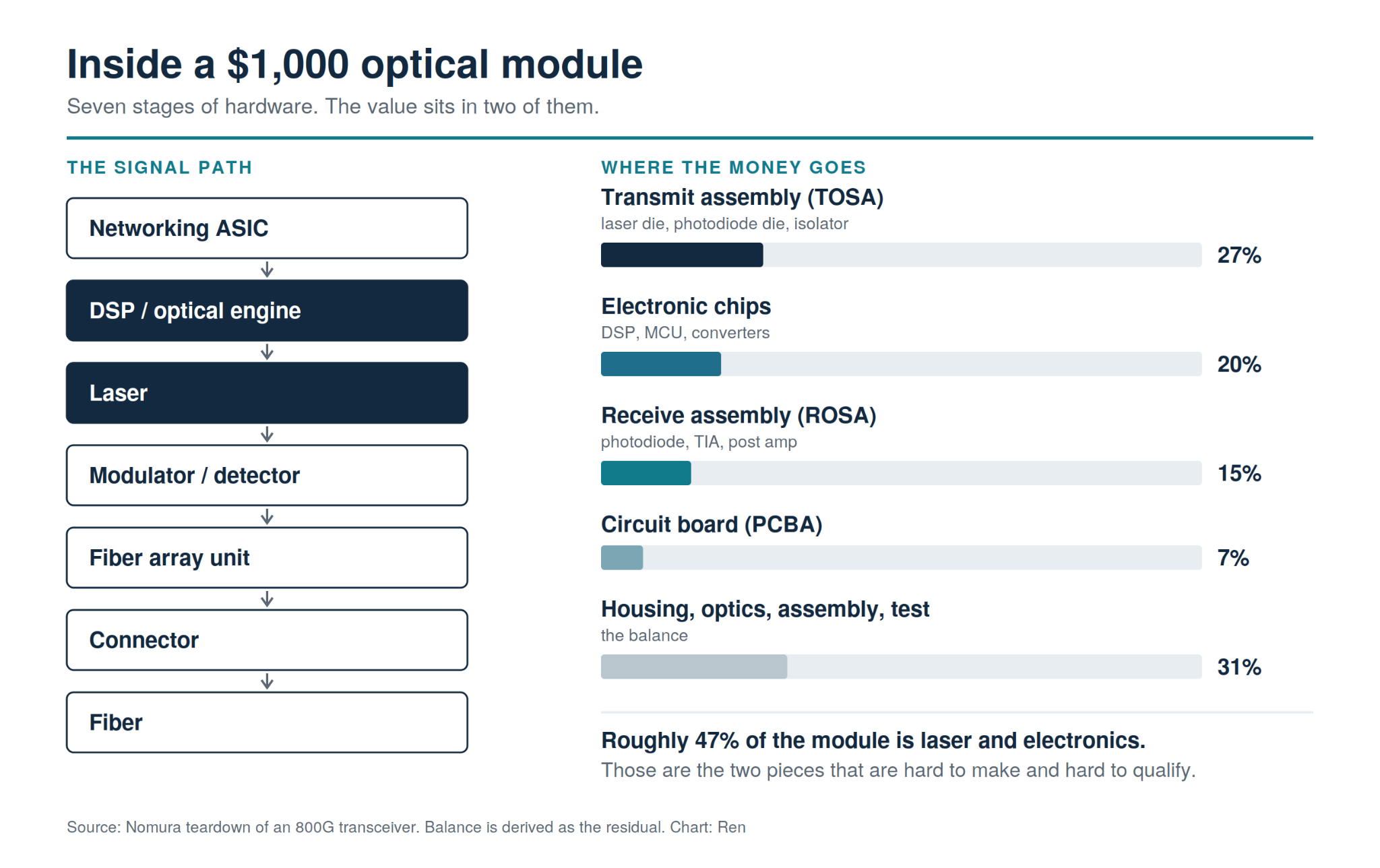
On Nomura’s teardown of an 800G transceiver, the transmit sub-assembly holding the laser die, photodiode die, isolator and receptacle is roughly 27% of the module, the electronic chips around 20%, the receive sub-assembly about 15%, and the circuit board about 7%. The remaining third is housing, optics, assembly and test.
So close to half the value sits in the laser and the electronics, which happen to be the two pieces that are hard to make and hard to qualify. The rest is putting parts together.
Keep that in mind when you read market share tables. Share of modules shipped and share of value captured are not the same number, and the gap between them is the whole reason components trade at a premium to modules.
Three of the drivers are arithmetic. The fourth is the one that changes the size of the prize.
More accelerators. Traffic grows faster than headcount. Double the GPUs and you more than double the conversation between them.
Faster accelerators. A faster chip is a hungrier chip. Keeping it fed takes more bandwidth per socket, not the same bandwidth spread thinner.
Bigger domains. Clusters measured in thousands are becoming domains measured in hundreds of thousands, and every expansion adds ports.
Optics moving closer to the compute. Optics used to sit at the edge of the data center. Then it moved into the rack. Now it is heading for the package. Every step along that path attaches more optical content to each individual GPU, and that is the difference between interconnect being a line in the networking budget and interconnect being part of what a GPU costs.
The expert BofA hosted in April put 2026 demand at 50 to 60 million 800G units and 30 million 1.6T units, with the industry able to supply only 70 to 80% and 50 to 60% of that. That is one specialist’s estimate, not a number any hyperscaler has confirmed, and unit forecasts in this industry have been wrong before. But a shortfall of that shape is the single claim I most want confirmed or killed over the next two earnings seasons, because it decides whether pricing holds or whether 2027 turns into a discount war.
Six fights are running at the same time. None of them is settled, and each one moves money between the names in section 10.
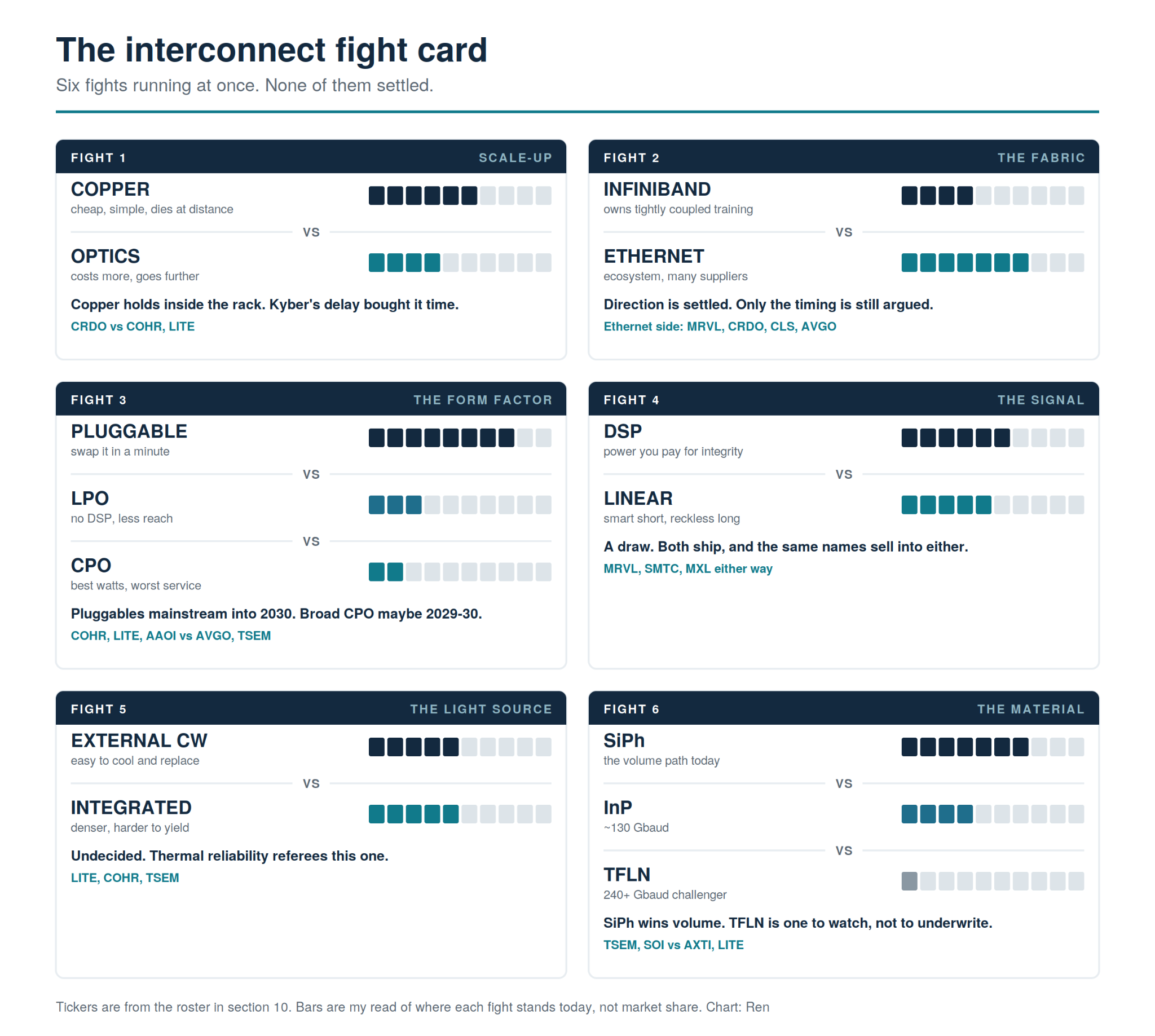
The form factor fight is the one people misprice. Pluggables are field-serviceable and boring, which in a data center is a compliment, because when one dies a technician swaps it in a minute. Linear pluggable optics rips out the DSP to save power and cost, and pays for it in reach. Co-packaged optics moves the optics onto the switch package for the best power per bit and the worst serviceability, since one failure now means touching the switch itself. The expert view is that pluggables stay mainstream into 2030, and Barclays argued in July that broad CPO adoption may take until 2029 or 2030. If you are paying up for the CPO story alone, you are early by years.
The light source fight is a packaging fight in disguise. External continuous-wave lasers are easier to cool and easier to replace, and they add parts. Integrated is denser and harder to yield. Neither wins on optics. Thermal reliability decides it, which means the winner gets picked by packaging engineers rather than by laser designers.
The materials fight has a challenger worth naming. Thin-film lithium niobate supports bandwidths above 100 GHz and single-channel modulation above 240 Gbaud, against roughly 60 to 90 Gbaud for silicon and about 130 Gbaud for indium phosphide, which makes it a candidate for 1.6T and 3.2T. Silicon photonics still owns the volume, at roughly 50% penetration for 800G and 60% for 1.6T in 2026. Watch TFLN. Do not underwrite it yet.
Comments
Nothing yet. Say the first thing.
Sign in to join the conversation.