
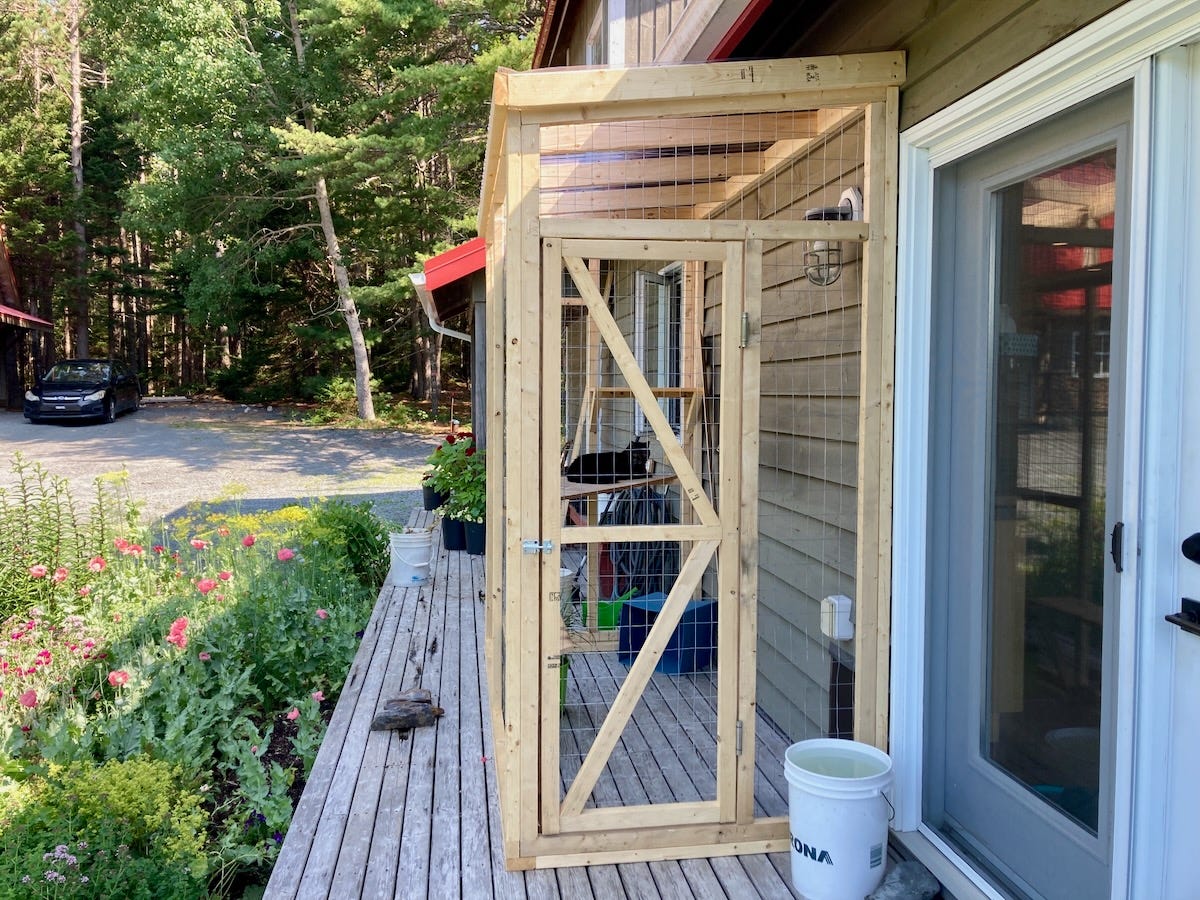
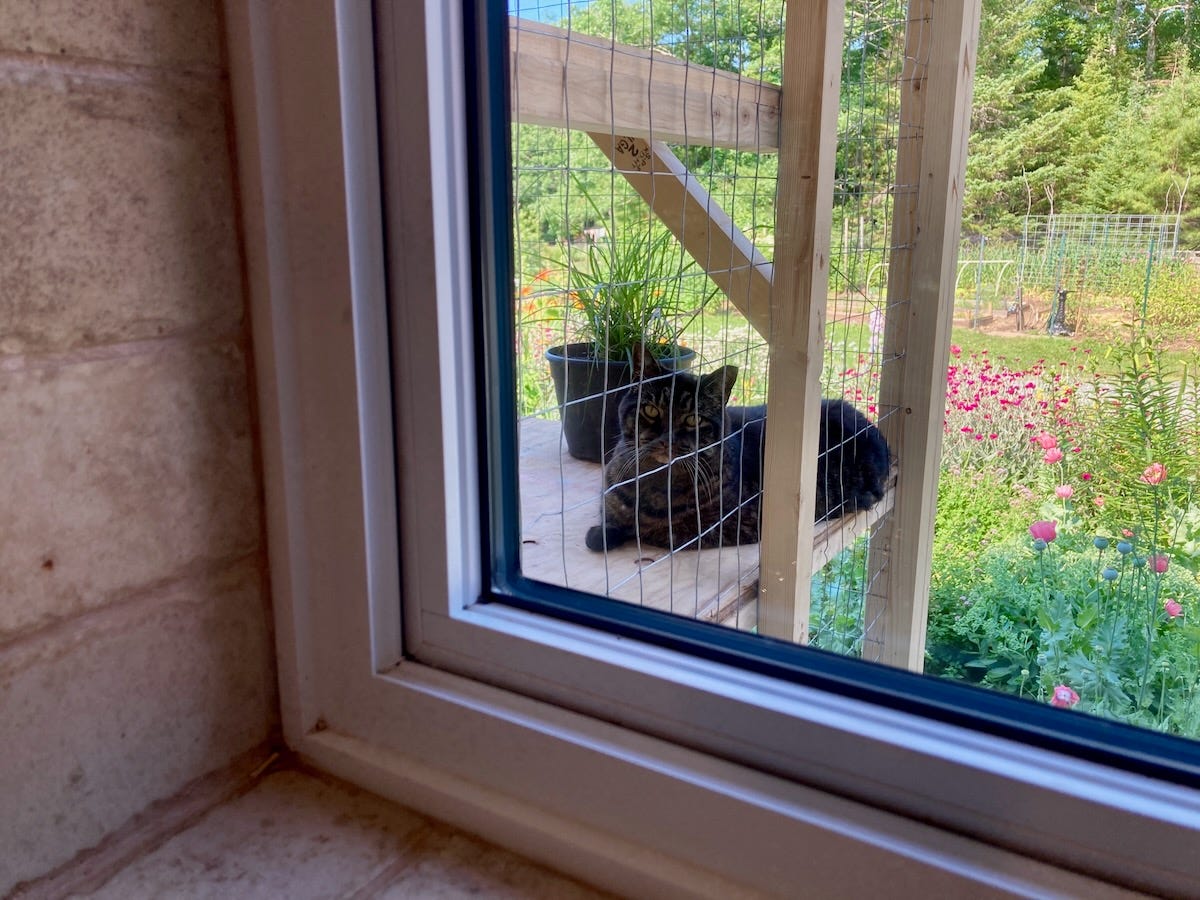
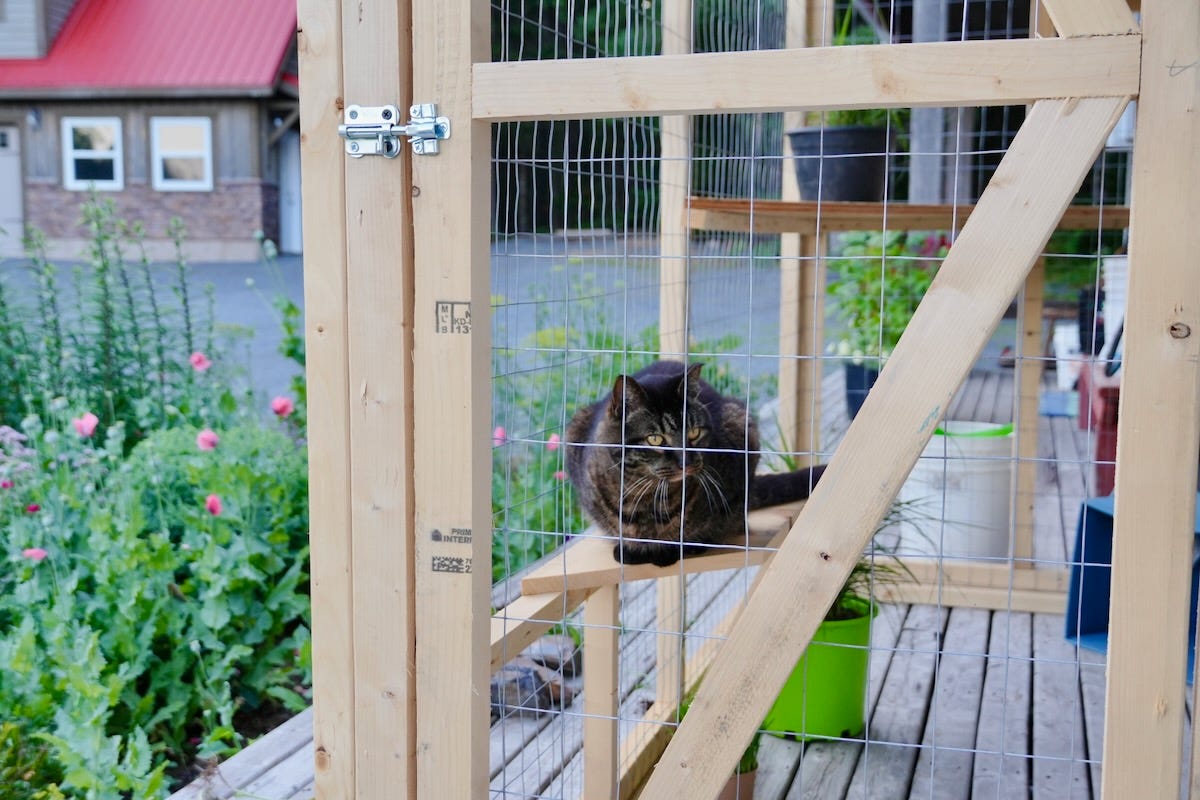
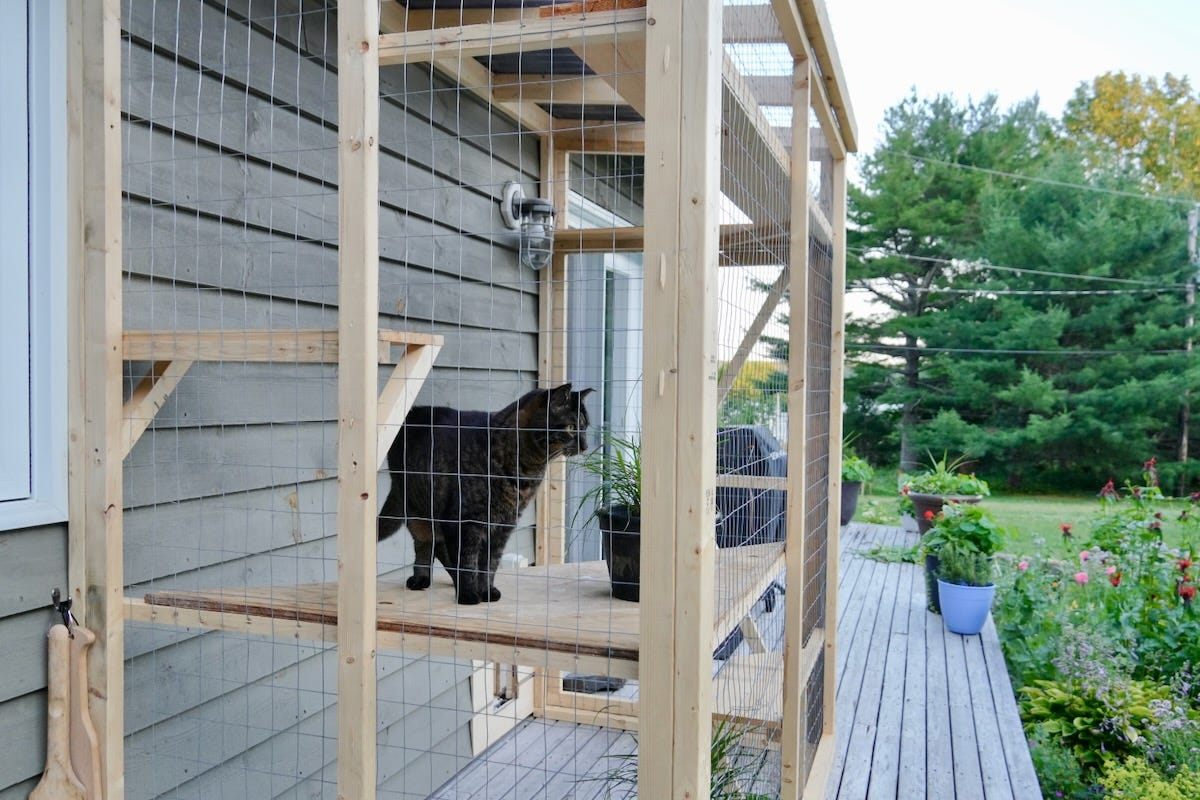
The weekend after our return from Montreal Dad and Damien built this catio.
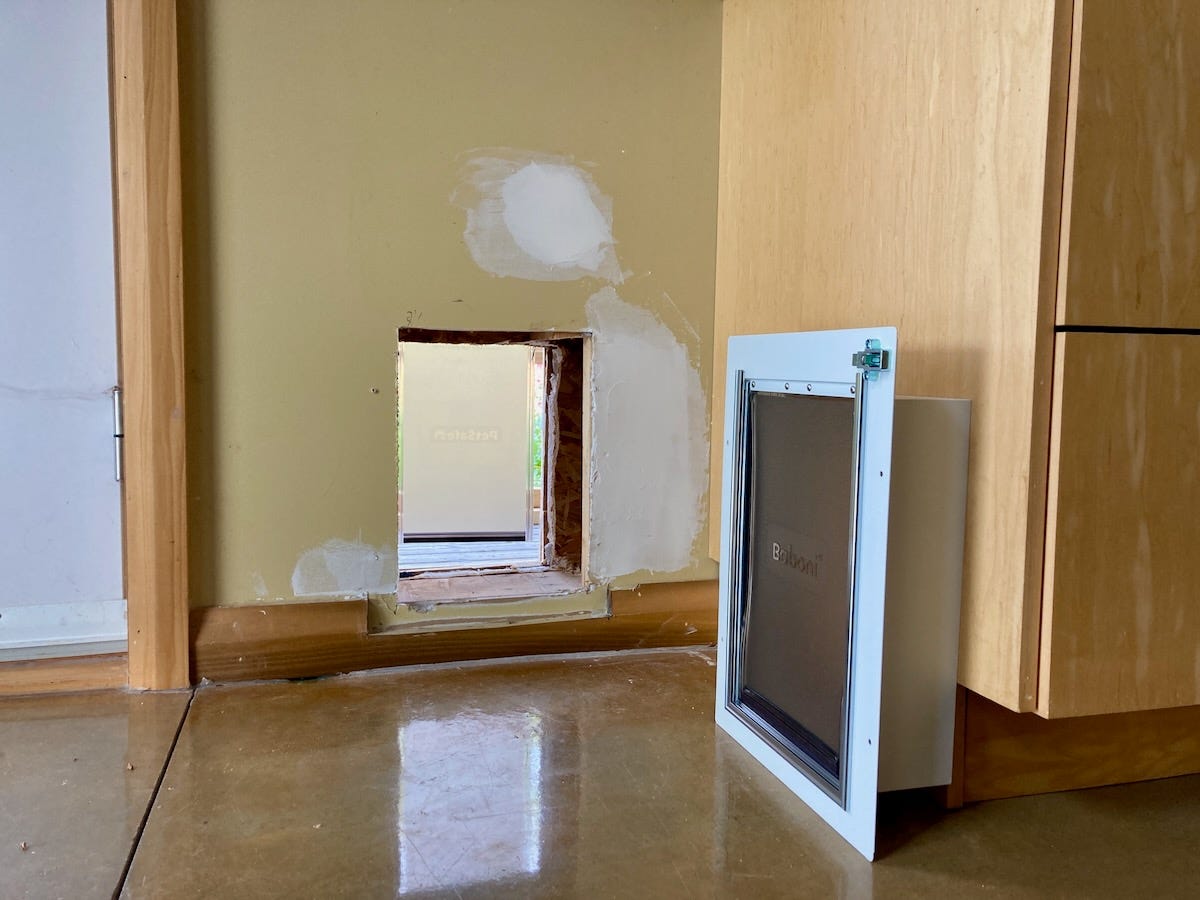
We’re at the last step now of installing the cat door into the kitchen wall.
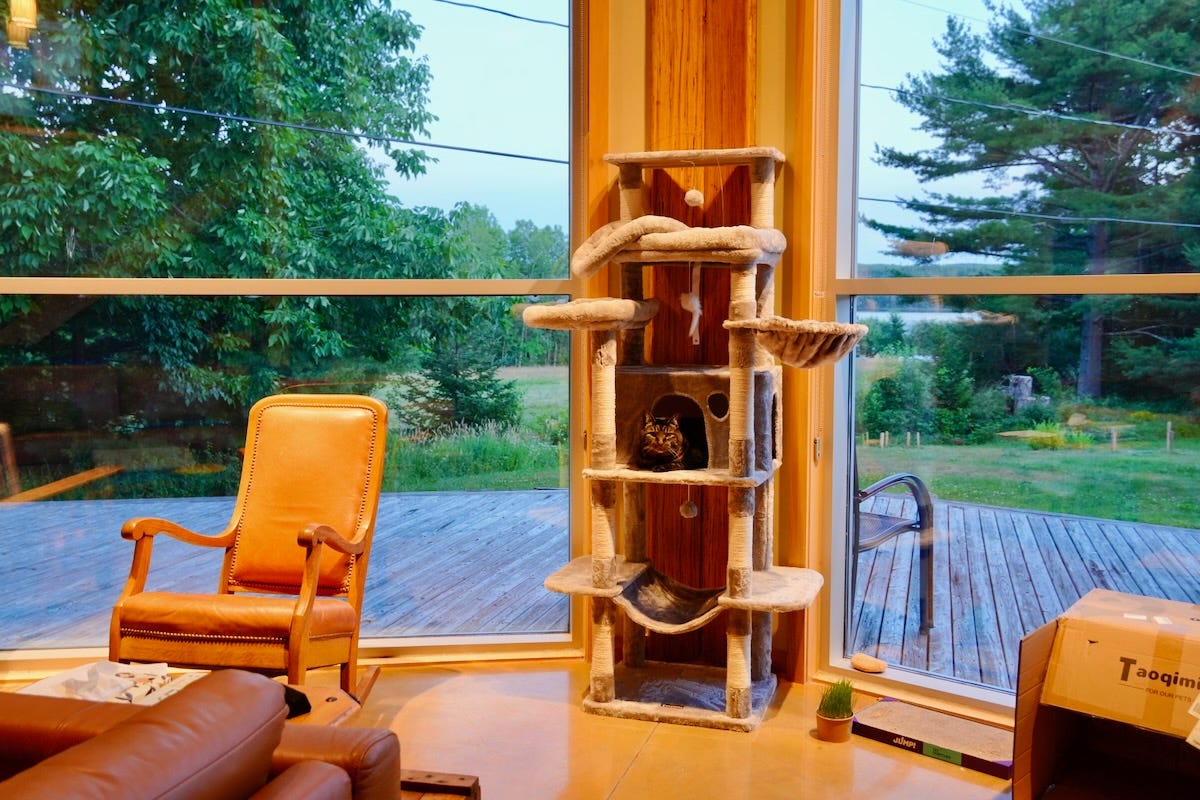
I added Fountain Grass (safe for cats) from the nursery and small pots of cat grass, sold in little takeout containers at the pet store. Pippin loves the former, regularly gnawing on it, and has completely ignored the latter. Duly noted: fancy pet store cat grass is a no.
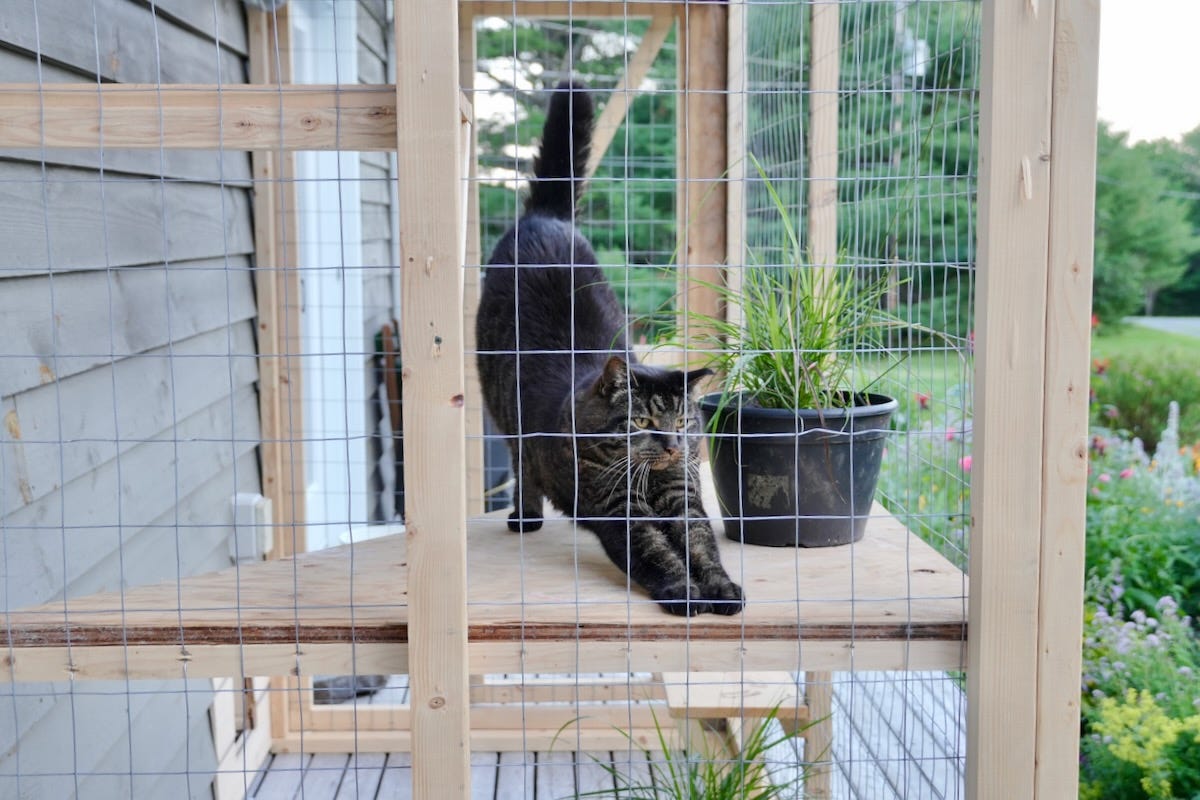
In August, sometime after we get back from our trip to Alberta, we’ll put some outdoor carpet on the triangular corner shelf and I’ll be painting all the wood white to match the house trim.
This cage enclosed outdoor space is one of the things we’re doing to make Pippin’s transition to being an indoor-only cat (from his years as an indoor and outdoor cat) more tenable.
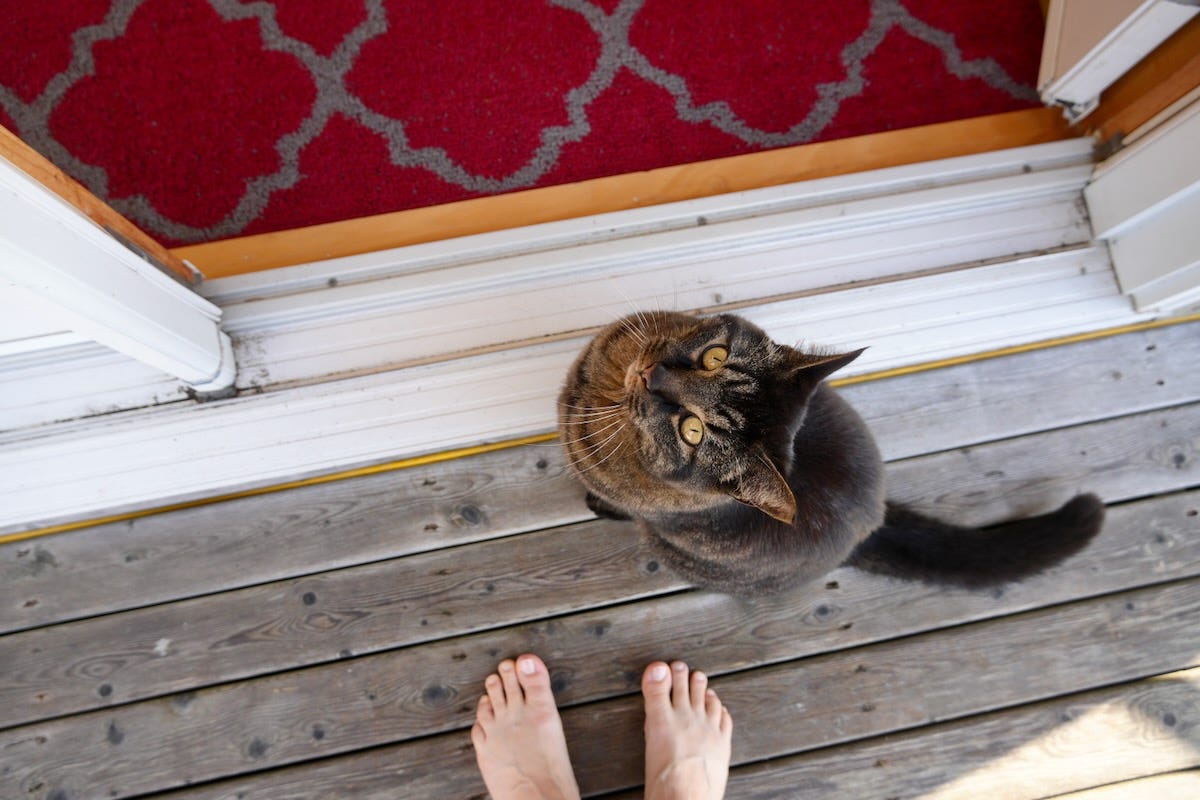
Pippin’s age has been slowing him down (or maybe it’s his underlying FIV that’s been slowing him down), even before this recent illness. So even though he’s grown accustomed to years of outdoor free reign, and is therefore presumably going through an acute sense of loss, he might accept the catio as a sufficient-enough space. Ie: It may be perceived as less limiting than it would have if Pippin had to make this transition in the prime of his life.
One can hope.
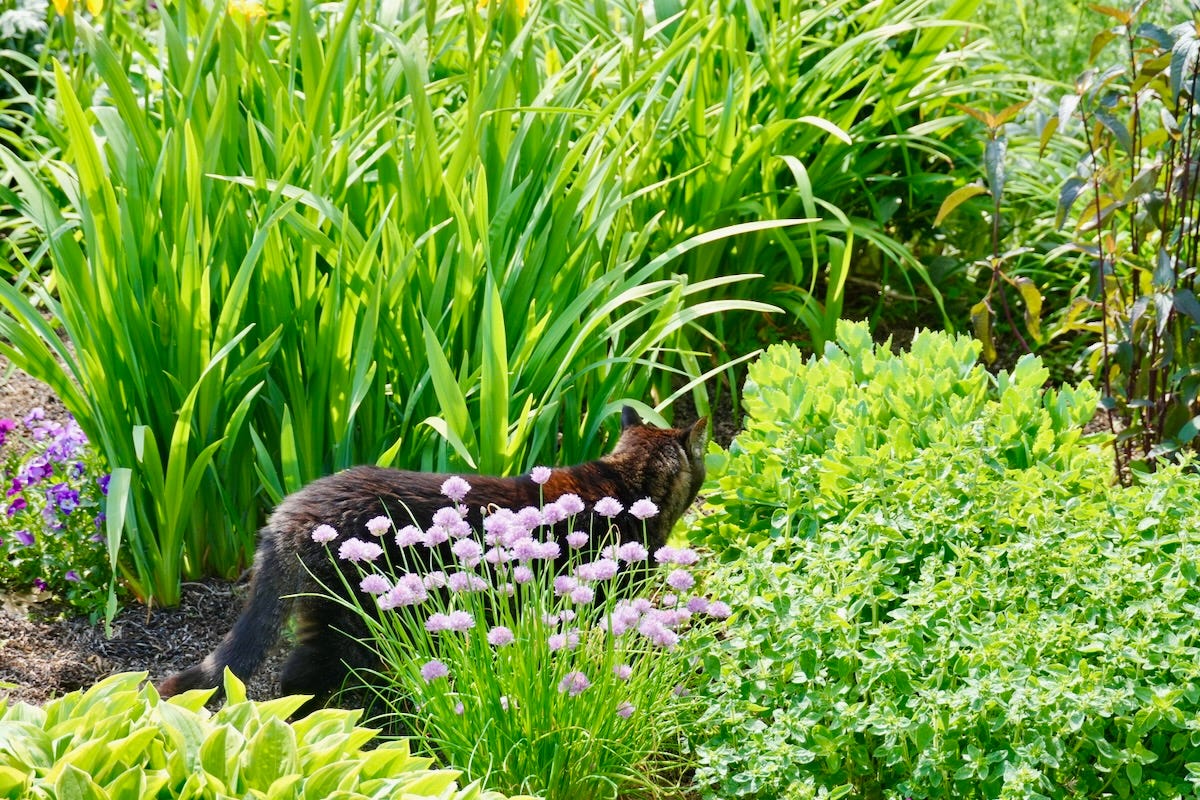
Pippin has always loved being outside and when we moved to Nova Scotia two summers ago he adapted very well to country life, roaming the neighbour’s field in front of our property like a lion on the savanna.
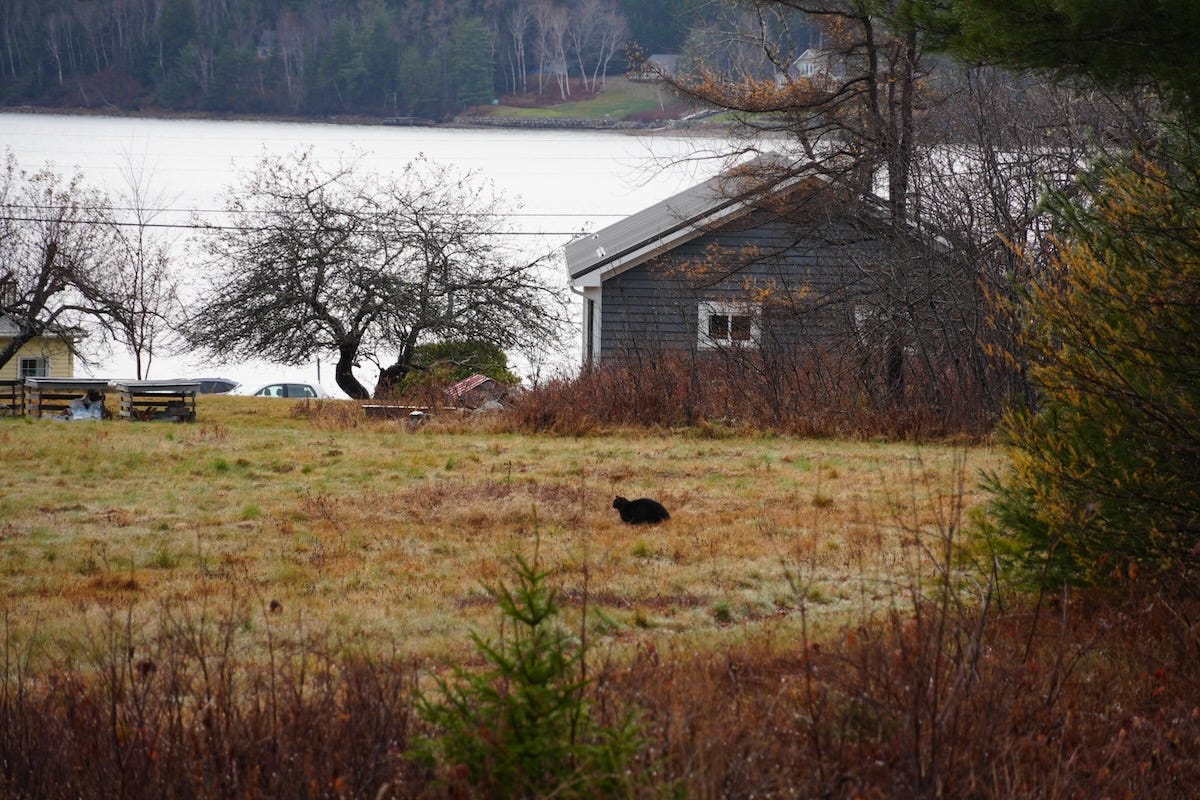
With the binoculars I’d watch him hunt prey, a David Attenborough-like voiceover narrating his pursuits in my mind.
In the hush of the autumn field, Felis catus moves with stealth precision, slowing closing the distance to its unsuspecting prey. Its muscles taut beneath its sleek black and grey striped fur, back arched and tail twitching, with a sudden burst of silent energy, it pounces - swift, exact, and lethal.
Within moments, the hunt is over, a stark and bloody reminder of the modern domestic cat’s primal instincts.
I recorded this scene in the opening 15 second sequence of one of my YouTube videos. Don’t worry, no blood is shown.
Part of me feels bad “caging” him, after a lifetime of outdoor freedom. But another part of me is also grateful he’s no longer a threat to the birds.
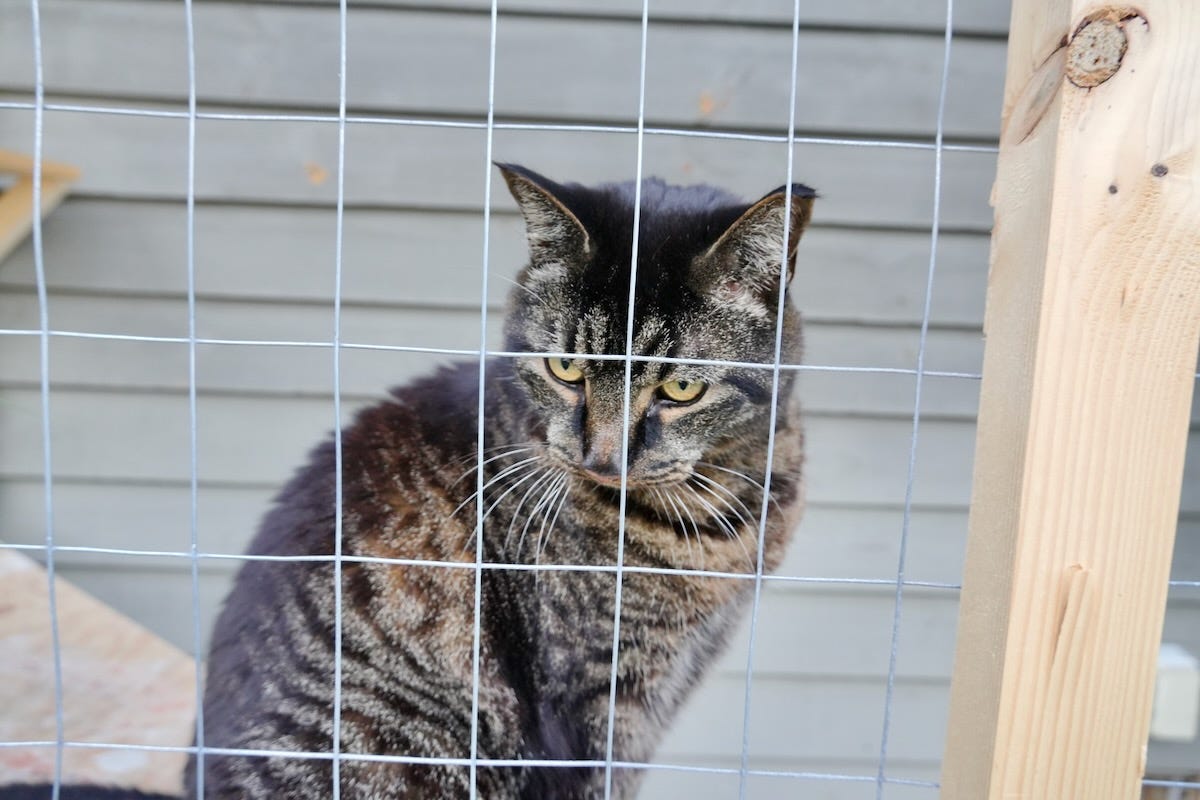
I find it interesting how I don’t mind Pippin being a threat to mice and squirrels but I am bothered by his bird killing nature. (I was also saddened when he’d kill little voles.)
Prior to us moving into this house, which my parent’s used to own, Dad had to rodent-proof parts of the siding where little animals were doing damage. Mice and maybe squirrels (or was it squirrels and maybe mice?) would get up under the siding and find their way to the attic space where they would make nests.
In children’s books this is cozy and cute. In real life it’s a nuisance and hazard.
With our arrival, Pippin was on patrol. And rodents, including groundhogs and porcupines, have not been a problem around the house or garden.
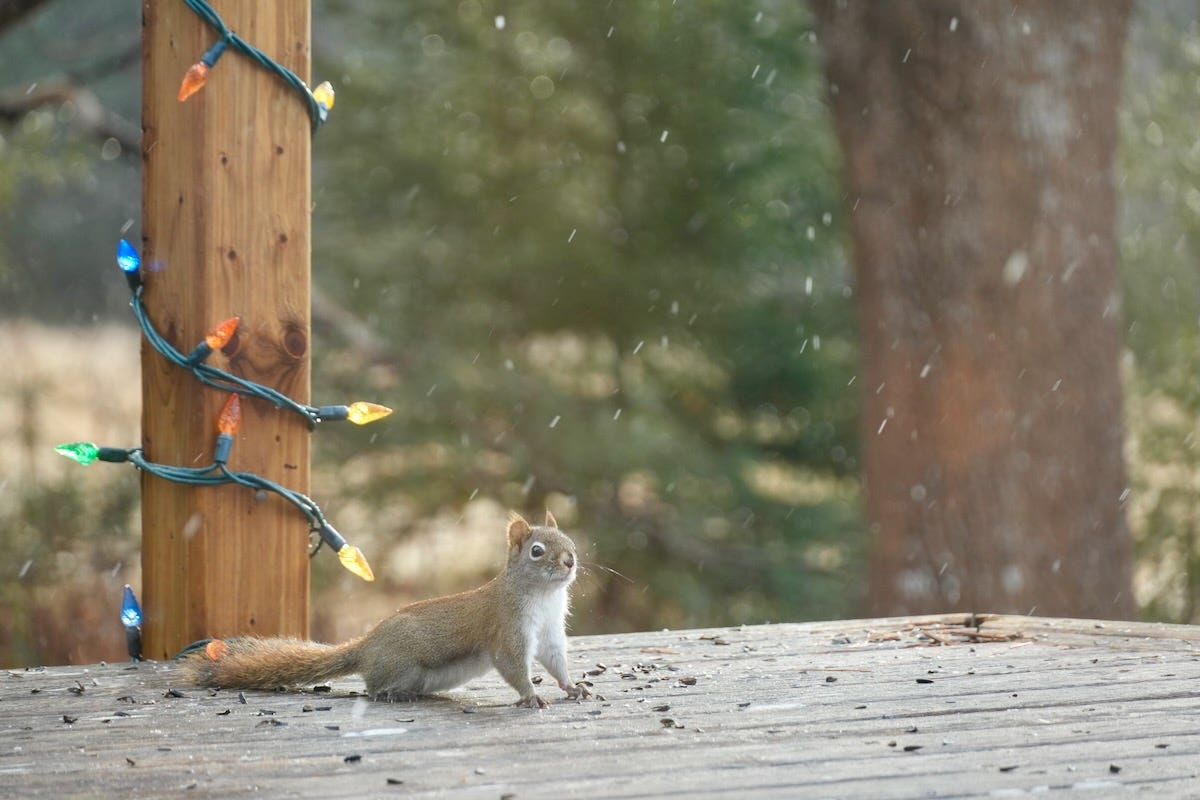
In this way, Pippin fulfilled the role of a barn cat or guard animal.
But he is also a beloved family pet that is doted on, fed high quality manufactured pet food, taken to the vet, etc…
Barn cats have a different purpose, and I imagine different human attachments and bonds than household cats do. And the inherent contradictions between these two different modes of cat life just couldn’t be sustained given his Feline Immunodeficiency Virus (FIV) diagnosis.
I talked a bit about his FIV diagnosis in my last post, mentioning that his compromised immune system makes him more susceptible to disease. But what I didn’t explicitly state is that it’s possible he’s at the feline acquired immune deficiency syndrome (FAIDS) stage, in which he’s very vulnerable to secondary diseases that inevitably are the cause of death with FIV.
Cats can live for years with FIV, as Pippin already has. But if he’s at the FAIDs stage getting sick can kill him. And it’s only a matter of time before a secondary disease does kill him.
This is the reason he can no longer be an outdoor cat. He could die from an infection/illness and so we have to reduce his chances of getting sick. And we’re trying try to give him the best life we can while he’s still with us.
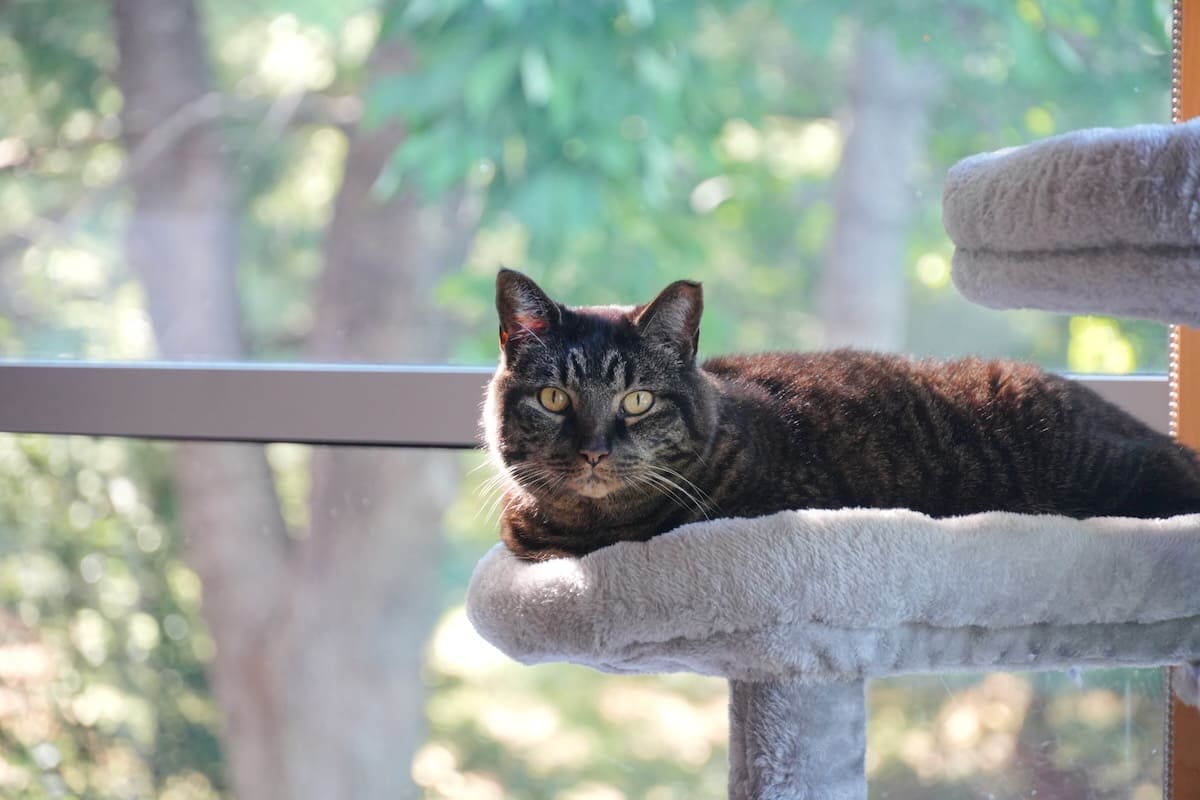
I’m sad for him that he can no longer do things he loves, like wander the field and woods. And I’m disappointed and a little vexed about how to manage the rodents now that we’ve lost our guard animal. But, bringing him indoors will be good for the birds. Ah, the contradictions and ironies of domesticated animals.
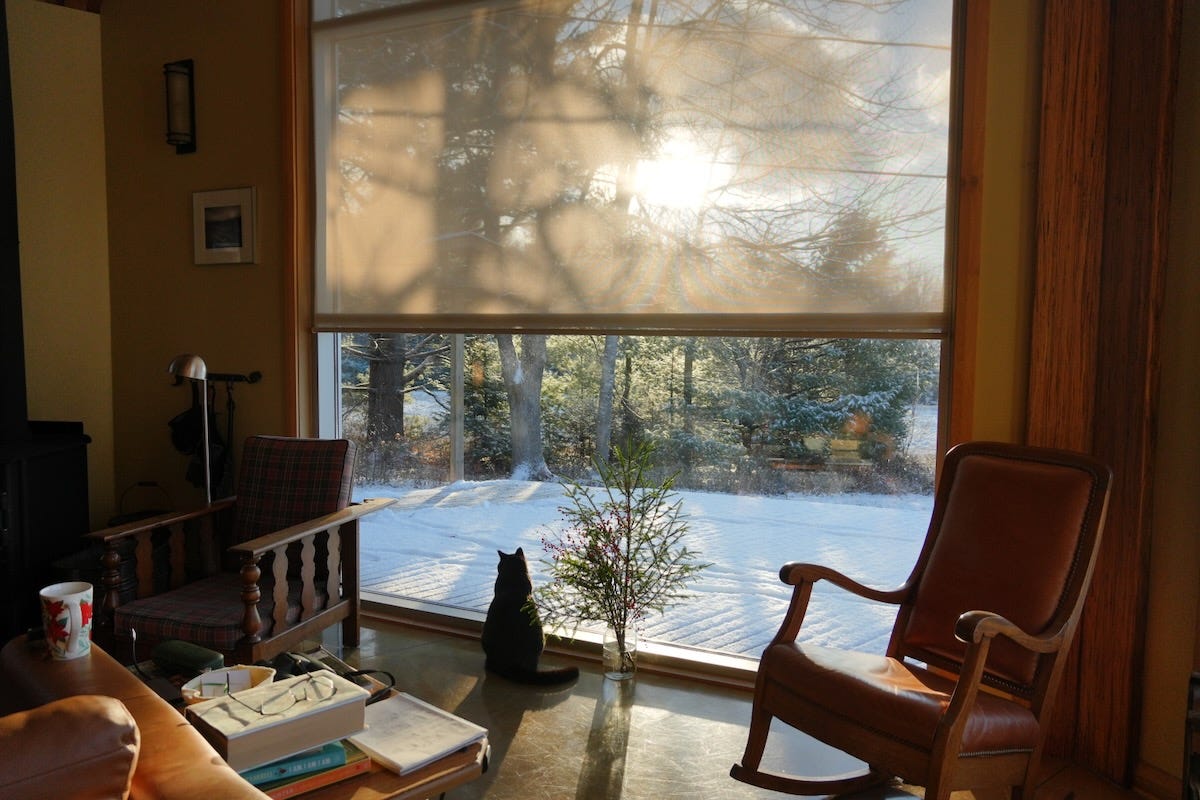
In past posts and on my IG account where I also post photos, I’ve shared pictures of the bird feeder on our deck. I don’t feed birds during summer but in the fall, winter and spring we’ve gotten so much joy from watching the activity at the feeder.
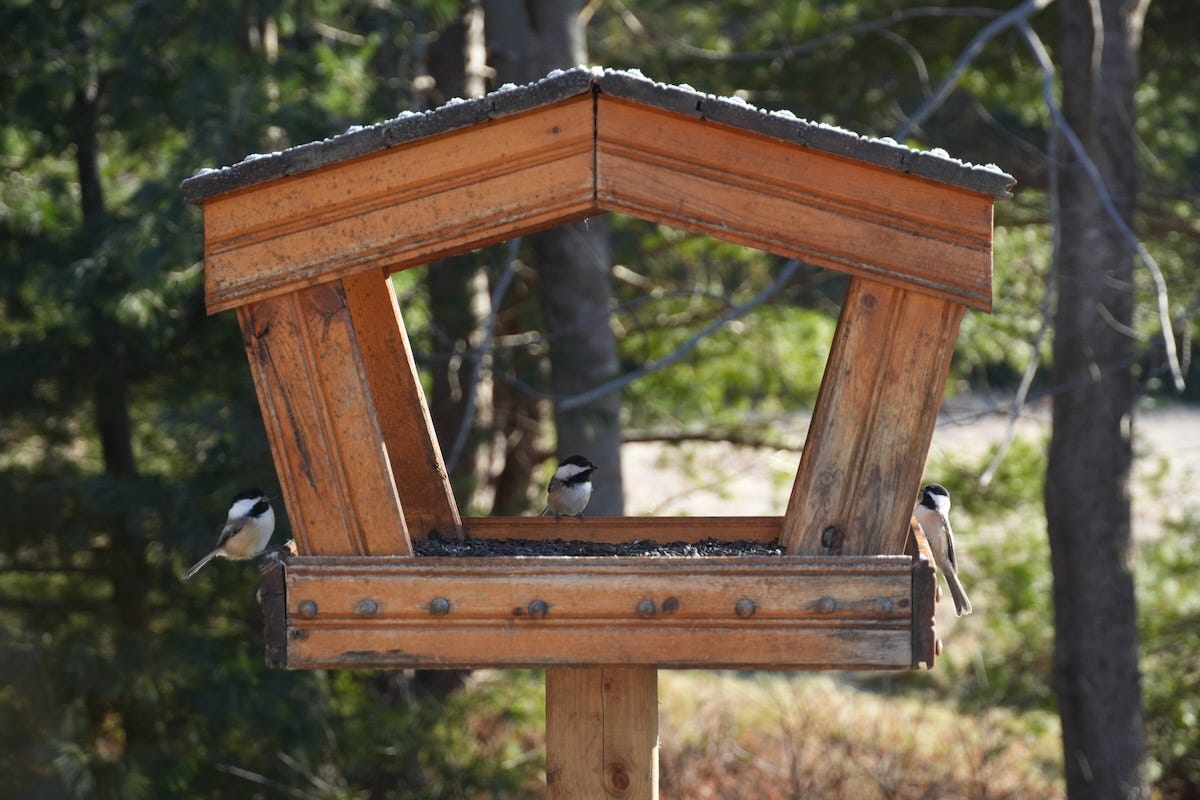
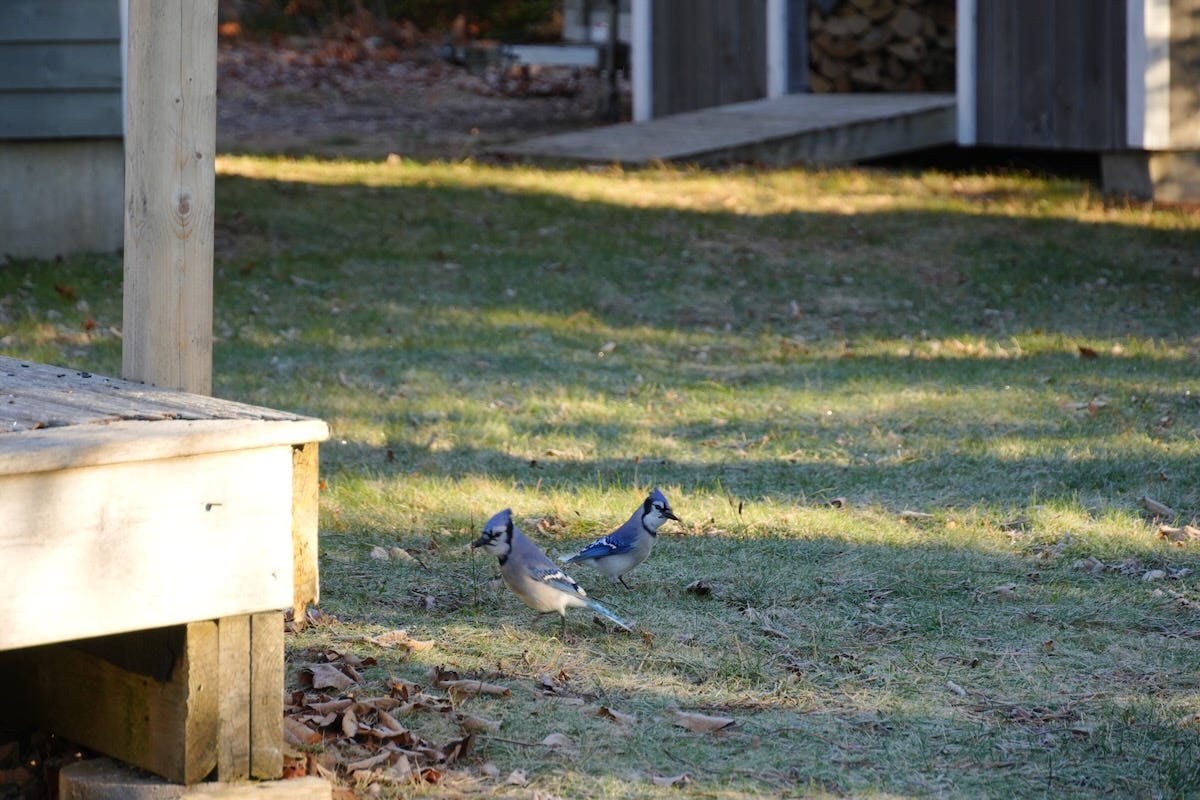
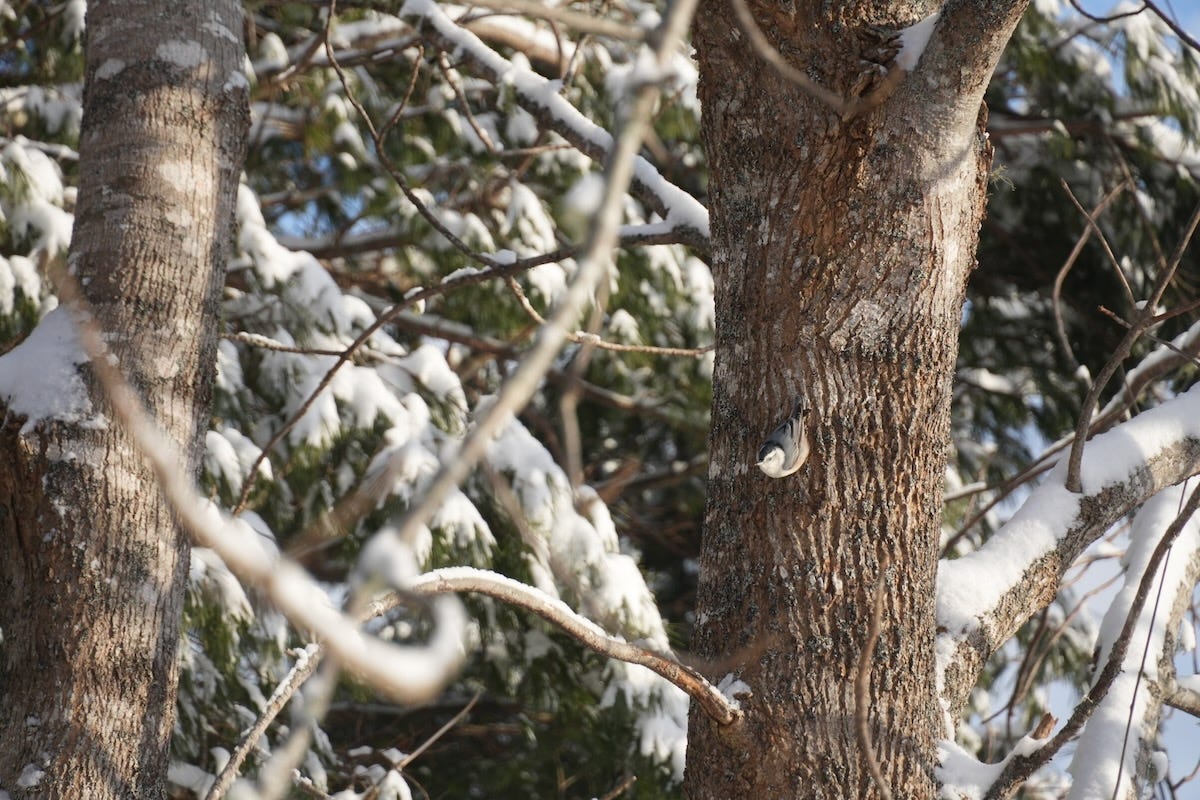
Blue Jays, Downy Woodpeckers, American Goldfinches, Sparrows, Black Capped Chickadees, Dark Eyed Juncos, European Starlings, Nuthatches, Mourning Doves, and Evening Grosbeaks - all came to the feeder.
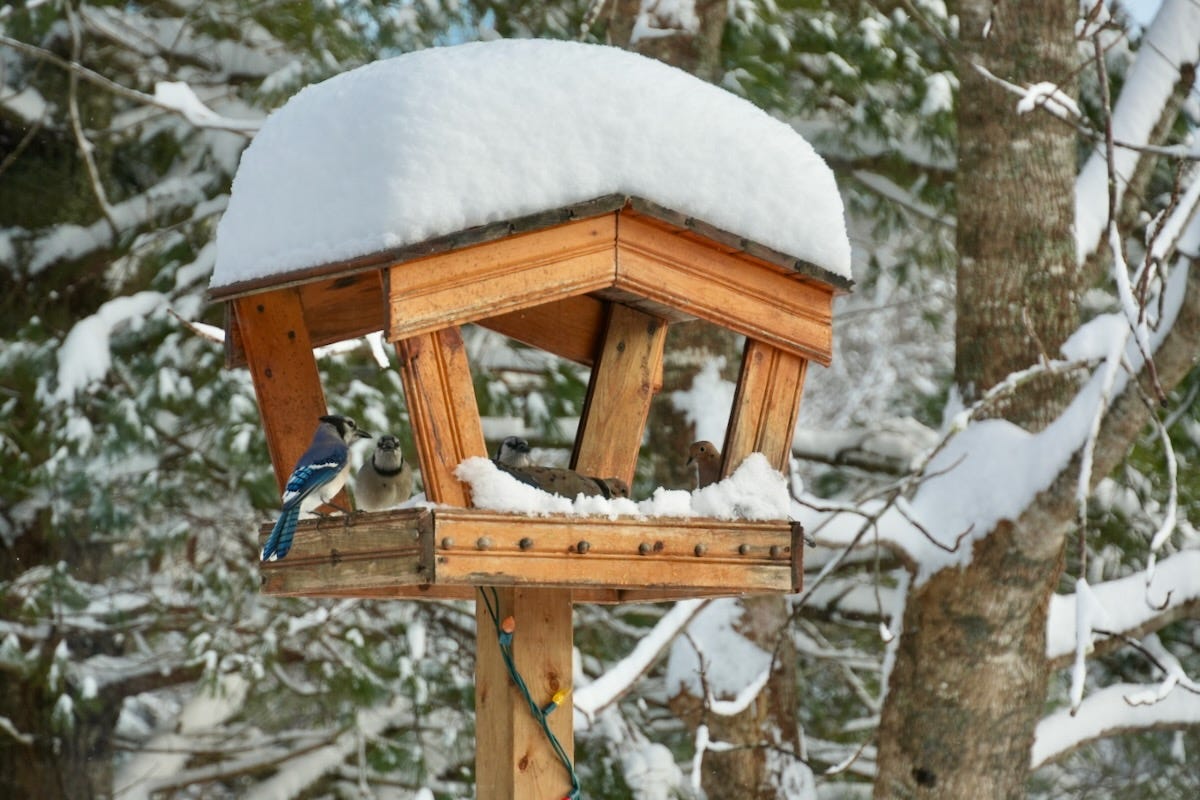
This past December and through Christmas I kept the feeder well stocked with black sunflower seeds, bringing so many birds to the yard.
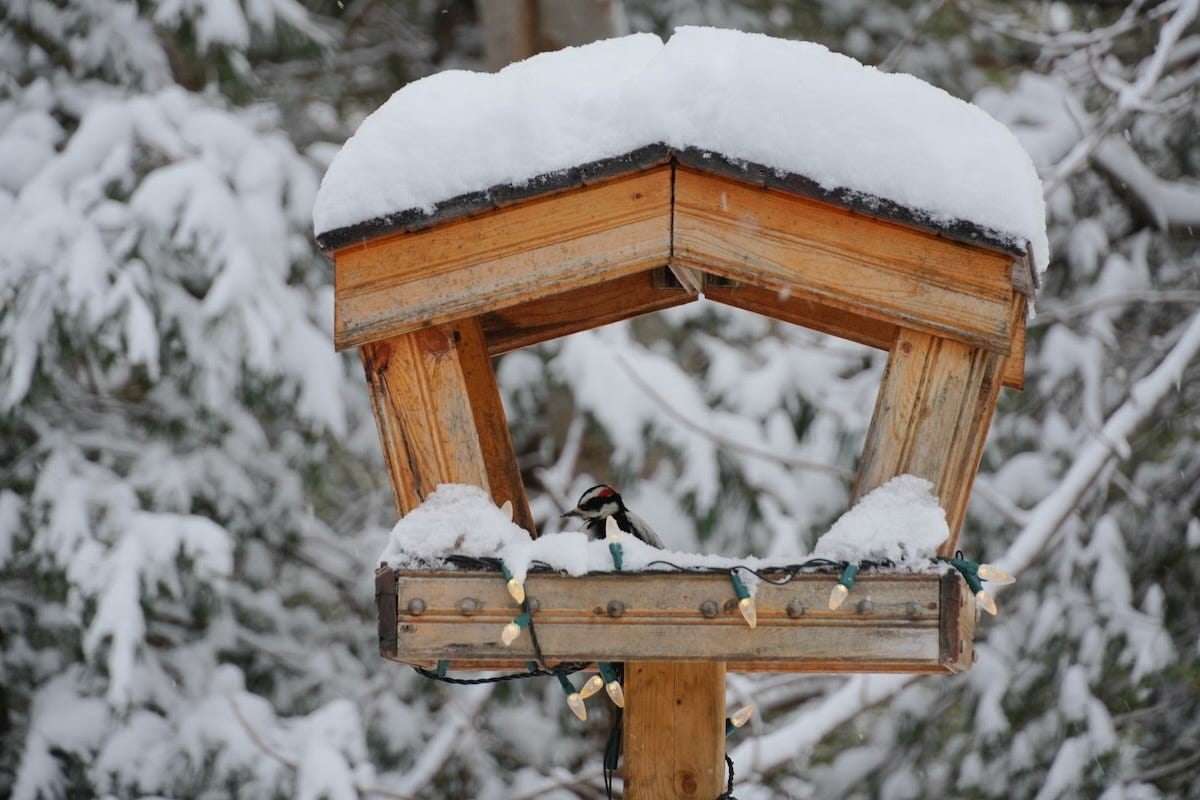
A bird watcher’s delight. But also, I had thought, a source of life for the birds. Shortly after Christmas this disillusion came crashing down.
For one thing, Pippin started catching the birds. Not from the feeder itself, but from the ground beneath, where seeds would spill.
It was an early January Sunday morning, Brie and Ian’s last day of Christmas holiday at our house, when Pippin proudly (oh so proudly) brought a Mourning Dove caught in his jaws to the double French doors off the dining room. The bird was alive.
Damien rescued the dove from the cat’s jaws while I called Hope for Wildlife. Thankfully, we were able to take the bird to one of their 24/7 wildlife rescue shelters only 30 minutes from our house. (Before your hopes get too high about this rescue, the dove later died.)
While the on-site vet technician examined the dove, I asked her questions about bird feeders. There had been a recent Avian flu outbreak and to reduce the risk of transmission I didn’t stock the feeder during that time.
I was curious how to manage feeders to reduce the spread of disease in general. She told me feeders should be cleaned regularly, every couple weeks with a diluted bleach solution, and then thoroughly dried. Birds are very sensitive creatures so it was important no cleaner residue remained. I asked what protocols might work for our fixed-in-place, wooden feeder. She replied, “get a different feeder.”
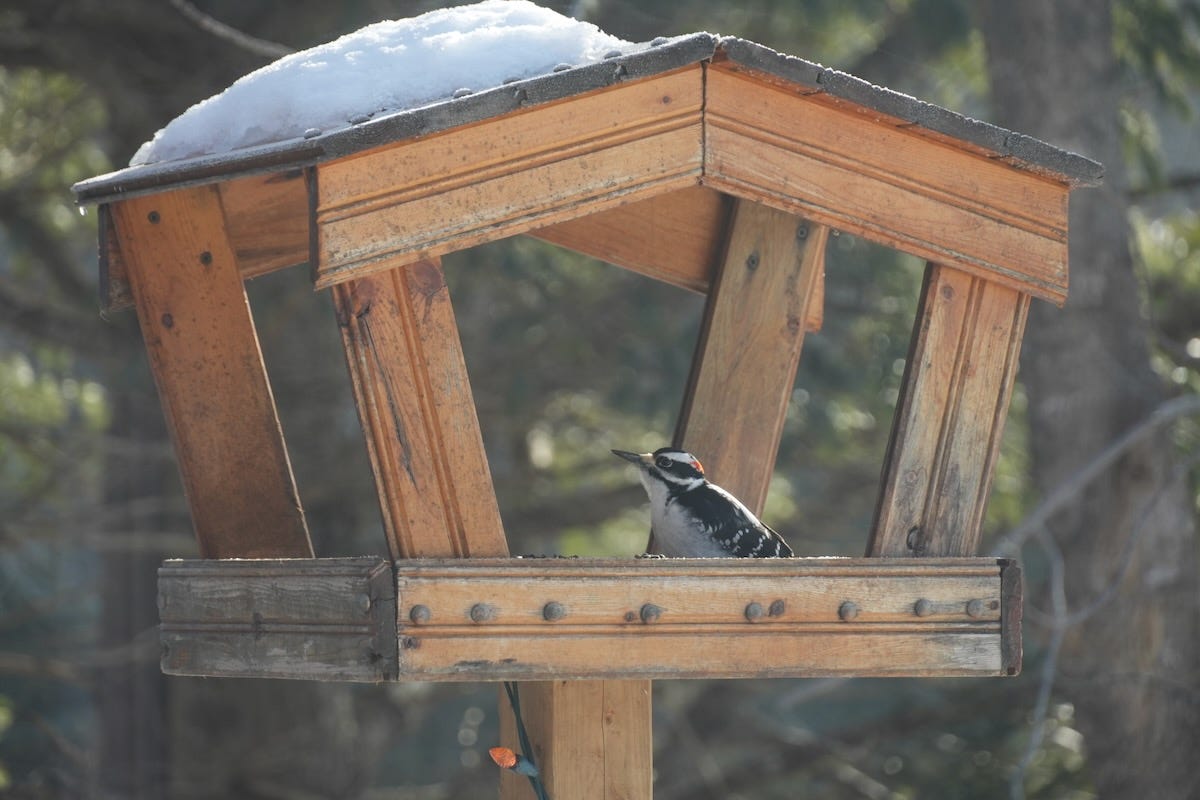
Additionally, our feeder was an especially bad design, as the large tray could collect bird droppings and allowed birds to congregate. Basically it created the perfect conditions for a big germ fest.
Everything about our bird feeder was wrong.
And then, just days later, Pippin caught another bird. This one was an American Goldfinch.
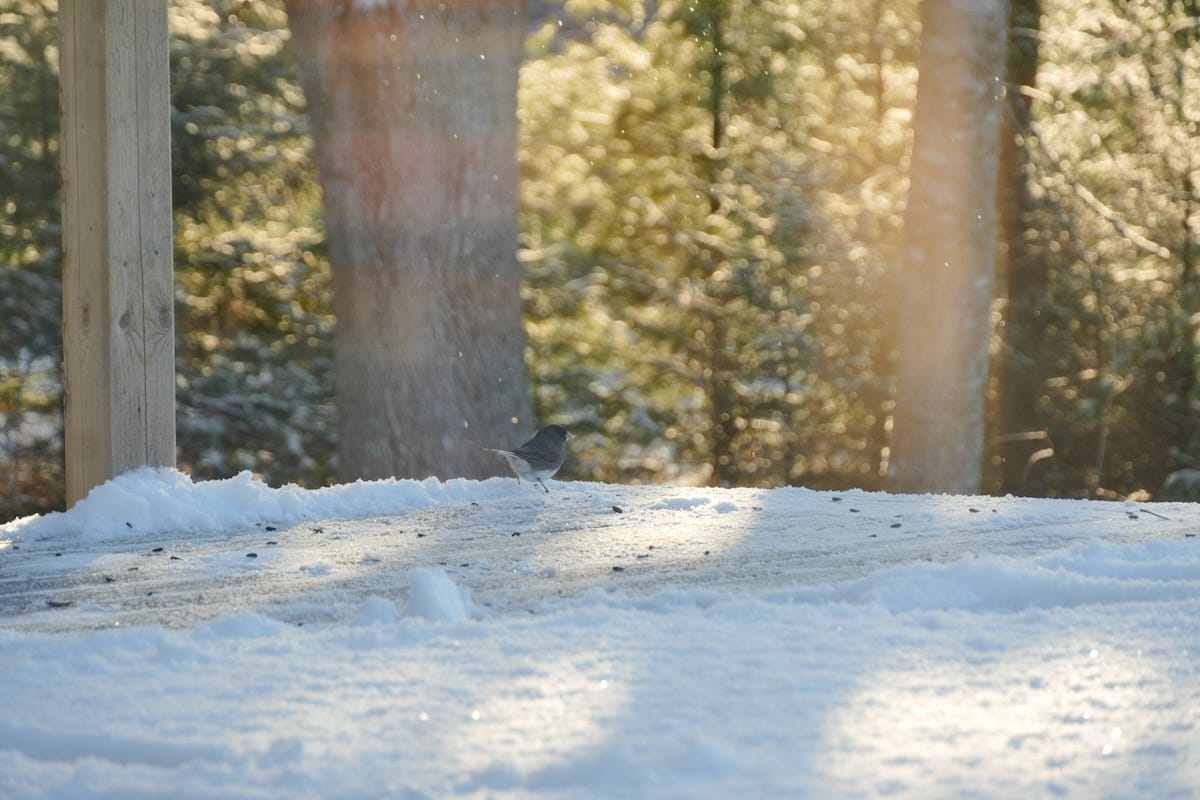
We had stopped filling the feeder after learning about the health risks it posed to the birds but there were still seeds on the ground. Unlike the dove this bird was very dead when Pippin brought it to the French doors. He proceeded to eat it, right there on the other side of the glass. And I was grateful for that at least. It always feels like such a waste of life when he kills just for the instinct of it.
And that was the end of feeding the birds. Even if we bought a different feeder that we could clean with a design less conducive to the spread of disease, we couldn’t in good conscience lure birds to the yard, ostensibly to provide nourishment to them, but putting their lives at risk with our on-site bird predator.
I was sad that we could no longer feed the birds. I was sad about the birds that Pippin had injured and killed.
Back in January I was writing about all this - the dead birds, and the bird feeder, and how human’s often make things worse, we mess things up, even if our intentions are good.
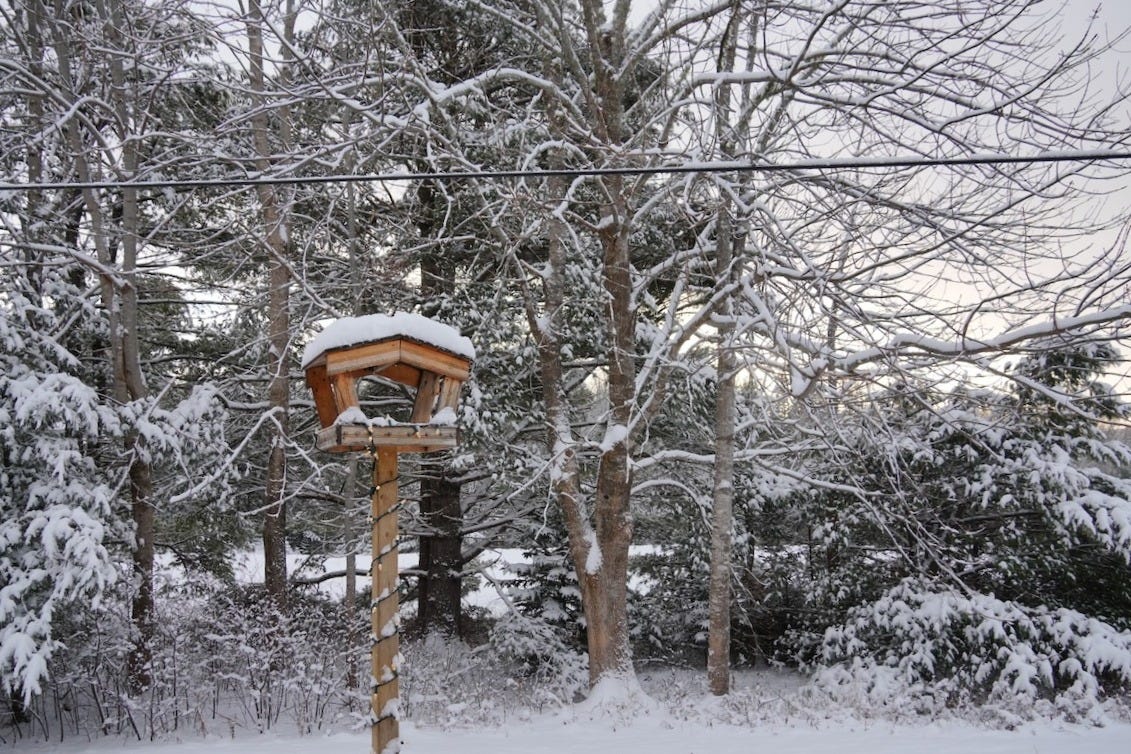
I was processing my sadness in no longer being able to watch the birds but also my shame of having delighted in something that was essentially a disease and death trap.
The writing was depressing and philosophically burdensome. It never got all the way to publication, sparing myself and you the woebegone tale and go-nowhere analysis.
Until now that writing has sat in drafts. Publishing this post, I’m ready to delete it, the tale having finally found its release.
To return to the present, now that Pippin is a caged cat (one can argue that this is a reduction in his quality of life, even as we are hoping to extend his quantity of life) we can once again feed the birds with a clean conscience. This is a small silver lining to the situation.
We will install a different feeder (or several), follow the cleaning protocols, and importantly, place them well away from the house to reduce the likelihood of birds hitting the front windows. Oh yeah, I haven’t mentioned that part yet, our house design with its wall of windows is also a bird hazard.
With Pippin now indoors, presumably fewer birds will die, which is a good thing. Also true, more rodents will live, which, in the uneasy calculus of human-animal ethics, we think is a bad thing.
Thanks to my Dad’s work the house is proofed against the small rodents, but our gardens and plants are not proofed against the larger ones, like porcupines. Something (not deer) got into the raspberries earlier this month and broke a bunch of canes, which is frustrating.
There are wins and losses in mitigating Pippin’s health risks. We’ll take the win of his recovery and a successful and speedy catio build. (Thanks Dad and Damien!).
We’ll solve for the rodents another day.
No posts
Comments
Nothing yet. Say the first thing.
Sign in to join the conversation.