
Dear friends,
around midsummer, the year stands open in a particular way. The days are long, the nights are brief, and yet the deepest things often do not show themselves in full daylight. They appear at the edge of things. In dusk, in moisture, in the half-hidden places where the eye has to become patient again.
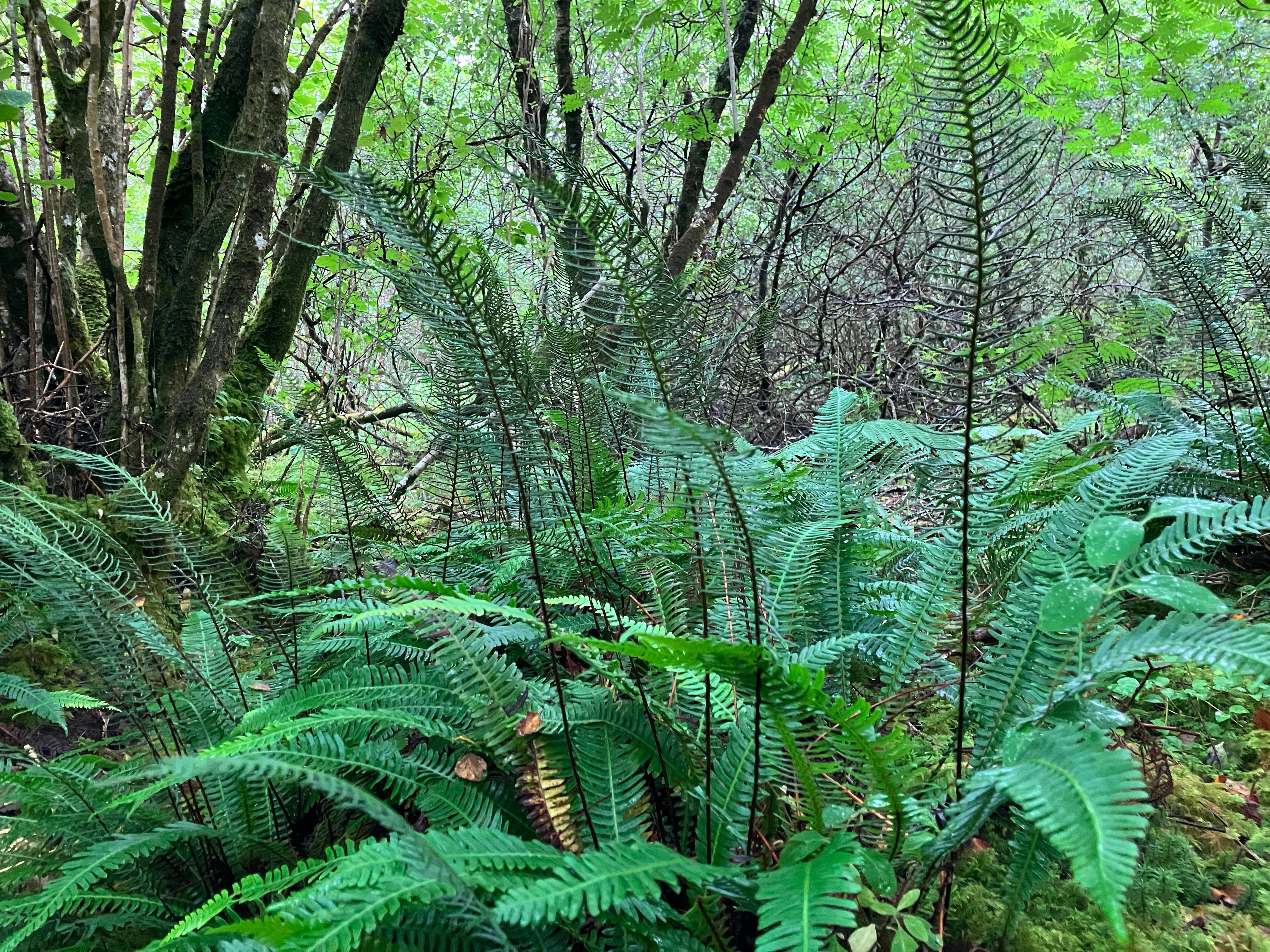
On the west coast of Scotland there is a forest that does not look like a forest from a fairy tale, and for that very reason it is enchanted. No high cathedral of mighty trunks, no romantic clearing, no dense green abundance. Rather, it is a breathing chamber of mist: oaks, gnarled and bent by the Atlantic wind; trunks disappearing beneath mosses; lichens hanging like beards from the branches; ferns growing not only on the ground but epiphytically from bark, forks of branches, and crumbling walls; rain that does not fall, but is already everywhere — dripping, shining, rising, sinking back again.
This temperate rainforest once covered large parts of the western British Isles. Today it is a relic. A remnant, isolated in small islands of habitat where it still survives. A living fringe along the edges of the Atlantic.
And at the same time, it is a habitat that has recently begun to receive attention again. People are starting to look more closely. They map, count species, report findings through apps, enter with lists, cameras, and identification keys into a space that for a long time was regarded as merely wet, dark, and difficult to access.
And then something beautiful happens: what has been overlooked begins to answer.
In West Cowal, recent surveys have documented more than a thousand species: lichens, fungi, slime moulds, mosses, insects — and among them, rare glow-worms. Suddenly, within this damp green, a point of light appears. No grand sign. No spectacle. Only a small phosphorescent light in the half-dark.
Yet precisely this small light brings into focus what this whole habitat is: hidden, alive, dusky, not immediately available.
The glow-worm is not a worm, but a beetle. Its light is not a decorative effect, but an expression of life. It belongs to searching, to mating, to silent communication in the night. It needs darkness, moisture, patience. It does not appear to the hurried glance. It does not appear where everything is illuminated, searched through, and made available.
Whoever wants to see it must become slower.
Perhaps that is where its real significance lies.
Of course, it is good that this habitat is now being researched. It is good that scientists, local communities, volunteers, and conservation groups are turning their attention to this forest. It is good that data is being gathered, species recorded, and threatened habitats made visible. In a time of disappearance, such work is necessary. One can hardly protect what one does not know.
And yet within this necessity there is also a symptom of our age.
We often approach nature with the gesture of taking hold. We want to understand, grasp, control, classify. Even protection can carry this tendency within it: only once something has been identified, counted, and mapped does it count as real. Only once it appears in data does it become politically effective.
The rainforest itself speaks differently.
It is not a clearly bounded object. It is transition, moisture, veil, interpenetration. Green within green. Lichens on bark, ferns on branches, violet fungal ears on hazel, water-air. Here nothing is entirely isolated. Everything lives through everything else.
Biodiversity here is not merely a number, but an experience. One stands inside an abundance that does not reveal itself all at once. One has to wait until the gaze adjusts.
The glow-worm then becomes more than a remarkable find. It becomes an image for another kind of seeing.
Not grasping, but participation.
Not control, but the capacity to be touched.
Not the quick scanning of a habitat, but the quiet dwelling within its mood.
What begins to glow when we see more slowly?
Perhaps at first only a point in the grass. A faint dawning between moss, droplets, and half-light. But at this point, the observer also changes.
We begin to notice that perception is not the collecting of impressions. Perception is an entering into relationship.
The world does not become alive because we map it. It is alive already. But our way of perceiving can either deaden or free what we meet. A gaze that only grasps, measures, and secures can miss the very life it wants to protect. A gaze that wonders, waits, and allows things to remain themselves can become life-serving in a deeper way.
In wonder, we become present enough again to experience the aliveness of the world.
The Scottish rainforest, like everything wild, natural, and living, needs protection. It needs research, care, local responsibility, political attention.
But it also needs people who do not merely want to make use of it. People who linger long enough for a wet, dark forest to become a breathing habitat. Long enough for species lists to become encounters. Long enough for a small light in the grass to appear not only as a finding, but as a question addressed to us.
As an encounter, concentrated into a single point, suddenly glowing.
Perhaps this is the quiet midsummer lesson of the glow-worm:
Some realities only reveal themselves when we stop wanting to possess them immediately.
With midsummer greetings,
Renatus
No posts
Comments
Nothing yet. Say the first thing.
Sign in to join the conversation.