
This Easter, I was on Iona with a small group as part of a Sacred Isles intensive week. We had spent the days before Easter Sunday immersed in the western edge of Scotland: in weather, in landscape, in observation, in conversation, and in shared inner and outer practice. The week had brought us deeply into the qualities of the Western Isles — into the harshness and beauty of their exposed character, their abrupt changes of mood, and their peculiar way of making one feel very close to the elements.
Often it had been cold. Again and again we had lived through what one might call four seasons in one day: wind, rain, bursts of sun, then hail, then calm, then gusts again. The day before Easter had been especially wild. A storm had swept over the islands. For hours we had no electricity. The wind raged around the house through the night, and sleep came only in fragments. It was one of those Hebridean nights when one feels how little separates shelter from exposure.
And then came Easter morning.
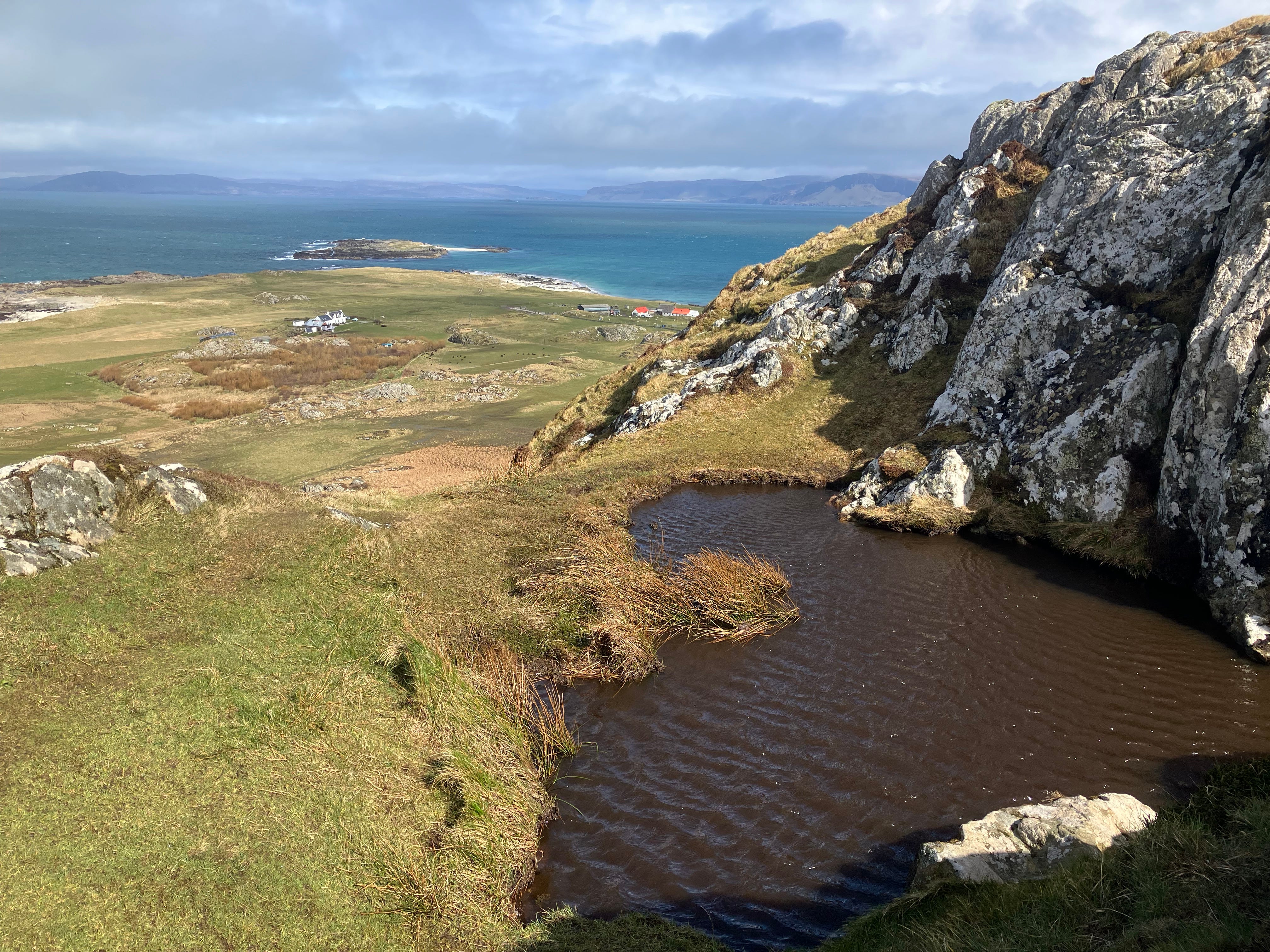
It is hard to describe how miraculous the world appeared after such a night. The storm had passed, and in its wake everything seemed washed clean. The sun rose into a bright and quiet sky. The air was clear. The sea shone. The pink granite of Mull glowed across the water. On Iona, the gneiss flashed with its silvery brightness. The Sound of Iona lay in tones of turquoise and blue — deep blue, pale blue, luminous blue — while fresh white clouds moved in finely shaped forms across the sky. The first flowers shone with that almost unbelievable brilliance of early spring. Everything was calm, lovely, and deeply pleasing to the eye.
It felt as though the whole world had become new.
That walk from the ferry towards the Abbey stayed with me, not only because of its beauty, but because it seemed to reveal something essential. It offered, almost like a gift, an image of what resurrection might mean.
What struck me was not just what I saw, but how it came towards me in perception. That distinction matters. Usually, when we perceive, we attend mainly to the object: this is a tree, this is a stone, this is the sea, this is the sky. We move quickly toward recognition, naming, concept, meaning. But one can also shift one’s attention slightly and ask a different question: not only what is being perceived, but how does perception itself arrive? What is the inner quality of what streams toward us through the senses?
Then something remarkable becomes noticeable. Every genuine sense perception is fresh. Utterly fresh. Dew-fresh, one could say. It is never stale. It is never used up. It is never lukewarm. Every perception comes with the quality of newness, of firstness, of something arriving now.
This is true even when the object itself is familiar. The tree may be the same tree. The stone may be the same stone. The place may be one we have seen a hundred times before. Yet the act of perception itself always bears the character of the present. It is always immediate, always newly given, always untouched by yesterday in its innermost quality.
On that Easter morning on Iona, this quality of freshness became almost visible as such. The washed light, the sharpened colours, the clarity of sea and stone and sky made palpable what is always there, though usually less dramatically revealed: the world comes to us through the senses in living newness.
Of course, spring speaks this language everywhere. The budding branches, the first leaves still folded and soft, the first flowers with their brilliant colours, the grasses turning vivid again — everything bears the signature of emergence. Nothing appears faded. Nothing appears exhausted. Everything seems to be pressing into life.
It is easy to see why human beings have always associated this season with resurrection. Spring itself is a yearly schooling in newness.
And yet I think there is something still more precise to be noticed. The resurrection forces are not only in the spring as an outer process of nature. They also meet us in the very way the world becomes present to us through perception. In the freshness of the given. In the fact that reality is always arriving now.
For me personally, this is one of the most immediate paths toward what I would call meeting the Christ being. Not first as a doctrine, and not first as a memory handed down from the past, but as a living presence encountered in the stream of present experience. Where perception is fully awake, where one is inwardly present to what appears, there one begins to touch something of the resurrection forces.
In many ways, this was what our whole Sacred Isles week had already been about.
We had not come together merely to look at beautiful places or to accumulate impressions. We had spent the week practising a different kind of attention. We had tried to experience nature in itself: the quality of weather, the feel of the air, the way the world appears in the Western Isles, the character of rock and sea and open distance. We had visited a stone circle. We had worked with direct perception. We had spent time on Iona, not only as a location with a history, but as a place with a distinct atmosphere and presence.
And this too belongs to the experience: Iona is not only visually beautiful. Many people sense there something more. One could call it an aura, though the word can sound vague. Yet something is there. A stillness. A peacefulness. A quality of enduring presence. Something in the air that feels like peace and love — not sentimental, but spacious, gentle, and quietly strong. There can be a feeling of being seen in a caring, understanding, loving way, while at the same time being left utterly free. Free to be whoever one truly is.
To me, this has much to do with the quality of the human “I”. Not the ego in its defensive or self-assertive form, but the deeper I that can stand in truth, in freedom, and in presence. Iona seems to carry something of that possibility.
Because Easter fell within the course, some participants very understandably wanted to go to church on Easter morning. They longed for the Easter service at the Abbey, perhaps to arrive at the feeling of Easter through the liturgy, the ritual, the communal celebration, the familiar outer form.
I understood that longing. And yet I also noticed a quiet disappointment in myself. It seemed to me that perhaps they did not yet fully trust what had already been given during the week. As though Easter still had to be found somewhere else — in a special outer event, in a recognised ritual, in a remembered form from childhood — rather than in the experiences they had already entered.
For the whole week had, in its own way, been a schooling in resurrection. In the practices, the observation exercises, the encounters with weather and landscape, in the quality of the group itself, something of the living present had already begun to show itself. The fresh, the new, the inwardly arising, the quietly radiant — all this had already been there.
It made me wonder how strongly we often remain bound to memory when approaching a festival like Easter. We may say, more or less unconsciously: this is how Easter is supposed to feel; this is how it always was; this is how I knew it as a child. And in doing so, we may overlook what is actually coming toward us now.
This, to me, is the crucial point. Resurrection cannot simply be remembered into being. It cannot be inherited second-hand. It cannot be secured by repetition alone. It has to be experienced. And this experience is not passive.
To receive it, we must become active in a very particular sense. We must open ourselves. We must enter the stream of presence. We must become inwardly available to what is being given now.
Sense perception is one of the primary doorways for this. Through perception, we are bound into the present. Through perception, the world reaches us in immediacy. Through perception, presence becomes possible.
The moment we step away from this into mere reflection, we are already dealing with what has just passed. Thinking has its dignity and necessity, of course. But it works on what has already detached itself from the stream of direct givenness. The same happens when we live in projections, fears, anticipations, or plans. We are then no longer within the living now, but turned toward what is no longer, or what is not yet.
If the Christ being belongs, as Rudolf Steiner again and again suggests, to the living middle, then this being is accessible only in the present. Not in the dead remains of perception, not in the mere recollection of what once happened, not in our ideas of what ought to happen later, but in the living current of presence itself.
Perhaps one could say it this way: perception as such is a doorway. It is the unique thread through which we are connected with the world, and with that in the world which is alive only in presence.
We are not passive recipients of this. We are the vessels in whom presences can appear. Through consciousness, through attention, through the awakened I, the world can become present in a new way. And perhaps this, too, belongs to the task of our time: that a new consciousness enters the world through human beings who are willing to witness, receive, and inwardly participate in what appears.
In that sense, resurrection is not only a past event to be believed in. It is an ever-present stream that asks for our participation.
So that walk on Easter morning became, for me, more than a beautiful memory. It became a quiet parable. The storm-cleansed world, the brightness of the air, the gleaming sea, the shining stone, the peace over the island — all of it spoke one language.
Easter was not only waiting for us inside the church. It was already there on the road to it. It lay over the island in the brilliance of things. It spoke through colour, form, freshness, and calm. And for a moment something became almost tangible: these forces of renewal are not far from us. They are streaming toward us continually. In fully awakened sense perception, the stream of resurrection itself can become present to us.
No posts
Comments
Nothing yet. Say the first thing.
Sign in to join the conversation.