
One central tenet not only of Donald Trump’s 2024 presidential campaign, but of his first nine months back in the White House, has been “Energy Dominance.” On its face, there’s nothing wrong with this phrase. The Biden administration could have used it and folks in the climate movement shouldn’t have batted an eye.
The problem, however, is how the current administration seems to define “Energy Dominance.” Based on the Trump administration’s first nine months in office, there appears to be two meanings: one for demand and one for supply.
Demand: Real men burn stuff. Fossil fuels = strong, and Renewables = weak. That’s about it.
Supply: The world needs fossil fuels, and the U.S. will supply them.
I’m not sure if there’s supposed to be a coherent strategy behind “Energy Dominance,” but if there is, I haven’t found it yet. Let’s just call it… a concept of a plan? (I love that phrase and I will continue to abuse it)
Let’s dig into each of these definitions.
The economic argument for renewables usually focuses on the fact that in many places, solar and wind energy are cheaper than fossil fuels on a per-kWh basis. One graphic from Lazard’s 2025 Levelized Cost of Energy report made it into last week’s post:
This isn’t new and it shouldn’t be surprising. There are a few main reasons for the low (and still falling) costs of renewables:
The costs of renewable generation depend primarily on technologies, while the costs of fossil fuel generation depend primarily on commodities. Especially when technologies are scalable and repeatable, like solar panels and wind turbines are, they can experience cost declines of 20 to 30 percent for every doubling of installed capacity. By and large, commodities are more volatile and do not see a clear downward trend in cost over time.
Renewable energy projects tend to have shorter timelines from planning to operations than thermal power generation projects, ensuring they have relatively low development costs.
All fossil generation projects have fuel costs and no renewable generation projects (aside from bioenergy) have fuel costs.
The administration wants to prop up domestic demand for fossil fuels, despite basic economics – and empirical evidence – telling us that’s a bad idea.
Another graphic from last week’s post illustrates this point quite clearly. The x-axis shows the percentage of electricity generated throughout the year from solar and wind. The y-axis shows the average residential price of electricity (in cents per kWh). The 51 points represent the 50 states and Washington, D.C.
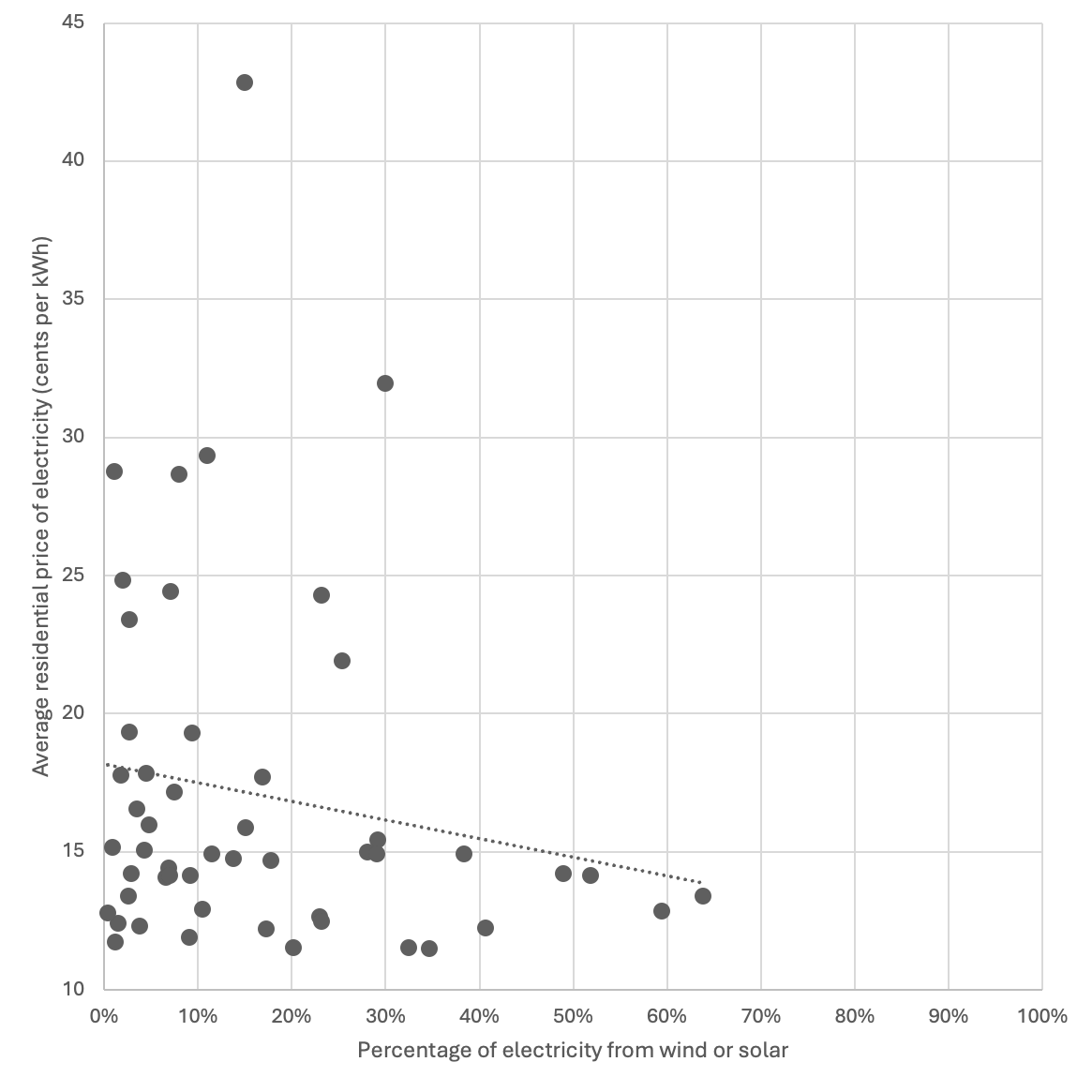
The clearly downward sloping trendline shows us that high penetrations of solar and wind are correlated with lower retail electricity prices and low penetrations of solar and wind are correlated with higher retail electricity prices.
The White House wants to grow supply of, in addition to domestic demand for, all fossil fuels. On the surface, this one makes more sense. After being a net importer of petroleum products for much of the 20th century and the first two decades of the 21st century, the U.S. achieved net exporter status in the 2019/2020 timeframe. We’re still the second largest crude oil importer in the world (behind China), but we now export more than we import by around three million barrels a day.
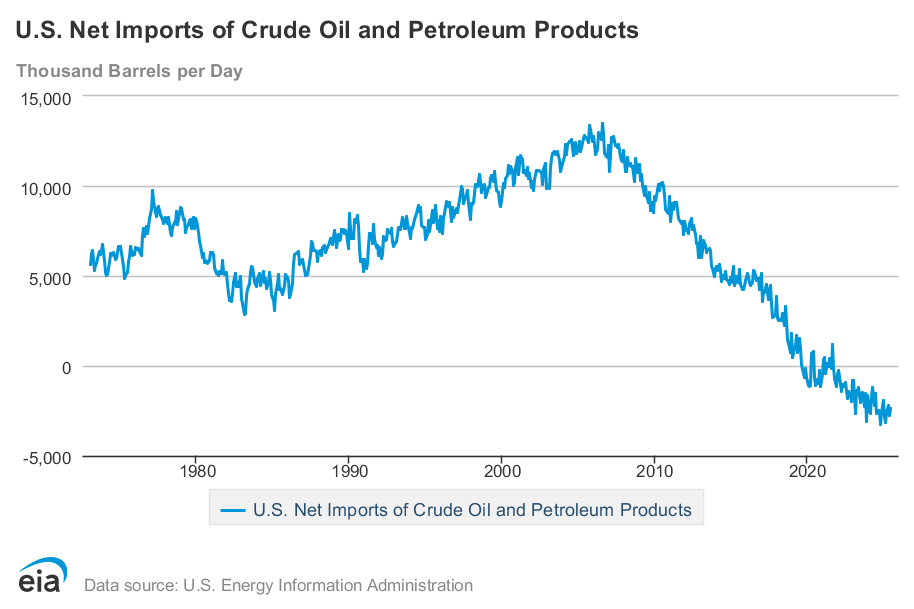
From a basic economic perspective, this is a positive:
Gross domestic product = Consumer spending + Investments + Government spending + Net Exports
This could also provide the U.S. with additional geopolitical leverage; for example, our allies would much rather buy gas from the U.S. than from Russia (this leverage may be limited in the grand scheme of things, though, as the U.S. supplies less than two percent of China’s crude oil imports). The Trump administration seems to want the world to be at the mercy of American fossil fuels. Their key miscalculation, however, is that the world isn’t stupid.
Throughout 2023 and 2024, global oil supply was practically equal to global oil demand. The first three quarters of 2025 have told a different story: Supply is now outpacing demand. The IEA expects this trend to continue at least through 2026:
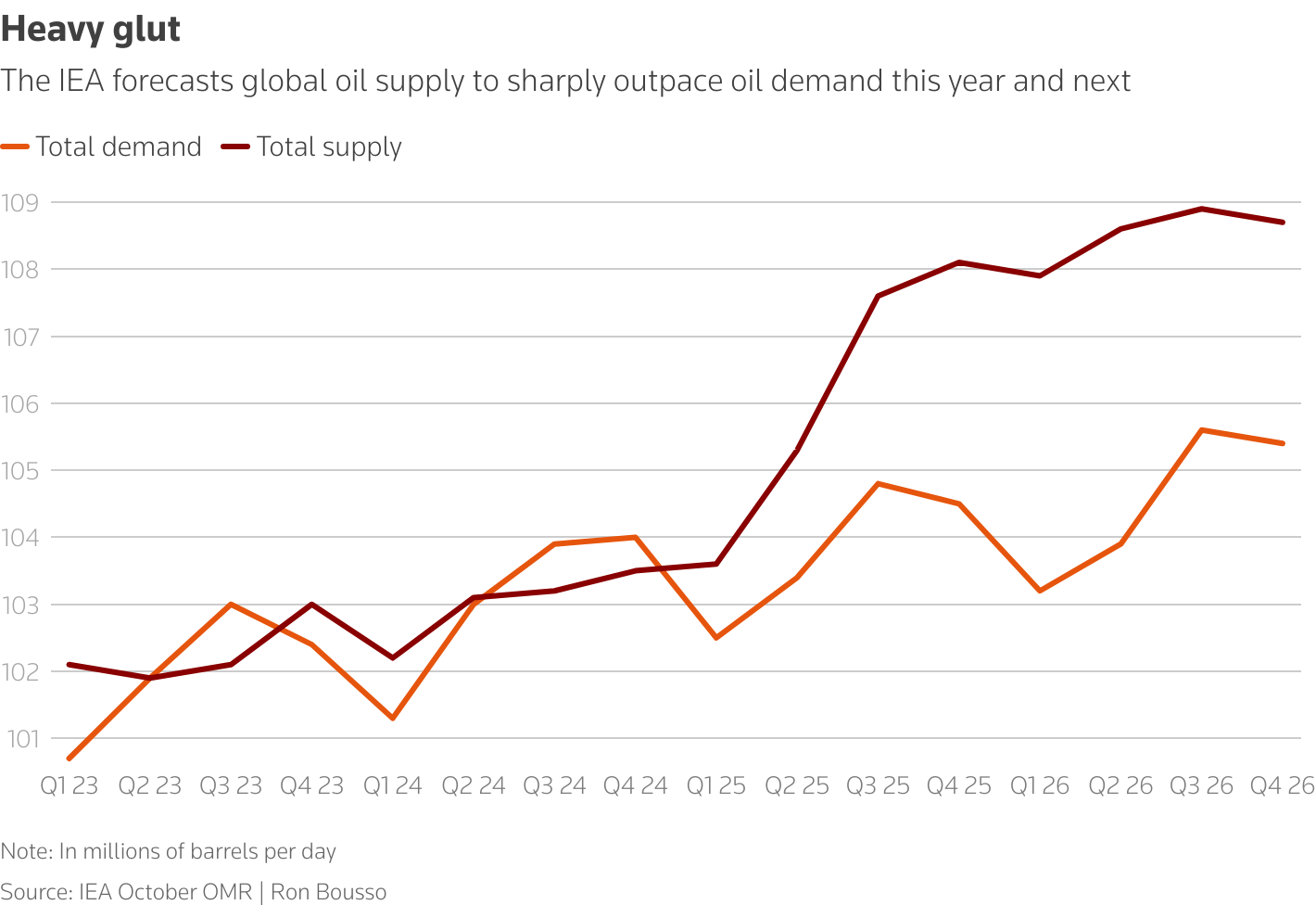
So, the U.S. wants to gain leverage over our trading partners by producing a larger share of something those trading partners will soon demand less of? Another graphic, by CarbonBrief, paints an even more concerning picture:
The fairly obvious problem with this graph, if you can think more than two weeks ahead at any given time, is that our international customer base is quickly dwindling. Sure, we could marginally increase our GDP by focusing our limited efforts (and capital) on becoming a dominant exporter of fossil fuels right now. But building out fossil fuel production capacity at the expense of domestic clean energy technology development and deployment, and assuming this fossil fuel production capacity will see high utilization three decades from now, is no way to build a robust energy economy for the mid-21st century.
Put simply, the U.S. may support hundreds of billions, if not trillions, of dollars of investment into an industry that is bound to retreat on the global stage no matter what we do. The real tragedy lies in the opportunity cost of where those dollars could go instead.
The White House claims to be for an “all-of-the-above” energy approach. Project 2025 even said it would be:
“A conservative President must be committed to unleashing all of America’s energy resources and making the energy economy serve the American people, not special interests. This means that the next conservative Administration should … Affirm an “all of the above” energy policy through which the best attributes of every resource can be harnessed for the benefit of the American people.”
Ha!
This administration has spent its first nine months undermining, if not outright stripping, support and even tolerance for economical renewable energy technologies and projects (primarily solar and wind). While China has built out its solar panel and wind turbine manufacturing capacity over the past few decades, the U.S. has more or less sat on its hands. By the time solar panel manufacturer Solyndra closed its $535 million LPO loan guarantee in 2009, the game was already over. We just couldn’t find the scoreboard until they went bankrupt two years later.
It’s impressive that China has been able to deploy as much solar and wind capacity as it has in recent years; the country deployed 329 gigawatts of solar and 80 gigawatts of wind in 2024 alone. For reference, the rest of the world combined deployed 268 gigawatts of solar and 37 gigawatts of wind in 2024.
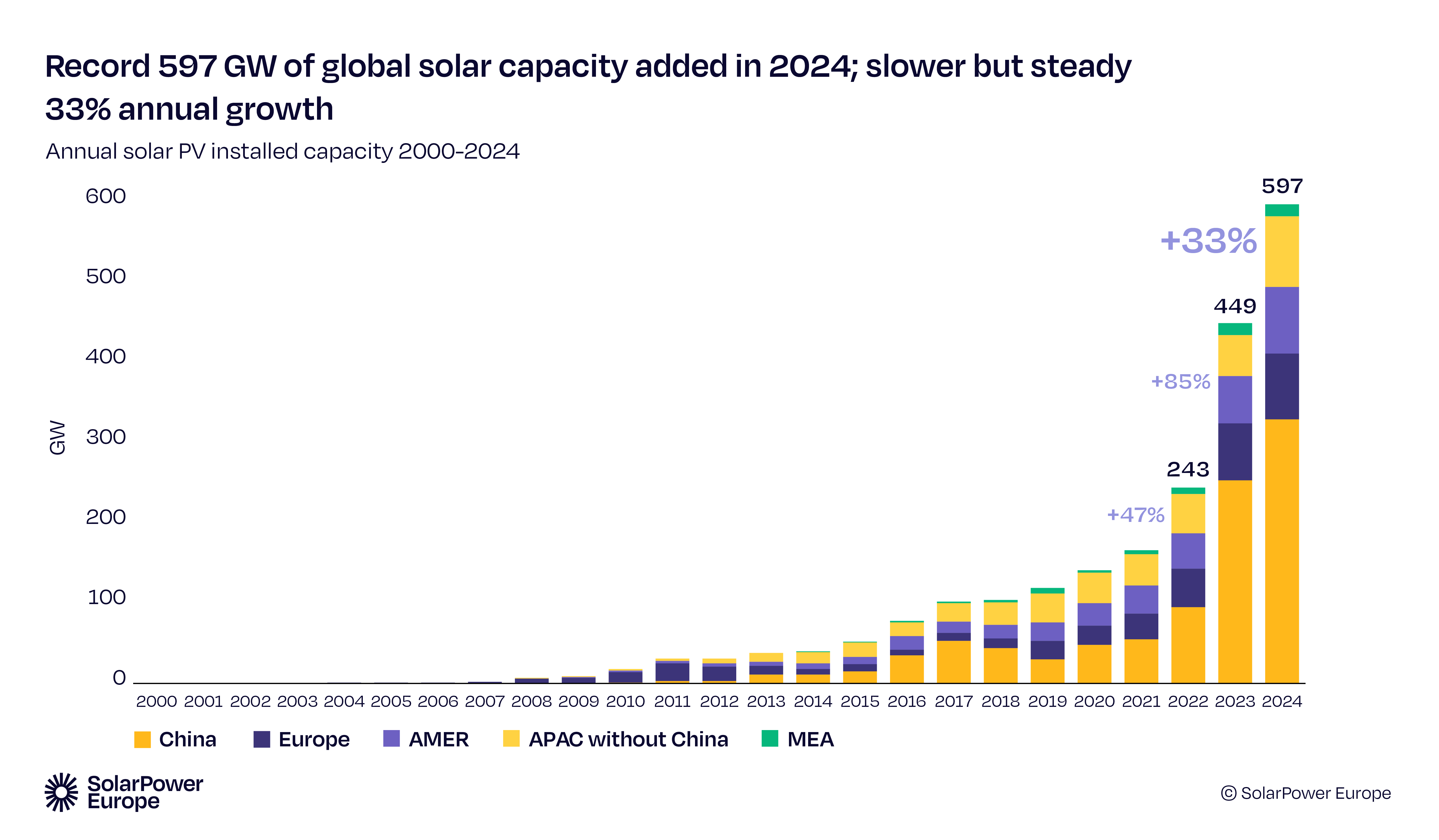
Perhaps even more striking is China’s capability to manufacture renewable energy technologies: The country accounts for 83 percent of global solar module manufacturing capacity and around half of global wind turbine manufacturing capacity.
So, while we may feel good right now exporting our fossil fuels to countries with little to no reserves of their own, at some point, we will be the so-called “rest of the world” importing energy technologies because we have little to no manufacturing capabilities of our own. In that sense, “Energy Dominance” is simply a precursor to energy poverty.
Promoting “Energy Dominance” on its own is not a bad thing. As long as we really mean energy dominance, and not “clean coal” or some other BS term, I don’t see why people of all political stripes wouldn’t use this terminology. Unfortunately, as with much of what the Trump administration does, labeling this energy strategy as short-sighted would be an understatement.
In other words: There might not even be a concept of a plan.
Rock ‘n’ roll afterword
Disclaimer: The opinions expressed in Renaissance Carbon are my own and do not necessarily reflect the opinions of any employer.
Contact: ryandavidson911@gmail.com
Comments
Nothing yet. Say the first thing.
Sign in to join the conversation.