
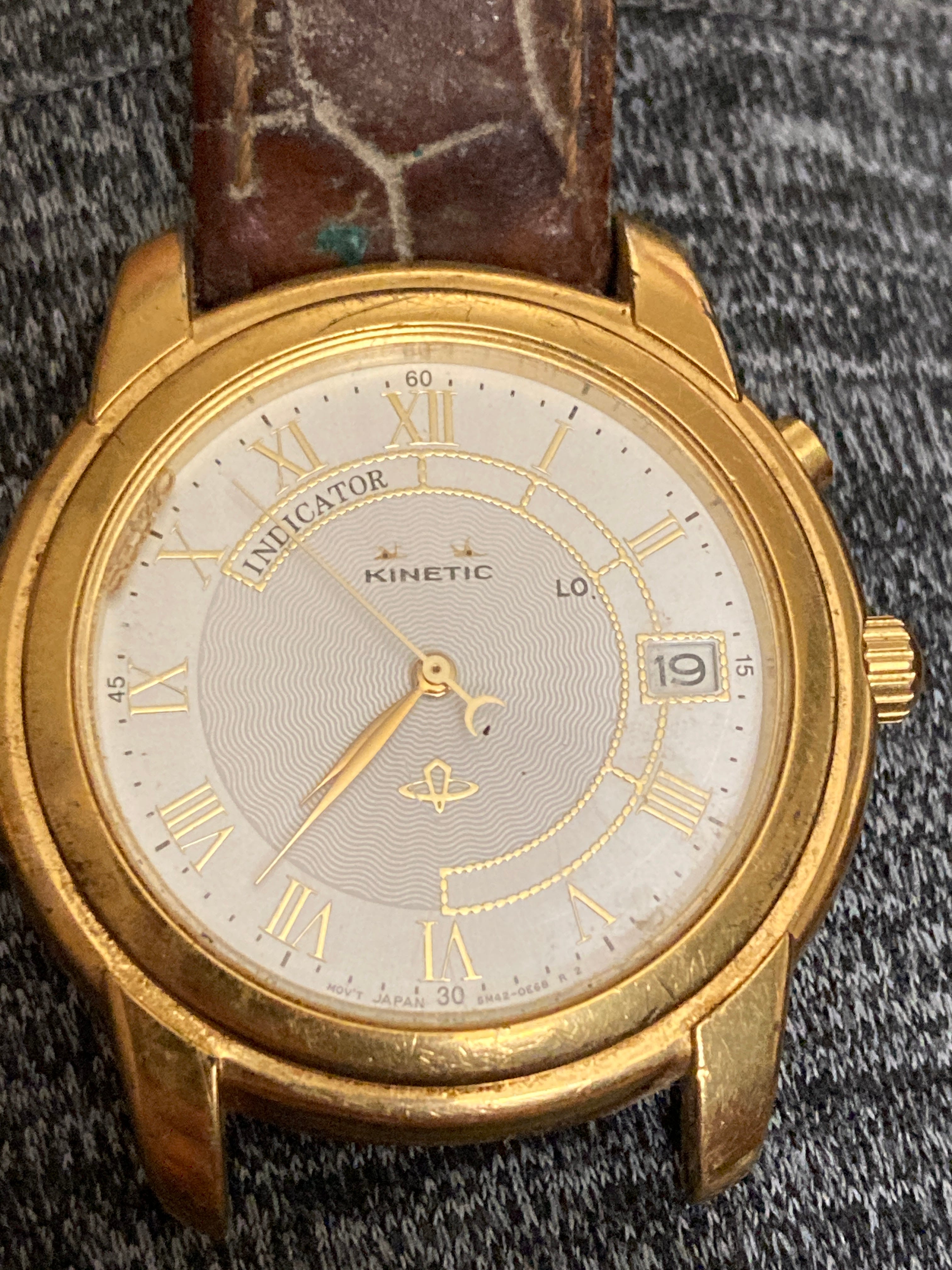
Tucked into a small parts organizer somewhere in a dark basement lies my grandfather’s old Seiko Kinetic. It’s surrounded by dozens of its compatriots: watches that I keep meaning to repair but haven’t had the time to get my hands on. I’ve been waiting on ordering a new battery to get it up and running, all the while uncertain of whether I’ll ever have the available funds to spend on a rather expensive watch battery or if that’s even all it needs.
The watch is nothing special at first glance—a gold-plated case that bears the many scars of my grandfather’s active life on the farm. But for what it means to me, it’s nothing short of extraordinary.
On Christmas Day of 1969, Seiko released the Astron, the world’s first quartz watch, and nothing was ever the same again in this little world we call horology. Or so I’m told, anyways, as I wasn’t there for that particular cataclysmic event. I imagine it was accompanied with something along the lines of a magnitude 8 earthquake in Switzerland.
In any case, things rolled merrily along as brands fought tooth and nail for control of the quartz world.1 In and among this turmoil came the unassuming Kinetic: a quartz watch that functioned like an automatic mechanical watch in that it sported a rotor that recharged the battery. So too came my grandfather’s watch, one of millions that would be produced by the year 2000.
Ever since he handed that old watch to me, I’ve been captivated by the way some brands play with quartz. In our times, I’ve read numerous essays arguing the traditional quartz watch is dead—indeed, just as reviewers declared the mechanical watch itself was dying not too long ago. The smartwatch will kill quartz, they proclaim, and herald the coming of the end times. But just like mechanical watches, the world of quartz has always been characterized by innovation and adaptability. You’ll find it a tricky bug to squash, I’d imagine.
So as an ode to quartz, here are two stories of innovation and charm, from long long ago when batteries in watches were young and anything seemed possible for watches with beating chemical hearts.
I’m indebted for much of the history of the Kinetic behind my summary here to the talented writer Coronet who explored the topic here.
Quartz has one great disadvantage compared to a mechanical wristwatch: longevity. Properly and regularly serviced, a mechanical timepiece can theoretically run forever. Of course, that means with plenty of replacement parts once things start to wear down over the years, but that’s just the thing: a good watchmaker can replace just about anything in a mechanical wristwatch by hand-making a new piece. There are obvious exceptions to this rule (silicon hairsprings come to mind, although a more traditional alloy version is certainly possible), but in essence, a good mechanical wristwatch can last many decades. We have dozens of antique Breguets now in private and museum collections that, now centuries separated from the master’s touch, still run today in superb condition.
Quartz watches, on the other hand, die rather rapidly. Battery changes are once a year or more frequent for many, and an average quartz watch itself rarely lasts too much longer than that. Circuity breaks down, batteries corrode and corrupt everything around them, and overall, whether they last or not, most are not really designed to. You can still find early quartz watches that run quite well with a battery change, but one thing is certain: you don’t “look after a quartz watch for the next generation.”
The Seiko Kinetic came as an initial effort to change all that. Introduced at Baselworld in 1986, its first prototype was simply known as “AGM.” By the time it hit markets in a full-production version, the name had undergone a one-letter change to AGS, or Automatic Generating Quartz. Initial advantages of this tech were abundantly clear: Seiko expected its rechargeable capacitors to be changed only once every 10 years. In that time, a lesser quartz watch would have received anywhere from 5-10 battery changes.
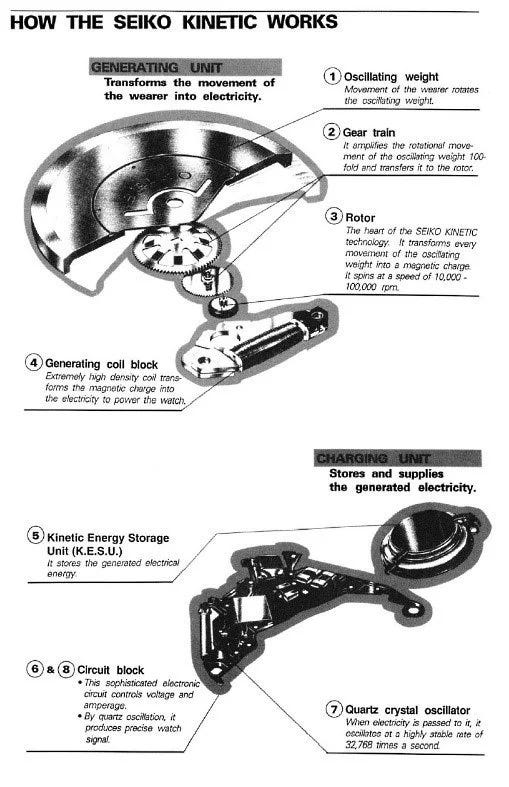
The Kinetic is simple in theory, but advanced in execution. Like an automatic watch, a heavy winding rotor spins round under the caseback, following the wearer’s movement. Its rotations are then amplified significantly by a small gear train, up to around 100 times. After that, the gear train connects to a small magnetic rotor, which sits in a generating coil block. The rotor is powered by the gear train and spins around quite rapidly, causing its magnetic field to rotate. This then creates an electrical field, captured and transmitted by the generating coil block. From here, power is sent to the capacitor and then distributed to the circuitry that powers and reads the quartz oscillator to keep time.
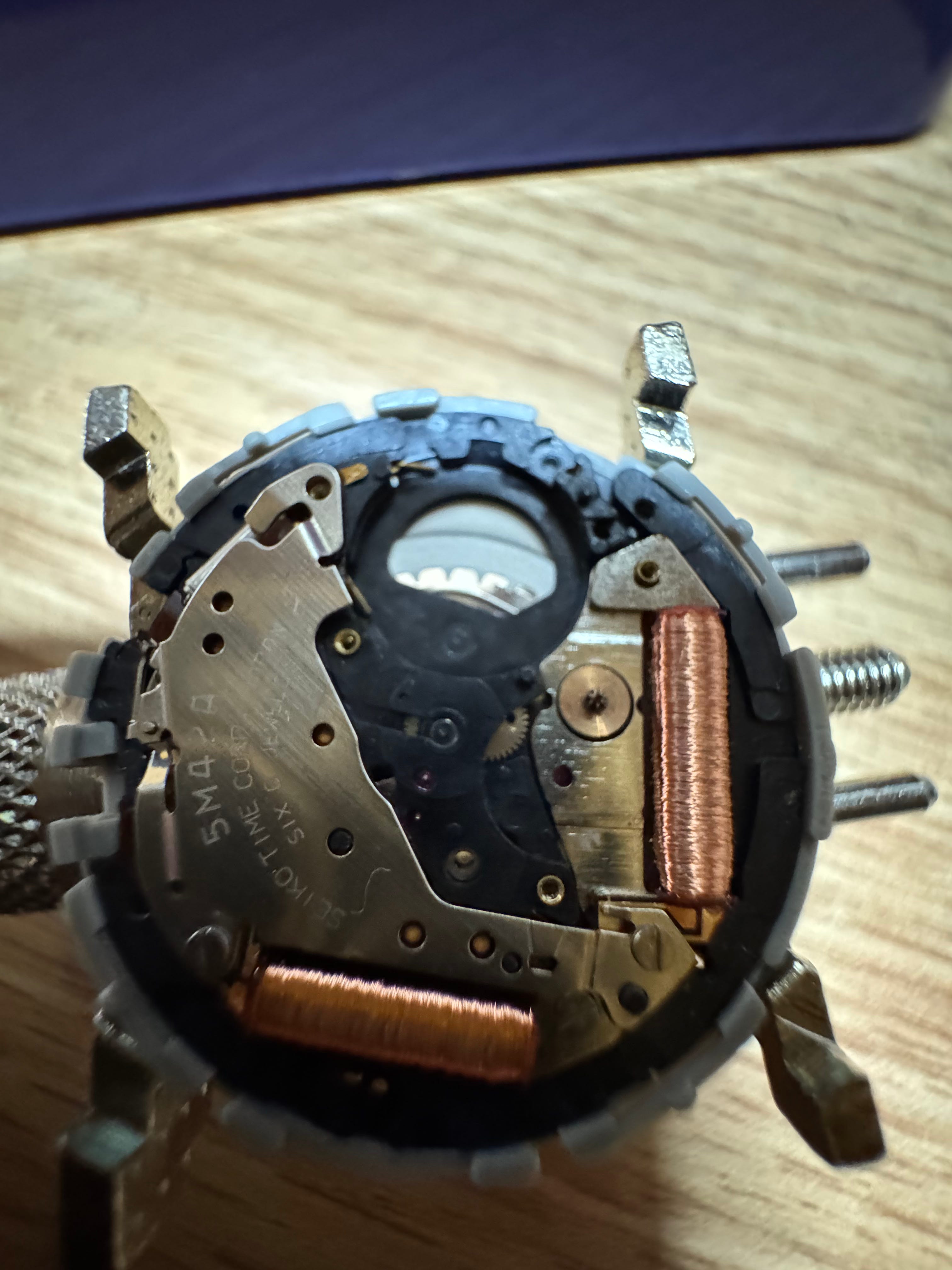
More advancements quickly followed, such as the replacement of the capacitor with a higher-efficiency Lithium-Ion battery. By 2000, as Coronet reports in their overview of the Kinetic, over 8 million kinetic-type watches were sold. Later models tacked on still more long-lasting features, such as power saving and more complications. Nonetheless, the Kinetic has all but disappeared from Seiko’s catalogs today.
Comments
Nothing yet. Say the first thing.
Sign in to join the conversation.