
Last night, I felt it start happening. The only way I know how to describe it, is like white noise building in my head. Static. A wall starting to go up. My trauma response was being “triggered,” and as it built, the person in front of me started becoming less of a whole person in my mind and more of a threat.
That sounds strange to write because I did not know I was doing that. I knew I was “triggered.” I knew what being triggered felt like. I had already learned how to separate what I was feeling from what was fact. I had already learned to stop treating every conclusion as certainty and instead ask whether it was a hypothesis. But this was something different…
I could feel myself losing the rest of the picture. And somehow, this time, I knew there was more to hold onto. I had to work to keep seeing this person as another soul who needed care and not only as the thing threatening me in that moment. Not safe, innocent, or excused. Just human. Both things were true, and for the first time, I knew how to hold both of them at once.
It felt like breaking through static. Then came the part that stopped me. I had never known I wasn’t doing this before. I had never known there was another way to be. That realization was almost more unsettling than the trigger itself, because suddenly I could look backward and see it everywhere. Not the same circumstances. Not the same people. The same missing piece.
I had spent my whole life thinking I was seeing the whole picture available to me. But how do you know you’re missing something when you’ve never experienced what it is to have it?
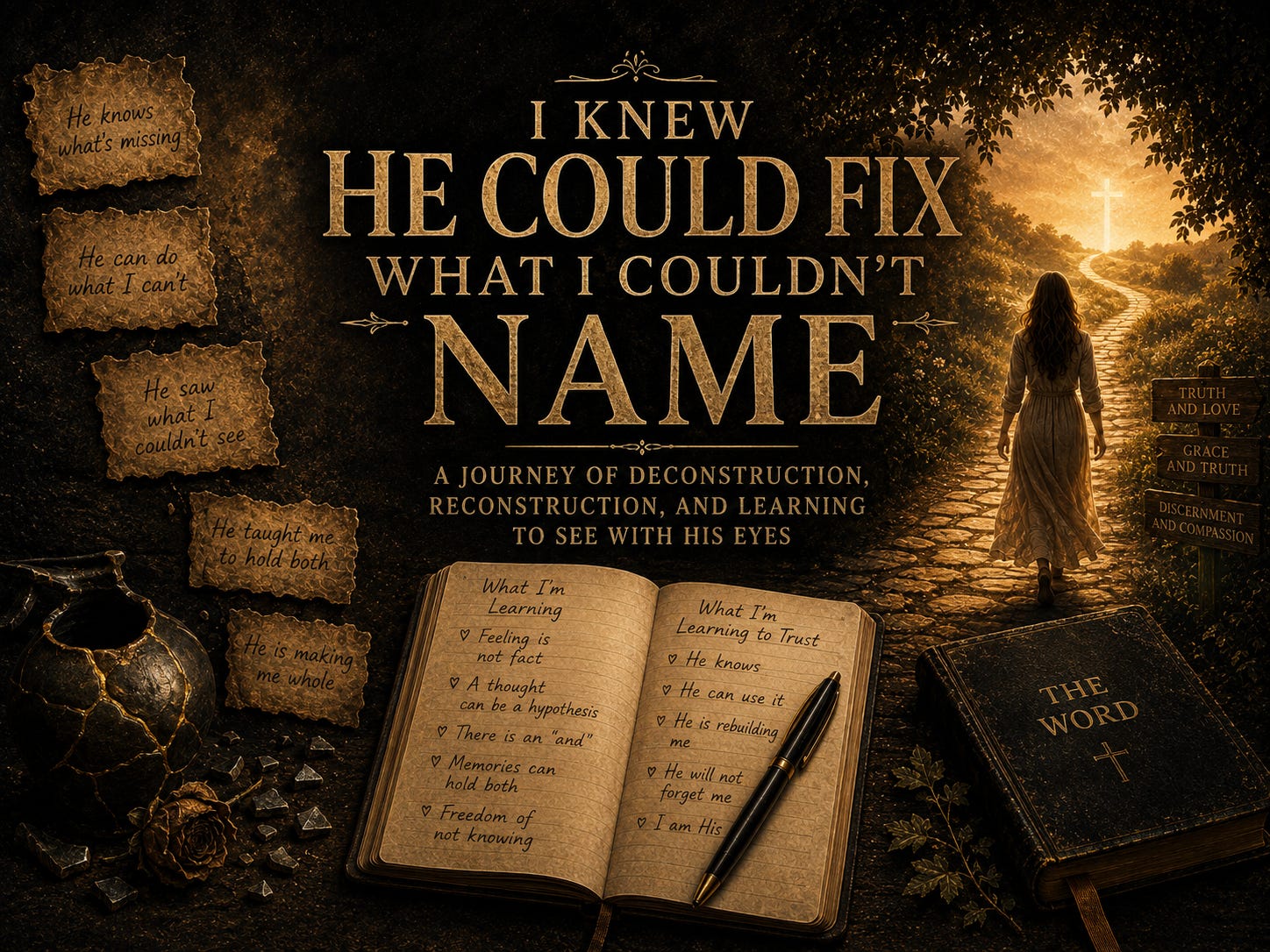
The strange thing is, I have always known I could see a lot. I see patterns. I see relationships between things that don’t always seem related at first. I notice inconsistencies, make connections quickly. Sometimes months before I can explain how I got there.
But I have also always known that there were entire pictures I was missing. I didn’t know what they were. That was the problem. It has been one of the great contradictions of my life. How could I see so much and still miss something so large? How could I recognize patterns other people didn’t seem to see and then somehow completely miss something that, once I finally saw it, seemed so obvious?
I think somewhere inside me I always knew there were pieces I didn’t have. But how do you identify something you have never experienced?
There was nothing to compare it to. I could recognize that the picture wasn’t complete without knowing what was missing from it. Last night gave me one of those missing pieces. Suddenly, things I have wondered about for most of my life began looking very different.
I recently watched “The Velveteen Rabbit,” and it brought back something I had forgotten. I loved that story as a child. More than that, I remembered the little girl I had been when I loved it. I remembered how badly I wanted to be normal. That is the word I used for it, anyway. Normal. But I don’t think normal was ever really what I wanted. I didn’t want to be like everyone else. I wanted whatever it was that seemed to let other people move through the world without constantly feeling like some essential piece of the picture was missing.
I didn’t have a word for that as a child. I do now. Shalem. The Hebrew word that means whole, complete, and intact. I thought I wanted to be normal. What I really wanted to be was whole. Shalem.
For now we see in a mirror dimly, but then face to face; now I know in part, but then I will know fully, just as I also have been fully known.
—1 Corinthians 13:12
I didn’t know exactly what was missing. I couldn’t have handed God a list and said, “This part is broken. This is what needs to be repaired. Start here.” I didn’t know enough to do that. I just knew there were things in me I couldn’t reach. Things I couldn’t understand. Places where I could feel the absence of something without being able to name what belonged there.
But I believed He knew. And I believed He could do what I couldn’t. That faith did not come with a timeline. It did not come with a guarantee that the process would be gentle. It definitely didn’t come with some private certainty that everything would eventually turn out beautifully. I definitely did not know that things would work out.
There were times when I genuinely wondered whether I would ever experience happiness again. Not joy or peace. Those He gives me regardless of circumstances. I mean happiness. Those are not the same thing.
I could still have joy in God. I could still know His peace. Neither required me to pretend I was happy about what my life had become, and somewhere along the way, the question changed. It became less, Will He make this better? And more, Can He use it?
Can He use a life that does not turn out the way I hoped? Can He use pain I would never have chosen? Can He use the parts of me that are still unfinished? Can He use the things I may never fully understand? I believed He could. So, I kept planting seeds.
And we know that God causes all things to work together for good to those who love God, to those who are called according to His purpose.
—Romans 8:28
I have a unique relationship with words. If I don’t fully (and I mean fully) understand a word, I dig into it. “Deconstruction” is one of the words I find I don’t like, and at the same time I do. I do not like some of the connotations around the word. But it is the perfect word for what He is doing in me. He has deconstructed and is reconstructing me, but not in the way I would have expected.
God has been pulling things apart, and sometimes it’s been so fast that I couldn’t even make sense of what was happening. My marriage. My family. My childhood. My memories. Things I believed about other people. Things I believed about myself. Even things I believed about the way my own mind worked.
I had to go back and look at things I had accepted as normal just because they had always been normal to me. That is a strange thing to discover. We don’t enter the world with some objective measuring stick for normal. We learn it from what surrounds us. And when something has always been there, sometimes you don’t even know to question it.
But this wasn’t a journey where God simply showed me everything everyone else had done wrong. I was in the examination too. Because if all I had done was uncover the failures of the people around me, I might have come out of this with better explanations for my pain, but not necessarily changed by it.
There were things outside of me that I needed to see differently. There were things inside of me that needed to change. There were assumptions I needed to question. Reactions I needed to understand. Ways of thinking I didn’t even know were ways of thinking because they were simply the way I had always thought. And there are still things I don’t understand.
At some point, though, I realized deconstruction wasn’t the right word anymore. Something had shifted. God wasn’t only taking things apart. He was putting something back together. Reconstruction had begun.
So I went down to the potter’s house, and there he was, making something on the wheel. But the vessel that he was making of clay was spoiled in the hand of the potter; so he remade it into another vessel, as it pleased the potter to make.
—Jeremiah 18:3-4
One of the first things He taught me was how to separate what I was feeling from what was actually true. That sounds simple when I write it. It really wasn’t. If I felt threatened, the threat felt real. If I felt rejected, the rejection felt real. If I felt certain, certainty itself could feel like evidence.
What changed was not that I stopped feeling those things. I didn’t. I learned to stop making the feeling carry more weight than it actually had. I could feel threatened and still ask, “Am I actually in danger?” I could feel rejected and still ask, “What actually happened?” I could feel completely certain and still leave room for the possibility that I was wrong. That space was new.
It was the space between what I experienced and the conclusion I drew from it. And once I could feel that difference, I couldn’t unfeel it. It wasn’t something I had memorized. It was something I could finally do.
The first to plead his case seems right,
Until another comes and examines him.
—Proverbs 18:17
Then He taught me something else. A thought could be a hypothesis. Again, they sound like simple words. For me, they were a completely different way of living. Something would happen, and my mind would make sense of it. In the past, the explanation could become the reality almost immediately. In the past I would jump to, “This is what happened. This is why they did it. This is what it means.”
But now there was another possibility. I was only seeing what I thought had happened, and that was being distorted by assumptions. That one change opened an enormous amount of space. I learned to ask better questions. What evidence actually supports this? What doesn’t? Is there another explanation that fits the same facts? What do I know? What am I assuming? What is still unknown?
Perhaps the biggest change of all was becoming comfortable with arriving at, “I don’t have to know yet.” I could leave something unresolved. I could hold an explanation without turning it into fact. I could say, “This is my best hypothesis right now,” without getting emotional about that hypothesis, and then let it stay there. Uncertainty no longer had to become certainty just because uncertainty was uncomfortable. That was freedom too.
The naive believes everything,
But the sensible person considers his steps.
—Proverbs 14:15
I Didn’t Know There Was an “And”
This brings me back to last night… The static was building, and for the first time I could actually recognize what was happening inside of it. My world was narrowing. The person was becoming a threat.
Again, that doesn’t mean there wasn’t anything threatening happening. This isn’t about convincing myself that something is safe when it isn’t. It was about what happened to everything else I knew once “threat” took over. I realized that I have spent much of my life organizing people and situations into something much more binary than I ever understood. Safe or threat. In that moment, I realized I didn’t have to decide to do that.
I wasn’t taught some philosophy that said people were one or the other. I didn’t even know I was doing it. It was simply how things were. And then, last night, there was suddenly an and. This person could be a threat to me and still be another soul who needed care. I didn’t have to make him safe to see his humanity. I didn’t have to erase his humanity to acknowledge the threat. Both could exist. Once I saw that, it began opening everywhere.
Someone can hurt me and remain human. Someone can need compassion and remain responsible for what they do. I can understand why someone behaves the way they do and refuse to accept the behavior. I can love someone and deny them access to me. Someone can have loved me in some ways and harmed me in others. Something I believe can contain truth and still be incomplete. I can discover that I was wrong about one thing without deciding I was wrong about everything. I can experience someone as threatening and continue seeing the rest of the person.
That last one is what I experienced. I didn’t move this person from the “threat” category back into the “safe” category. I realized I didn’t have to put him entirely in either one. There was more. Suddenly I understood something about those missing pictures.
Maybe I wasn’t always missing information. Maybe sometimes I was missing a way of holding the information together. I could have Piece A. I could have Piece B. I could even understand both pieces individually. If they appeared to contradict each other, however, I couldn’t hold both as true at the same time. By doing that, I could possess both pieces and still never see the picture they made together.
That is enormous for me. Because it begins to answer a question I have carried for most of my life. How could I see so much and still miss entire pictures?
They say I have Autism Spectrum Disorder. I am beginning to have more of a problem with labels. But I have spent a lot of my life learning that things that I assumed everyone else experiences the way I do? They don’t. This may be another one of those things. I don’t need to turn that into an explanation for everything. I don’t think it is one, but I can already see places where it may explain things I have never understood about myself. Maybe even the way I attach to people.
I have noticed in life, that if I had categorized someone as “safe”, it may have meant more to me than I realized. I think, perhaps, safety carried a weight I didn’t know I was giving it. It may explain why attachment could happen so quickly for me. I don’t know yet. And for once, I don’t need to.
Because there is something between “safe” and “threat” now. There is an “and,” and suddenly there is so much more room to see.
but speaking the truth in love, we are to grow up in all aspects into Him who is the head, that is, Christ,
—Ephesians 4:15
Almost immediately, it started changing the way I looked at my memories. Not the memories themselves, but what I could see in them.
I started recognizing the same way of processing in the person I had been. I could look back and see places where things had become either/or without ever knowing there was another option.
My relationship with my mother is probably the simplest example. Even now, I can stop and think, “She couldn’t really have been that bad.” There is something in me that still wants that sentence to settle the question. But then another fact comes up. I would actually feel dread before visiting her and needed to pray on the way to her house just to center myself. Both of those things are there, and now I don’t have to force them to fight until one wins.
Maybe there were good things. Maybe there were harmful things. I loved my mother. There were also times I dreaded being around her. One does not have to erase the other.
That changes the questions I can ask about my past. I don’t have to decide first whether someone was a good person or a bad person before I am allowed to look honestly at what happened. I don’t have to turn someone into a monster to acknowledge that they hurt me, and I don’t have to minimize what hurt me in order to preserve the parts of them that were human. I can let the pieces remain what they are. I can look at what happened, what I felt, what I know now, and can admit there is much I still don’t know. And I don’t have to force all of it into one simple answer.
Therefore do not go on passing judgment before the time, but wait until the Lord comes, who will both bring to light the things hidden in the darkness and disclose the motives of human hearts; and then praise will come to each person from God.
—1 Corinthians 4:5
Something unexpected has come with all of this. The more I am able to understand, the less I feel like I have to understand everything. I can say, “I don’t know.” “I could be wrong.” “There are several possibilities.” “Both things may be true.” “I don’t understand what God is doing here.” And I can leave it there. That is freedom.
I have spent so much of my life searching for the missing pieces, trying to understand enough to finally see the whole picture. I don’t need the whole picture anymore. God has it.
Maybe this is part of what He has been teaching me about abiding all along. A branch doesn’t need to understand the whole vineyard. It only needs to remain connected to the Vine. I need to see what He gives me to see, walk faithfully with what is in front of me, and trust Him with the rest.
Remain in Me, and I in you. Just as the branch cannot bear fruit of itself but must remain in the vine, so neither can you unless you remain in Me.
—John 15:4
There was another fear underneath all of this that I didn’t talk about as much. What if my life actually got better? I wanted relief. Of course I did. But suffering had driven me so close to God that somewhere inside me was another question. “What happens if I don’t need Him like this anymore?” What if happiness made me comfortable? What if the desperation disappeared? What if, after everything, I finally got to be happy and somehow forgot who He is? What if I lost the Way?
I used to worry about that. I don’t anymore. Not because I have decided that I will make sure I remember, and not because I have promised myself that I will remain grateful. It is something much simpler than that.
How could I? How could I forget this? I remember what it was like not to be able to see what I can see now. I remember knowing something was missing and having no idea what it was. I remember trusting Him to repair something I couldn’t even name. I remember how much it hurt. I remember continuing to plant seeds when I genuinely didn’t know whether I would ever sit beneath anything that grew. And now I have both. I remember the before from inside the after. The difference is too drastic for me not to know it happened.
He knew I would need that confidence, and maybe He knew I would need the memory of the before for another reason too. Because now I know what it is like not to see. When someone else cannot see something that seems so clear to me, I don’t have to stand over them wondering, “How can you possibly not understand this?” I know how.
Sometimes you genuinely cannot see what you have never learned (or been given) the ability to see. Remembering that doesn’t require me to abandon truth. It gives me more room for compassion while I hold onto it, and that changes what I can give to other people. This journey has increased my ability to serve Him, as it has increased my ability to serve and help others. They are, after all, one in the same.
When you have eaten and are satisfied, you shall bless the Lord your God for the good land which He has given you.
“Be careful that you do not forget the Lord your God by failing to keep His commandments, His ordinances, and His statutes which I am commanding you today;
—Deuteronomy 8:10–11
I keep coming back to that little girl who thought she wanted to be normal. She didn’t have the language to explain what she was looking for. She just knew something was missing. I understand her better now. She wanted to be shalem. Whole. Not someone who understands everything. Not someone who can never be hurt. Not someone who finally possesses every missing piece of every picture. Someone who is whole enough not to need every piece before trusting the One who does.
I kept planting seeds when I didn’t know whether I would ever sit beneath anything that grew, and now I realize that some of what was growing wasn’t around me. It was in me.
That doesn’t suddenly make the entire journey make sense. There are still things I don’t understand, things I am still healing from, and there are still pictures I may not be able to see. But that doesn’t terrify me the way it once did. Because now I know what it is like for something I couldn’t even identify as missing to suddenly become visible.
I couldn’t have thought my way into this. I couldn’t have studied my way into knowing what it would feel like. I had to experience it. Now that I have, the old question doesn’t need another promise from me. The question of, “What if happiness comes and I forget Him?” doesn’t even need consideration. It has an answer.
How could I forget the One who taught me how to see?
The Lord will accomplish what concerns me;
Your faithfulness, Lord, is everlasting;
Do not abandon the works of Your hands.
—Psalm 138:8
This ministry/work is reader-supported. If you would like to help support my writing, ministry, and help me as I support myself and my children during a very difficult season, you can do so here: Buy Me a Coffee.
No posts
Comments
Nothing yet. Say the first thing.
Sign in to join the conversation.