
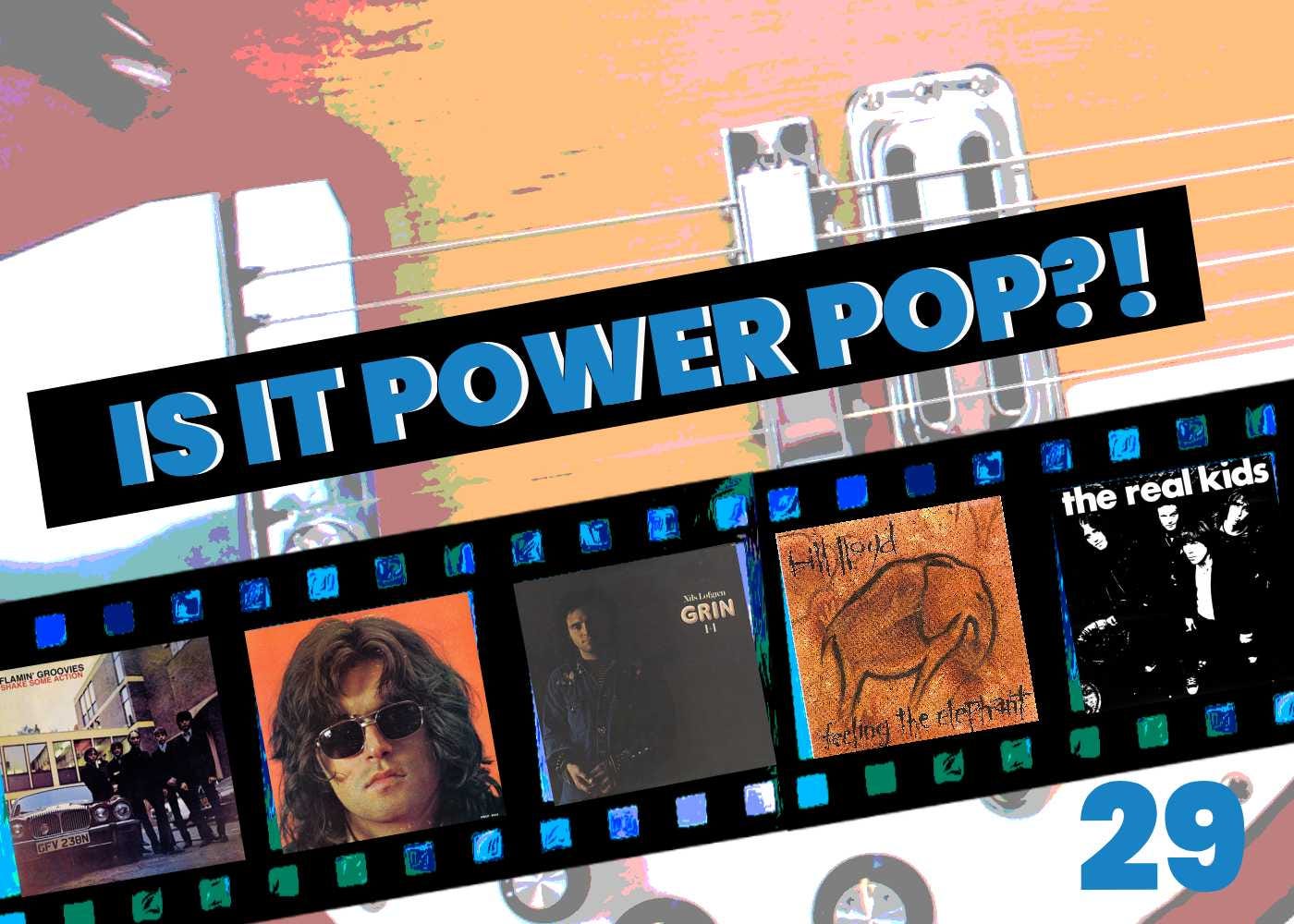
This is a guest post series about power pop featuring some of my favorite music writers. We’ll be sharing a new installment every few weeks or so (while supplies last). Full series here.
What about the attributes that are rarely, if ever, brought up in any power pop discussion? First of all, despite all the dismissive misconceptions, I think we need to establish once and for all that power pop is Art (yes, with a capital A). Convince me Roxy Music is art but Badfinger isn’t, or that David Bowie made “important music” while T. Rex’s boppy pop lacked artistic credibility.
A genre once bullied by critics raised on the post-Bob Dylan rock school of blues, folk, and drawn-out instrumentals, power pop is a rejuvenating flashback to the simplicity and rhythms—basically, the fun—of early rock and roll. Critical adjectives like “disposable” and “wimpy” completely missed the point.
The other thing, as far as I’m concerned, is that power pop isn’t merely a row of ticked boxes or a self-contained jukebox. On its deepest level, it yanked the delicate (post-disco) chain of my romantic curiosity.
At 18, the year I discovered the music that changed my life, I was in the throes of living through the ups and downs depicted by bands like Shoes, Big Star, and the dB’s. I was young and hormone-driven—not to mention heart-breakable—when I discovered the genre. It was more than music to me; it was a friend that knew what I was going through. The songs I’m about to list don’t pretend to be definitive—or the best. Those lists have been amply disseminated. I decided to branch out a bit; to give some ink to the under-represented.
This might be my favorite power pop song. Maybe it’s because the first time I heard it, I was blown away by its simple, stunning perfection. The Canadian hit is appropriately Beatles-ish, but, like all my favorite power pop anthems, adds its own twist.
For one thing, the title isn’t the chorus, so don’t look for it there. It has a sprinkling of string-laden country and a soaring and stately instrumental motif. And I haven’t even mentioned the chorus (“I do want to hold you”), which is so catchy and exultant, it sounds like it was just meant to be written. While many Pag fans tend to prefer his other power pop masterpiece, “Lovin’ You Ain’t Easy,” this one is even better; it’s next-level in its silvery distillation of everything that’s great about power pop.
If there has ever been an overlooked power pop band—no less, a seminal one led by one of the world’s greatest guitarists (who also happens to be a wonderful songwriter)—it’s Grin.
“White Lies,” with its momentum-gathering opening verse, is a beautiful example of power pop’s raucousness in its first wave, the ‘70s. It navigates a fine line between Buffalo Springfield and Artful Dodger, but Grin marched to the beat of its own drum. Nils Lofgren and company were the first power pop aggregation with a bonafide guitar hero as its leader. Perhaps that was a distraction. Lofgren of course went on to play lead guitar for Bruce Springsteen, but Grin were not only overlooked in their day, they still haven’t gotten a fair shake in retrospect.
While they’d have had every right to change their name to Frown, they kept a stiff upper-lip, releasing great records like 1 + 1. You can hear their guiding influence in bands like Shoes (particularly the Gary Klebe songs). It’s a simple fact: Putting Grin on your turntable will put a smile on your face.
The Groovies were the only seminal power pop band to stylistically start with the ‘50s in the ‘60s, and the ‘60s in the (mid-to-late) ‘70s. My favorite tracks by them are “Slow Death,” “Shake Some Action,” and “Teenage Head.” The latter sounds like mutant Stones, raunchy to the core. “Slow Death” is also Stones-y, but injected with a fuzzily amped-up blues progression and a decadence informed by The Velvet Underground. “Shake Some Action “ is their quintessential power pop contribution, but there’s also this one, and it’s hiding in plain sight.
The closing track on their crowning Shake Some Action LP, “I Can’t Hide” kicks in with a rolling, bass and jangle riff, then veers into Beatles ‘65 territory, and culminates in a thunderously explosive guitar solo that comes across like a burning bridge before the final chorus. Like most of my favorite songs in the genre, “I Can’t Hide” breaks all the rules, but, most importantly, whittles the genre down to the essential components of power and pop.
They were a bit like the Ramones with more conventional song structures, and, in John Felice, had a writer and lead singer who could tap almost viscerally into the slippery topic of teen angst. “My Baby’s Book,” which is even more cleverly titled than it might seem at first, is so rousing and catchy that I likely have it on more power pop mix tapes than any other song. It’s the real thing.
It really is a tie between this and Tommy Keene’s “Back Again (Try)” for the final spot (is that cheating?), but thanks to some audacious but evocative similes (“…left a hole in my heart the size of my jacuzzi”), “Lisa Anne”—specifically its counterbalance of longing and jangle—has a dreamy timelessness that pulls your heart out of your chest like something from Indiana Jones. Bill’s written a lot of great songs, but, wow, this one is top drawer in the Bureau of Power Pop.
Jordan Oakes founded, published, and edited the Yellow Pills power pop magazine beginning in 1991, and compiled five Yellow Pills CD compilations beginning in 1993. His journalism has also appeared in Sound Choice, Speak, The Riverfront Times, The Christian Science Monitor, Rolling Stone’s Alt-Rock-a-Rama book, and elsewhere. He’s a published poet and occasional standup comedian. He loves dogs and dog-eared magazines.
Is It Power Pop?!
Is It Power Pop?!
Feb 28
This is a guest post series about power pop featuring some of my favorite music writers. We’ll be sharing a new installment every few weeks or so (while supplies last). Full series here.
Comments
Nothing yet. Say the first thing.
Sign in to join the conversation.