
If you want to live and work abroad, what I’d stress in 2026 is that there are many, many ways to do it. I have discussed many of these paths at The Global Move, like how you can make it so that an EOR can put you on a payroll abroad. Or how a talent visa or a digital nomad visa can get you there on your own merits rather than through an employer. Or even the educational path, which remains an option.
But still, there’s a less quirky way, and you probably know it by heart: If you want to work and live abroad, you can start by finding an employer that can sponsor your move. I often call this the “classic” way of relocating with a job.
Today’s article talks about this classic route, done by a company that has a well-built relocation strategy that has been helping them find the best engineers out there. This company is Vinted, which I recently wrote about on my LinkedIn, in part perhaps because of their whopping limited-time gross bonus of €30,000 and full support when moving to their HQ in Lithuania.
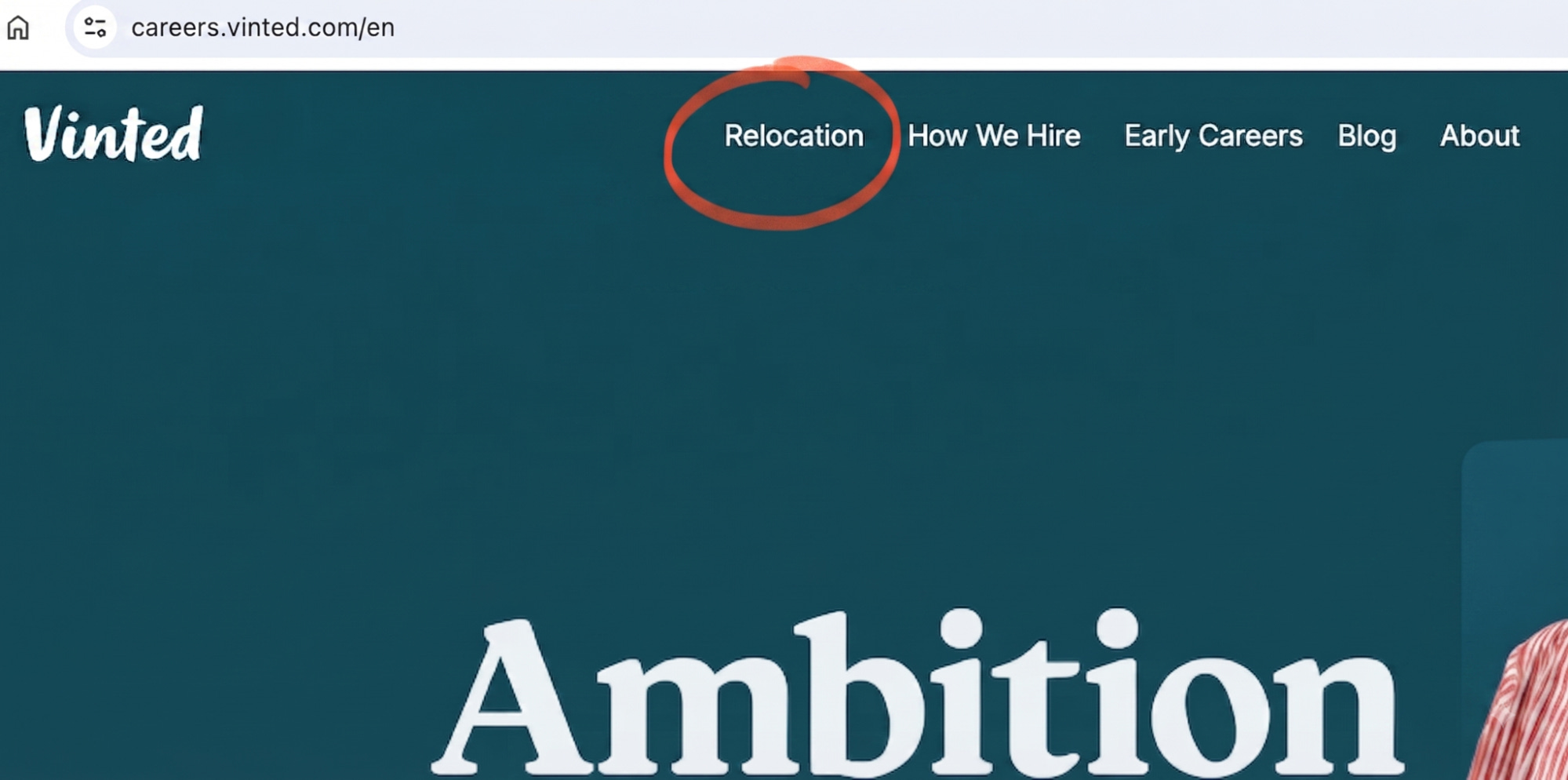
Go to careers.vinted.com. The first item in the navigation bar is Relocation. Ahead of How We Hire, ahead of Early Careers, ahead of the blog, ahead of About. You’ll soon realize this is on purpose and not an accident.
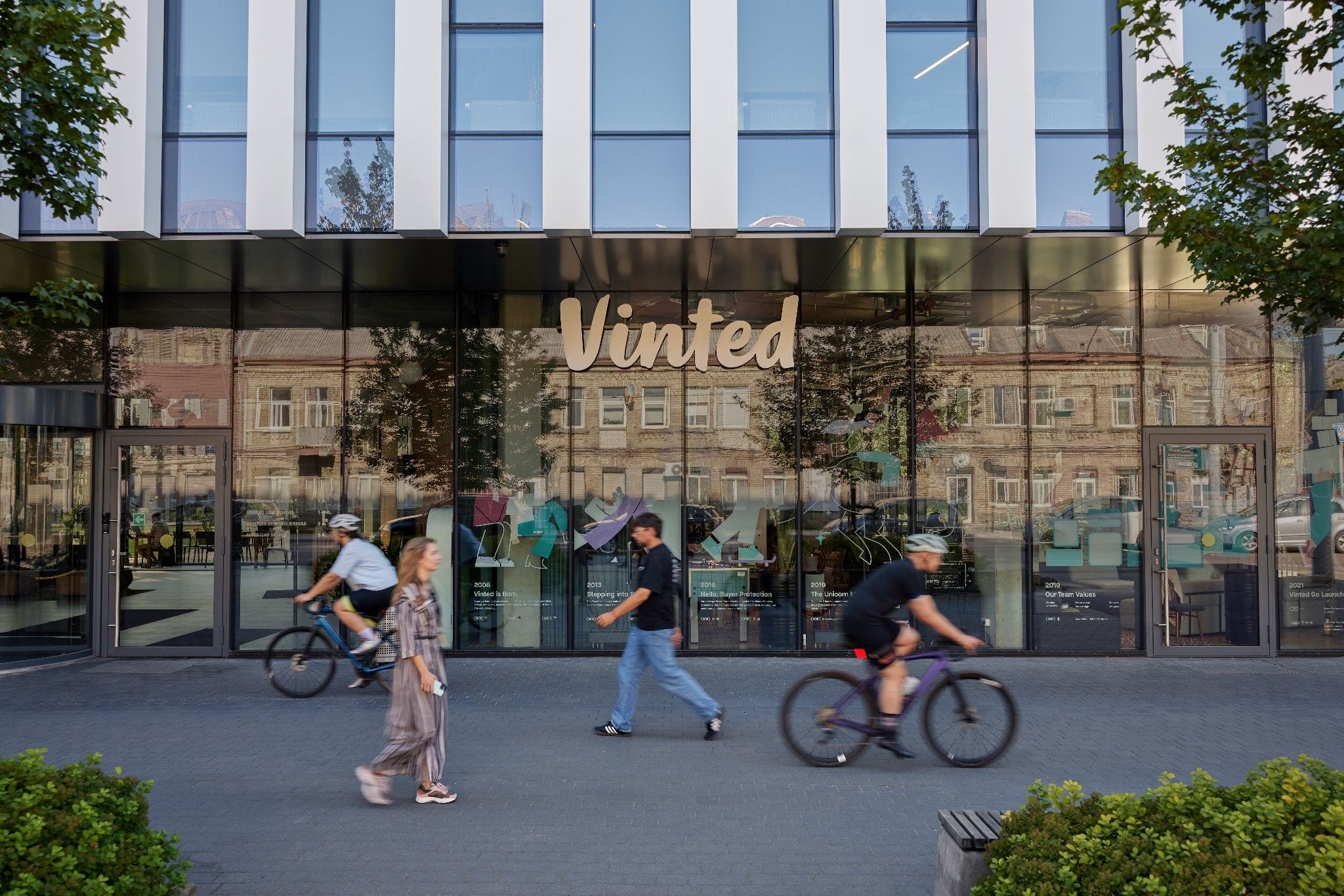
Vinted Marketplace invites you to sell what is yours and declutter your closet. You can, of course, also buy second-hand products on their platform. The picture that forms in your head is a barter table at a street fair, and that’s partly accurate. Two friends in Vilnius, Lithuania, did start it in 2008 because Milda Mitkutė was moving apartments with too many clothes, and Justas Janauskas built her a site to give them away.
What it became is a technology company, and I would like to mention that exactly like that, plainly, because if you walk into the process with the swap table in your head it is going to cost you.
The figures are on the record, and they are not small. Vinted became Lithuania’s first unicorn in 2019, when they raised €128 million at a €1 billion valuation. In 2024, a secondary share sale of €340 million put it at €5 billion. According to their own website, this helped drive some outstanding 2025 results: €10.8 billion in gross merchandise value and more than €60 million in net profit. A great deal of this growth is probably due to their active strategy to bring in international talent. I’ll discuss that in a moment.
The company has three main business units. Vinted Marketplace is the platform everybody knows, the market itself, and which also has an app for mobile users. Vinted Go is logistics, with more than 500,000 pickup and drop-off points and a sorting center in France, running across France, Belgium, the Netherlands, Spain, Portugal, and Finland. Vinted Pay handles payments. They employ over 2,200 people, in Vilnius, Kaunas, Amsterdam, Berlin, Hamburg, London, Luxembourg, Paris, and more. Count the countries on that list before you keep reading. In July 2026, they opened operations in Australia, with Australia Post handling every delivery, after research that put decluttering ahead of the cost of living as the reason Australians were signing up.


(A short note because I went and checked before writing it. Very few companies on Earth own a marketplace, a payments institution and a logistics network all at once. Mercado Libre does, in Latin America, and it is a monstrously large company with no serious rival across a region of hundreds of millions of people. Alibaba does, in China, and it is Alibaba itself. That is the shelf Vinted has quietly climbed onto, and I do not think most candidates realize how hard it is to have this kind of vertical integration in 2026.)
I ran vinted.com through Wappalyzer while I was doing some research for this piece (the same move I recommended in our cover letter article, where one of our readers checked a company’s front end and then wrote about it in his letter). But this is a marketplace, payments, and logistics company, so a few components off a website won’t tell the whole story.
Fortunately, the backend is public and well documented. It was originally a large Ruby on Rails application, and in 2023 the engineering team wrote about bringing Go in as a general-purpose backend language because Rails on its own stopped fitting the scale (again, on its own! Not dissing Ruby on Rails here). They handle search on Elasticsearch with data coming from MySQL and going through an indexing pipeline made of Kafka and Kafka Connect, with Kubernetes and Docker at the base. They regularly publish open-source tooling around Kafka and Elasticsearch on GitHub.
So this means they have plenty of programmer (I’m specifically saying programmer here, as in, broader than just saying developer) roles. On their site, you can see backend, data engineering, data science, or analytics engineering roles with relocation packages open right now. And some of them are mixed in a way I find quite interesting. For example, the analytics engineering role I opened sits inside marketing, where the people around you are mostly not technical, and where most engineers have never once had to think about attribution. Marketing people are rarely versed in the stack, and engineers are rarely versed in marketing*. A role that stands in the middle of that is exceptionally unlikely, and I would check it out on those grounds alone.
*I, personally, know a couple of exceptions but my point holds!
As I write this, searching relocation on their jobs page returns 11 open roles. All engineering and data science, mostly to Lithuania. And every single one of them carries the same tag in the title: limited-time relocation bonus.
Vinted has a long-standing relocation culture, and as such they have a standard package already in place. The standard package if you get the job and need relocation includes:
Help with documentation for you and your family,
help in finding temporary and then permanent housing,
help opening a bank account,
cultural integration support, which includes language lessons so that you can handle Lithuanian.
The standard gross bonus is €3,000 moving alone from within Europe, €5,000 with a partner or a child, or €6,000 and €10,000 if you are coming from outside Europe. For the limited-time offer they took the gross bonus to €30,000, threw in the first two months of temporary housing, and added a nursery and school search for your kids.
Sit with the €30,000 gross limited-time bonus for a second, because I did.
Nobody hands you €30,000 by accident. A number like that means a people team sat down, analysed what this profile costs to find locally, and concluded that bringing international engineers into Vilnius and Kaunas pays for itself. It is a studied, strategic decision, and it tells you how serious they are about relocation. When we wrote about how to tell whether a company is genuinely open to international candidates, this might be the strongest signal on the whole list.
They also say 100+ colleagues from across Europe have already moved to Lithuania, and they run an internal community called Internationals at Vinted for exactly those people. So yes, Vinted has a long-standing relocation culture.
Vinted publishes the salary band inside the job ad, which on its own puts them ahead of most of the market. The analytics engineering role I opened lists a gross monthly range of €3,433 to €4,650.
A number in euros means nothing without a floor to stand it against, so: the average gross monthly wage in Lithuania was roughly €2,430 in 2025, per the State Data Agency.
Which means the bottom of that band already sits around 40% above the national average, and the top is roughly double it and level with what the capital pays its engineers. That is a good salary. For a mid-level role, in a country where your rent is not, let’s say, Zurich rent, it is a very good salary. Do the arithmetic on take-home and cost of living the way we walked through it in answering the salary question before you hold it up next to a headline number out of Berlin.
Their How We Hire page gives you five stages. They’re:
Talent acquisition interview.
Hiring manager interview.
Assignment.
Panel interview.
Final evaluation round.
They tell you up front that the last three do not apply to everybody, and that you will be told which ones apply to you at the start.
I like that they publish it. I also like that they answer how long hiring takes. Literally, off their site, they say it depends. Yes, they’re honest, but I understand if you’re irritable about this, since we all like specifics. So let me put two reference points on the table from outside Vinted.
In 2025, we interviewed a software engineer who moved to Amsterdam, and his employer runs an explicit four-week policy from application to offer: take-home assignment, technical round, pair programming and a behavioural interview, all sit inside that window.
But let’s use a different example. In the cover letter article, we studied a letter from one of our own readers. The letter was dated 30 December. His first interview for the relocation role happened in June. Six months, door to door.
So, as a reference, in 2026, four weeks is the exception, and six months is what the market looks like in 2026, and I would much rather tell you that now than have you spiral in week seven. It is the same thing we said about preparing months before you apply. This is not the 2021 market. The people who get through are the ones who started early and stayed patient while nothing appeared to be happening. So expect a hiring-with-relocation process that could last between one and six months.
No, you do not need to speak it to work at Vinted. Vinted works in English and says so in its FAQ. They also say (and I agree) that picking up the basics will make your life outside the office considerably easier, and they point you to the learning budget to pay for the lessons.
Nobody is asking you to speak the way Domantas Sabonis speaks Lithuanian and English at an NBA press conference. Aim lower than the Sabonis bar. Just start.
What comes next repeats advice I have given for several other job application processes on The Global Move. But wait! I am not telling you to copy and paste an application from another job. The opposite is the point. All I’m saying is that, for Vinted, there’s a common piece of advice that I would use, and if you’ve been reading these last few months, you won’t find it surprising at all.
So, if I wanted this job, I would build the application on a bunch of things.
Know their mission very well. Second-hand as a first choice is a real position with real consequences. I’m thinking, right now, a lower carbon footprint per garment, or objects that were once loved passing into new hands. Also, money going into the pockets of seemingly ordinary families. Their marketplace also carries shops, so small businesses sit in there too. Now: if none of that moves you, say something else instead, but don’t just think these guys are a marketplace. They really have a mission underway.
Think about the market you could work on. Look at where they just opened and think about where they go next. Australia landed in July 2026. If I were interviewing for a role based in Vilnius, I would still show up with an actual opinion about what New Zealand would take.
Show them you have applied to the role and have considered the target city. If the role were in Hamburg, where Vinted has offices, I would also mention my deep affection for the Beatles, who got great at playing live in Hamburg. A person who has thought about a city is a person who is likely to stay in it.
Think of the vertical, so you can think horizontal. Marketplace, Go and Pay are three genuinely different engineering problems assembled inside one company. They integrated vertically instead of outsourcing their business, which means you might get a shot at moving horizontally. Just tell them you acknowledge these facts! A backend engineer who joins on the marketplace side and later moves into a licensed payments institution has done something very, very few engineers in Europe ever get the chance to do.
The homework. Read the engineering blog. Read the newsroom. Read what their tech leads have published. Then find those people on LinkedIn and count how many degrees of separation you actually have, and go through our piece on getting a job abroad through LinkedIn and the one on networking and referrals while you do it.
Their application form has a cover letter field. Use it. Read our cover letter guide first, and keep in mind what PostHog says in their own hiring advice: keep it short, do not reword your resume, do something that makes you stand out.
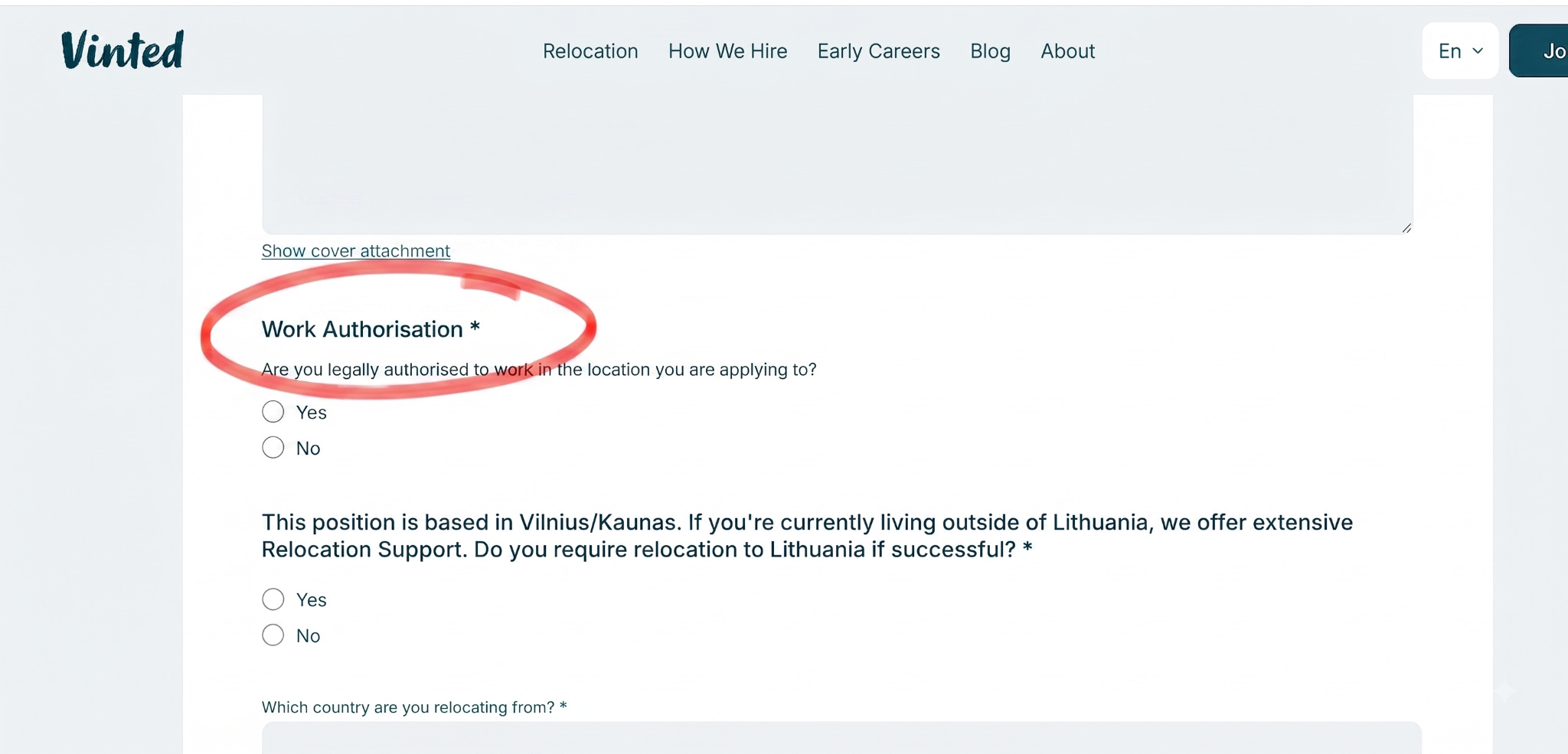
The form asks whether you are legally authorised to work where you are applying. Then, separately, whether you would need relocation to Lithuania, and which country you are relocating from.
We have written about knockout questions in applicant tracking systems, or, the ones that downgrade your candidacy on one answer. Do you live within 50 kilometres of the office?, the form asks, but you live somewhere around 51. You answer honestly. The system filters you out, and so on. Those kinds of questions sometimes make candidates submit any random response just to advance to the next stage.
This form is not that, and the wording deserves credit. Work authorisation and relocation are two separate questions, and the relocation question exists precisely so you can say no, I am outside Lithuania and yes, I need support. Answering no on work authorisation costs you nothing here. So do not invent one in order to get further into the process and negotiate it later. I implore you! It costs you the offer at the point where somebody in legal opens your passport.
A company that puts relocation first in its navbar, publishes its salary bands, publishes its interview stages, and then puts €30,000 gross behind moving one engineer to Vilnius has made a decision about international talent and is paying real money to act on it. And yes, that’s Vinted in a nutshell.
So be sure to make the best out of this opportunity. Take advantage by really preparing your application. Recruiters and hiring managers alike will love that there’s someone on the other end that’s as invested as them in relocation.
Good luck!
Text within this block will maintain its original spacing when published
I publish relocation-friendly tech roles every week at The Global Move, and it’s slowly becoming the largest hand-curated list of jobs with visa sponsorship and relocation support. If you are getting ready for your move, subscribe and start building your runway now.
No posts
Comments
Nothing yet. Say the first thing.
Sign in to join the conversation.