
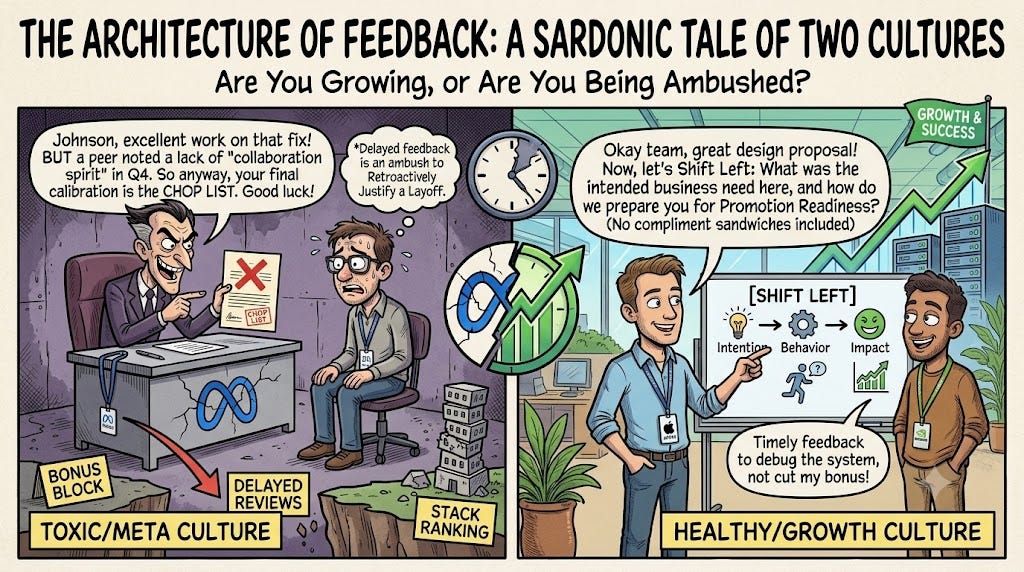
Giving and receiving feedback is the most misunderstood mechanic in modern corporate life. Most organizations treat it as a bureaucratic box-checking exercise or, worse, a weaponized tool for performance management.
But as companies scale and the disconnect between leadership and ICs (Individual Contributors) deepens, feedback ceases to be optional. It becomes the primary mechanism for visibility, career velocity, and psychological safety.
Feedback delivered exclusively during review season is a lagging indicator of a toxic culture. When critique is withheld until compensation decisions are locked in, its purpose shifts from professional development to corporate defense. It becomes a tool for professional sabotage rather than progress.
In a small startup, feedback is organic. Teams work closely, skin-in-the-game is obvious, and everyone knows exactly what everyone else is delivering. If you stay up late fixing a critical production blocker, your team sees it in real-time.
As a corporation grows, that proximity vanishes. A massive leadership disconnect develops. Layer upon layer of management isolates your actual output from the decision-makers who control your compensation and promotions.
In a massive enterprise, feedback becomes the currency of visibility. Being vocal about your own work is necessary, but being vocal about your colleagues’ contributions is a double-edged sword. Championing a peer can lift the collective floor, but how you provide that feedback, how often, and why requires strategy. In a healthy company, it builds a tight-knit network of collaboration. In a toxic environment, unsolicited or poorly framed feedback can inadvertently paint a target on someone’s back.
Not all feedback loops are created equal. The exact same critique can be an invitation to grow at one company or a termination notice at another.
In hyper-aggressive, stack-ranked environments like Meta, feedback is frequently weaponized for survival. Because performance distributions are forced, peer reviews and top-down critiques are heavily tied to calibrating who stays and who goes.
The Reality: If a team lead drops negative feedback on your work in this type of environment, it is rarely a coaching moment. It is a lagging indicator that you are already on the “chop list,” and your runway to find a new company is likely down to six months. Credit hijacking becomes the survival strategy of choice.
Conversely, world-class engineering organizations like Nvidia focus their feedback loops on long-term employee success. Feedback here isn’t designed to find a reason to eliminate you; it is designed to prepare you for the next level. The goal is calibration for capability, not survival.
To understand why healthy feedback matters, you have to understand why companies promote people in the first place. It comes down to two rigid criteria:
Business Need: If a business is stagnant or contracting, it doesn’t need more leaders. It needs to lean down. But if the business is growing, new scopes, new systems, and new teams emerge. Vacancies open up.
Person Readiness: Once the business need is established, the next question is whether the individual is actually ready to handle the next level of complexity.
This is where constructive feedback becomes invaluable. It acts as an early-warning system and a roadmap. It highlights your positive impact so leadership has data to justify your promotion, while simultaneously pinpointing the exact gaps you need to close to be ready for the next massive challenge. Think of it as a way to minimising risk for giving you higher responsibilities.
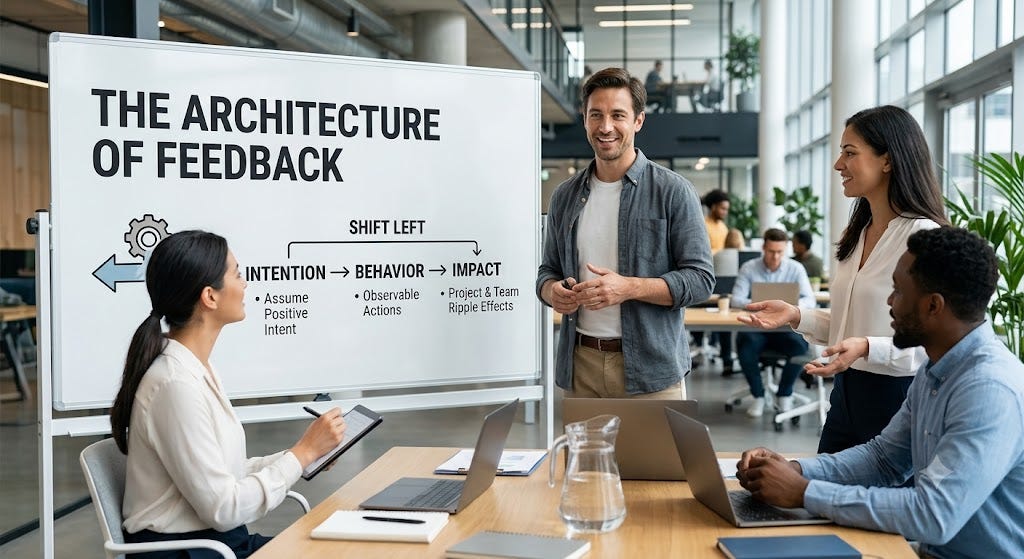
Traditional corporate training tells you to focus on two things: Behavior and Impact. What did the person do, and what was the objective fallout?
But to truly master feedback, you need to engineering-ize the process and Shift Left—moving past the outcome to look directly at the root cause: Intention.
   [ SHIFT LEFT ]
  Intention  ---->  Behavior  ---->  Impact
When analyzing a breakdown or a success, trace the lineage from right to left:
The Impact: The objective ripple effect on the team, code, or timeline.
The Behavior: The observable actions or omissions that occurred.
The Intention (The Shift Left): What was the driving force?
If the action was positive but the outcome was mixed, the intention was likely good, and the breakdown was simply a gap in execution or an unconscious mistake. We highlight the behavior gently to build resilience.
If the intention was deliberately self-serving, you are likely dealing with a culture of credit-hijacking where feedback is used as political currency rather than engineering progress. [aka Meta culture]
By shifting left to analyze intent, you remove emotional bias and address why the behavior happened in the first place, rather than just complaining about the result.
The biggest mistake professionals make is waiting for formal performance cycles to deliver feedback. If the first time your peer or report hears about an issue is during a bi-annual review, you have failed as a collaborator.
“If constructive feedback only appears at the end of a performance cycle, it isn’t coaching—it’s a paper trail. Delayed feedback isn’t meant to help you improve; it’s a retroactive justification to cut a bonus or secure a layoff, a tactic frequently weaponized in stack-ranked cultures to hijack credit and stall your growth.”
Feedback must be continuous and consistent. It does not need to be a formal calendar invite or a documented HR artifact. The most high-impact feedback loops are fast, real-time, and casual:
A quick face-to-face sync right after a high-stakes presentation.
A crisp, objective note left directly inside a complex Pull Request (PR) commit.
A 2-minute alignment chat directly following a chaotic cross-functional meeting.
Keep the positive and constructive notes flowing constantly. When feedback becomes an ongoing, low-stakes baseline conversation rather than a high-stakes event, the anxiety disappears, teams build resilience, and real engineering growth takes over.
So, next time you want to give feedback, don’t hold back. Start on positive note. Acknowledge their work and let me know what they did well. But, also don’t hold yourself back when you see your feedback can help him grow.
Keep feedback flowing
These exercises use the Intention → Behavior→ Impact framework and the concept of Shifting Left to build practical skills.
Comments
Nothing yet. Say the first thing.
Sign in to join the conversation.