
Titanium has been the material of choice for medical implants — dental, orthopedic, joint replacements — for several decades because of three physical properties that happen to also make it remarkably well-suited to sauna use:
First, titanium is non-ferromagnetic. Unlike iron, steel, or nickel-based metals, titanium is not pulled or twisted by magnetic fields. This is the foundational reason patients with titanium implants can safely undergo MRI scans at field strengths up to 3 Tesla — fields that are far more electromagnetically intense than anything a FIR sauna produces.
Second, titanium has very low electrical conductivity and low magnetic permeability. This means it does not absorb electromagnetic energy efficiently, and it does not generate significant heat when exposed to electromagnetic fields. The 2022 Frontiers in Bioengineering and Biotechnology study by Wang and colleagues on titanium alloy implants and microwave irradiation specifically noted that the low permeability and low conductivity of titanium alloy is the reason patients with titanium implants tolerate these electromagnetic exposures safely (Wang et al.).
Third, the heating data from MRI studies is the strongest evidence. Multiple peer-reviewed studies measuring titanium implant heating during MRI exposure — which is far more electromagnetically intense than any sauna — show temperature increases of less than 2°C, well within the FDA safety limit of 4°C (Practice Test Geeks, citing FDA implant heating studies). If titanium does not heat dangerously during MRI exposure, it is not going to heat dangerously in a FIR sauna environment.
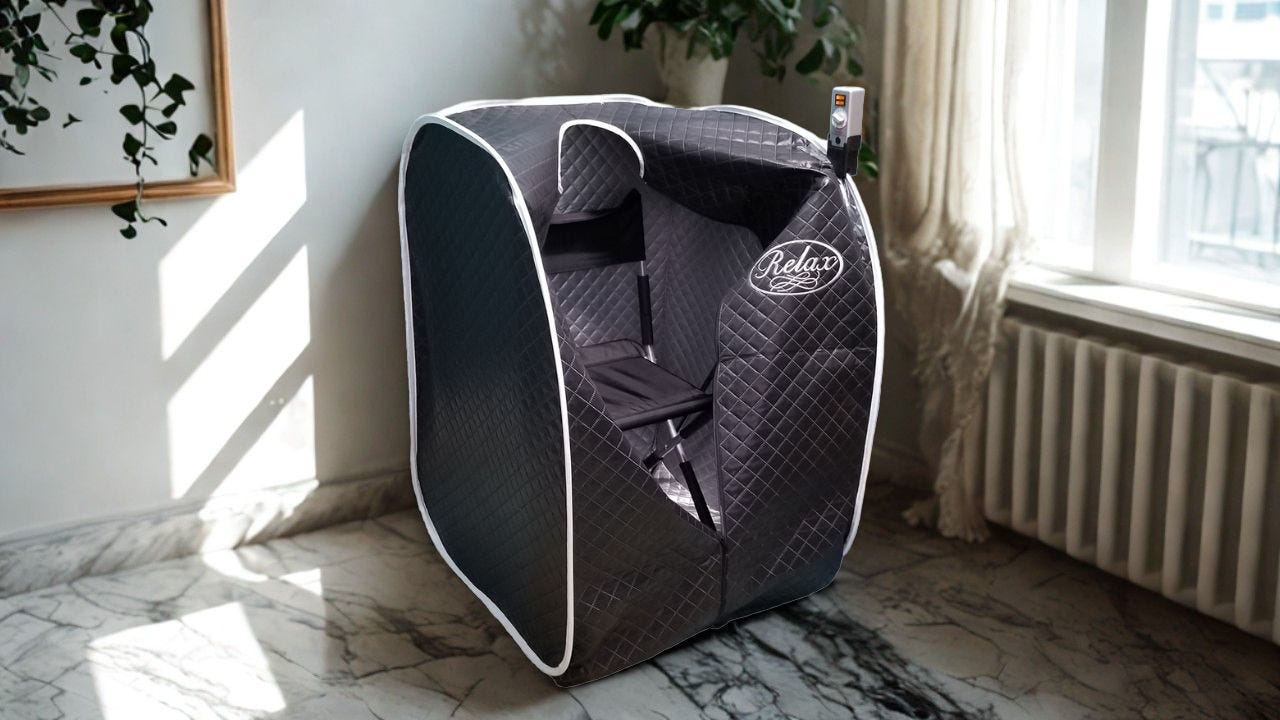
The Relax Sauna’s far-infrared output operates at wavelengths around 9.4 microns — wavelengths that are absorbed primarily by water molecules in tissue, not by metals. Titanium implants do not selectively absorb the FIR energy band the sauna produces, which means the implant is not heated preferentially relative to surrounding tissue. The implant warms only to the extent that the surrounding tissue warms, which is the same gentle, gradual warming everyone experiences during a FIR session.
This is a meaningful distinction from a conventional Finnish-style sauna at 180°F, where convective heat warms all of the body’s surfaces uniformly through air contact. The FIR mechanism is photonic absorption by water — and titanium, being non-magnetic, non-conductive, and biologically inert, is not a target of that absorption.
The single clinical situation worth flagging is the immediate post-surgical period when a titanium implant is still undergoing osseointegration — the three-to-six-month window during which the implant is bonding to the surrounding bone. During this period, surgeons typically recommend avoiding any unusual physical or thermal stress to the area, not because the sauna would damage the titanium itself but because the surrounding healing tissue benefits from a stable environment without added physiological demands. Once osseointegration is complete and the surgeon has cleared normal activity, sauna use does not present any additional concern.
If your titanium implant has been in place for more than six months and your physician has cleared you for normal activity including exercise, hot showers, and other heat exposures, FIR sauna use is in the same category — fully appropriate.
For routine sauna use with a titanium implant that is fully healed and integrated:
No special precautions are required beyond the normal sauna guidelines that apply to anyone.
The implant area may feel slightly warmer subjectively during sessions because titanium does conduct heat from the surrounding tissue, but the actual temperature differential is small and not clinically significant.
Hydration before and after sessions matters for everyone, and it matters slightly more if you have any orthopedic hardware — well-hydrated tissue around an implant maintains better perfusion during heat exposure.
If you have any concerns or experience any unusual sensation in the area of the implant, stop the session and consult your physician. This is a general principle that applies to anyone with implanted hardware, not a sauna-specific caution.
Titanium was chosen as the material for your implant precisely because it is biologically inert, non-magnetic, and well-tolerated under a wide range of conditions including MRI scans at field strengths that vastly exceed anything a sauna produces. The Relax Sauna’s FIR output, delivered at gentle cabin temperatures, presents no meaningful additional risk to titanium hardware. The published research on titanium and electromagnetic exposure has been consistent for decades, and the FIR sauna environment is well within the safe operating range that research has established.
Enjoy your sessions.
References
Wang, Yifu, et al. “Study on TiO2 Nanofilm That Reduces the Heat Production of Titanium Alloy Implant in Microwave Irradiation and Does Not Affect Fracture Healing.” Frontiers in Bioengineering and Biotechnology, vol. 10, 2022, article 829706. doi:10.3389/fbioe.2022.829706.
Shellock, Frank G., et al. “Heating of Orthopedic Implants Used for Fracture Fixation Evaluated at 3-T MRI.” American Journal of Roentgenology, vol. 196, no. 5, 2011, pp. W531-W533.
Ye, Junfeng, et al. “Thermal Effects of Microwave Hyperthermia on Tissues Near Titanium Implants in Animal Models.” Cited in Wang et al. 2022.
This information is provided for general guidance. For specific medical questions related to your implant, please consult your orthopedic surgeon or implanting physician.
No posts
Comments
Nothing yet. Say the first thing.
Sign in to join the conversation.