
I just got back from a family reunion, which is to say I spent several days with the people who share the most DNA with me on Earth. I needed subtitles, and I don’t mean metaphorically.
My extended family spans Israel, Canada, and three distinct regions of America. So when we get together, we bump into the fact that some of us speak English well and Hebrew barely at all while others operate in the reverse. Even those of us who do share a common language have different accents (Canadian “sorries” never fail to make me smile1), different senses of humor, different definitions of “on time,”2 and different rules about what counts as an argument versus a lively conversation. Same gene pool, but it’s a total Tower of Babel situation.
And yet, despite the challenges of connecting with people I hadn’t seen in decades, some of whom don’t share my native language, I felt so profoundly connected and nearly giddy with love and belonging. That remained true although nobody got more punctual.3 Nobody adopted my definition of a reasonable volume and kindness when debating. The love outweighed the friction that sometimes emerges from stark differences.
Part of why, I think, is that nobody at this once-in-a-lifetime reunion expected sameness. When your cousin barely speaks your language, you translate without taking it personally. The trouble starts when someone shares your language, your home, and your bed, and you assume the translating isn’t necessary. But some translation, it turns out, is always necessary.
Which raises the question germane to today’s newsletter: Can we love the people closest to us more than their different brains drive us crazy?
A couple sits in a therapist’s office. The wife is changing jobs and feels completely unsupported by her partner. The husband is dumbfounded. He researched openings for her. He offered to move. He built her a pros and cons spreadsheet.
She wanted him to ask how she was feeling. He gave her color-coded cells.
These two people come into the relationship with different hardware, each one hoping that the other’s can sync up with their own.
That example comes from my conversation with Dr. Cindy Ariel, a psychologist who has spent over thirty years working with neurodiverse couples, where one partner is autistic and one is not. Her new book is Autism and the Two of Us, and our conversation drops tomorrow on the Psychologists Off the Clock podcast.
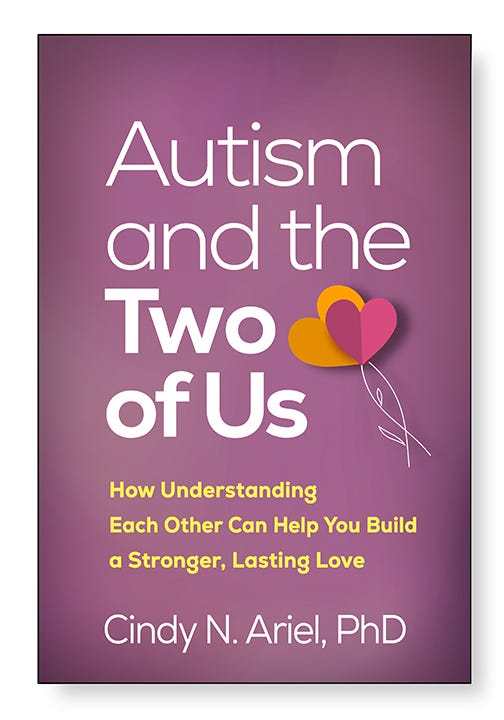
Now, neurological difference runs deeper than accents and time zones, and I don't want to flatten that important fact. But the stance that worked at my reunion of expecting difference instead of assuming sameness is exactly the stance Cindy has spent three decades teaching couples whose brains are wired differently.
That stance is useful to all of us, because in a very real sense, every close relationship is neurodiverse. That is, you did not partner with yourself (probably for the best), which means you partnered with a brain that filters, prioritizes, and makes meaning differently than yours does. Sometimes that's a little differently. Sometimes it's spreadsheet-not-hug differently.
Research on a bias called closeness communication bias shows that we assume the people closest to us define words and interpret situations the way we do, more than they actually do. Ironically, we question our assumptions about our accuracy more with strangers than with people we love. With a partner or other close person, we simply assume we think the same. And so the gap between brains gets read as intent: he doesn’t care, she’s doing this on purpose.
Cindy’s reframe: recognizing that we have different brains helps us also recognize that difference, not malice, drives dissimilar responses and interpretations. It’s two brains moving through the world, marching to their own unique beats.
When you can see the difference as wiring, developmental, or cultural rather than a verdict on how much you’re loved, the resentment can shrink. You can begin to see the spreadsheet less as “they don’t care” and more as “this seems to be what caring looks like in their brain.”
Once you’re reading wiring instead of intent, collaboration options open up. One couple in Cindy’s practice replaced the card-dinner-roses Valentine’s script with picking out flowers together at the Sunday market, whenever that fell. Though it may not be the culturally approved version of romance, it was completely satisfying to both of them. As Cindy’s book explains:
The typical ways of loving must be redefined for success in a neurodiverse partnership.
And perhaps defining success must be done in every one of our partnerships because the “typical definition” was designed for a generic couple that does not actually exist.
Sometimes, though, the answer to the question of whether you can love someone more than you detest their quirks is ‘no.’ Cindy is direct about this: two lovable people sometimes don’t work together, not because either of them is fatally flawed, but because the friction that arises from the differences is too significant. Naming it kindly beats spending a decade trying to bang each other into different shapes.
In the episode, we also covered the red flags that mean a relationship has crossed from difficult into unhealthy (they have nothing to do with neurodiversity), what the research actually says about autistic adults and intimacy, and why couples therapy works better than most people think. The episode comes out tomorrow, wherever you get your podcasts. Come for the science, stay for two couples therapists geeking out in their natural habitat.
Not yet a paid subscriber? Upgrade here to become one.
Comments
Nothing yet. Say the first thing.
Sign in to join the conversation.