
0:00
-21:45
When I was young it was the 1980s. I had blond pigtails, wore overalls as often as possible, and loved playing hide and seek around the neighbourhood. I joined with my big sister, a group of kids of all different ages, and we got a game going on warm summer afternoons.
It felt like a foundation of childhood.
Over my years as a play therapist I noticed hide-and-seek coming into sessions in several different ways and at different ages and stages. I became curious. And, like I do when I get curious, I gathered my experiences and took them on a deep dive to explore what hide-and-seek means and how I could best work with it.
What came out of my research was an affinity for using hide and seek therapeutically, enjoying it almost as much as I did during those neighbourhood games in the 80s.
Our first experience of a hide-and-seek game is often in the arms of our caregivers. Peekaboo. The trusted adult, or the child, covers their eyes with their hands for a few moments, then pulls them away, and with a delighted facial expression exclaims ‘Peekaboo!” The infant often laughs in response.

Allan Schore teaches us that peekaboo is far more than a simple game. It is, in fact, a neurobiological event. A carefully orchestrated cycle of nervous system arousal, disappearance, and return that, repeated hundreds or thousands of times in the first two years of life, literally shapes the developing brain. It’s playful rupture and repair.
Here is what happens. The caregiver’s face appears. It is animated, warm, and engaged. The infant’s arousal rises with excitement, aliveness, and positive affect climbing. Then the caregiver’s face disappears. Tension builds in the gap. The child’s nervous system registers the absence. Disconnection. And then, the face returns and it is lit up, delighted, glad to be back. In that moment of reunion, the infant’s arousal is met, matched, and brought back into regulation through shared joy. The infant’s nervous system learns something essential through that cycle: the gap of tension, disconnection, and uncertainty can be survived. The caregiver will return. And the return will be marked by delight.
The caregivers face is actually building the child’s orbitofrontal cortex, what Schore calls the senior executive of the emotional brain. Situated just behind the eyes, it is exquisitely sensitive to the face, to eye contact, to the emotional expressiveness of the caregiver. It is not fully formed at birth. It is built through experiences, shaped during the first two years of life, by attuned, face-to-face interactions like peekaboo. Every cycle of arousal and regulation, every reconnection marked by a warm and animated face, is laying down neural patterns for affect regulation. The caregiver’s face is, in the most literal sense, building the child’s brain. But this only happens under particular conditions.
First, the caregiver must initiate. They must be willing to play, available enough to enter into the game, regulated enough to bring genuine delight rather than flatness or distraction. A face that does not animated at the beginning and at return, a caregiver too depleted, too frightened, or too overwhelmed to meet the child with joy, is not able to support the building of affect regulation. A distressed face cannot do the work the brain and nervous system needs.
This brings up something worth pausing on, because it speaks to the heart of what peekaboo is building. There has been a big conversation in the play therapy field for the last several years about regulation and co-regulation. A child’s arousal being met by the therapist who then teaches the child to find regulation. It is important work. But, affect regulation, as Schore describes it, is something deeper. I define it as ‘the capacity to be with, feel, and move emotions through the body’. It is our ability to modulate the intensity, duration, and expression of emotional states and it is built through attuned, right brain to right brain caregiving in early life.
Which is why the second consideration matters so much. For peekaboo to build affect regulation, the child must feel safe enough to tolerate the gap. Because there is a real risk in peekaboo. The trusted face disappears. Connection is momentarily lost. For a child whose environment is unpredictable, whose caregiver does not reliably return to them with warmth, the risk of that gap is not worth taking. The disappearance is not a playful pause. It feels like a genuine threat. Peekaboo cannot be played when the nervous system is organized around survival.
What this means is that children can arrive in the playroom having missed peekaboo. Not the game itself perhaps, but the important neurobiological experience it can provide.

Peekaboo seems so simple, but it literally builds affect regulation that supports a person over their lifespan. I began, through my research, to understand hide and seek as a developmentally progressed version of peekaboo.
The structure is similar. Disappearance, tolerating the gap of disconnection, return, and the face of the one who finds you. The child who runs off to find a spot and then waits in the dark for the counting to stop, is asking the same question the infant asked in their caregiver’s arms. Will you come and find me? And when you do, will your face show that you are glad?
In the playroom, within the safety of the therapeutic relationship, that question can finally be asked and answered. In most cases it will be asked and answered again and again. Which makes sense when you consider the repetition involved in peekaboo with an infant and how many times the pattern is repeated to shape the orbitofrontal cortex.
I spent several years working with a preteen boy who loved to hide and especially loved when I found him. My room was not huge and the spots were not plentiful, but he always found somewhere. Under a pile of puppets, behind the dollhouse, inside a blanket fort, under a chair with a blanket draped over.
He was a child who had learned to make his presence small. Not in a way that was immediately obvious, but in that quiet, practiced way children do when the adults around them have not had the capacity to make room for the child’s full, authentic Self. When a caregiver is chronically misattuned, preoccupied, or simply too depleted to meet the child’s emotional aliveness with warmth and presence, the child learns to adapt. They tuck parts of themselves into hiding. They become smaller, more manageable, more careful. Winnicott called this the False Self, a protective structure that develops when the environment cannot receive and reflect back the child’s true nature. What gets hidden is not just emotion. It is the True Self.
A persistent theme in our work together was his feeling that he was not good enough. Not enough to be fully seen. Not enough to take up space. That wound which constructed his internal working model, lives in the body before it ever becomes a thought. It is organized in the right hemisphere, in the implicit relational knowing built through thousands of early interactions that communicated, without a single word, what was welcome and what was not.
Hide and seek offered him something he could not yet ask for. The chance to be looked for. To have someone move through the room with intention and warmth, wanting to find him, all of him. And then, when he was found, to receive a face that showed unmistakable gladness.
I cover my eyes. I count. He hides. I search around while singing a playful, prosodic song about how much I want to find him. And then, when I locate him inside the huge basket under a pile of puppets, my eyes light up, my face expresses delight, and I share my authentic gladness to see him.
Every round of that game offered a different story than the one he carried. You are worth finding. I looked for you and I am glad I did. There you are. There you are.
Eventually, he invited his parents into our seeking game. When they arrived to pick him up at the end of our session he would hide in the room, I would advise them that he had gone missing, and then the parent, with a little coaching and support from me, would initiate a search for him. He started the tender work with me and then was able to ask for it from his caregivers in the safety of the therapy room.
This is relational healing. This is right brain development through hide and seek.

For many years, my office was in a 1910 heritage house. The whole building was our group practice. My client was biologically 11 years old, big for his age, and developmentally younger after experiencing trauma, chaos, and instability in his early life. He loved to play hide and seek and he especially loved using the entire house when there were no other therapists working at our time. Sometimes his sibling would join in when she had her own session with another therapist. The four of us had the run of the whole house.
His sibling and her therapist are in the waiting room counting to 40. We excitedly dash off to find our place to hide. He wanted him and I to hide together, not in separate spots. He goes down the stairs into the basement. The basement in our office is a little damp, has unfinished concrete floors and walls, low ceilings, and smells basement-y. It serves as storage and the laundry room. He leads me to the back corner, opens the heavy metal door that leads into the small furnace room.
We go inside.
It’s pitch black.
I can see nothing.
It feels uncomfortable in my body.
Fear.
I begin to whisper about my feelings in this experience, reflecting the content of what he is doing as well as what was happening inside of me.
I am feeling afraid, uncertain, on the edge of something that is too much for me to tolerate, and I have a lack of agency. He is committed to our needing to stay in the dark furnace room and remain silent. He actually seemed delighted.
I say “I am feeling terrified. It’s so dark. Part of me wants to run out of here.”
He says “No. We have to stay. Be quiet.”
I say “I don’t feel safe in here. I can’t leave. I don’t know what is going to happen next.”
He laughs a little.
When I think about our experience in that furnace room, I think about what was being communicated. Not in words, but through the body, through the dark, through the weight of that metal door. He could not tell me in words what it felt like to be him or what had happened to him in his early life. But he could create the conditions for me to know it from the inside. And I did. What arrived in my nervous system in that room was not mine. The fear, the uncertainty, the lack of agency, the sense that something overwhelming was close and there was no way out. That was his terrifying past experiences projected onto, or into, me. All while the person with me seemed to not feel any of this at all.
Lisa Dion, founder of Synergetic Play Therapy, names this phenomenon the “Set Up.” The child unconsciously orchestrates the play or the relational dynamic so that the therapist is recruited into feeling the child’s internal experience. The therapist becomes the vessel for what the child cannot yet hold or articulate. This concept has deep roots in the clinical literature. Melanie Klein first described projective identification in 1946, the idea that unbearable internal experience can be unconsciously evacuated into another person, who then carries and feels it as their own. Wilfred Bion extended this through the 1950s and 60s, describing how the therapist functions as a container for the client’s unprocessed emotional experience, metabolizing what the child cannot yet digest alone. What Allan Schore’s work, more recently, adds is the neurobiological mechanism, the explanation of how this transmission actually happens. Right-brain to right-brain, implicit and embodied, below the level of conscious awareness, before a word is spoken. The child’s nervous system speaks directly into the therapist’s. The body receives what the mind cannot yet hold.
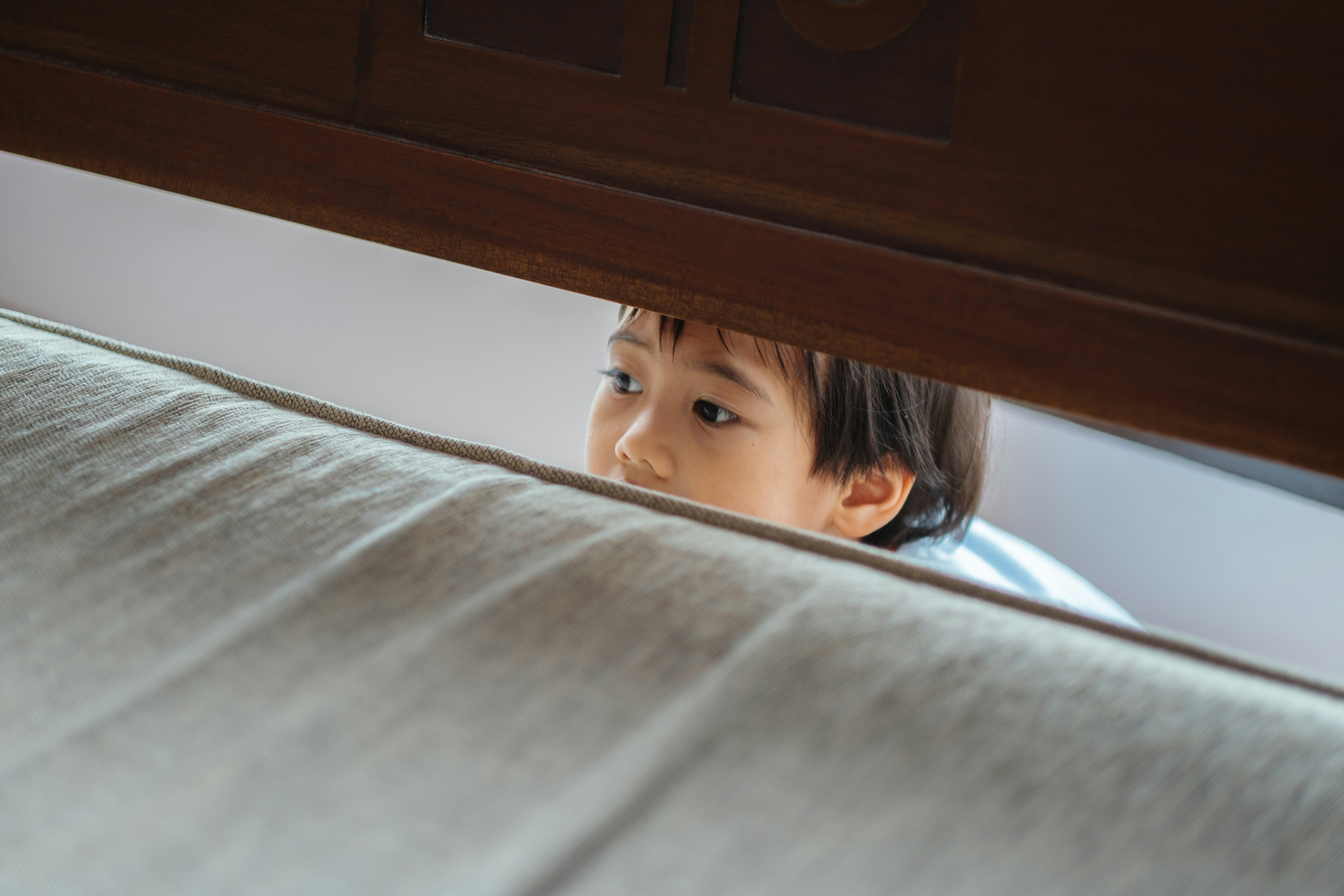
Sometimes hide and seek is much smaller. It is tiny figurines buried under the sand.
A child buries six things. I count to ten and then search the sand with my hands and find them. Then it is their turn. They cover their eyes and count, I hide six things, they find them.
Can you hear the volley in that last paragraph describing the game? There is a relational back and forth.
When we play like this I often add a hidden thing that will surprise the child. Something to make them laugh or delight them, bringing in a little vagal tone. Or something connected to a past session, building a relational bridge between us. A small way of saying I remember what has been special in our time together, and that it matters to me.
Hide and seek in the sand is small. And I wonder if the smallness is exactly the point. For some children, hiding their whole body and waiting to be found is too much. Too vulnerable. Too risky. Too tender. So my delight in finding the small hidden things comes alive as if I were laying eyes on the child themselves in a regular game of hide and seek. It is vicarious finding. Vicarious delight. Vicarious attachment repair. My joy is focused on the tiny cat figurine, but it is intended for the child.
The question underneath the sand tray hide and seek is the same. It is just asked quietly, with more protection. Something in me is hidden. Will you look for it? Will you find it? And when you do, will your face show that it mattered?
And then there are children who play peekaboo exactly as it is meant to be played.
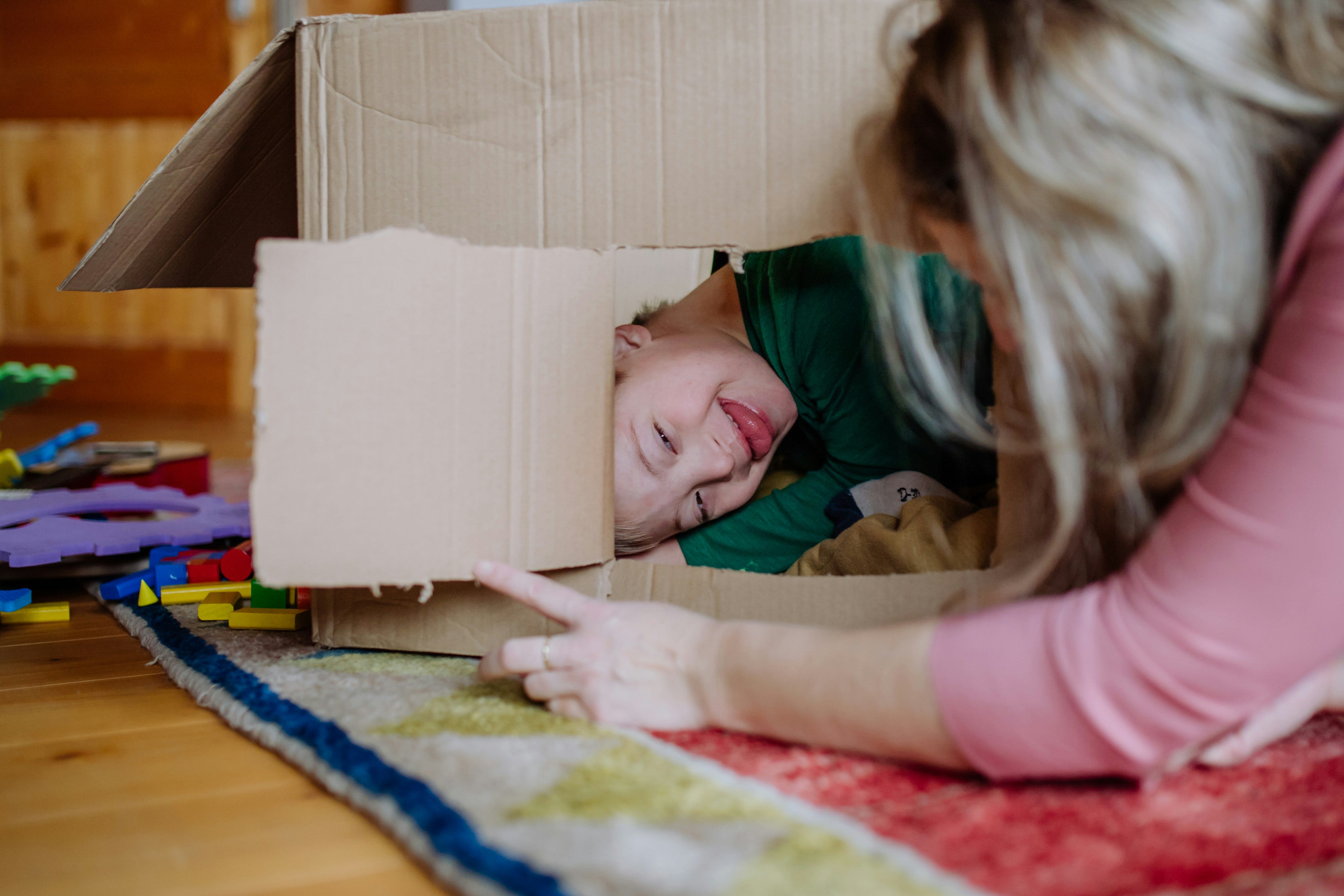
She was seven years old. Every session, at some point, she would disappear behind the dollhouse. And then she would pop out. Dramatically. Joyfully. In a different way each time. A different angle, a different sound, a different expression on her face. Sometimes slowly, building the anticipation. Sometimes all at once, launching herself into view.
And I was delighted to see her every single time.
Real delight. The kind that arrived in my body before I decided to express it. The kind a seven year old nervous system can detect and knows is true. And, man, did we laugh.
She was playing peekaboo. Pure, essential, developmental peekaboo. The disappearance, the gap, the return, and the lit-up face of the other. She had found, in that room, in that relationship, the two conditions Schore describes. A willing other who would initiate and receive. And enough safety to trust that the loss of connection would be met, once again, with genuine gladness.
What was being built behind that dollhouse was not just a game. Every pop, every reappearance, every round of real delight was laying down something in her nervous system that may not have been laid when she was younger. The gap can be survived. I will come back. And when I return, the face across from me will show that I am worth seeing.
I want to say something about the delight itself, because it is not incidental. In these moments it is the therapy. The intervention, if you will.
The delight I feel and express changes in intensity and volume from child to child. It is attuned to what the moment asks for. Sometimes it is soft and tender, quiet, present, warm. Other times the play is loud and boisterous and so my delight has more volume, more expression, more drama. What matters is that it is authentic and it is attuned.
I am also mindful of the child’s capacity. Can they tolerate my full delight? Will that be too much for them? For their system? Perhaps when they are discovered and seen, they need a smaller, softer dose of joyfulness. If I am my full, delighted Self too soon it could feel misaligned, like misattunement. Sometimes the connection needs to be titrated in little drops around the injuries until the child’s capacity is increased.
What the child is asking in every form of this game — from behind her tiny hands, in the furnace room, under the puppets, in the sand, behind the dollhouse — is the same question. It is a tender attachment question.
Will you come and find me?
And when you do, are you glad to see me?
In the playroom, we get to answer that question with our whole selves. With our eyes, our voice, our nervous system, our genuine and embodied gladness. It can seem simple. It is just our warm presence and the true pleasure we feel in being with the child. But for the children who have been unconsciously yearning for that experience, it is not simple, it is medicine.
I would love to hear your thoughts on this and how hide and seek arrives in your practice.
Thanks for reading,
Warmly,
Rachael.
If you are curious and want to learn more about a relational embodied approach to play therapy and clinical work with children:
group supervision sessions for the Fall Season will be organized and open to reserve a seat soon
I have some workshops in development for the Fall and ongoing
message me to chat about 1:1 consultation
I look forward to meeting you.
No posts
Comments
Nothing yet. Say the first thing.
Sign in to join the conversation.