
0:00
-16:11
(I can read it aloud to you ↑, if you feel more like listening)
It is 2017. I am midway through training in Synergetic Play Therapy, and I am showing my supervisor a video of me in session with a child that felt challenging. Part of the challenge was her repetitive play. She took plush baby dolls wearing onesies with sweaters and stuffed materials and silks into their clothes until their bodies were much, much bigger and their clothes looked like they were about to burst.
I couldn’t make sense of it and wasn’t sure where to go in our work.
The play had been repeated many times.
I felt stuck.
While I was in the room with her, I noticed my body felt very heavy. There was a bone-deep exhaustion that moved over me. At times, I felt so depleted that I wanted to give up on being awake and lay on the floor to go to sleep.
It felt uncomfortable inside my body when I was with her.
My supervisor and I are together, on Zoom, watching the session unfold over our screens. There I am in the video, sitting on the floor while the child gets the babies and the pile of materials and begins to stuff them.
Then I see it.
I dissociate.
My eyes go blank, glaze over.
My facial expression goes flat.
One.
Two.
Three.
About eight seconds later I very slightly shake my head side to side and we watch me come back into the room, back into my eyes, back into my body.
At first I was surprised by what I saw, then I felt a little ashamed, but pretty quickly from there I became wholly enthused by what I had just witnessed.
This is why watching ourselves in session is so valuable. When I was in the room I couldn’t see myself leaving the moment like that. I didn’t know it was happening. I could only feel the fuzz come over and then that bone-deep desire to lay flat on the floor.
Reflecting on those sessions now, I can see that she was stuffing those baby dolls until their bodies were about to burst, full of something they could barely hold, almost spilling out beyond their edges. She was showing me, metaphorically, about a lack of capacity and the subsequent overwhelm. And those babies’ big bodies in the too-small clothes must have been really uncomfortable. Perhaps they felt heavy, tired, the dorsal vagal discomfort that was also happening in the room between us. She was full of something she could not contain. I also became full of it as our nervous systems resonated in session.
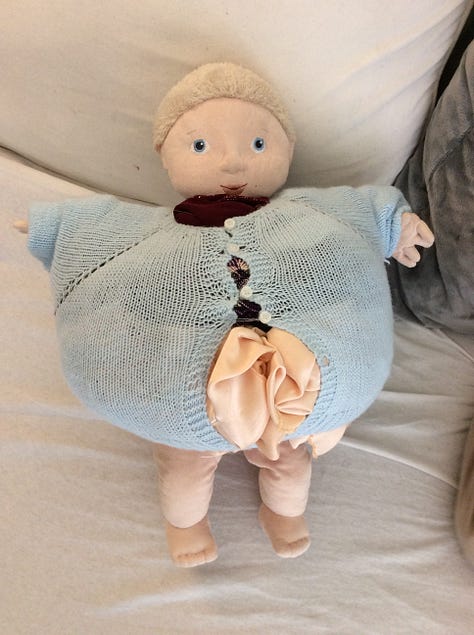


After I saw myself in that video and discussed it with my lovely, warm, accepting supervisor, something shifted. What was being enacted between my client and I in session unconsciously was now in my awareness. I had observed it from the outside.
This was a very exciting beginning for me. I was working with the nervous system using Synergetic Play Therapy but it was in the context of my training in Somatic Attachment Psychotherapy, from 2016 forward, that I really clarified what had transpired in this session and how I wanted to develop my practice so I could respond.
When two nervous systems are in connection, each brings its own state, its own story and patterns. Her nervous system carried significant dorsal vagal trauma. The collapsed, hypoaroused state she existed in was entering the intersubjective space between us and I was being pulled into it.
I was feeling what her body lives with all the time.

This is the relational field at work. It is the implicit, intersubjective space between two people. What is happening beneath the level of words. It is unconscious. It includes that nervous system-to-nervous system communication that Schore describes as right-brain-to-right-brain, the felt quality of the space itself, and the moment-to-moment nonverbal exchange in an attuned connection. The field is not created by either person. It arises between them. And it is exquisitely sensitive to what each person carries into the room.
The relational field is the space that requires therapist presence, embodiment, self-awareness, and trust, to decipher. There is rich, meaningful information about the child that can be sensed by the therapist through the intersubjective field.
Embodied play therapy begins with and requires the therapist’s own body.
What I experienced in that room has a name and a solid, supportive body of research it stands on.
Schore gives us the right-brain-to-right-brain framework to explain this kind of experience as somatic countertransference, also called somatic resonance. The therapist’s body reacts to the client’s conscious and especially unconscious communications. It is the therapist’s right hemisphere receiving and registering what the child’s right hemisphere is transmitting, below the level of conscious awareness, through the implicit relational field between them.
The body is the instrument. And mine was doing its job by registering my client’s deep collapse and dissociation.
Sensations of sleepiness and muscle tension in the therapist correspond with clients who are dissociating or suppressing activation. The therapist’s body picks up what the child cannot yet express. The exhaustion I felt, the pull toward sleep and collapse, was her dorsal vagal state arriving in my nervous system.
The more disconnected the client is from their own emotion or sensation, the more strongly the therapist may feel it. Perhaps you are sitting with a parent who is sharing something deeply painful while showing no emotion at all, because they have disavowed that feeling, walled themselves off from it. You find yourself awash in a deep wave of sadness. Their emotion is present in the relational field. They cannot feel it. So you do.
As I wrote in the previous essay on hide and seek, this mechanism has roots that go back to Melanie Klein and Wilfred Bion, who named it projective identification. It is the process by which split-off, unbearable emotional experience is evacuated into another person, who then carries it. Schore brings this concept into interpersonal neurobiology and makes something clear: when a child numbs or shuts down, disconnecting from their own pain, they do not need less from us. They need more. The pressure on the therapist's nervous system actually increases. The emotion does not disappear when the child disconnects from it. It moves into the field, and lands in the therapist’s body.
Bion described the therapist’s role as a container, receiving the split-off material the client cannot hold, processing it within themselves, and returning it in a more metabolized form. The child stuffing those dolls until they were about to burst was doing this both symbolically in the play and somatically in the room. She was showing me, in the only language available to her, exactly what was happening between us.
Ed Tronick describes this as a dyadically expanded state of consciousness: the idea that two people in genuine connection do not simply influence each other, but expand each other's individual states into something more complex and coherent than either could hold alone. My client's collapsed state and my collapsed response were not two separate events happening in parallel. They were one event, unfolding in both our bodies.
The question is not whether this happens. It does, and it will, in every room we enter. The question is whether we are conscious enough to be clear about what our bodies are receiving, or whether, like me on that floor, we are pulled under before we even notice we have left the surface.

This is why embodied self-awareness is not a personal development luxury for play therapists. It truly is a clinical skill. Our bodies are collecting information about the child. The exhaustion, the restlessness, the sudden sadness, the strange urge to run away or hold very still. These are not random feelings we have during the play. They are the work, waiting to be felt, known, and then integrated.
Schore is direct that the therapist’s moment-to-moment somatic and emotional reactions to the client serve as crucial sources of information about the child’s unconscious relational world. By learning to attend to these signals and stay curious about what the body is receiving rather than getting swept away, the therapist can begin to bring the child’s implicit experience into conscious awareness.
Engaging in my own somatic therapy changed the game in my therapy room, and my life. Experiencing a client's dissociation and dorsal state in this way is taxing on a therapist. It doesn't just brush off when we walk through our office door at the end of the day. There can be a residue that stays in the body, in the mood, in a vague heaviness that lingers into the evening. Having a place to bring that, to process it with someone who understands the somatic language, became a necessary support.

Most of the time, receiving somatic material in session is not intense dissociation. It is quieter than that, and more continuous. It is the heaviness that settles in my chest when a child is carrying grief they have no words for. The restlessness in my legs when a their body is full of unexpressed fear. The unexpected loneliness that arrives in me when I am sitting with a child whose play is technically elaborate but somehow empty of true contact. The subtle contraction in my own nervous system when something unspoken is present in the room.
In these moments I do my best not to leave. I receive.
And what I have learned to do with what I receive is to pause, not visibly, not dramatically, and turn toward it. To be with it clearly enough that I can tell what it is. To ask, with as much honesty as I can bring: is this mine, or is this theirs? Sometimes it is mine, and that is important information too. But often, especially when the feeling arrived without cause, it belongs to the child. It is what their body is living with that they cannot yet bring into words or symbol or conscious awareness.
Once I have a sense of what I am holding, the next task is to regulate. Not to discharge the feeling, push it away, or rush back to a feeling of ease, but to actually metabolize it. To make sure my own capacity is wide enough to hold what is there, in the room between us. This is the work beneath the work. The child cannot move through what they cannot yet feel. But they may be able to move through it if there is a safe, accepting, attuned someone in the room can feel it steadily, without being overwhelmed by it.
Dissociation is what happens when that capacity is exceeded. When the material arriving through the field is more than the therapist’s nervous system can receive and metabolize in the moment, the system does what nervous systems do. It protects itself. It leaves. That is what happened on that video. Her dorsal vagal collapse arrived in the field between us and exceeded what I could hold at that stage of my own development. My body received the sensations and was taken over, because I did not yet have the internal resources to metabolize what was arriving and to stay present at the same time.
This is why the therapist’s own ongoing healing work is not optional. The wider our own window of tolerance, the more we can receive through the field without being pulled under by it. The more familiar we are with our own inner landscape, the more quickly we can distinguish what is ours from what is theirs. And the more consistently we can do this, the more available we are to the child whose nervous system is reaching, through the only channels it has, toward something it cannot yet name.
What changed in the sessions that followed was not that I stopped receiving her. I could not stop that, and I would not want to, even though it felt uncomfortable in my body. What changed was that I learned to stay closer to my own inner state. To notice what was arriving. To feel the pull toward collapse and remain curious about it rather than becoming it.
The video had shown me the moment of return. That slight shake of my head. The eyes coming back. My body softening as if I had arrived back inside it. I began to use that. When I felt the fuzz coming over me in session, I learned to catch it earlier, to orient back to myself before I was fully gone. The rupture of my leaving her was still there sometimes. But so was the repair, the coming back.
In the sessions that followed, things felt easier. Not easy. It was still hard to stay present. But I had increased capacity to hold steady. I was more aware of what was happening in my body and more able to stay with it rather than disappear into it. Making the unconscious conscious had given me something to work with.
Her play slowly shifted in response. Not because I had changed my technique or my approach. Because the field between us had changed. I was more steady, grounded, regulated, consistently there, and her nervous system could feel it.
Thanks for reading,
Warmly,
Rachael.
No posts
Comments
Nothing yet. Say the first thing.
Sign in to join the conversation.