
Nuclear is not one machine. It is a family of technologies designed for different scales, fuels, locations, and public purposes.

The interlude before this chapter asked readers to reconsider nuclear power honestly: neither by forgetting the accidents that shaped public memory nor by pretending that the technologies, institutions, and risks of nuclear energy have remained frozen in time. With that ground properly considered, the discussion can now move from whether nuclear power deserves a place in American energy policy to what kind of nuclear system the nation must build.
Nuclear energy is not returning because America has rediscovered a favorite technology. It is returning because the country needs firm, clean, compact, domestic power at a scale that few other resources can provide. It is returning because electricity demand is growing, dependable margins are narrowing, industrial and computational loads are arriving faster, and the strategic cost of depending on foreign fuel-processing and manufacturing capacity has become impossible to ignore.
The return is also more tangible than earlier cycles of enthusiasm. Existing plants are seeking longer operating lives and additional output. Previously closed reactors are moving through restart reviews. Utilities have filed applications for small modular reactors. Advanced reactors are under construction or formal regulatory review. New fuel facilities are being licensed. Domestic enrichment is receiving sustained federal support. Test beds are opening. Long-lead equipment is being financed. These are not yet the same thing as a mature deployment program, but they are more than speeches and venture presentations.
The central task is therefore not to choose one reactor and declare victory. It is to rebuild the complete system that can preserve, license, fuel, manufacture, construct, operate, and eventually retire many kinds of reactors responsibly.
The Return Is Being Driven by Need
The United States still operates the world’s largest commercial nuclear fleet. Ninety-four reactors provide roughly one-fifth of the nation’s electricity, and the fleet operated at an average annual capacity factor of about 91 percent in 2025. That output is especially valuable because it is available through seasons, weather changes, and most hours of the year without continual fuel deliveries or combustion emissions.
Those characteristics once seemed merely useful. They are becoming strategic. A grid built around narrower reserve margins, weather-dependent output, constrained transmission, larger industrial loads, and more severe cyber and physical threats places a premium on generation that can remain present when the system is stressed. Nuclear power does not answer every grid problem, but it provides an unusually durable foundation beneath the resources that must vary, store, transmit, or respond.
The compactness matters as well. A nuclear site can deliver large amounts of energy without requiring an equally large fuel-delivery network or geographic footprint. Its fuel can remain on site for long periods. Its output can support factories, data centers, military installations, hospitals, water systems, and communities without making their operation dependent on favorable weather during the same hour.
The argument is not that every region should build the same reactor. It is that a nation seeking abundance, resilience, and sovereignty should retain access to the full range of nuclear tools.
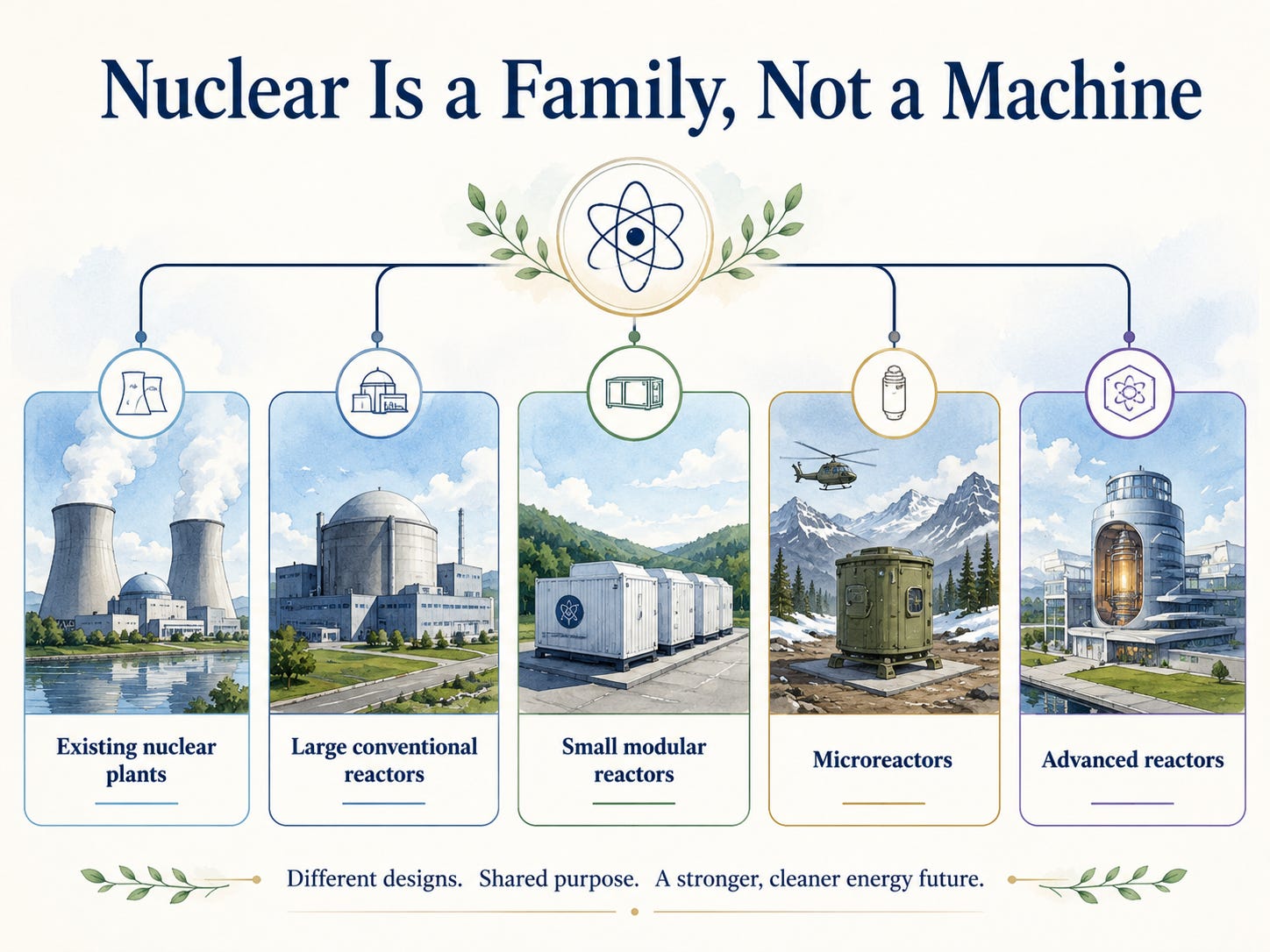
Nuclear Is a Family, Not a Machine
Public discussion often treats nuclear power as though every project were a variation of the same large twentieth-century plant. That is no longer an adequate picture. The emerging nuclear family differs in output, coolant, fuel, operating temperature, construction method, customer, location, and purpose.
• Existing nuclear plants provide the fastest path to preserving large quantities of dependable clean power through safe-life operation, modernization, uprates, and carefully reviewed restarts.
• Large conventional reactors remain appropriate where a utility or region needs sustained gigawatt-scale capacity and can support a multi-unit program.
• Small modular reactors divide capacity into smaller increments and seek to move more work into repeatable factory production and standardized field assembly.
• Microreactors are designed for much smaller loads where resilience, remoteness, fuel logistics, or mission assurance can matter more than bulk-grid economics.
• Advanced reactors use different fuels and coolants to pursue higher temperatures, passive behavior, flexible output, thermal storage, industrial heat, hydrogen, desalination, or other capabilities beyond electricity alone.
These are not stages in a contest that produces one winner. Existing plants, large reactors, SMRs, microreactors, and advanced systems can serve different parts of the same national architecture. The discipline is to match the machine to the mission and to judge each design by what it can actually deliver.
The Existing Fleet Is the First Build
The first nuclear priority is not a new rendering. It is the fleet already connected to the grid. Existing sites possess licensed operating organizations, trained workers, emergency plans, security systems, transmission access, cooling infrastructure, community relationships, and decades of accumulated knowledge. Replacing that combination after a premature closure is far more difficult than preserving it.
Subsequent license renewal can extend qualified plants from 60 years of operation toward 80 years, subject to detailed review of aging management, materials, structures, and environmental impacts. Uprates can add output through improved turbines, generators, instrumentation, operating limits, and other plant modifications. The Nuclear Regulatory Commission has approved uprates adding roughly 8,000 megawatts of electric capacity over time - the equivalent of several large reactors without developing several new sites.
Modernization also includes digital controls, cybersecurity, cooling and electrical upgrades, improved fuels, component replacement, workforce renewal, and stronger domestic fuel arrangements. These investments are not glamorous, but they may preserve more near-term firm clean power than any other nuclear action available.
The restart efforts at Palisades in Michigan and the Christopher M. Crane Clean Energy Center in Pennsylvania are especially significant. Both remain subject to NRC licensing and inspection rather than assumption. Their importance lies in testing whether the nation can responsibly recover valuable nuclear assets after shutdown. A restart is not a shortcut around safety; it is a demonstration that preservation, inspection, repair, relicensing, and disciplined operation can sometimes restore capacity that would otherwise take far longer to replace.
The governing principle should be simple: retire a nuclear asset because it can no longer operate safely or economically after honest review - not because the national value of its dependable output was never placed on the ledger.
Large Reactors Still Have a Large Job
The rise of smaller designs has sometimes created the impression that large reactors belong to the past. They do not. A region facing sustained multi-gigawatt demand may be better served by a fleet of large standardized units than by assembling the same capacity from many smaller machines. Large plants can anchor transmission systems, industrial regions, and long-term fuel-secure generation for generations.
The lesson of Vogtle Units 3 and 4 is not that the United States has forgotten how to finish a large reactor. The units are operating. The lesson is that rebuilding a dormant supply chain through a first-of-a-kind project, an incomplete design, changing contractors, lost workforce continuity, and one-off procurement is painfully expensive. The next large project must begin where the previous one ended: with completed engineering, trained teams, qualified suppliers, captured lessons, and a commitment to repetition.
That is why the June 2026 federal conditional financing structure for long-lead AP1000 equipment matters. The program is intended to support equipment purchases for as many as five two-unit projects - potentially ten reactors - and to move major orders earlier in the schedule. Its deeper purpose is to convert possible projects into a visible demand signal for forgings, reactor vessels, steam generators, pumps, valves, turbines, generators, and other components that suppliers cannot produce on command.
Large reactors should not be forced into places that cannot finance, absorb, cool, or govern them. But where the need and institutional capacity exist, America should not surrender the economics and resilience that can come from building proven large designs as a program rather than as isolated national experiments.
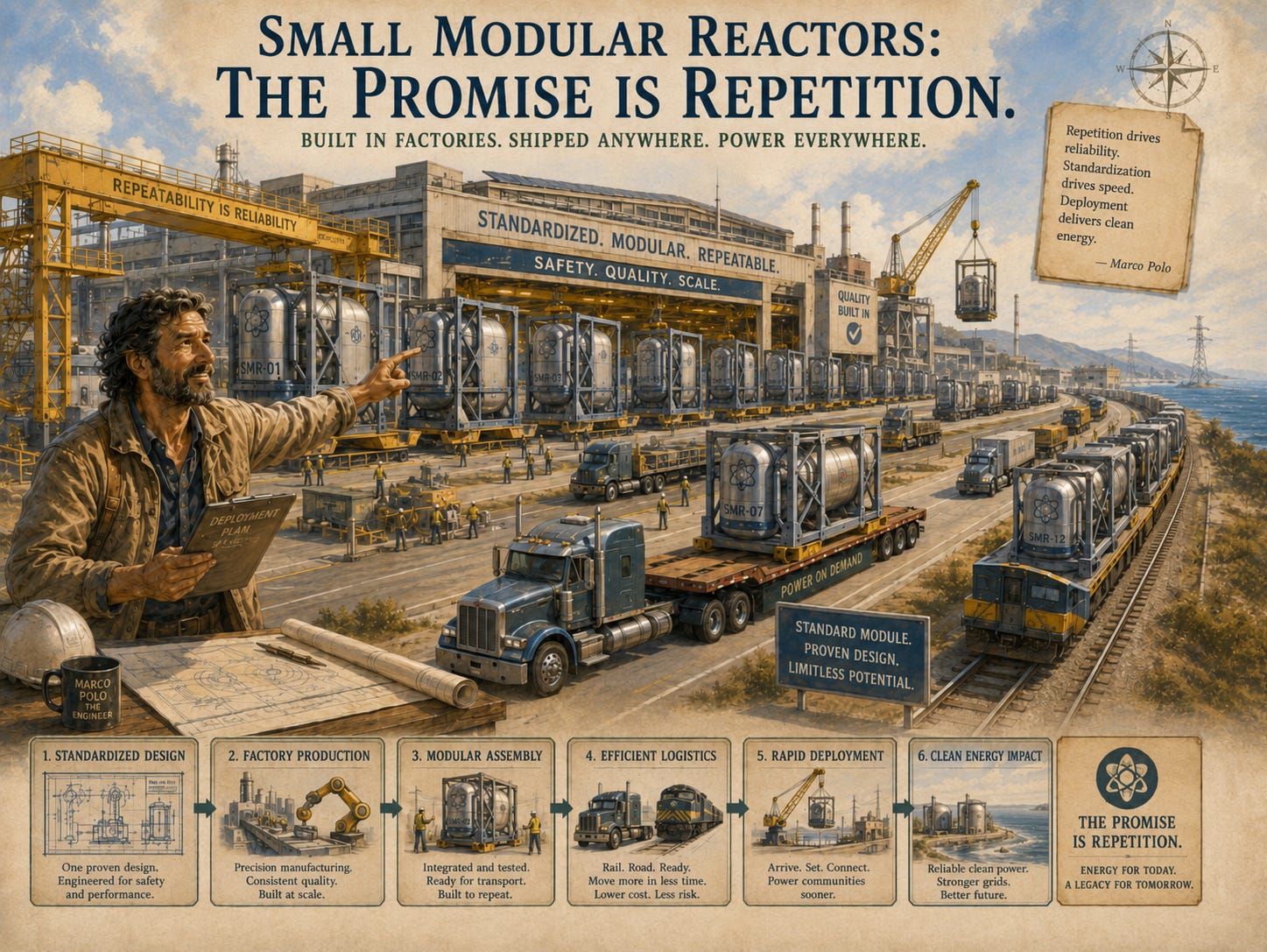
Small Modular Reactors: The Promise Is Repetition
An SMR is not valuable merely because it is smaller. Smallness can reduce the amount of capital placed at risk at one time, allow capacity to be added in stages, and fit sites or grids that cannot accept a gigawatt-scale unit. But the industrial promise is repeatability: a stable design, factory-produced modules, common components, shorter field schedules, and learning that carries from one unit to the next.
That promise must be earned. A first unit still bears design completion, licensing, factory startup, tooling, quality assurance, and workforce costs. Small reactors do not automatically produce small prices. Their economics improve only when customers order enough similar units for the manufacturing system to learn, suppliers to invest, and construction teams to repeat the same work.
Retired coal sites may provide one of the strongest early markets. They can offer transmission access, water, industrial land, roads, rail, skilled communities, and a local identity already tied to power production. DOE analysis has identified hundreds of operating and retired coal sites as potential nuclear candidates and estimated that reuse of suitable site assets could reduce construction costs materially. The opportunity is not to place an abstract reactor on a blank map, but to repower energy communities using infrastructure the nation has already paid to build.
The Tennessee Valley Authority’s construction-permit application for a BWRX-300 at Clinch River and DOE’s May 2026 selections providing more than $94 million for licensing, supply-chain, and site-preparation work are signs of a more deployment-oriented phase. They do not prove commercial cost or schedule. They do show that the conversation is moving from generic enthusiasm toward specific sites, applicants, designs, and work packages.
The decisive moment will come when one customer becomes several, and several projects become a fleet order. That is when modularity becomes an industrial method rather than a description of size.
Microreactors: Power Where Fuel Logistics Become Risk
Microreactors occupy a different category. Their early value may be greatest where the alternative is not an efficient regional grid but diesel delivered over long, vulnerable, or expensive routes. Military installations, remote communities, mines, ports, critical communications sites, disaster-recovery hubs, and resilient microgrids may value years of compact fuel and continuous output more than the lowest wholesale cost per megawatt-hour.
Project Pele illustrates the national-security logic. The Department of Defense demonstration is designed as a transportable high-temperature gas reactor in the roughly 1-to-5-megawatt range, manufactured in modules and intended to reduce dependence on repeated fuel convoys. Its purpose is not to replace a utility reactor. It is to reduce the logistical tail and exposure created when mission-critical electricity depends on continual liquid-fuel delivery.
Microreactors will still require qualified fuel, transport packages, site preparation, security, operating models, decommissioning plans, and a licensing approach proportionate to their risks. Their small size does not erase those obligations. It allows the obligations to be designed around a different mission.
Advanced Reactors Expand the Product
Advanced reactors widen the nuclear proposition beyond steady electricity. High-temperature gas reactors can pair electricity with process heat. Sodium-cooled reactors can operate with thermal storage. Molten-salt systems may offer different pressure and temperature characteristics. Heat-pipe designs can simplify heat transport at very small scales. The relevant question is not which coolant wins an argument. It is which complete design can be licensed, fueled, built, operated, maintained, and repeated for a real customer.
The pipeline is becoming physical. In March 2026, the NRC issued a construction permit for TerraPower’s Kemmerer project in Wyoming, a 345-megawatt sodium-cooled reactor paired with storage designed to raise output when needed. The Long Mott application in Texas proposes four X-energy modules totaling about 320 megawatts and supplying both electricity and heat to a Dow industrial site. Kairos Power is constructing test reactors in Tennessee to establish data and operating experience for fluoride-salt-cooled technology.
DOE’s Reactor Pilot Program added another kind of milestone when four privately developed reactor designs completed zero-power fueled criticality demonstrations by early July 2026. Criticality means a controlled chain reaction was achieved; it does not mean the projects are commercial power plants or that economics and full operation have been demonstrated. But the distinction cuts both ways. These projects moved beyond conceptual slides into fabricated fuel, assembled systems, authorization, testing, and measured nuclear behavior.
This is how a technology family matures: test reactors before commercial fleets, first plants before repeat plants, limited demonstrations before broad claims. The nation should celebrate physical progress without confusing a milestone with the destination.
Fuel Is the First Factory
The reactor receives most of the attention, but fuel determines whether the machine can operate. The chain begins with uranium mining and milling, then conversion, enrichment, deconversion where needed, fuel fabrication, transport, qualification, and delivery. Each step requires specialized facilities, licenses, workers, materials, quality controls, and long planning horizons.
The existing light-water fleet primarily uses low-enriched uranium. Many advanced designs require high-assay low-enriched uranium, enriched above conventional reactor fuel but below 20 percent uranium-235. HALEU can support smaller cores, longer operating cycles, higher burnup, or different performance. It also creates a supply problem: a reactor developer cannot commercialize a fuel form that does not exist in reliable commercial volume.
DOE’s January 2026 commitment of $2.7 billion over ten years for domestic enrichment services is therefore foundational. It supports expanded low-enriched uranium capacity and the beginnings of a HALEU supply chain. Centrus had produced 900 kilograms of HALEU under DOE’s demonstration contract by mid-2025, but demonstration quantities are not yet a broad competitive market. Enrichment must be followed by deconversion, fuel-form production, qualified transportation packages, and licensed fabrication capacity.
The NRC’s February 2026 license for the TRISO-X fuel fabrication facility in Tennessee is an important part of that chain. TRISO fuel surrounds each small fuel kernel with multiple carbon and ceramic layers and is intended for several high-temperature reactor designs. DOE’s Fuel Line Pilot Program similarly seeks to move advanced fuels from development toward production.
A reactor without qualified fuel is not a power plant. It is a design waiting on chemistry, machinery, licensing, and time. Fuel security must therefore be planned with the reactor order book, not after it.
Regulation Must Learn Repetition
Nuclear regulation exists because the technology demands disciplined protection of the public. A nuclear return that weakens that trust would defeat itself. The objective is not less regulation. It is regulation that understands the technology before it, focuses effort on meaningful risk, reaches decisions on a known schedule, and allows approved learning to be reused.
The NRC’s Part 53 rule, finalized in March 2026, creates an optional technology-inclusive, risk-informed, performance-based licensing pathway for commercial reactors. It is important because a framework developed around large light-water reactors should not require every sodium, gas, salt, or heat-pipe design to pretend it is the same machine. The agency has also proposed a more streamlined Part 57 pathway for microreactors and reactors with comparable risk profiles.
New rules alone will not create deployment. Applicants must submit complete designs and defensible safety cases. Regulators need enough engineers, inspectors, technical tools, and institutional experience to review them. Standard designs should be reviewed once and referenced repeatedly. Similar units should benefit from prior findings while remaining accountable for site-specific conditions. Environmental and safety reviews should proceed in parallel where possible rather than serially through avoidable administrative delay.
The measure of reform is not the number of days removed from a calendar. It is whether a predictable process produces safe decisions soon enough for utilities, suppliers, communities, and investors to act on them.
The Knowledge System Must Be Rebuilt
Factories cannot scale what laboratories, universities, codes organizations, and test facilities have not matured. A nuclear industrial system therefore includes research reactors, irradiation facilities, hot cells, fuel-testing loops, digital twins, materials laboratories, cybersecurity ranges, and places where new systems can be operated before they are placed beside customers.
Idaho National Laboratory’s DOME test bed opened in April 2026 to host privately developed microreactor experiments. Purdue’s PUR-1, the nation’s only all-digital university research reactor, is being used to test digital communications, artificial intelligence tools, digital twins, and cybersecurity methods relevant to advanced systems. These facilities are small compared with commercial plants, but they shorten the path between a promising concept and evidence that regulators, operators, and customers can evaluate.
The same infrastructure trains people. DOE’s 2026 university and workforce awards support reactor-safety curricula, certifications, facility upgrades, and partnerships among universities, technical colleges, national laboratories, and industry. The workforce challenge is not solved only by producing more nuclear engineers. It also requires technicians, operators, craft labor, inspectors, radiation-protection professionals, cybersecurity specialists, quality personnel, and instructors who can pass nuclear discipline to the next generation.
A nation that allows its nuclear knowledge system to atrophy will struggle not only with fission. It will also be poorly prepared for fusion and other long-term technologies that depend on many of the same capabilities in materials, regulation, heat transfer, radiation science, precision manufacturing, and complex-project execution.
Factories, Order Books, and Nuclear-Quality Work
A reactor project creates unusual demands on industry. Components must be manufactured to exact specifications, records must remain traceable, welds and materials must be inspected, nonconformances must be resolved, and suppliers must maintain qualified processes over long schedules. A commercial component that performs well may still be unacceptable if the evidence of how it was produced cannot meet nuclear requirements.
That discipline is a strength, but it creates a market problem when projects arrive one at a time. Suppliers cannot justify new forging capacity, machine tools, clean manufacturing areas, quality programs, or workforce pipelines for an order that may never be repeated. Utilities hesitate because the supplier base is thin; suppliers hesitate because the utilities have not committed. The industry becomes expensive partly because it is asked to remain ready without being given a durable sequence of work.
The answer is coordinated demand: standard designs, multi-unit commitments, fleet procurement, common component specifications, advance purchase of long-lead equipment, and transparent milestones that protect customers if projects fail to perform. Public finance can help bridge first-of-a-kind risk, but it should be structured to create private execution and repeat orders rather than permanent dependence on one-off rescue.
Workforce programs must follow the same schedule. Welders, pipefitters, electricians, machinists, lineworkers, operators, inspectors, nondestructive-examination specialists, project managers, and nuclear-quality professionals should be trained against a visible construction sequence. A certificate without a project loses talent; a project without trained talent loses years.
The Back End Is Part of the System
A credible nuclear policy cannot speak confidently about new reactors and vaguely about used fuel. The United States has demonstrated that spent fuel can be stored safely in pools and dry casks. Dry systems use sealed metal canisters, shielding, passive heat removal, monitoring, and designs evaluated for earthquakes, floods, tornadoes, temperature extremes, and other hazards.
Safe storage, however, is not the same as a completed national disposal policy. The federal government accepted responsibility for commercial spent fuel and has not delivered a permanent disposal system. The result is fuel stored at operating and retired sites, continuing federal liability, and a political failure that weakens public confidence even when the engineering of interim storage remains sound.
The nuclear return should therefore include a complete back-end strategy: standardized canisters and transport interfaces where practical, consolidated interim storage developed through a consent-based process, continued research into fuel cycles and waste forms, realistic decommissioning funds, and a permanent geologic disposal pathway. Advanced reactors should be required to describe their fuel and waste streams early, not after deployment decisions are made.
The small physical volume of nuclear waste is an advantage because it can be identified, contained, guarded, and accounted for. That advantage becomes an obligation. Concentrated waste should produce concentrated responsibility.
Communities Must Be Partners, Not Hostages
Nuclear facilities are built in places, not in national averages. A host community must live with construction traffic, emergency planning, security, cooling-water questions, tax changes, workforce growth, and the long life of the site. National need does not erase local consequence.
The strongest nuclear communities often understand both sides of the relationship. Plants provide high-quality employment, tax base, local procurement, stable institutions, and a public-service culture. Communities provide land, trust, workers, schools, emergency services, and political continuity. Coal-to-nuclear transitions may preserve part of that social and industrial fabric, but only if local leaders and workers participate before a project is announced as a finished decision.
Developers should publish realistic schedules, explain water and land use, identify who bears cost overruns, fund workforce preparation, support emergency services, describe decommissioning and waste obligations, and maintain public access to performance information. Trust is not a communications campaign conducted after engineering. It is part of the engineering.
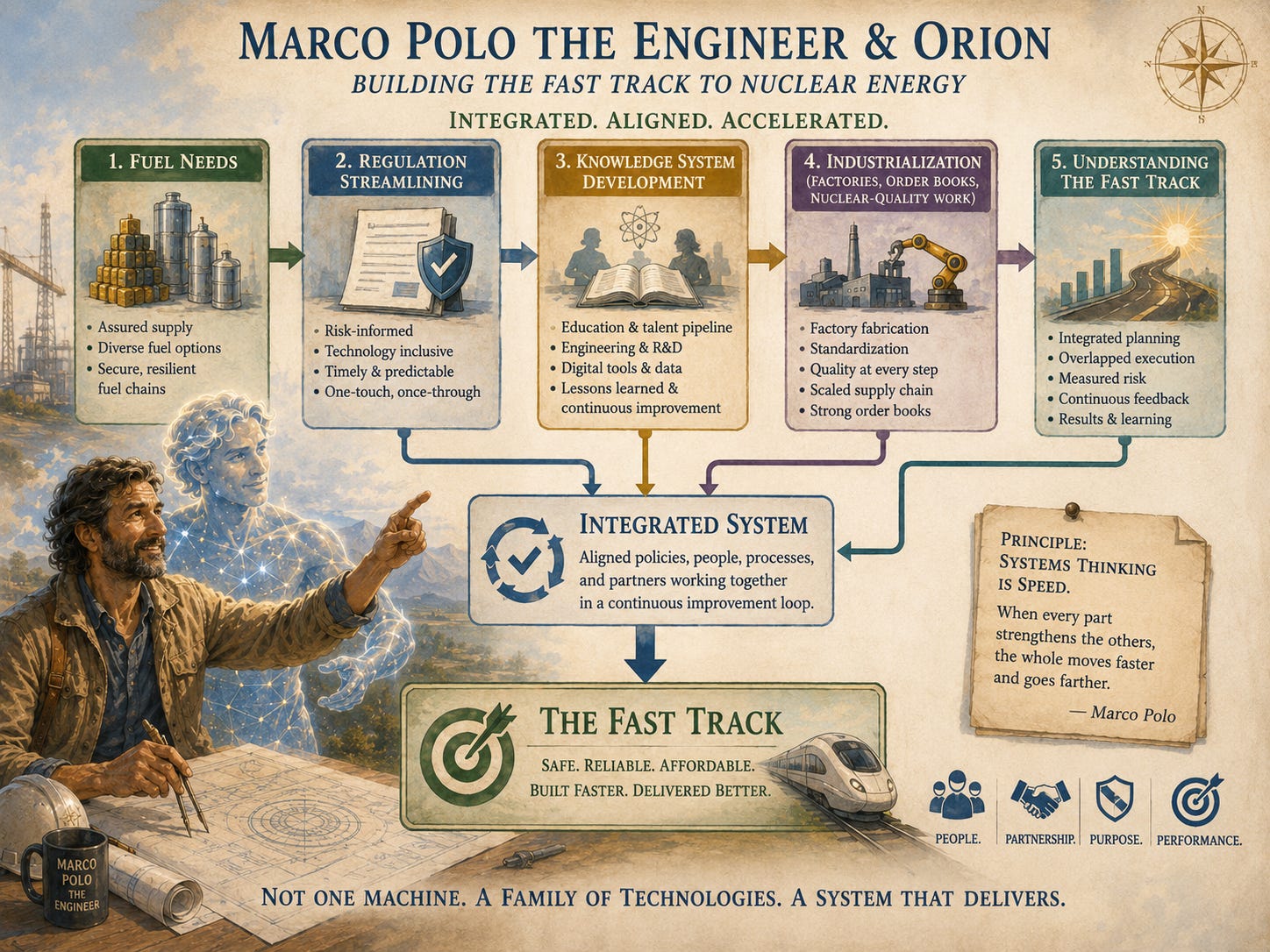
The Nuclear Industrial Strategy
Preserve the fleet first. Extend safe operating lives, modernize equipment, pursue justified uprates, secure fuel, and complete restart reviews without assuming their outcome.
Match the reactor to the mission. Use large reactors for sustained regional scale, SMRs for repeatable increments and repowered sites, microreactors for resilient local needs, and advanced systems where heat or storage adds value.
Turn projects into programs. Commit to standard designs, multi-unit orders, fleet procurement, common components, and construction teams that repeat rather than relearn.
Build fuel with the order book. Expand domestic mining, conversion, LEU and HALEU enrichment, deconversion, fabrication, transport packages, and fuel qualification against credible reactor schedules.
Regulate by risk and reuse learning. Maintain strong independent oversight while creating predictable, technology-appropriate reviews and allowing prior approvals to shorten repeat applications.
Rebuild the knowledge commons. Invest in test reactors, irradiation facilities, hot cells, digital test beds, national laboratories, university programs, codes, standards, and nuclear-quality training.
Finance factories, not announcements. Use conditional public support and private commitments to place long-lead orders, qualify suppliers, and expand capacity that can serve several projects.
Complete the back end. Pair new construction with consent-based storage, transport readiness, decommissioning discipline, and a permanent disposal pathway.
Make communities durable partners. Share information, opportunity, responsibility, and long-term economic value with the people who host the system.
From Return to Renewal
The nuclear movement is more real than it has been in years because its pieces are beginning to connect. The existing fleet is being valued differently. Restart proposals are being tested. Large-reactor supply-chain financing is tied to multi-unit demand. SMR applications are attached to named sites. Advanced plants and test reactors are under construction. Fuel enrichment and fabrication are receiving sustained attention. Regulatory pathways are changing. Universities and laboratories are preparing people and infrastructure.
None of this guarantees success. First plants may cost more and take longer than promised. Some designs will fail commercially. Some projects will discover that their customer, fuel, site, or supply chain was less mature than their presentation suggested. A serious strategy expects that variation and builds a portfolio without allowing every setback to become a verdict on the entire field.
The standard must be working capacity: reactors that are licensed, fueled, constructed, connected, operated, maintained, and ultimately decommissioned under a system the public can trust. Announced megawatts do not cool a data center, run a factory, secure a military installation, or keep a hospital operating through a grid emergency.
Nuclear power will not be the whole American energy system. Natural gas, hydropower, renewables, storage, transmission, demand flexibility, and local resilience will all remain essential. But a nation seeking dependable abundance will find it increasingly difficult to exclude the one resource that can deliver large quantities of compact, fuel-secure, clean power across seasons and decades.
The deeper return is not simply the reactor. It is the return of national competence: the ability to think in generations, manufacture difficult things, maintain exacting standards, train skilled people, accept responsibility for waste, and repeat a complex project until it becomes ordinary.
America does not need a nuclear renaissance of speeches. It needs a nuclear renaissance of fuel, factories, skilled labor, repeat orders, and working plants.
The factual context in this essay draws principally from the following current public sources. Applications, permits, financing commitments, criticality demonstrations, and construction milestones are distinguished from completed commercial generating capacity.
1. U.S. Energy Information Administration, “The United States Operates the World’s Largest Nuclear Power Plant Fleet,” April 24, 2025; and Nuclear Explained: U.S. Nuclear Industry, updated 2026. Used for the 94-reactor fleet, nearly 97 gigawatts, nuclear’s roughly 19 percent generation share, and the 91 percent average capacity factor in 2025.
2. U.S. Nuclear Regulatory Commission, Reactor License Renewal Overview; Status of Subsequent License Renewal Applications; and Backgrounder on Power Uprates for Nuclear Plants. Used for the 40-, 60-, and 80-year licensing structure and the approximately 8,030 megawatts of electric capacity added through approved uprates.
3. U.S. Nuclear Regulatory Commission, Palisades Nuclear Plant and Christopher M. Crane Clean Energy Center restart pages and 2026 inspection and licensing releases. Used to describe both efforts as active, first-of-a-kind restart reviews subject to NRC decisions, not completed restarts.
4. U.S. Department of Energy, Coal-to-Nuclear Transitions materials and information guide, 2022-2026. Used for the identification of hundreds of operating and retired coal sites as potential advanced-reactor locations, possible reuse of existing infrastructure, workforce continuity, and estimated construction-cost reductions at suitable sites.
5. U.S. Nuclear Regulatory Commission, Clinch River Nuclear Site application materials; and U.S. Department of Energy, “Energy Department Awards $94 Million to American Companies to Help Expedite the Deployments of Small Modular Reactors,” May 14, 2026. Used for TVA’s BWRX-300 construction-permit application and cost-shared work on licensing, supply chain, and site preparation.
6. U.S. Nuclear Regulatory Commission, “NRC Issues First Commercial Reactor Construction Permit in Decades,” March 4, 2026, and Kemmerer Power Station Unit 1 materials. Used for the TerraPower Natrium construction permit, 345-megawatt rating, and storage-supported output capability. A construction permit is not authorization to operate.
7. U.S. Nuclear Regulatory Commission, Long Mott Generating Station Xe-100 project page and May 18, 2026 review update. Used for the four-module, approximately 320-megawatt proposal at Dow’s Seadrift industrial site and its planned delivery of electricity and process heat. The application remains subject to NRC review.
8. U.S. Nuclear Regulatory Commission, Kairos Hermes and Hermes 2 construction-permit materials; and U.S. Department of Energy Reactor Pilot Program criticality announcements, June-July 2026. Used for test-reactor construction and four zero-power fueled criticality demonstrations. Criticality is treated as a test milestone, not proof of commercial power production or economics.
9. U.S. Department of Energy, “U.S. Department of Energy Awards $2.7 Billion to Restore American Uranium Enrichment,” January 5, 2026; HALEU Availability Program; and “Centrus Reaches 900 Kilogram Mark for HALEU Production,” June 25, 2025. Used for domestic LEU and HALEU enrichment investment, supply constraints, and demonstration-scale HALEU production.
10. U.S. Nuclear Regulatory Commission, “NRC Licenses TRISO-X LLC Fuel Fabrication Facility in Tennessee,” February 13, 2026; and U.S. Department of Energy Fuel Line Pilot Program materials. Used for licensed TRISO fuel-fabrication capacity and efforts to establish advanced fuel production lines.
11. U.S. Nuclear Regulatory Commission, 10 CFR Part 53 and March 25, 2026 announcement; proposed Part 57 microreactor framework, April 24, 2026. Used for the new optional technology-inclusive commercial-reactor pathway and the proposed streamlined framework for microreactors and comparable risk profiles.
12. U.S. Department of Energy, “Department of Energy Announces American Nuclear Supply Chain Loans,” June 23, 2026. Used for the $17.5 billion conditional financing structure for long-lead equipment associated with up to five two-unit AP1000 projects. The program is financing, not a grant or completed reactor order.
13. Idaho National Laboratory, “DOME, World’s First Nuclear Reactor Test Bed, Ready for Privately Developed Advanced Reactors,” April 8, 2026; Purdue University, PUR-1 digital-reactor research materials, July 2026; and DOE 2026 nuclear workforce and university-infrastructure awards. Used for test infrastructure, digital and cybersecurity experimentation, and workforce development.
14. U.S. Nuclear Regulatory Commission, Backgrounder on Dry Cask Storage of Spent Nuclear Fuel and Storage of Spent Nuclear Fuel. Used for passive dry-cask storage, containment, heat management, monitoring, and accident-condition review.
15. U.S. Government Accountability Office, Nuclear Waste: An Integrated Disposal Plan Could Help DOE Complete Its Cleanup Mission and Save Billions, May 29, 2025; and DOE Consent-Based Siting Consortia materials. Used for the continuing federal disposal impasse, growing liability, and the need for integrated interim-storage and permanent-disposal planning.
16. U.S. Department of Energy, Nuclear Reactor Safety Training and Workforce Development Program; April 7, 2026 awards; Nuclear Energy University Program; and Idaho National Laboratory Advanced Test Reactor materials. Used for the workforce, research-reactor, irradiation, and institutional capabilities required by a durable nuclear industrial system.
No posts
Comments
Nothing yet. Say the first thing.
Sign in to join the conversation.