
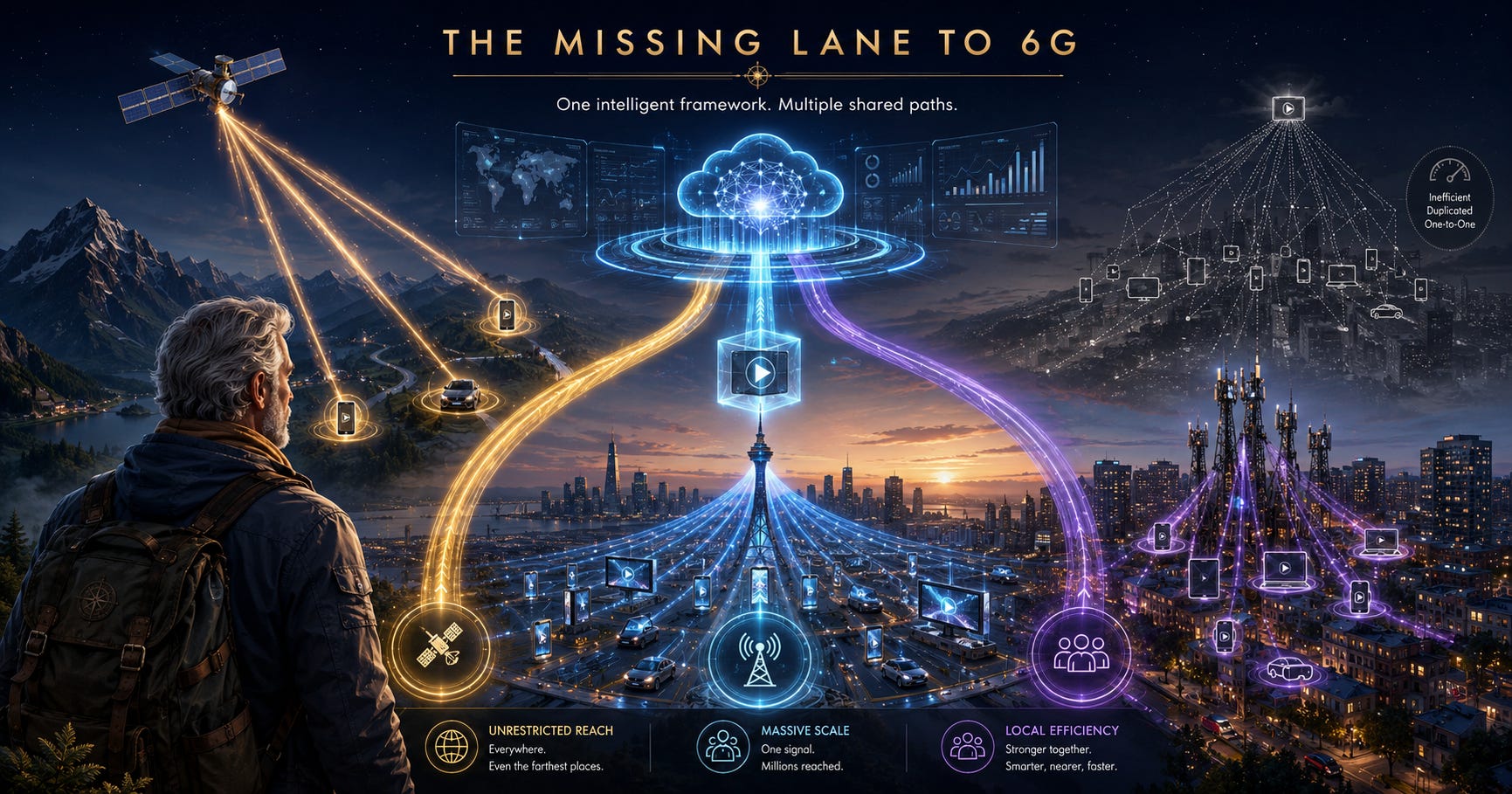
The mobile industry is right to make energy efficiency a defining requirement of 5G-Advanced and the road to 6G. New mechanisms create more opportunities for cells to sleep, reduce unnecessary signaling, adapt antenna configurations, vary transmission bandwidth and power, and preserve mobility while portions of the radio access network enter lower-energy states.
Those are meaningful advances. They attack waste inside the cellular network and improve the way installed infrastructure responds to changing traffic. The rise of Non-Terrestrial Networks (NTN), however, opens a larger question: what if future mobile service no longer has to begin and end inside one terrestrial radio network?
Satellite Direct-to-Device (D2D) demonstrates that an ordinary handset can be served through a different network when reach, coverage, or resilience demands it. India’s terrestrial Direct-to-Mobile (D2M) work offers the complementary proposition: when many devices need the same content, a high-power broadcast path may be better suited to the burden than millions of individualized cellular sessions.
The multicast gap in the mobile architecture has not gone unrecognized. That immediately raises a fair question. 3GPP has continued improving 4G LTE-based 5G Broadcast through Releases 18 and 19, why not make that the terrestrial answer? The technology is IP-based, designed for receive-only and free-to-air operation, capable of large single-frequency networks, and increasingly robust for mobile reception. It deserves to be evaluated seriously—not dismissed because it comes from a different standards tradition.
The answer is not that 4G LTE-based5G Broadcast has no value. While Release 18 and Release 19 may improve 5G Broadcast, it still does not make it the most efficient or most naturally integrated one-to-many lane for the future Internet. The fuller answer is that its name promises more architectural integration than its present design delivers. It improves an LTE-derived broadcast system. It does not, by itself, create the most spectrally efficient broadcast bearer, a modern OFDMA multicast resource system, or a plug-in pipeline to the interfaces through which 4G and 5G radio networks are actually disaggregated, scheduled, observed, and controlled.
The cleanest packet is the one that does not have to be
sent a million times.
Operational efficiency asks how a network can perform a task with less energy. It improves power amplifiers, cooling, antennas, baseband processing, signaling, handovers, scheduling, sleep states, and software control. These gains matter because the radio access network carries substantial fixed loads and represents a major share of many operators’ energy consumption.
Architectural efficiency begins one step earlier. It asks whether the same network should perform the same task that many times at all. A system may lower the cost of each individualized delivery while continuing to create thousands or millions of nearly identical deliveries.
When a payload is personal, interactive, confidential, or uniquely generated, unicast is the right tool. When it is common, repeated point-to-point transmission may be a design choice rather than an unavoidable fact. Operational efficiency makes each delivery cleaner. Architectural efficiency reduces the number of deliveries that must occur.
A credible sustainability strategy needs both. Better radios cannot, by themselves, cure an architecture that treats common demand as millions of unrelated sessions. The cleanest network is not simply the one that transmits each copy efficiently. It is the one that knows when another copy is unnecessary.
NTN matters here for more than coverage. Formally, it brings satellites, high-altitude platforms, and other airborne systems into the mobile architecture. More importantly, it establishes a principle: a service can remain native to the mobile experience even when another network carries it.
D2D is the clearest current example. The handset, service layer, and operator relationship remain intact, but the physical path may come from a satellite rather than the conventional terrestrial RAN. Discovery, authentication, policy, continuity, and device support make that outside resource usable within one service environment.
D2M extends the same logic in a different direction. It is terrestrial, not non-terrestrial, and it does not share the satellite radio architecture. Its value is wide-area scale: one common transmission can reach many mobile and portable devices without multiplying the payload across individualized paths.
The larger lesson of the NTN era is that different networks can be made legible to one another without being made identical. Once the ecosystem accepts that principle for satellites, the question is no longer whether broadcast is sufficiently cellular. It is whether broadcast can expose the interfaces, capabilities, and measurements needed to become an ordinary selectable bearer.
3GPP has not ignored multicast. Its work now contains two materially different one-to-many branches, and neither should be confused with the terrestrial broadcast path being developed through ATSC 3.0 and B2X (Broadcast to Everything).
The first is 5G Multicast and Broadcast Services (5G MBS), introduced in Release 17 through the 5G Core and New Radio. It allows an operator network to establish group services, share delivery toward the RAN, choose point-to-point or point-to-multipoint transmission, and switch dynamically as audience conditions change. This is the most naturally integrated 3GPP answer for multicast inside an MNO environment, but lacks the large area capability due single cell limitations (no single frequency network support).
The second is 4G LTE-based 5G Broadcast, descended from eMBMS and FeMBMS. Despite the name, it is not the NR-based MBS bearer. It is a profile of the LTE broadcast lineage designed for dedicated, downlink-only, receive-only, free-to-air operation, including large-area television, radio, file delivery, and hybrid services.
The third path is a non-3GPP terrestrial broadcast network. ATSC 3.0 already provides a flexible, all-IP, high-power one-to-many platform. B2X is now extending that foundation toward an OFDMA broadcast RAN, physical-resource scheduling, mobile user-plane alignment, and open, disaggregated interfaces.
The labels can conceal the choice. 5G MBS is close to the mobile core but ordinarily inherits cellular coverage geometry. 5G Broadcast reaches beyond ordinary cellular geometry but remains a separate LTE-derived broadcast system. ATSC 3.0 offers the stronger broadcast-native physical layer, while B2X is being designed to close the interface gap. The missing lane requires the advantages of the last two without pretending that one name has already combined them.
The latest 5G Broadcast work is substantive. Release 18 and the corresponding ETSI profile work broaden the scenarios, receiver profiles, UHF-band support, concurrent operation with unicast, service signaling, public-warning functions, and deployment guidance. This makes the system more usable as a dedicated broadcast network.
Release 19 goes directly at one of the waveform’s most important weaknesses. The LTE-based 5G Broadcast Phase 2 work adds time interleaving, and associated performance work introduces demodulation tests and reference channels for time-frequency interleaving. Additional bands, subcarrier-spacing options, and coexistence mechanisms are also moving into implementation and plugfest activity.
Interleaving matters because mobile broadcast channels do not fail as independent, neatly spaced bit errors. Deep fades and impulse disturbances can erase clusters of symbols. Spreading coded information across time and frequency gives the receiver a better chance to reconstruct the object after the channel has changed.
These advances should narrow the gap with ATSC 3.0 in mobile conditions. They also correct an omission that comparative studies repeatedly identified. It would be unfair to judge the frozen Release 19 implementation as though the improvements had never occurred.
But an improvement is not a change of inheritance. Release 19 does not turn the LTE-derived physical layer into ATSC 3.0’s broadcast-native coding and modulation system, into NR MBS, or into the OFDMA multicast RAN now contemplated by B2X. It makes 5G Broadcast better at the job it was designed to do. It does not make it the complete answer to the interworking problem.
Spectral efficiency is often reduced to a peak-rate number. For broadcast, the more useful question is how many payload bits can be delivered per hertz at the robustness, coverage, mobility, and receiver complexity required by the service. A waveform that posts a high laboratory rate but needs materially more signal to close the link may require more transmit power, more sites, smaller coverage areas, or a lower operating code rate in the field.
The strongest public comparisons have favored ATSC 3.0. A 2023 IEEE Transactions on Broadcasting study evaluated ATSC 3.0 and Release 17 5G Broadcast for handheld mobile reception and concluded that ATSC 3.0 performed better because its bit-interleaved coded modulation and time interleaver were more effective against deep fades. The study connected those physical-layer differences to network deployment and operating cost.
A later ETRI-led laboratory and field assessment reached the same general direction across fixed and mobile scenarios. ATSC 3.0’s 64,800-bit LDPC codes, non-uniform constellations, extensive interleaving, flexible OFDM parameters, and long-echo SFN options were designed as a modern terrestrial broadcast system. The LTE-derived path began with a different coding, framing, and deployment inheritance.
Release 19 time-frequency interleaving should improve 5G Broadcast, especially in mobile fading. New, apples-to-apples measurements against the completed profile are therefore necessary. The earlier studies should not be treated as the last word on a waveform that has changed.
They nevertheless establish the burden of proof. The new interleaver must demonstrate how much of the measured gap it closes; it does not erase the remaining differences in forward-error correction, constellation design, service flexibility, guard-interval choices, receiver acquisition, or interface architecture. Until those measurements exist, calling 5G Broadcast the more efficient replacement is a claim, not a result.
One point requires precision. It is too broad to say that 5G Broadcast is not one-to-many at the physical layer. It plainly is. A common LTE-derived broadcast waveform is radiated to many receivers, and IP multicast or broadcast services can ride that bearer.
The meaningful distinction is how the physical resources are organized and exposed. 5G Broadcast is principally a dedicated broadcast channel and service profile. It is not the same thing as an OFDMA multicast RAN in which a scheduler allocates physical resource blocks among multiple service groups, bandwidth parts, device classes, and applications inside a common time-frequency resource grid.
That is the idea B2X is now bringing forward. The ATSC candidate-standard work describes services multiplexed in time and frequency using OFDMA across one or more broadcast or IMT carriers. The supporting IBC architecture assigns physical resource blocks to services, uses virtual bandwidth parts for different applications and battery profiles, and treats multicast as a schedulable physical-layer resource rather than only as a common program channel.
This is what the phrase true physical-layer multicast is trying to capture. The better wording is not that 5G Broadcast lacks a broadcast PHY. It is that B2X is being designed to combine broadcast reach with group-aware, application-aware physical resource allocation—the behavior an MNO expects from a modern RAN.
5G MBS provides part of that behavior inside NR and the 5G Core, but usually within the operator’s RAN footprint. B2X seeks to apply similar service and scheduling logic to high-power, wide-area infrastructure. That is a different architectural prize from placing an LTE broadcast transmitter beside the mobile network.
The same precision is needed at the network boundary. 5G Broadcast is IP-based, but IP compatibility does not make two radio systems plug-in compatible. Ethernet can carry the packets entering both systems while their control, scheduling, timing, fronthaul, security, telemetry, and device procedures remain separate.
An MNO does not operate a RAN by handing a transmitter an IP stream and hoping the rest aligns. It needs defined points at which the core or service platform requests capacity, the scheduler admits and maps the traffic, the distributed and radio units exchange user-plane and control information, timing is maintained, faults are reported, performance is measured, and usage can be reconciled commercially.
eCPRI is one example of that hidden machinery. It specifies Ethernet-based fronthaul messages between radio-equipment control and radio equipment, including user-plane data, real-time control, synchronization-related functions, delay measurement, and fault indications. O-RAN’s open-fronthaul work similarly standardizes the relationship between distributed and radio units.
The 3GPP label on LTE-based 5G Broadcast does not automatically supply those interfaces as a direct extension of an operator’s 4G or 5G RAN. The system has 3GPP and ETSI service reference points, but its dedicated broadcast transmission chain remains separately engineered and operated. It is interoperable at selected service and content layers, not natively interchangeable with an MNO’s eCPRI or O-RAN pipeline.
B2X is unfinished, but it is aiming directly at that seam. The published architecture uses O-RAN concepts, an F1/PDCP path for 5G or 6G traffic offload, and disaggregated broadcast RAN elements. The broader B2X alignment design goes further by proposing B-eCPRI between distributed and radio functions. That does not make B2X deployable everywhere tomorrow. It makes interface alignment a design requirement rather than an afterthought.
This is the honest comparison: 5G Broadcast has a more mature standards profile but an incomplete fit with the MNO’s modern RAN interfaces. B2X has the more direct interworking ambition but remains under standardization and product development. Neither should be sold as finished. Only one is being shaped around the exact seam the missing-lane argument identifies.
A mobile operator does not principally need another stand-alone downlink bearing a familiar brand. It needs usable capacity. That capacity must be discoverable, requestable, policy-controlled, secure, measurable, supportable in devices, and capable of preserving the operator’s relationship with the customer and application.
For an operator-controlled group within a local or regional footprint, 5G MBS may be the cleanest answer because it is native to the 5G Core and NR. For linear television or radio in a dedicated broadcast allocation, 5G Broadcast may be a legitimate solution, particularly where its device, spectrum, infrastructure, and regulatory ecosystem are deliberately assembled.
But neither answer fully captures the D2M burden. Wide-area common objects should move over the bearer that delivers the most useful bits per hertz and the lowest system-wide cost across the required coverage. In markets with ATSC 3.0 infrastructure, that argues for using the stronger broadcast platform already being deployed and making it legible to the MNO through B2X and core-network interfaces.
5G Broadcast can still participate. ATSC 3.0’s bootstrap and time-domain flexibility allow 5G Broadcast windows to coexist inside an ATSC-controlled RF channel where a specific receiver or service opportunity warrants them. That is a practical additive role. It is different from declaring the LTE-derived waveform the universal replacement for a higher-performing broadcast foundation.
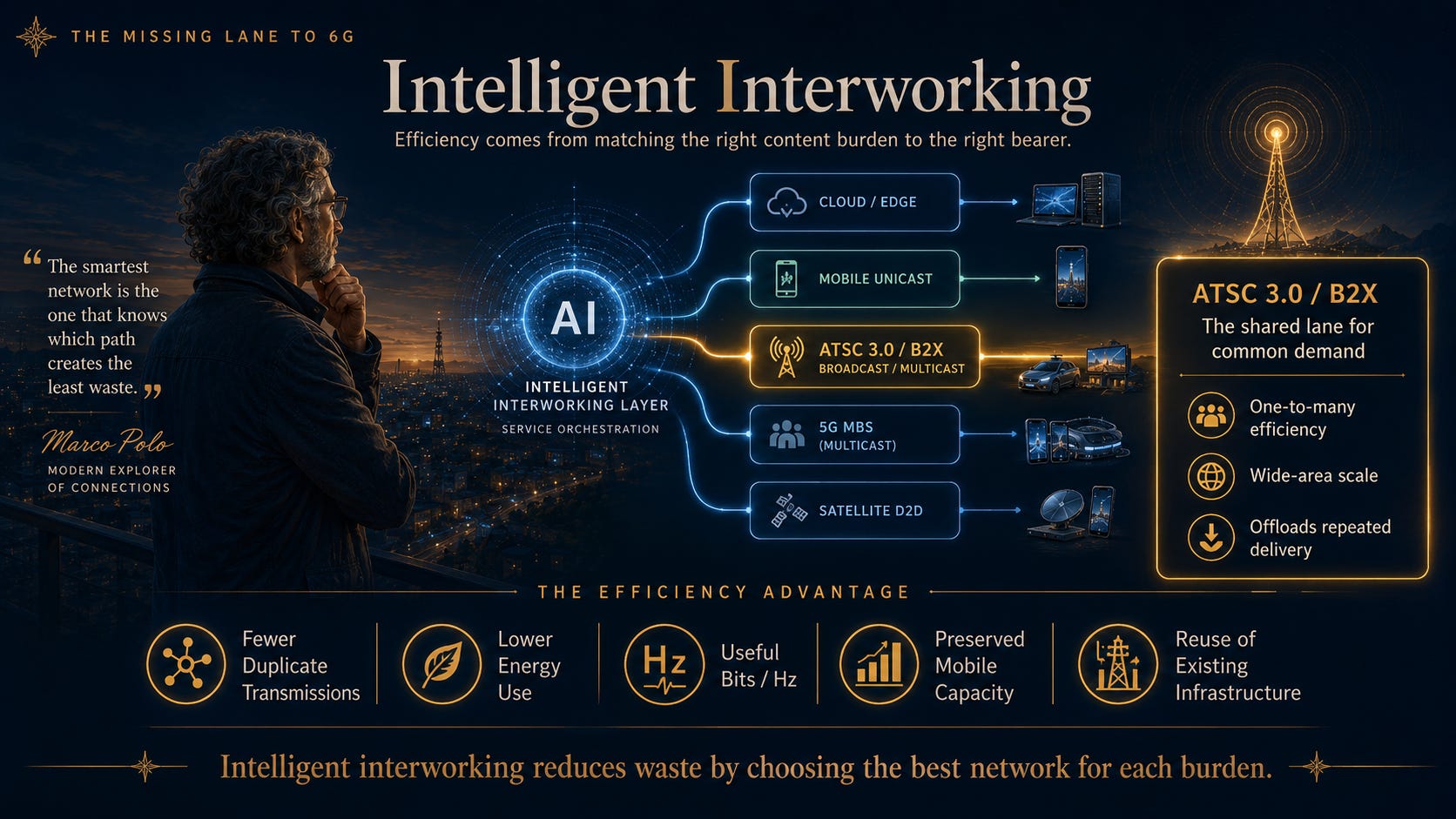
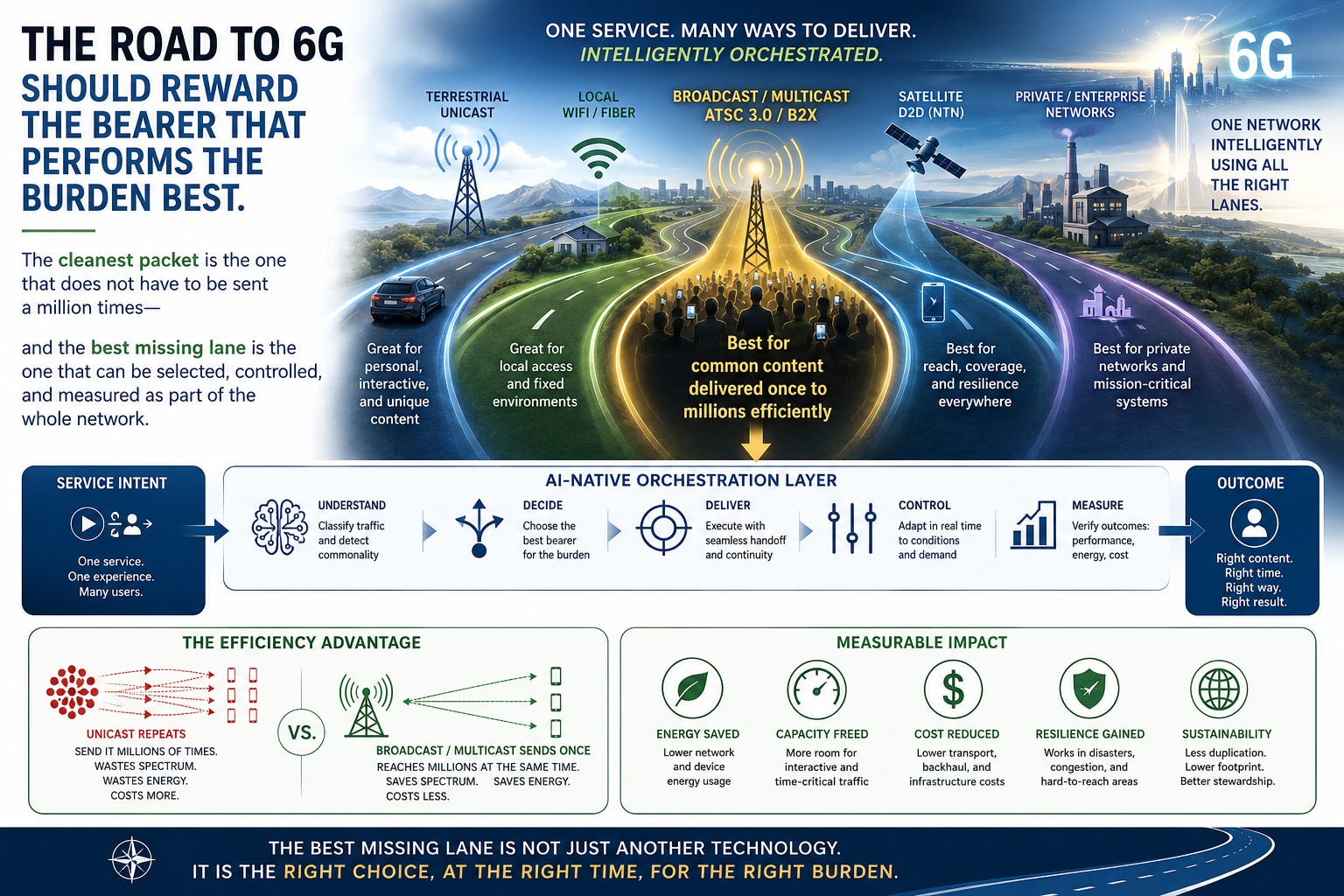
The best architecture is therefore not winner-take-all. It is layered. Cellular unicast carries personal and interactive sessions. 5G MBS serves groups where the operator RAN is the right footprint. D2D extends service where terrestrial reach fails. ATSC 3.0 and B2X carry dense, wide-area common demand. 5G Broadcast remains available where its particular broadcast profile and device path make sense.
The 5G-Advanced sustainability work deserves credit on its own terms. Cell discontinuous transmission and reception can create deeper inactivity. Conditional handover enhancements can preserve mobility while neighboring resources save energy. AI-assisted traffic prediction can help operators deactivate carriers, cells, or antenna elements when demand permits.
These measures improve the supply side of network efficiency: how much energy the cellular system uses while providing capacity. The missing complement is demand-side efficiency: how much avoidable capacity the architecture asks the system to provide.
Repeated common traffic can keep efficient cells, carriers, transport, and edge systems busy. Moving the right common load to a shared bearer does not guarantee that a cell will switch off. It does create more room for sleep states, peak reduction, deferred expansion, and preservation of scarce interactive capacity.
The decisive question is not whether 5G Broadcast, ATSC 3.0, B2X, or 5G MBS can carry IP. They all can. The question is which path carries the required object with the fewest radio resources, the least duplicative infrastructure, the lowest receiver and network energy, and the most useful integration into the service environment.
No bearer is automatically efficient in every circumstance. A wide-area transmitter serving a sparse audience may consume more energy than targeted unicast. A satellite path has space and ground-segment costs. A multicast transmission may need conservative coding. Receiver energy, repair traffic, redundancy, and acquisition behavior also matter.
The comparison therefore cannot stop at the power meter of one base station or one broadcast transmitter. It should include origin and cloud processing, core functions, transport, edge systems, spectrum, radio transmission, receiver behavior, repair, redundancy, site count, and the infrastructure required to meet peak demand.
Audience density, geographic concentration, start-time alignment, mobility, object size, latency, reliability, device capability, spectrum, and existing infrastructure determine the crossover point. Below it, unicast may be best. Across a coverage gap, D2D may be best. Within an operator-controlled group, 5G MBS may be best. Across a large terrestrial audience, ATSC 3.0 or B2X may preserve the most capacity.
That is why the Chapter 2 commonality engine matters. AI should not merely optimize the bearer that already owns the session. It should compare the available paths and select the one that best fits the service, geography, audience, performance target, and full system cost.
Release 19 5G Broadcast is a better broadcast technology than the version that entered the decade. It deserves continued testing, receiver work, and deployment where its profile fits. But it is not the missing lane simply because the words 5G and Broadcast appear together.
The missing lane is the ability to see all appropriate bearers, understand what each does best, and direct common traffic without forcing every external network to become a copy of the cellular RAN. That requires common service descriptions, bearer discovery, device capability exposure, admission, authentication, rights, security, continuity, measurement, repair, telemetry, and settlement.
3GPP has begun acknowledging the bridge through Release 19 interworking between non-3GPP terrestrial broadcast and 5G multicast-broadcast services. ATSC is developing B2X discovery and signaling and studying harmonization with NR and MBS. 5G-MAG is bringing NTN, multicast, broadcast, streaming, and reference implementations into the same conversation. The pieces are finally facing one another.
The NTN-era answer is not to choose a single radio religion. It is to build an intelligent delivery framework in which D2D supplies reach, 5G MBS supplies native operator multicast, and D2M supplies terrestrial scale. Within that framework, the wide-area broadcast bearer should be judged by physical performance and interface utility—not by whether its acronym begins with 5G.
Chapter 4 will turn to that terrestrial foundation and explain why ATSC 3.0 is already an advanced IP network—and why B2X is the more promising path for making its one-to-many capacity genuinely useful to mobile, cloud, edge, and 6G systems.
The industry’s efficiency scorecard should expand accordingly. Bits per joule, useful bits per hertz, site consumption, sleep-state performance, and equipment utilization remain important. A multi-network architecture should also measure avoided duplicate transmissions, preserved interactive capacity, deferred peak expansion, use of existing infrastructure, receiver duty cycle, and the resilience created by having more than one viable path.
Those measures allow the alternatives to be compared without pretending they perform the same job. Coverage restored in a remote area is a meaningful D2D gain. A local group served within the 5G Core is a meaningful MBS gain. A common object removed from millions of individualized terrestrial sessions is a meaningful D2M gain.
The objective is not to award every common object to broadcast or every remote connection to satellite. It is to stop treating cellular overbuild—or a cellular-branded broadcast waveform—as the only serious answer. Pilot programs should report the end-to-end energy, capacity, reliability, spectral efficiency, interface burden, and cost of the selected path, including the resources that choice allowed the rest of the network not to consume.
Release 19 removes several legitimate objections to earlier 5G Broadcast profiles. It strengthens mobility, broadens deployment options, and deserves a fair implementation cycle. Yet the technology still occupies an awkward middle ground. It is less naturally integrated with an operator’s current NR multicast architecture than 5G MBS, and it has not demonstrated the broadcast efficiency and wide-area flexibility already available from ATSC 3.0.
For the MNO, the cleaner hierarchy is increasingly visible. Use NR MBS where the mobile network itself is the best group-delivery platform. Use D2D where reach and resilience require the satellite layer. Use ATSC 3.0 and B2X where common terrestrial demand calls for high-power scale, stronger broadcast performance, and an interface deliberately designed to participate in mobile orchestration.
Within that hierarchy, 5G Broadcast can remain a useful specialized bearer, a coexistence waveform, or a service path in markets that build its receiver and infrastructure ecosystem. Its latest improvements strengthen that role. They do not establish that broadcasters or mobile operators should replace a higher-performing ATSC foundation with another separately operated broadcast network simply because it carries a 3GPP name.
The road to 6G should reward the bearer that performs the burden best. The cleanest packet is the one that does not have to be sent a million times—and the best missing lane is the one that can be selected, controlled, and measured as part of the whole network.
• 5G Americas, “5G-Advanced Overview,” July 2025: Used for the Release 18 energy-efficiency framework, including cell sleep, discontinuous transmission and reception, conditional handover, antenna adaptation, bandwidth and power management, AI-assisted control, and the broader 5G-Advanced path toward 6G.
• 3GPP, “Non-Terrestrial Networks (NTN)”: Used for the formal NTN framework and for the architectural principle that mobile services can use satellite and airborne access alongside terrestrial networks.
• GSMA, “Satellite direct-to-device (D2D)”: Used for current mobile-industry terminology and for the treatment of satellite D2D as a supplement to terrestrial coverage and resilience.
• 5G-MAG, “NTN & Content Delivery: From Specs to Software,” April 2026: Used for the active convergence of NR-NTN, Direct-to-Device, 5G MBS, content delivery, and open implementation work.
• 3GPP, “Broadcast, multicast technologies”: Used for the evolution from MBMS and eMBMS/FeMBMS to 5G MBS, dynamic point-to-point/point-to-multipoint operation, and Release 19 interworking with non-3GPP terrestrial broadcast.
• 5G-MAG, “5G Broadcast — ETSI TS 103 720 and Release 18/19 updates”: Used to distinguish LTE-based 5G Broadcast from NR MBS and for Release 18/19 profile work involving UHF bands, receiver profiles, concurrent broadcast/unicast deployment, public warning, service URLs, and RAN-only scenarios.
• 3GPP, “LTE-based 5G Broadcast Phase 2,” Release 19 work item: Used to confirm the formal Release 19 Phase 2 work item, its LTE-based lineage, approved status, and completion schedule.
• 3GPP Change Request 577134, “Support of time interleaving for LTE-based 5G Broadcast”: Used for the specific Release 19 introduction of time interleaving.
• 3GPP Change Request 591419, time-frequency-interleaving performance tests: Used for the agreed demodulation test cases, reference measurement channels, and channel model supporting time-frequency interleaving.
• 5G-MAG, “Time and Frequency Interleaving for Broadcast Services in 3GPP Systems”: Used for the rationale for interleaving in mobile fading environments and the industry work that supported the Release 19 improvements.
• 5G-MAG, “First 5G Broadcast PlugFest,” July 2026: Used to recognize that the frozen Release 19 functions are moving from specification toward implementation, with attention to time/frequency interleaving, CAS muting, additional subcarrier spacings, and new bands.
• Ahn et al., “Evaluation of ATSC 3.0 and 3GPP Rel-17 5G Broadcasting Systems for Mobile Handheld Applications,” IEEE Transactions on Broadcasting, 2023: Used for the peer-reviewed physical-layer, network-deployment, CAPEX, and OPEX comparison and for the finding that ATSC 3.0 outperformed the evaluated Release 17 5G Broadcast configurations in handheld mobile channels.
• Kwon et al., “Comparative Assessment of Physical Layer Performance: ATSC 3.0 vs. 5G Broadcast in Laboratory and Field Tests,” IEEE Transactions on Broadcasting, 2025: Used for the later laboratory and field comparison across fixed and mobile reception scenarios. The chapter treats these results as evidence on the pre-Release-19 baseline, not as a completed test of the final Release 19 implementation.
• ETRI, “ATSC 3.0 for Future Broadcasting: Features and Extensibility”: Used for ATSC 3.0 physical-layer features including long LDPC codes, non-uniform constellations, interleaving, flexible OFDM framing, SFN support, and the relationship between robustness and useful throughput.
• ATSC, A/300, “ATSC 3.0 System”: Used for the all-IP ATSC 3.0 system architecture and its broadcast/broadband service framework.
• ATSC, “B2X System Discovery and Signaling” Candidate Standard, July 2026: Used for the emerging B2X physical-layer discovery framework, OFDMA time-frequency multiplexing, operation across broadcast and IMT bands, and B2X endpoint discovery. Candidate-standard status is stated because the work is not yet a final ATSC standard.
• IBC Technical Paper, “ATSC (B2X) Multicast Broadcast Neutral-Host O-RAN System Architecture,” September 2025: Used for the proposed B2X OFDMA resource grid, physical resource blocks, virtual bandwidth parts, O-RAN alignment, F1/PDCP interworking, dual-connected devices, and multicast/broadcast scheduling. These are design proposals under development, not claims of completed nationwide deployment.
• Marco Polo, “B2X (Broadcast to Everything): The Alignment Layer,” June 2026: Used for the B2X translation-layer framing and the proposed B-eCPRI fronthaul between broadcast distributed and radio functions. This is an architectural proposal under development, not a claim of completed commercial deployment.
• CPRI Cooperation, “eCPRI Specification V2.0”: Used to explain the role of Ethernet-based fronthaul messages between radio-equipment control and radio equipment, including user-plane data, real-time control, delay measurement, and fault indications.
• O-RAN Alliance Work Group 4, Open Fronthaul Interfaces: Used for the open-fronthaul relationship between distributed and radio units and for the distinction between carrying IP content and integrating a radio bearer into a disaggregated RAN.
• Prasar Bharati, “ATSC 3.0 Based D2M Test Results,” November 2025: Used for India’s Direct-to-Mobile terminology and documented ATSC 3.0 broadcast-radio-head, mobile-reception, HPHT/LPLT, and cellular-coexistence testing.
• NGMN Alliance, “A Roadmap to Energy Efficient Networks,” July 2024: Used for traffic-aware energy management, measurement, carrier and cell shutdown, AI/ML-assisted prediction, and the need to assess savings without reducing network performance.
No posts
Comments
Nothing yet. Say the first thing.
Sign in to join the conversation.