
Consciousness is the interface through which we operate the most complex system any of us will ever meet… our body.
The interface mostly runs in the background. Breath, temperature, hunger, balance, the coordination happens silently, and we notice it only when it fails. Homeostasis is the mode in which we exist. The thin surface we call attention sits over an enormous machinery of feedback loops that remains politely out of view. When the machinery is intact, the body appears to us as a single coherent thing. When it fails, we discover that it was a system all along, held together by an operating consciousness we never had to see.
Large projects have their own version of this arrangement. They too are systems maintained by feedback loops most participants never notice. They too can appear coherent for years, for decades, before revealing that no operating consciousness was ever really keeping them alive. And they too, like bodies, tend to be understood only when they begin to fail…
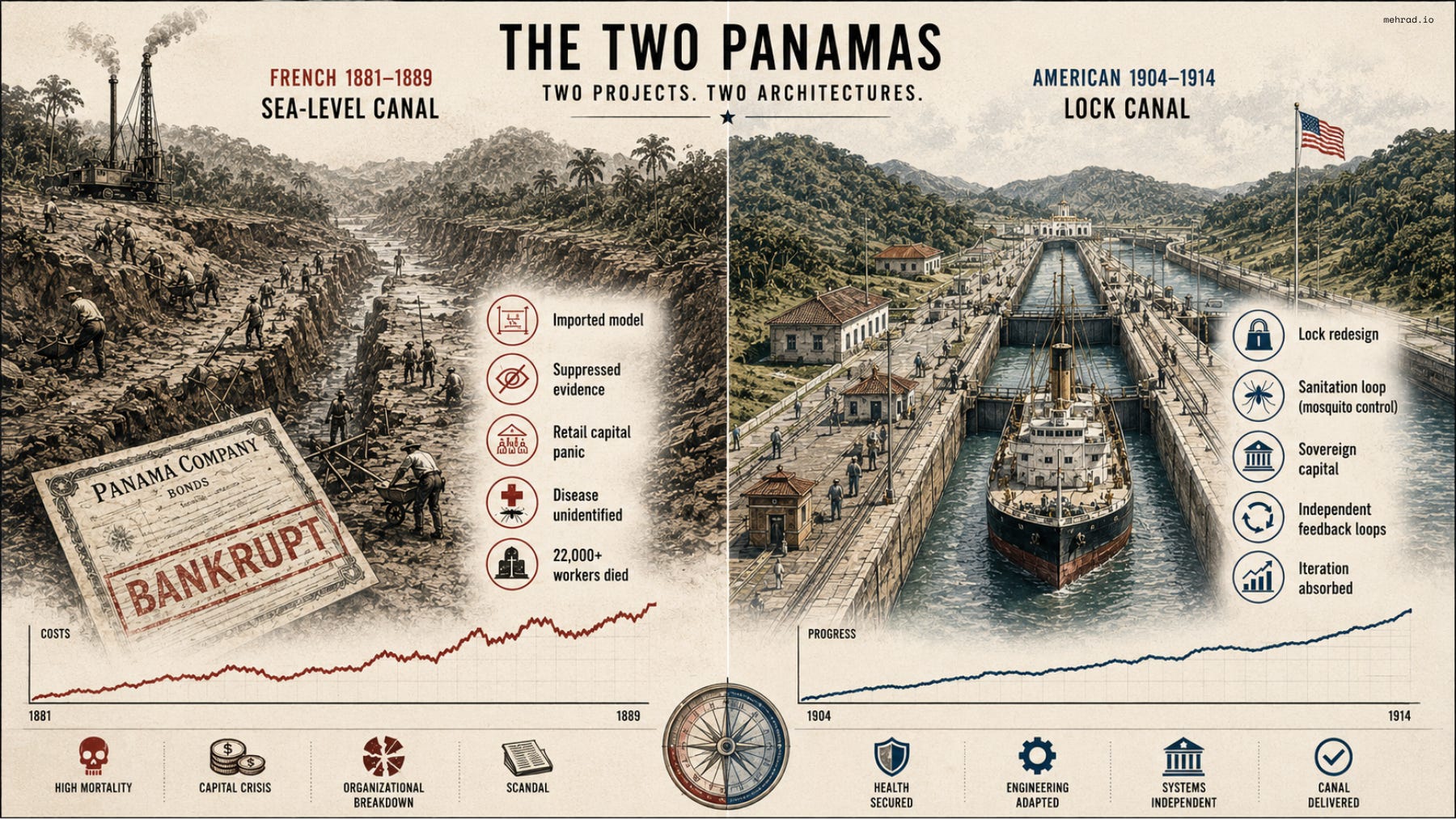
In 1881, the French began work in Panama under Ferdinand de Lesseps, who carried the surest reputation in nineteenth-century infrastructure. He had come from successfully building the Suez Canal.
He had the capital, the engineering talent of France and the political backing of a nation that wanted very much for him to be right. He spent the next eight years building the wrong thing, in the wrong way, with the wrong sensing apparatus, and bankrupted the better part of a generation of French savers in the process.
Twenty-two thousand workers died. The company collapsed in scandal. The mosquito had been named as the vector of yellow fever in 1881. Nobody believed it until long after the French had lost. The hypothesis sat unaccepted until long after they had lost.
The Americans, arriving two decades later, had broadly similar engineers. What they brought was a different architecture for iterating on First-of-a-Kind project development.
This essay concerns the architecture of these unique project types and why, more than a century later, most first-of-a-kind projects are still being built the French way.
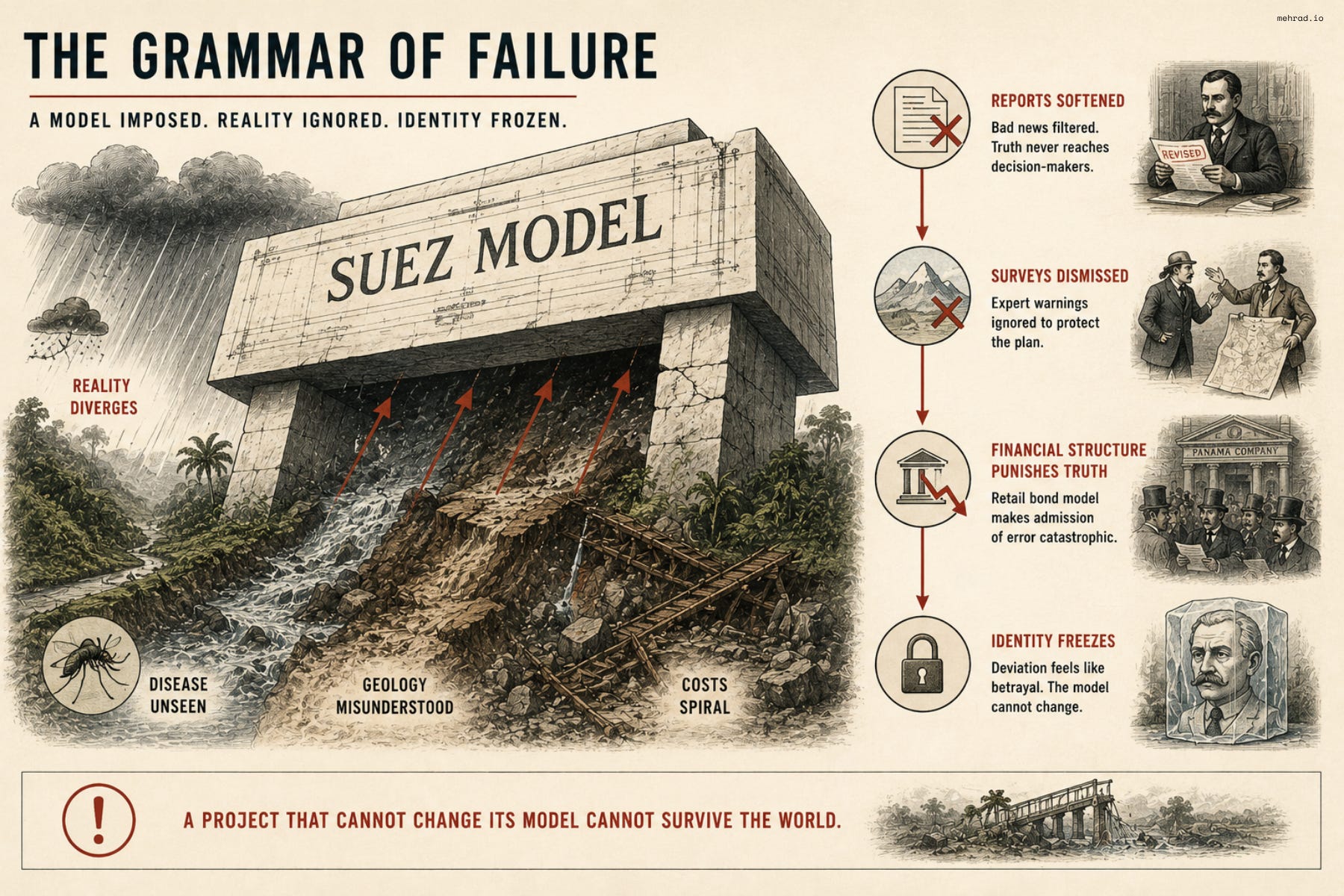
What undid de Lesseps lived underneath the engineering. He imported his Suez model, a sea-level canal cut through sand, into a jungle where geology, hydrology, and disease all behaved differently. When reality diverged from the model, his organization suppressed the divergence. Casualty reports were softened. Geological surveys were dismissed.
The financial structure, built on retail bond issuance to French households, made every admission of error politically catastrophic. The project could not afford to learn.
The American effort that followed reorganized around a single different premise: the model would have to change. Under John Stevens, the second chief engineer, the sea-level canal became a lock canal.
The sanitation department was made an independent bureau and empowered to act on William Gorgas's mosquito programme over the objections of a commission that thought him a crackpot. The capital structure was sovereign, which meant it could absorb iteration. The engineering, medical, and political layers ran on partially independent feedback loops, each allowed to be surprised without taking down the others.
This is, at root, a story about the architecture of identity under surprise. The French project could not deviate from its founding model without ceasing to be itself. The American project was built so that deviation was the design.
Identity is the discipline of selective absorption.
Biology has been solving this problem for four billion years. The cleanest formulation comes from neuroscience, by way of the psychiatrist and neuroscientist Karl Friston, who has spent two decades arguing that any system which maintains its identity over time must do so by minimizing a quantity called variational free energy. The mathematics is forbidding; the intuition is simple.
A living system carries a model of its world and receives a continuous stream of sensory evidence about that world. Free energy is, roughly, the discrepancy between the two: the surprise the system encounters when reality refuses to match its predictions. The system has two ways to reduce this discrepancy. It can update its model so that future predictions are better. It can act on the world to bring reality back inside the predicted range. Perception and action, in this view, are the same activity seen from two sides.
The cell does this perpetually. It samples its environment, predicts what comes next, and acts when prediction errors exceed tolerance. It defends a small number of variables ferociously: pH, temperature, oxygen. Nearly everything else is allowed to flex.
Crucially, it maintains a statistical boundary, a Markov blanket, between its interior states and the world. The blanket is what makes the cell a cell. It permits exchange while preserving identity.
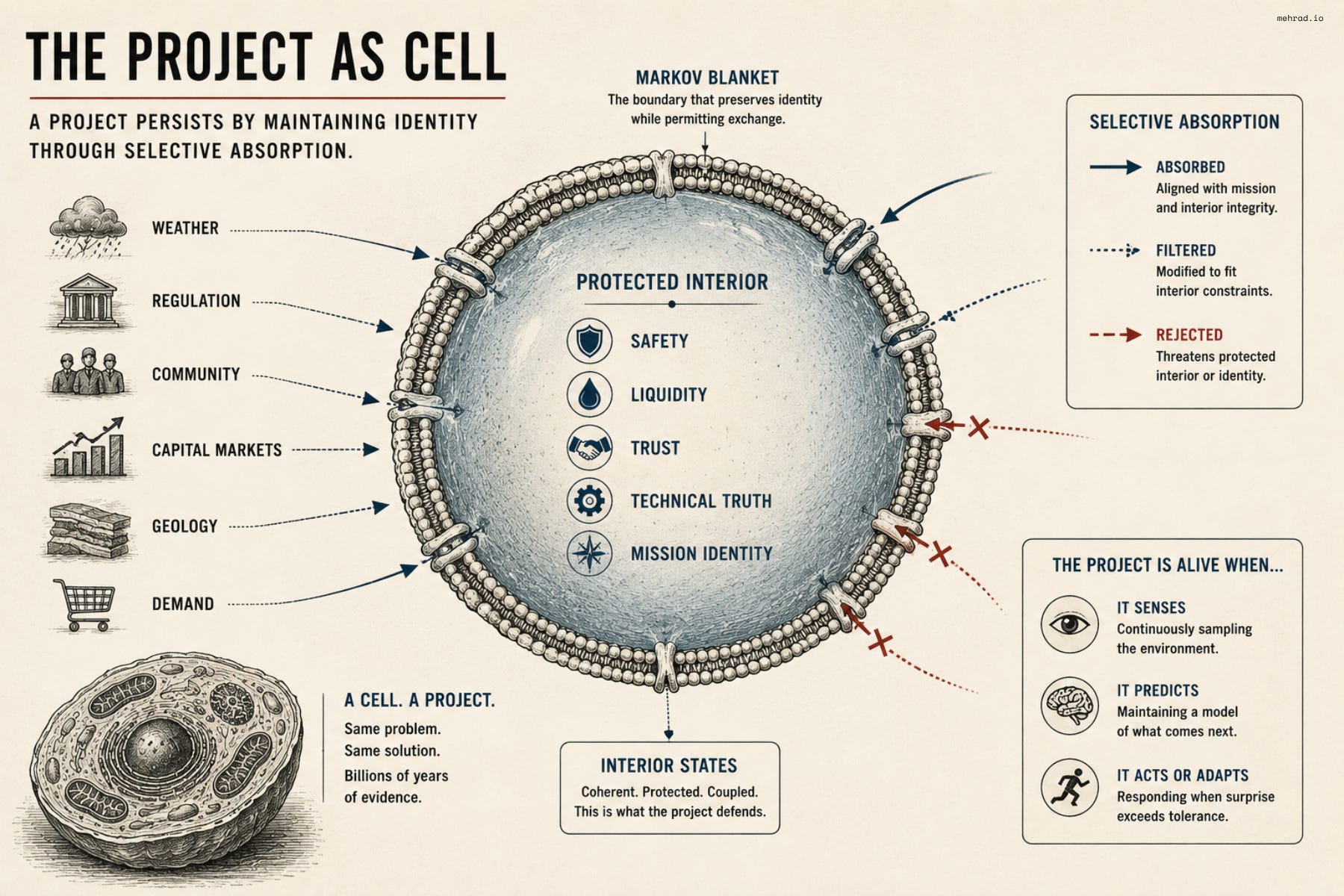
A project, viewed honestly, is the same kind of object. It carries a model of itself. It has sensors. It has interior states and exterior pressures. It has, or fails to have, a coherent boundary between the two. The project that persists under stress is the one whose architecture knows where its blanket runs, what is permitted to cross it, and which interior variables must be defended.
What persists is what predicts.
There is a further move available worth making. The same body of theory that explains how a cell persists has a great deal to say about what it means for a system to be aware of itself.
Two strands of consciousness research matter here. The first, Giulio Tononi’s integrated information theory, holds that consciousness is a measure of how much a system’s information is irreducibly integrated across its parts, a quantity Tononi labels Φ.
A high-Φ system is one where you cannot understand any part without simultaneously understanding many others. A low-Φ system is a collection of mostly independent components that happen to share a label. The second strand, global workspace theory, treats consciousness as a broadcast layer: local processing becomes globally available, and the system becomes capable of acting as a whole.
Most project coalitions are low-Φ structures. They share documents but not models. Each stakeholder holds information that is largely inaccessible to the others. They have been bound together by contract, which is a weak form of integration. When stress arrives, the coalition fragments along its original seams, because there is no coherent whole to which any part can speak.
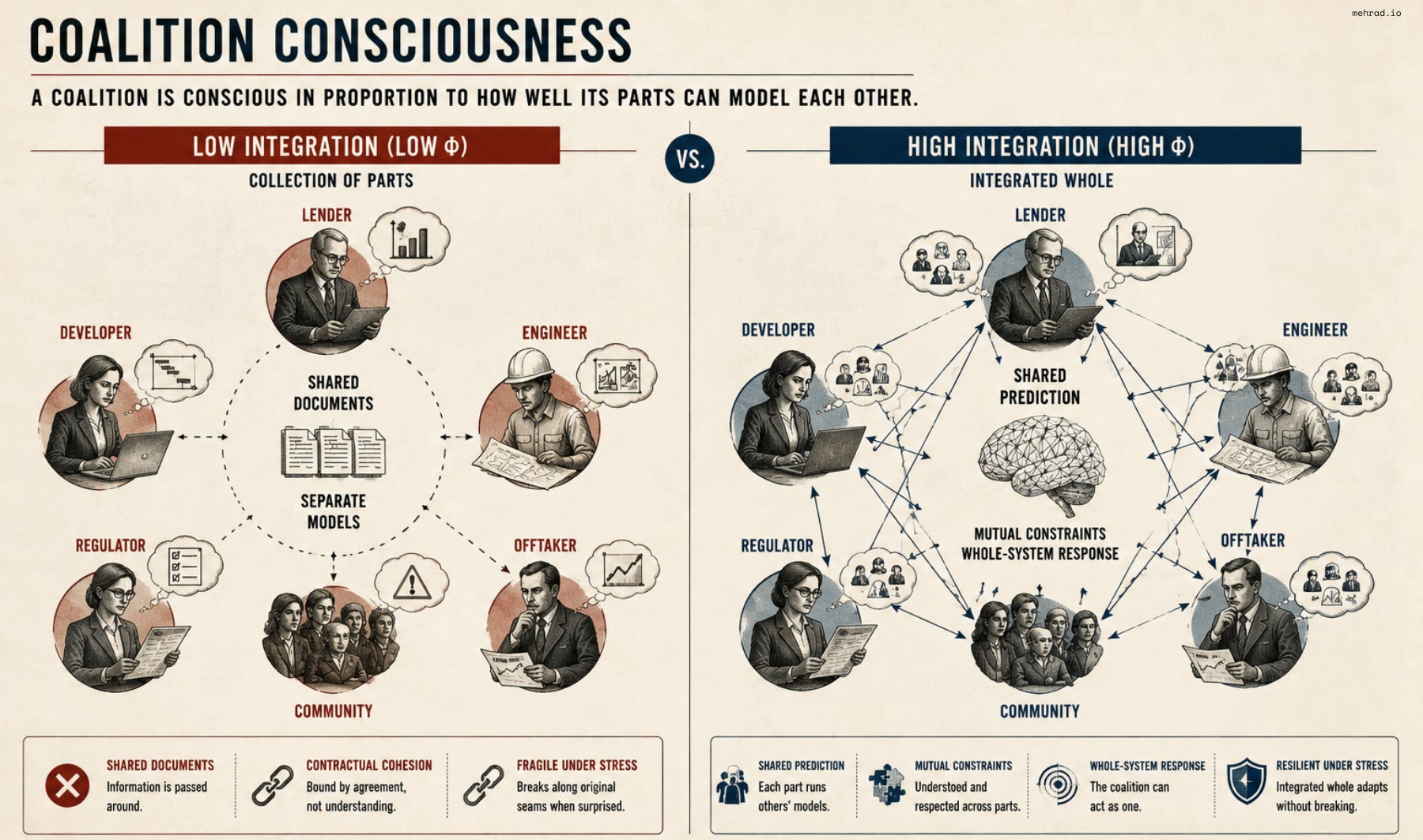
The coalitions that survive surprise, Panama under Stevens, Apollo under Webb, the better corners of the modern semiconductor supply chain, share a property the contracting documents never name. Their parts run each other’s models.
The lender understands what the engineer is solving for.
The engineer understands the regulator’s constraint set.
The community knows what the financier is exposed to.
What binds them is harder to put in a contract: mutual prediction, shared interior life, the practical capacity to model one another under pressure.
A coalition is conscious in proportion to how well its parts can model each other.
Where does that shared interior life actually form? Not, as it turns out, on the agenda.
The brain has two large-scale networks that toggle against each other. The task-positive network attends to immediate stimuli: the spreadsheet, the meeting, the deliverable. The default mode network activates when the brain is ostensibly idle, and engages in autobiographical memory, future scenario construction, and the modeling of other minds.
The default mode is where the brain integrates its days into a coherent self, rehearses possible futures, and develops theory of mind about the people it is going to meet tomorrow. Brains that lose default mode function lose, in measurable ways, the capacity to be themselves.
Project coalitions have a default mode, though we tend to call it something else… the dinner before the term sheet, the walk between sessions at the offsite, the long thread that wanders off-topic, the unscheduled call where someone says what they actually think. We treat these as overhead or relationship-building. They are the substrate on which coalitional intelligence is built. The default mode of a coalition is where its parts come to run each other’s models well enough that the contractual layer can hold.
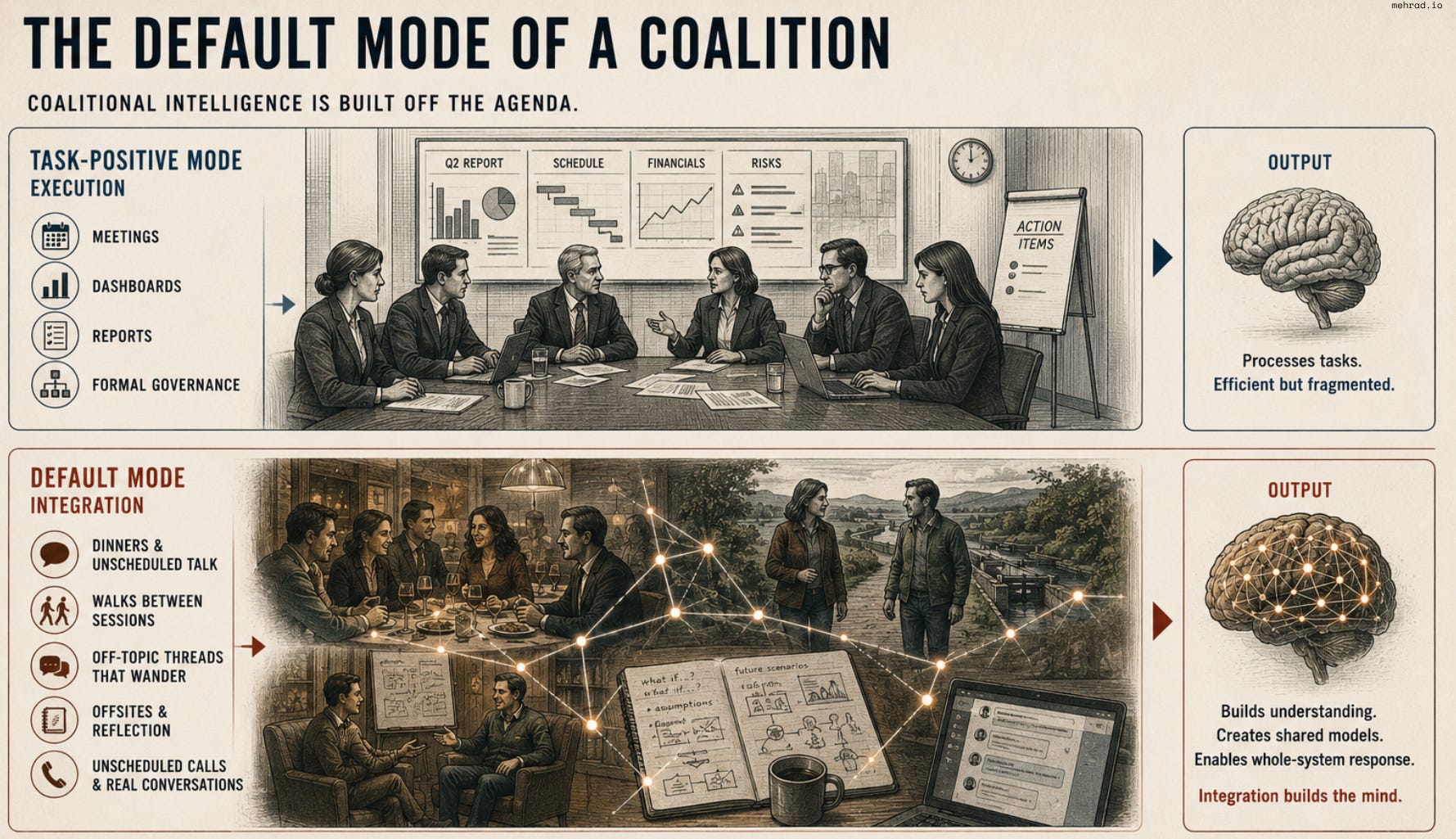
Quarterly reports, structured updates, formal governance. A coalition that runs only on these has no default mode network.
It will look efficient on the dashboard but it will fragment at the first deviation, particularly if they haven’t pre-defined what resilience looks like for their respective organization.
No coalition becomes conscious of itself on the agenda.
Most first-of-a-kind projects fail along three predictable lines that follow directly from this architecture.
The frozen prior. Stakeholders enter with mental models that are never formally updated. When reality diverges, the response is renegotiation under duress rather than recalibration by design. The Panama Company could not update its model and remain solvent. Most modern infrastructure vehicles inherit the same defect, dressed in modern documents.
Note: The Panama Company’s yellow fever was not an unknown unknown. It was a phenomenon everyone had seen, whose mechanism no one had modeled, what we call in futurist scnearios, a black jellyfish, the risk that arrives wearing the face of something familiar.
Mismatched precision. The lender watches debt coverage. The developer watches schedule. The offtaker watches reliability. The community watches the externality nobody priced. They are looking at the same project and weighting different signals within it. Conflict surfaces at the threshold breach, never at the drift, and by the time the dashboards agree the coalition has already broken.
Passive monitoring. Covenant reporting is a financial fossil, a residue of the era when data was expensive. The instrumentation now exists technically; the governance has not caught up. We have built digital twins and operate them as if they were quarterly newsletters.
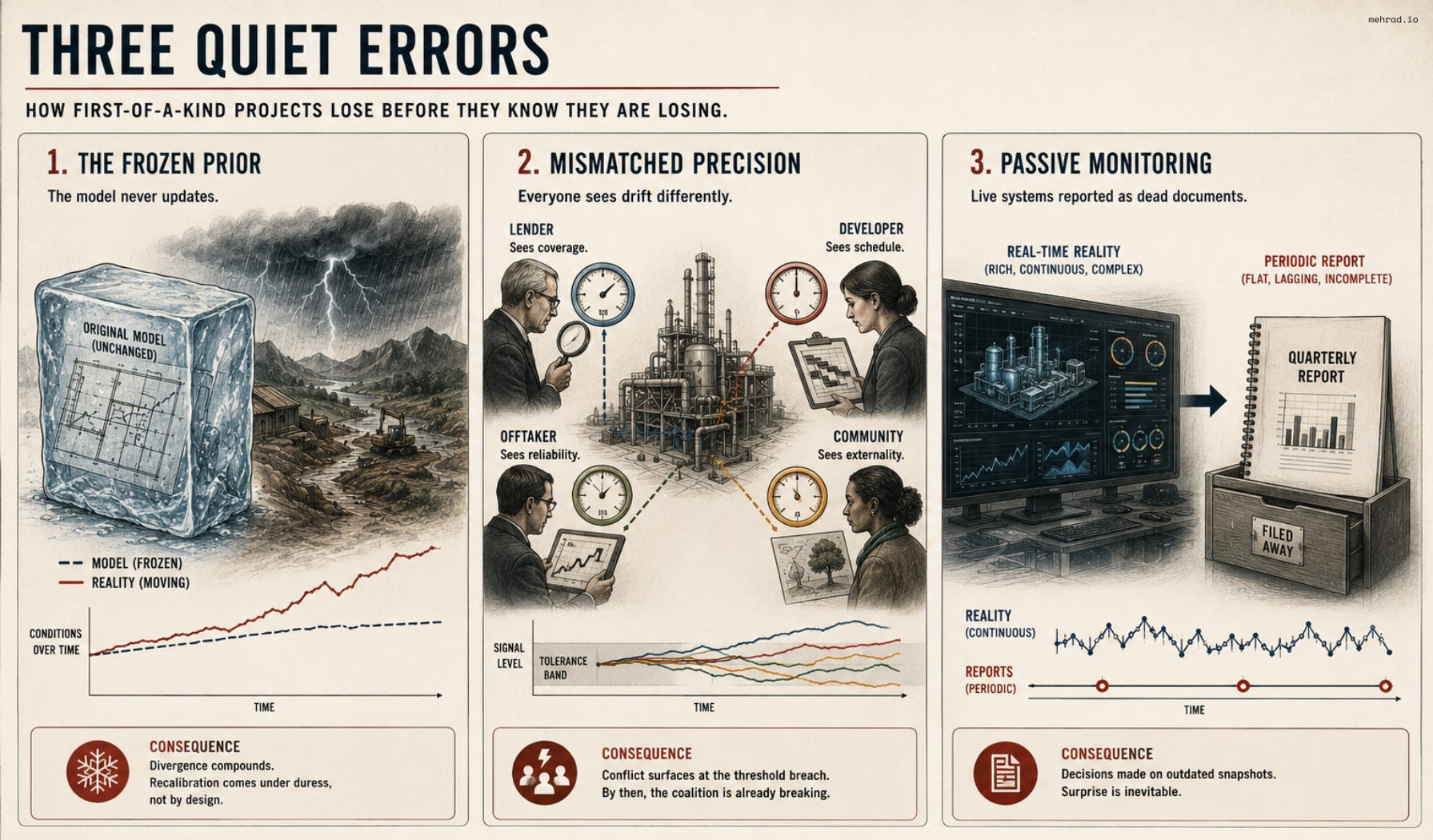
The biological correction in each case is the same: continuous prediction, selective surprise absorption, and a clear architectural decision about which layers are permitted to learn and which must hold.
There is a deeper conceptual move available, from homeostasis to allostasis. Homeostasis defends a fixed set-point. Allostasis adjusts the set-point in anticipation of change. Living systems do not sit in equilibrium with their environments; they move with them, shifting their targets as the world shifts.
Most project structures defend fixed equilibria: fixed prices, fixed covenants, fixed milestones. They are then surprised when the world refuses to hold still.
The allostatic version writes recalibration into the structure itself: indexed pricing, milestone-gated capital, planned governance reviews, contingent tranches.
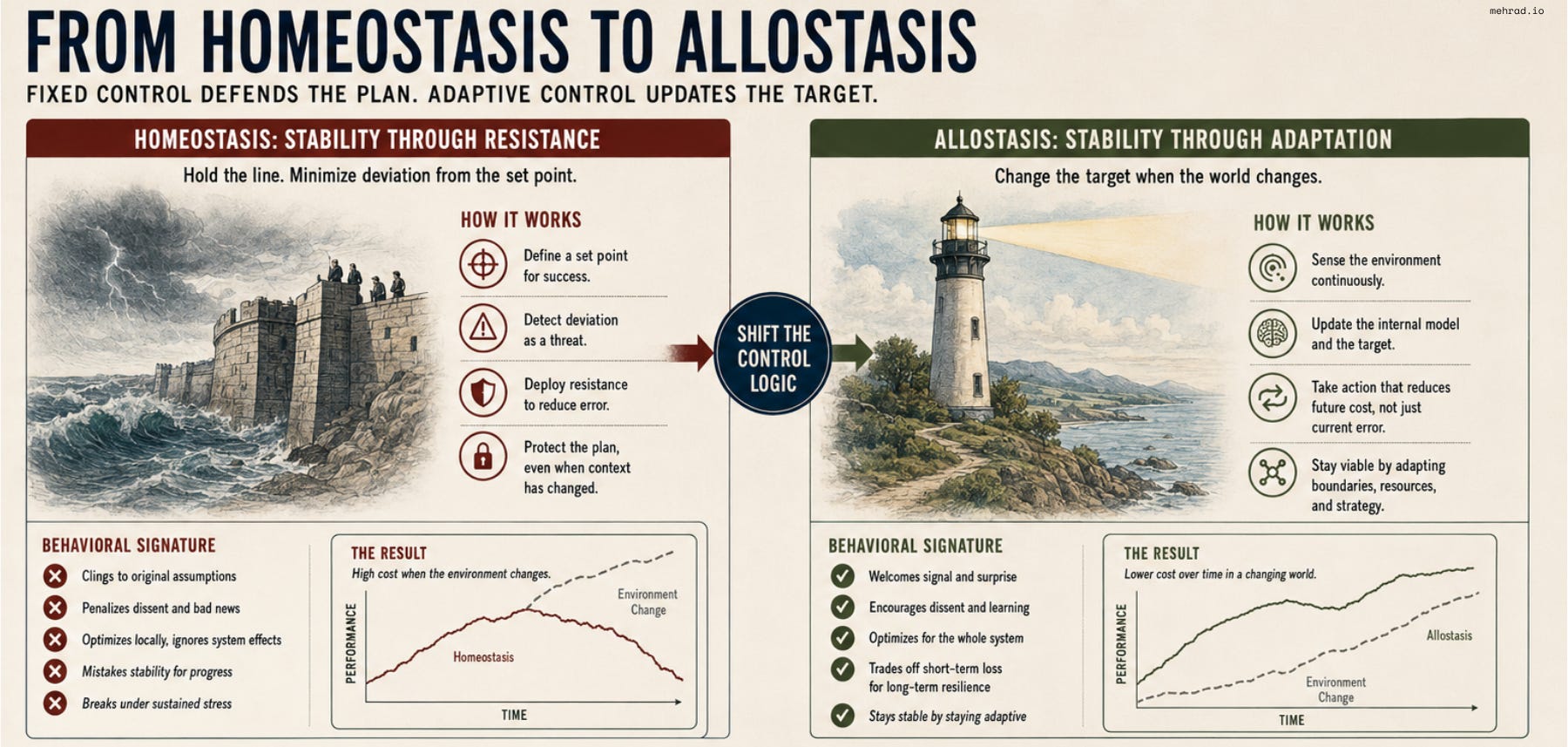
The body has done this for several hundred million years and we are slowly importing the vocabulary and this understanding.
Every first-of-a-kind financing hides a deeper design question that most term sheets refuse to name. Are you building this project to survive surprise, or to learn from it?
The survival-mode project is over-collateralized, fixed-offtake, conservatively covenanted. It minimizes free energy by suppressing variance. It is brittle under deviation, and legible to traditional capital. Most of what gets built lives here.
The learning-mode project is staged, instrumented, milestone-unlocked, contingent. It minimizes free energy by improving the model. It is antifragile under deviation, and largely illegible to capital trained on the older paradigm.
The interesting commercial space, the one some of us are quietly working in, sits in the instruments that make learning-mode projects legible to institutional capital. The translation layer is the sense-making infrastructure itself. It is what allows learning to be underwritten by capital that does not yet know how to underwrite learning.
The systems that persist in nature have evolved architectures for absorbing the right amount of surprise in the right places. They run continuous prediction. They defend the variables that must hold. They flex the ones permitted to move. They share interior life across their parts, integrated tightly enough that the whole can speak when the world demands a response. They develop these capacities in the rest periods between tasks, where the integration work is quietly done.
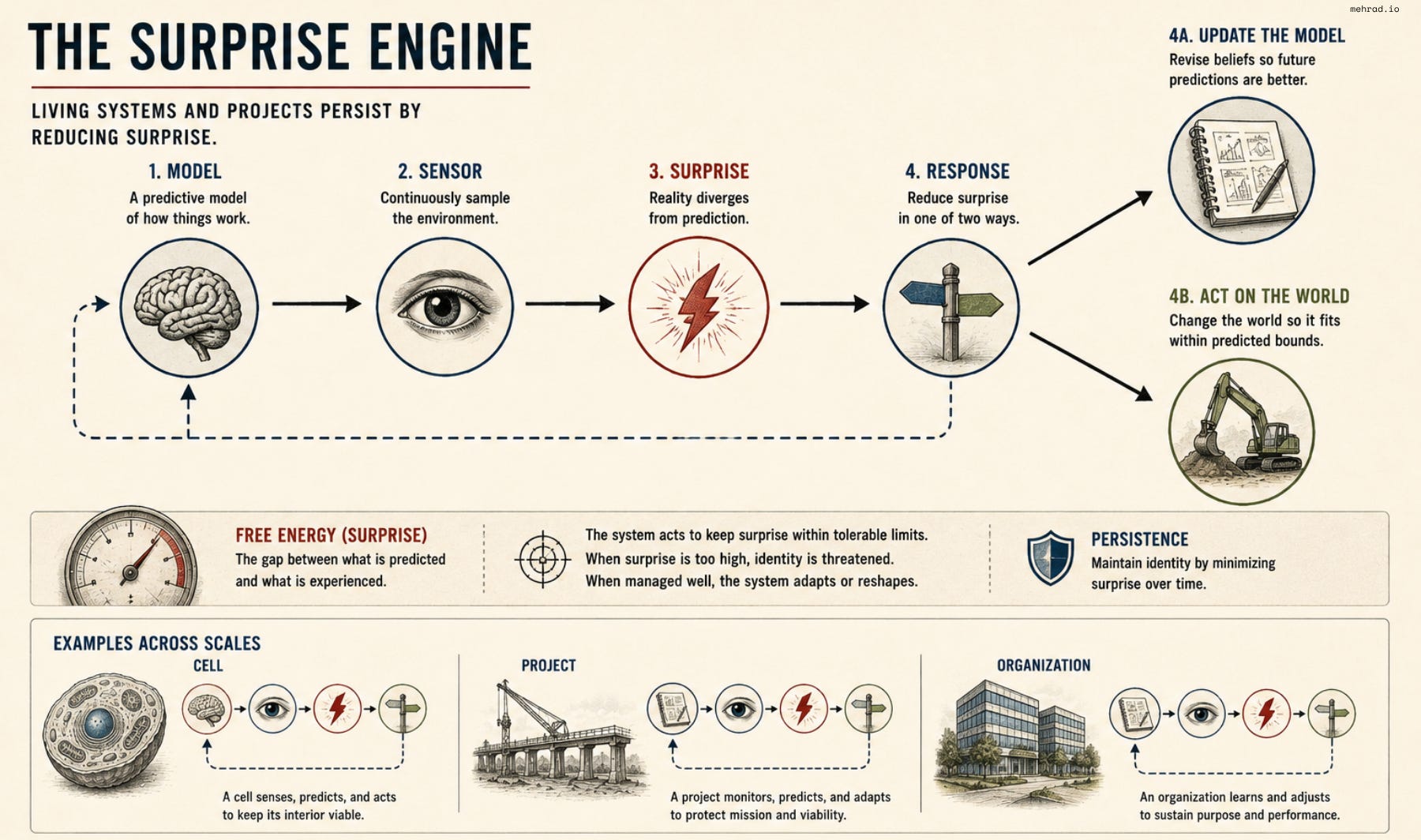
First-of-a-kind project finance is, structurally, an identity-preservation problem under high uncertainty. Its biological analogue is fully specified, four billion years old, and freely available in the substrate of every living thing.
De Lesseps built a static model he could not revise. Stevens, whose name almost nobody remembers, built something that could learn.
The work still to be done is to make the second kind contractible, at the rate the world is now producing surprises.
Some are black swans, genuinely unforeseeable. Most are black jellyfish, familiar phenomena that turn uncontrollable at scale and tipping points we watched approach. Most of what will break the next decade of infrastructure is already visible to someone.
The outlier was once the thing a structure survived. It is becoming the thing a structure is for.
No posts
Comments
Nothing yet. Say the first thing.
Sign in to join the conversation.