
What is it about a summer illness that makes it so much harder to tolerate than one that strikes in the heart of winter? I got sick last month and lost most of July and a little bit of August to flu and pneumonia. I’m not a patient patient. I want to recover quickly and reclaim my life. I’m annoyed at the imposition of illness, the refusal of my body to cooperate and cast out the sickness quickly. Usually, all I can muster the energy to do is watch British crime dramas and read. Even then I don’t pay much attention to what’s in front of me. Mostly I lie on the sofa and whine inside my head.
I don’t remember ever feeling this sick before, and as I shook with chills and fever, I knew the flu would develop into pneumonia. Not because I’m susceptible to pneumonia — I’ve never had it before. Still, I was positive it was coming for me.
Why?
Because I’m 67. And when my father was 67, he got pneumonia and died. When he was admitted to the hospital and the doctor in the ICU said “Pneumonia,” we all thought, “Okay, that’s treatable. People get it all the time. He’ll recover.” But in his case, it wasn’t treatable. And he didn’t recover.
Things to know. I am a healthy person. I don’t feel 67 — or, rather, 67 feels pretty good to me. I live the life I want to live. I’m active. I don’t (yet) have any of the illnesses that many people my age do, and my hips, knees, and shoulders (head and toes) all seem to be working quite well, thank you.
I could exercise more, but I walk most days and I mostly eat healthy food because I like it, and sure, I could strength train more, but I’m doing okay. I admit I was feeling a little bit smug about my health. Not quite taking it for granted but thinking that if I just kept doing what I was doing, good health would stay with me. But the universe was laughing at me when it sent pneumonia my way at the age of 67. Ha, ha, take that. Better watch it. Your good health and your life can change in a moment. Just like it did for your father.
I’ve been thinking a lot about my father recently. He died in 2000 and this year, he’s been in my thoughts more than he has been in ages. I’ve been thinking that I want to write about him and also thinking about how to avoid writing about him — well, really, I’ve been thinking about how to avoid writing altogether and doing a pretty good job at it.
Before I got sick, I was on a roll with my writing, working most days, making great progress on a first draft of a novel, and then I put my writing aside because I had some traveling to do and then I got sick.
So now I’m trying to find my way back into my writing, which is hard to do after more than a month, and while my novel is on my mind, so is my father. So rather than open the draft of my novel, I’ve decided to write this post and empty my head of thoughts about the lost July and the coincidence of getting pneumonia like my father did at age 67.
I had a complicated relationship with my father. Back in the day, when we still used landlines, he was the only person I regularly hung the phone up on — actually slammed the receiver down into the phone. How satisfying that was for a few moments until I started to feel guilty and then called him back.
Twenty-six years after his death, however, I find myself repeating the phrases that so many others have said about people they’ve lost. I wish I had been more forgiving. I wish I hadn’t been so quick to judge. I wish I had known him better. It’s not that I don’t wish he had done things differently or not done certain things. It’s that my anger at him seems to have been buried by the years. And my interest in who he was as a person — separate from who he was as my father — has increased. I’m trying to remember the good things he did, the person he was when I was younger.
I was at the beach for a few days recently, perfect medicine for recovering from illness, and the ocean was so rough and cold. Most of the time there was a red flag posted and people could only go out in the water up to their knees. As I watched the waves, time shifted, and in my head I was in the past, down the shore with my parents, before their divorce, when my siblings and I were young.
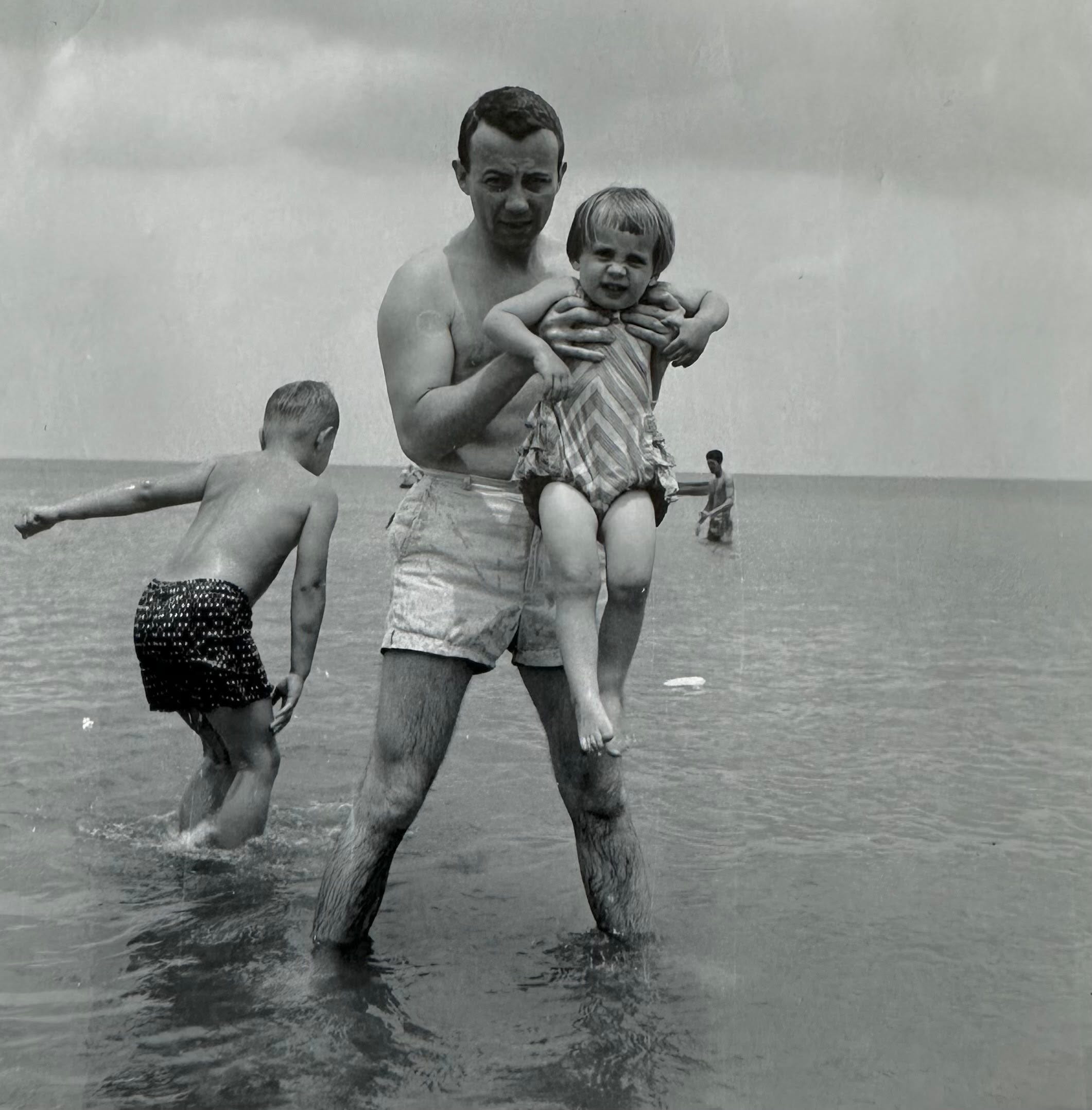
I saw my dad, my young dad — he was in his 30s — striding across the sand and walking out into the waves. Stepping over them, laughing as they tried to knock him down. He made it over the biggest swell and then he raised his arms over his head, bringing his hands together, fingers pointing skyward, and dove into an oncoming wave. For a few long moments, he disappeared under the churning water, but then there he was, breaking through the ocean’s surface. He shook his head and wiped the water from his eyes. I imagined him turning to wave at my brothers and sisters and me, where we watched from the safety of our beach blanket. And then we joined hands and ran to meet him, screaming with joy as we ran into the surf.
He liked to pick us up and toss us into the ocean. When we emerged from the water, he liked to cup the back of our heads and squeeze lightly — like a hug for the base of our skulls. He liked to use baby oil and iodine to get the perfect tan, and he’d let us rub it on his back and shoulders. He liked the smell of the bay as we drove over the bridge that would deposit us onto the shore island — we all did — and we’d roll the car windows all the way down to take it in.
I like writing about these things he liked, and I like how I feel when writing them. I’m smiling at this moment. Someday, I may write about the things I don’t like remembering about my father and I know I won’t be smiling. But that’s for another time.
The Reading Life
I remember clearly the books I’ve read during previous summer illnesses. I read them in a haze of fever, with cups of tea and honey. Life After Life, The Great Believers, Emma, Cold Mountain — amazing books all and worth a reread. I cried at the end of The Great Believers and sobbed when I finished Cold Mountain. My children were young and still at home when I finished Cold Mountain, and I recall dragging myself out of my daughter’s loft bed, which was a great bed to read in, and going to my children with the book gripped in my hands, crying about the ending.
This most recent illness, this lost July, the book I had at hand was Yesteryear and though I read it straight through, propped up with ibuprofen and tea, I am disappointed that this is the book I chose to comfort me. Not a classic, but a bit of a trick book, even if it is the read of the year. A lost opportunity, that.
Three books I have recently read and can recommend are: Whistler by Ann Patchett, The Things We Never Say by Elizabeth Strout, and On the Calculation of Volume IV by Solveg Balle (such a great series!).
Not That This Has Anything to Do with My Father or Pneumonia or Books
This bout of pneumonia, coming as it did in summer, reminded me of a previous summer when I was sick with mono. I don’t know what the protocol is these days, but it used to be that children with mono weren’t allowed to do anything except stay inside and rest. I was 11 or 12 and couldn’t join my friends in swimming, or riding my bike, or running outside to play games. I wasn’t allowed inside my friend’s houses because my mononucleosis germs insisted on coming along with me, which also meant that I couldn’t go to the movies at Parkwood Movie Theater where you could see a double-feature matinee on Saturdays for less than one dollar. I spent the summer mostly in our house and my mother, who had five children to take care of, kept me company, entertaining me for hours with card games. We played Gin Rummy and she taught me Pinochle. We practiced the Zampa piano duet though I could never keep up with her. I pored over her cookbooks (which I wrote about in a previous post) and made my first and only Black Bottom Pie. It turned out to be a great summer.
No posts
Comments
Nothing yet. Say the first thing.
Sign in to join the conversation.