
When we started ReGen, we didn't set out to create another venture capital firm. There’s way too many of those. We decided to build ReGen Ventures from scratch because we saw a glaring gap: a need for a firm that’s as bold as the founders we partner with and purpose-built for this moment in history. A firm designed for unreasonable partnerships with founders building a future of abundance.
ReGen exists to back the aliens inventing, developing and scaling foundational technologies - the building blocks of a regenerative future - to deliver abundance for humanity and all life on Earth.
Charlie Munger famously compared investing to surfing: there’s the surfer, the board, and the wave. The wave is what matters most. Choose the right wave, and almost everything else works itself out. As a team that is more comfortable in wetsuits than suits, we think about the quality, shape and duration of waves a great deal.

We believe the convergence of foundational technologies across energy, intelligence, matter, and autonomy represents the building blocks of a powerful and long-lasting technology wave. This wave is the power source for transformational, durable, and iconic companies to ride.
We are focused on these foundational technologies that are self-reinforcing to create the foundation layer for a future of abundance:
Energy: Infinite, clean energy is the foundation of all regenerative technologies. Ultra-cheap renewables, advanced geothermal, next-generation storage and fusion are rapidly driving energy costs toward zero with near-limitless supply, opening up plausible pathways to entirely new possibilities.
Intelligence: AI is the universal discovery, design and control layer for regenerative systems. Self-learning models are beginning to function as a generative layer across biology, materials, and energy—designing proteins, experimenting within physical systems, and orchestrating processes in days that used to take decades.
Matter: Every era of accelerated human progress—Stone Age, Bronze Age, Industrial Revolution—has been defined by breakthroughs in materials. Today, advances in AI, bioengineering, and quantum computing are reshaping our relationship with physical matter, enabling us to precisely grow materials from the atom up rather than extracting and refining them.
Autonomy: Robotics is the force multiplier for regeneration, enabling physical work at planetary scale. The cost of core robotic hardware has decreased more than 30x over the last decade, paving the way for autonomy to transform entire human workflows, from autonomous ocean exploration and precision agriculture to self-driving science labs.
Historically, technological revolutions have not stemmed from isolated breakthroughs but rather from simultaneous maturation and interaction among multiple technologies. The steam revolution required engines, metallurgy, and railways. Computing demanded semiconductors, global communications, and software.
Today, the same integrated and self-reinforcing effects are occurring between multiple technological breakthroughs. What’s changed is the exponential rate of change that we are witnessing in the post LLM-world. This rate of progress and compounding cause and effect is laying the platform for unprecedented change.
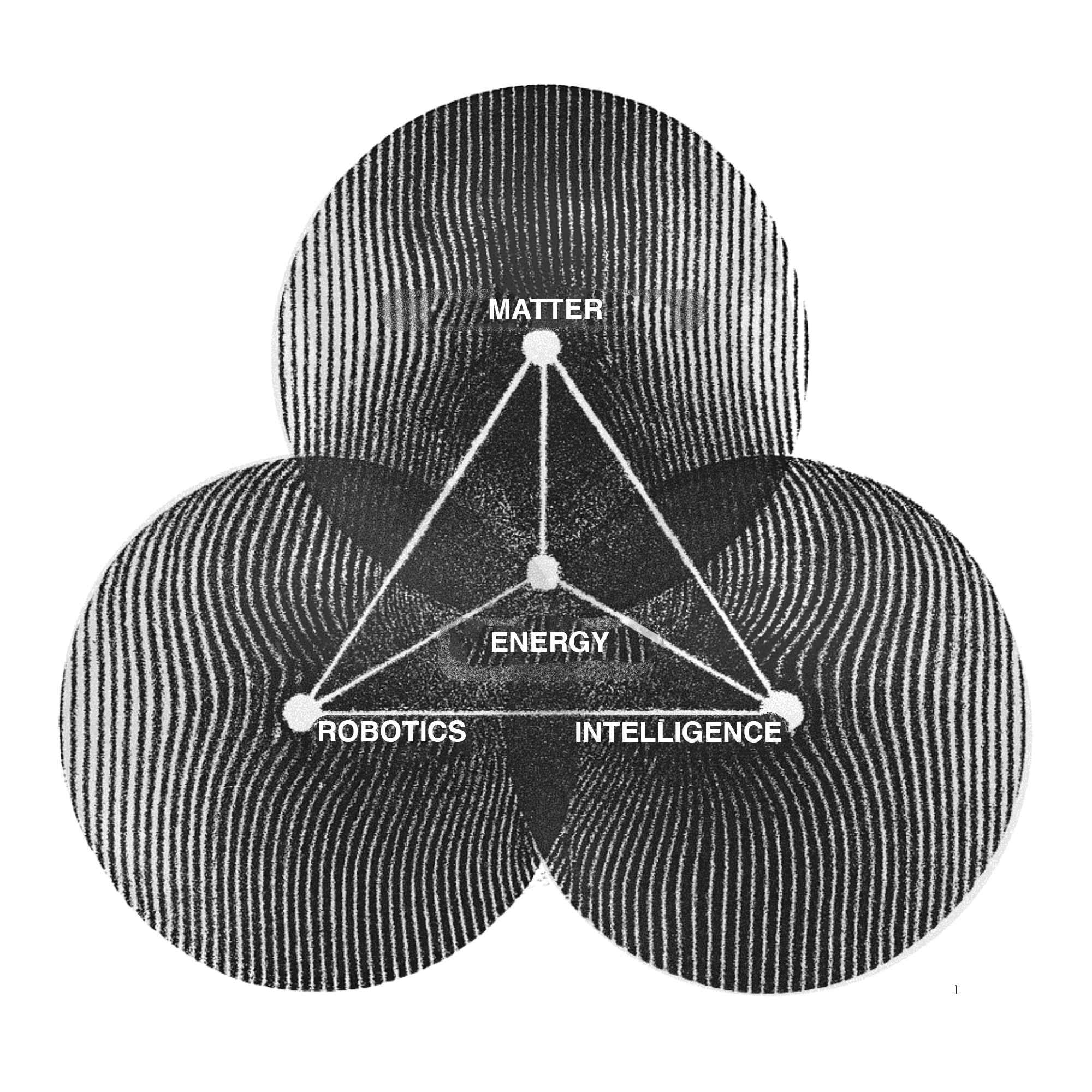
Breakthroughs in AI, robotics, biology, and materials science are colliding and accelerating each other in ways no individual discipline could reach alone:
Abundant energy lowers the marginal cost of intelligence and manufacturing, which in turn accelerates automation, which unlocks processes and products that once seemed impossible or uneconomical.
Generative intelligence increases precision, reduces failure, and shortens design cycles across all forms of manufacturing. Real-time learning gets embedded directly into physical systems.
Autonomous robotics handle high-friction, remote, and continuous tasks while feeding data back into the system such that every deployment improves the next.
It’s this convergence that unlocks the possibility of replatforming how we produce, regenerate, and coordinate life on Earth.
What makes this moment a paradigm shift, not just a technology revolution, is that we are leaving behind the operating assumptions of the previous system.
Like other revolutionary innovations, these technologies shift the productivity frontier, but in this case it’s more accurate to say they are rewriting the production function itself. Classical models assume finite inputs, each with diminishing returns. Growth plateaus, and progress depends on external technological shocks to temporarily boost efficiency within a fixed system.
But that logic breaks when intelligence, energy, labor, and materials become programmable and composable. Better put, when inputs behave like technology—because they are technology— Moore’s Law begins to apply across all components of the function. Declining costs, compounding performance, and modular recombination become the norm. Productivity and growth no longer wait for breakthroughs; it generates them.
Resultantly, where in the old paradigm, ‘tech’ was a vertical: a bounded industry focused on building tools that made other sectors more efficient. Today, the boundaries between tech and non-tech sectors are dissolving. Even the most traditional industries will start to behave like adaptive systems. Agriculture, ecosystem management, industry are all trending towards software-like learning curves: iterative, modular, and compounding.
This isn’t just about doing more of the same faster. We currently waste vast amounts of limited and precious resources while barely using the planet’s massive surplus of renewable energy, biological diversity, and material potential. By tapping into these flows, these technologies unlock that hidden abundance across sectors, moving us beyond limits to growth by intelligently adapting, coordinating, and amplifying what’s available. Scarcity no longer defines us; abundance and compounding growth do.
Because of this, the companies built in this new paradigm will be orders of magnitude larger than the incumbents they displace, often larger than entire industries themselves.1 They’ll capture whole stacks, redefine category boundaries, and outgrow the industries they were born into.
This is no longer a forecast for progress - it’s a shift we’re already witness to. $1 billion exits now represent the ~85th percentile, not the 99th as they did 2 decades ago.
At ReGen, we obsess over shaping our firm into the ideal board to ride this techno-economic wave (there’s the surfing analogy again!). We’ve architected ReGen to assemble a densely clustered community of people with audacious ideas, united by our shared mission to build a future of abundance.
We are privileged to partner with visionary and pragmatic founders building transformative companies that exemplify this convergence of energy, materials, autonomy and intelligence, unlocking hidden abundance:
Anthrogen uses AI to engineer proteins, robotics to automate lab workflows, and biology to grow molecules traditionally derived from petrochemicals, creating a platform over 1,000 times more efficient than traditional chemical synthesis.
Differential Bio launched a digital twin for microbial life, rapidly achieving commercial scalability by integrating AI and biology to replace petrochemical-based manufacturing.
Ulysses deploys autonomous ocean robots actively restoring marine ecosystems at scales previously unimaginable.
Foray is developing an AI-powered plant-science platform, representing the core operating system to program plants.
We exist to back founders who see the extraordinary potential of exponential technologies to build genuine abundance within those boundaries. We’re driven by the power of these technologies to fundamentally reimagine every aspect of our lives. These are just a few examples of the vast surface area of potential to restore what’s been lost and turn what once seemed finite into boundless growth within planetary boundaries.
Imagine a world where energy is free, materials are precisely grown rather than brutally extracted, four billion years of evolutionary intelligence embedded in our systems, and swarms of robots regenerate ecosystems rather than degrade them.
It’s a directional phase shift into the unknown potential of a regenerative and abundant future. It’s akin to a groundswell - energy, momentum, and possibility rising far offshore with elemental force.
This opportunity can’t be neatly plugged into a spreadsheet, but if you’re lucky though you might hear the change through your bedroom window while it’s still dark. From our experience, these are not the mornings you wait for the sun to rise. And wisdom says you should’ve been here yesterday.
Waves like this don’t punish commitment; they punish hesitation.
We’re paddling out, trajectory set towards the horizon; dead set on catching the wave towards an abundant, regenerative future. Come join us.
Packy McCormick stated this in Everything as Technology as “The addressable market for venture-backed tech companies will grow by at least an order of magnitude as they battle incumbents in industries not traditionally considered tech, and as they turn previously fragmented and unaddressable markets into addressable markets.”
No posts
Comments
Nothing yet. Say the first thing.
Sign in to join the conversation.