
There was a silence this past week, and in that silence, the forest breathes a little differently.
The world has lost one of its gentle giants. Jane Goodall, who embodied the qualities of a regenerative leader, taught us to listen to the wild, has passed. As someone writing about futures, regeneration, and what it means to keep hope alive, I want to sit with what her life means for us now, and for the regenerative futures we try to seed through my Substack newsletter.
And in that sitting, to understand that this sadness of her passing is love that must become action. How do we carry forward her legacy? What lessons might guide us in these anxious, unnerving times?
Jane’s story has never been abstract for me.
My connection to her work is deeply personal. Learning about her in elementary school planted a seed. I remember Mrs. Wright’s fifth-grade class doing an entire unit on the rainforest. Our task: transform the library into a “life-size”, immersive rainforest diorama. We used leftover cardboard carpet rolls as tree trunks, hung green crepe paper as vines, positioned stuffed animals all around, and painted murals of the forest floor. For weeks, we studied species of flora and fauna, and each student had to give a biographical presentation on a naturalist, ecologist, or wildlife educator. I chose Jane Goodall. Standing before my classmates, telling her story, something shifted. That presentation began a lifelong love affair with her work, Africa, and conservation.
I’d go on to dress up as her for four Halloweens straight, trying to embody the persona of a woman I found so brave and curious. I wanted to be a primatologist for a long time and absorbed everything I could on the subject. And her inspiration fostered a deep love for Africa, a continent I was determined to experience firsthand. That dream became a reality when, at 16, I won a scholarship that allowed me to conduct field research at an international plant & animal science research center in Kenya. Her legacy taught me that curiosity, when paired with empathy and courage, can take you anywhere.
Jane showed me it was possible: that science, wonder, and care for the living world could be a life’s path. Much of what I do now—in systems thinking & design, educating the next generation, and building regenerative futures—began with the seed she planted in a little girl’s imagination. Her courage to challenge convention, ask “heretical” questions, and follow conviction over consensus still anchors my own work.
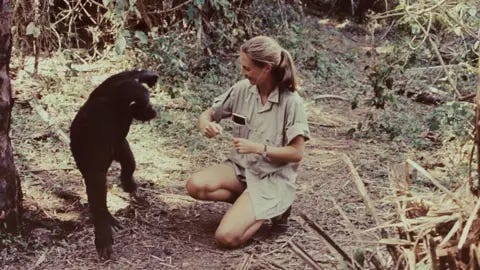
When Jane first arrived at Gombe in what is now Tanzania, she came with little more than curiosity, persistence, and a refusal to accept the “rules” of how science should be done.
She observed chimpanzees intimately, patiently, over years. She saw their personalities, their grief, their joy, their social bonds. She named them: Flo, Fifi, Frodo—rather than numbering them. She treated them as individuals, not specimens.
The radical humility in that approach, the willingness to slow down, to listen, to see, to wonder—this was regenerative from the start. She defied the dominant paradigm of extraction, of studying nature from a distance, as though we were wholly separate. She embodied an embedded science, one where the human is part of the web, not above it.
Over decades, she built up a long-term project of relationship, not conquest. The chimps gradually accepted her presence. Her work revealed patterns of tool-use, social politics, empathy, conflict, cooperation, culture. She blurred the line between “us” and “them.”
Jane’s life had a turning point. In the 1980s, she recognized that observing wasn’t enough. The forest was shrinking; chimp populations were plummeting. The human pressures of deforestation, habitat loss, climate change, and persecution were encroaching. She could not remain neutral.
That’s when she said she “became an activist.” She realized the privilege of her voice, her platform, and committed to speaking for those who had no voice.
She founded the Jane Goodall Institute in 1977 to protect chimpanzees and to engage local communities in conservation. She also launched Roots & Shoots in 1991, a youth-led program that empowers young people worldwide to care for their communities, to restore their habitats, and to act with empathy for people, animals, and the planet.
She understood that regeneration must engage human communities, not exclude them. Her approach recognized that people are part of the solution, not the enemy of nature. She wove together science, ethics, education, and community empowerment.
Her life was her message. As I reflect on it through the lens of regeneration, these are the ten principles she embodied, drawing from her life’s work and the leadership insights many have observed in her approach. These are lessons we must now carry forward in our own work:
Relationality over domination: She invested in trust and treated every being as having agency. Jane’s method was relational. She did not dominate the chimps; she lived among them, observing boundaries, letting them choose to accept her. A regenerative leader nurtures relationships among people, communities, ecosystems. Leadership is not about control but about cultivating conditions for mutual, continuous flourishing. In doing so, she echoed a wisdom long held by Indigenous cultures: that we are part of a living, sentient natural world of beings, not separate from it.
Long time-frames, deep patience: Decades at Gombe showed regeneration is slow, requiring endurance of care. Jane’s patient presence over years revealed that real understanding and real healing cannot be rushed. Projects and systems we build must respect natural cycles and the slow but steady and sustainable rhythms for soil recovery, forest regrowth, community trust, cultural regeneration, etc.
Adaptive humility, learning and public outreach: She changed course as she learned, modeling responsive leadership. Jane never claimed final wisdom. Her early assumptions were challenged. She was open to new alliances, even with unlikely partners, if they advanced conservation. Regenerative leadership is never fixed. It listens, pivots, learns from failure, breaks down siloes, and collaborates across boundaries. She also knew that science could not be kept contained in the lab or in the field — to be fully transformative, it must be taken to the public in a way they can understand - via speaking tours, educational partnerships, TV and new media appearances, etc.
Bridging scales: From the local forest to global advocacy, she held the tension between rootedness and universality. She encouraged local youth to act in their neighborhoods while speaking to world leaders. Regeneration demands both rooted action and broad vision. We must tend the local while keeping our eyes on planetary systems, and continuously strive to better understand the interplay between both.
Hope grounded in action. No action is too small: She insisted that optimism must be earned through doing, not denying. Jane refused despair. She said that pessimism is a self-fulfilling prophecy. She believed in the power of everyday acts, no matter how local or small: planting a tree, forming a youth group, speaking truth, changing a mindset. Regeneration needs hope, but not blind optimism. It needs clear-eyed agency: understanding the crisis, and acting anyway. And it needs the courage to start. Somewhere. Anywhere.
Intergenerational stewardship: By centering youth, she honored the future. Through Roots & Shoots, Jane passed on agency, not charity. Regenerative futures honor that we are caretakers, borrowing from the future, and must design systems that embed intergenerativity.
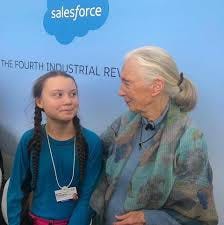
Jane Goodall with youth climate and humanitarian activist Greta Thunberg Ethics & reverence: She reminded us that all life is worthy of being understood and respected, beyond economic measure. She spoke of compassion, reverence, and responsibility. Regeneration begins with ethics: recognizing intrinsic value in all beings.
Leadership through respect, not dominance: From observing chimpanzee hierarchies, Jane distinguished between being a “leader” (who earns respect, builds coalitions, shows empathy) versus being a “boss” (who rules through intimidation and force). In regenerative work, power should flow from building trust and demonstrating care, inspiring others to act, not from controlling resources, top-down control, or imposing vision. True leadership creates the conditions for others to flourish.
Maximizing unique strengths over uniformity: Jane didn’t try to fit the mold of a traditional academic. She leaned into her observational gifts, her storytelling, her ability to forge deep connections. She understood that great leaders are self-aware about their strengths and maximize them rather than trying to be everything. In regenerative work, we need diverse strengths working together to create something bigger than the sum of its parts. We need the scientist AND the poet, the activist AND the farmer, the elder AND the youth. We don’t all need to be the same; we need to be complementary and collaborative.
Lifelong learning & perpetual curiosity: Jane remained a student throughout her life. Curiosity, passion, commitment to innovation, and discipline sustained her across decades. Regeneration requires us to stay perpetually curious, to keep questioning our assumptions, to remain humble students of the systems we’re trying to heal. The world is constantly evolving and so must we along with it, especially in this current age of accelerated change and disruption. The moment we think we’ve arrived at final answers is the moment we stop listening.
Jane’s passing leaves a gap, but the seeds she planted now sprout in many hands.
So, what does this mean for you, right where you are? Carrying her torch forward isn’t about replicating her journey, but about finding the Gombe in your own backyard. It means:
Ground your hope in Jane’s framework. She articulated what she called her reasons for hope: the amazing human intellect, the resilience of nature, the power and dedication of young people, and the indomitable human spirit. Later, she added a fifth: the power of social media and connectivity to mobilize collective action. Some may call this naive optimism, but regenerative leaders call it hope, rooted in observable capacities. When despair threatens, return to these pillars. Which can you activate today, from your own little corner of the world, with your unique skills and strengths?

I highly recommend this book to ground yourself while being inspired in these trying times Tell more stories of connection and belonging. Jane was a master storyteller and science communicator, capturing hearts and moving minds. To regenerate, we must weave narratives of connection, belonging, and possibility. What story of regeneration in your community needs telling?
Build partnerships with indigenous and local communities. Jane worked alongside local communities, engaging them in protection of their natural surroundings, rooted in respect for indigenous knowledge and local resources and perspectives. Regeneration cannot be parachuted in and unilaterally implemented. Knowledge transfer is not top-down, or from West to East, North to South. It must emerge from genuine partnership with those who hold place-based wisdom. Who are the knowledge-keepers in your place, and how can you learn from them?
Invest in youth and grassroots action. Support young voices. Give them agency. Create structures, be it fellowships, microgrants, mentorships, etc., so that young people can be proactive stewards and long-term strategists, not passive inheritors and reactive victims of their predecessors. What young person in your sphere needs your mentorship or resources?
Design human systems in harmony with ecosystems. In every regenerative project, ask: which relationships am I enhancing or cutting? How do human systems integrate with ecological cycles? Let nature’s logic inform design, not dominion. What system in your work could be redesigned to mirror natural patterns?
Cultivate patience in a culture addicted to speed. We live in crisis urgency, but regeneration demands that we resist quick fixes. Build for recovery, redundancy, buffers, and slow but steady growth where necessary. Where in your work can you commit to a longer timeline?
Practice humility and deep listening. Create spaces to listen, to local communities, to indigenous wisdom, to nonhuman lives, and most importantly, listen to the silence. Starting from within yourself. What is that silence telling you? Let leadership come from careful listening. What voices have you been missing in your work?
Integrate science, activism, and art. Jane herself bridged these realms. Our regenerative work lives in the overlaps: policy, ecology, culture, education. We should not silo but integrate. What unlikely collaboration could your work benefit from?
Multiply leadership, don’t centralize it. The greatest lesson of Jane’s leadership isn’t about her alone. It’s about seeking and allowing connection to others. Her greatness grew far beyond her, to countless people who took up her purpose and shaped it into their own. True regenerative leadership multiplies itself, empowers others to lead, becomes distributed rather than concentrated. Who are you empowering to lead alongside you?
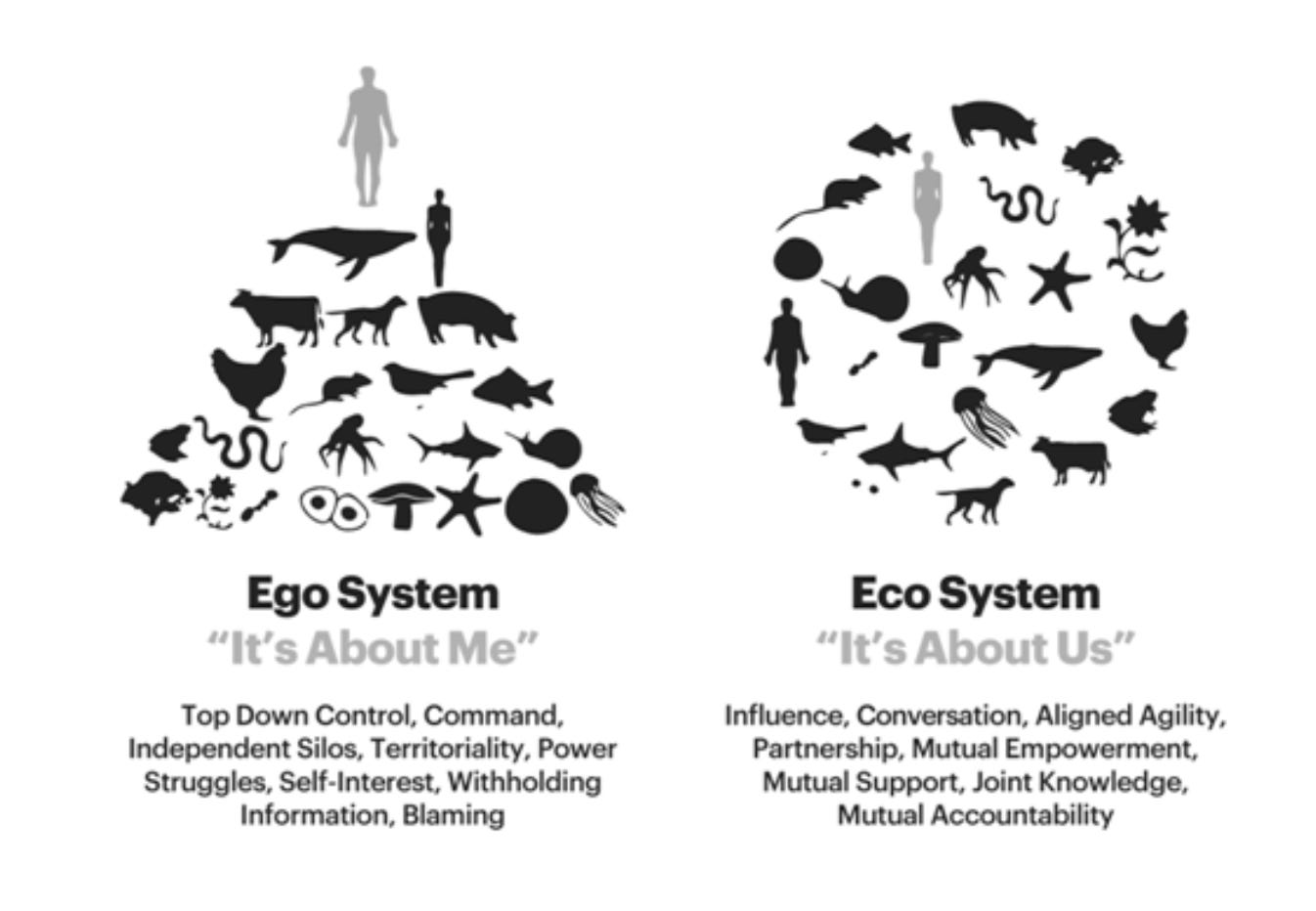
Honor the web of life, always. And to that end, always remember that we are not apart. We are part of the web, of the ecosystem, not the ego-system. Our regeneration is bound up with all species. Center that interdependence in every plan. How does your next decision account for the more-than-human world?
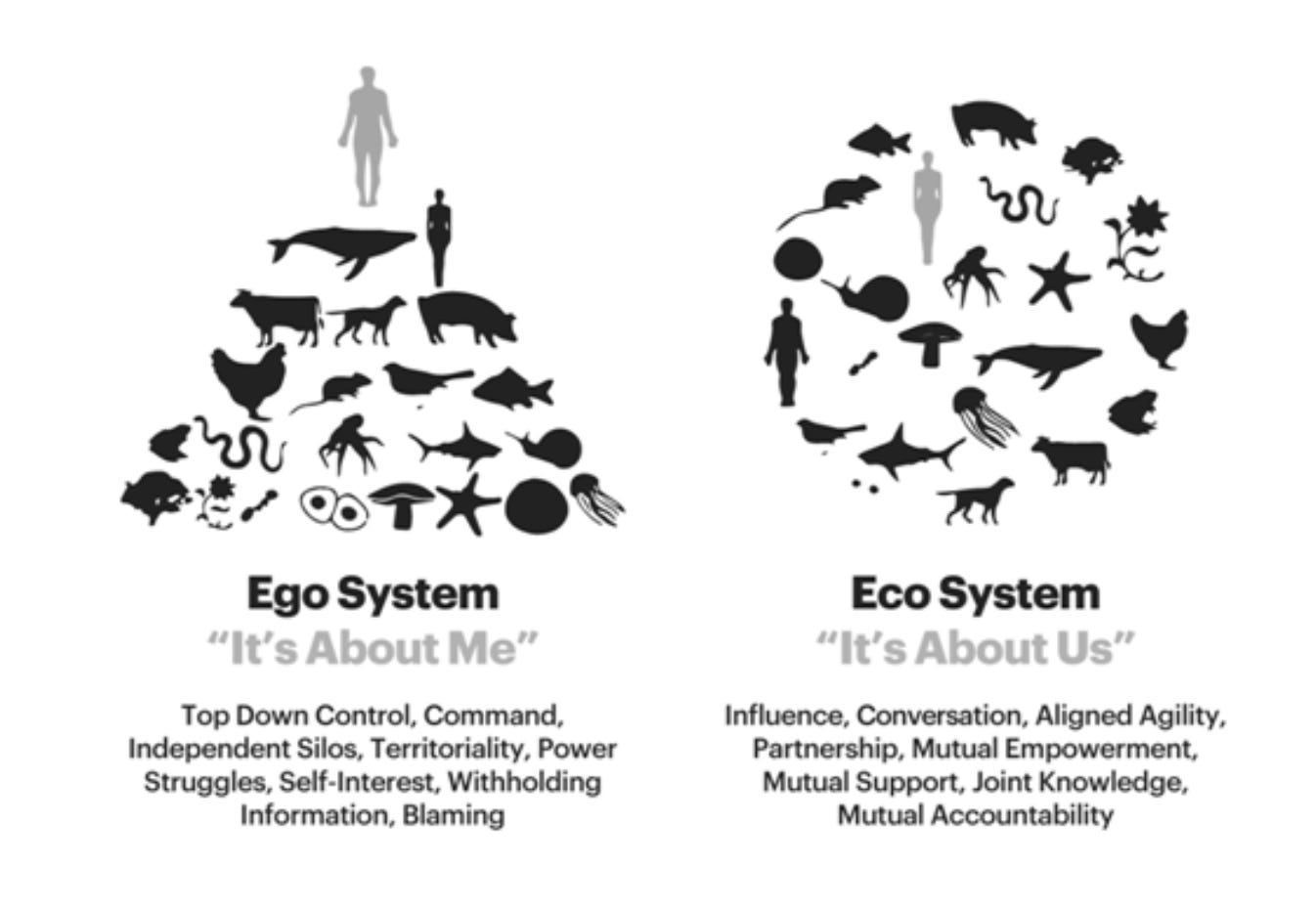
Source: Oxford Leadership, via ResearchGate

Jane spent her life teaching us to pay attention to the intelligence of other species, to the urgency of habitat loss, to the power each of us holds to make change.
That attention is now ours to practice. That urgency is ours to meet. That power is ours to use.
The forest keeps breathing. Our work continues.
With gratitude and resolve,
Bian “B” Li
The Regenerative Futurist
Thank you for reading! If this piece resonated, provided insight, or fueled your fire, consider upgrading to a paid subscription if you’re able. It keeps this work going.
Grateful for your support as we resist, reimagine and co-create a regenerative future together!
This post is public so feel free to share it!
Comments
Nothing yet. Say the first thing.
Sign in to join the conversation.