
August: the month of ripe tomatoes, glorious wildflowers, and buzzing anxiety about the start of a new school year. Even after thirty years of teaching, I still feel both anticipation and anxiety as students return to campus. I’m teaching environmental literature this semester, so sixteen lucky students will be reading (among other things) a few climate dystopia novels with me. Fun!

Just goes to show: you can pretend you’re going to neatly trellis a Yakteen gourd and a couple bean plants. But neglect them for one day and the plants develop other ideas.

The pollinators continue to lose their little minds over the banquet we lay out before them.
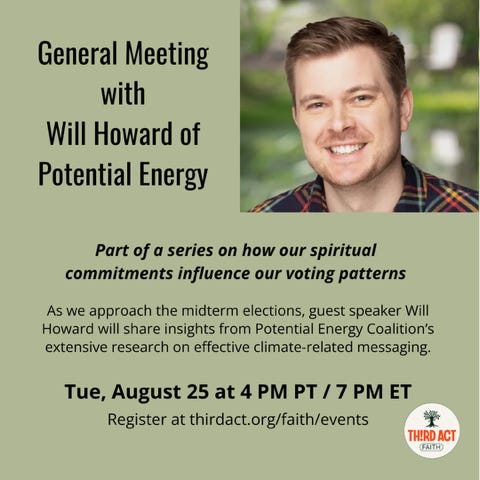
Quick reminder to join us, if you can, on August 25 for a Third Act Faith event featuring Will Howard of Potential Energy Coalition. Learn what the research says about how best to talk to people about climate change and climate solutions. There are traps to avoid and strategies that actually move people to action. Click on the image to register—it’s free!
I’m also delighted to share with you a recent episode of the Green Lectionary Podcast, in which host Derrick Weston and I have a marvelous time discussing the story of Jesus walking on the water in Matthew 14. The Green Lectionary Podcast is a terrific resource for preachers or anyone else who wants to learn how to read scripture through the lens of climate justice. I’m recording another episode with Derrick next week, this one featuring the manna-n-quail story in Exodus 10. I’ll let you know when that one releases.

Another couple weeks of the usual climate news mix we face in these difficult days: dystopia-level extreme weather events, nefarious deeds from the usual corporate suspects, lots of clean energy wins, and good people doing good things. We press on, friends.
First, a brief summation of extreme weather news. You’ve probably seen these stories in some form already, but let’s get the global picture a minute. The predicted “super El Niño” cycle has arrived, with the recent devastation of Hurricane Lala in Hawai‘i as exhibit A.
In case you find the whole El Niño cycle confusing—as I do—you might appreciate this excellent explainer from Carbon Brief. Here comes the science—with wonderful graphics, region-by-region analysis, and a careful assessment of prediction models.
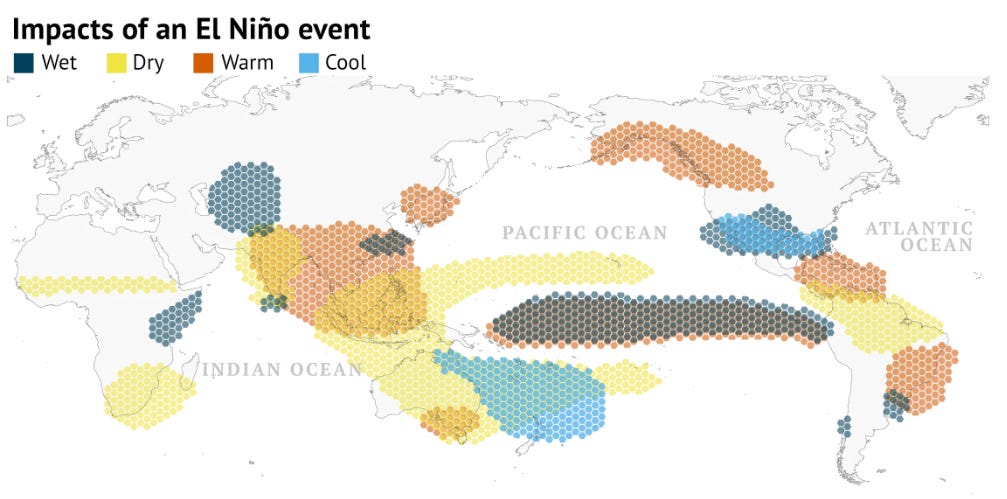
From Carbon Brief: “El Niño impacts temperatures and rainfall around the world, raising the risk of extreme weather events in many regions.”
In an already hotter, wetter, less predictable global weather system, this super El Niño cycle will be more disruptive than ever. The models are nearly unanimous on this point:
Carbon Brief analysis of forecasts from 14 different modelling groups that track El Niño globally – updated with the latest data – finds that 96% of runs predict that this event will be the strongest in the modern observational record.
Meanwhile, the American Meteorological Society released their annual peer-reviewed State of the Climate report this month for 2025. It is, unsurprisingly, grim. Bob Berwyn for Inside Climate News summarizes:
As global warming continued to reshape Earth’s climate, the planet’s oceans reached record high temperatures for the third year in a row in 2025. Some northern forests and tundra released more carbon dioxide than they absorbed. And the Greenland Ice Sheet lost about 129 gigatons of ice, enough to form a cube of ice about three miles wide on each side. …
The report identified continued burning of fossil fuels as the primary source of record-high greenhouse gas levels, which are raising global temperatures and intensifying extreme weather. In Europe, for example, average temperatures have risen about 3.6 degrees Fahrenheit since the 1960s, while extreme high temperatures have shot up by as much as 18 degrees Fahrenheit.
None of the report’s findings are surprising, of course. (Also, for another good summation of where we stand on global climate disruption, see Bill McKibben’s newsletter from last week.) The only possible silver lining here is that devastating events like floods, droughts, extreme heat, and wildfires have become so obvious, it’s harder and harder for people to persist in denial—or accept the lie that “it’s all a hoax.”
One more entry in the “this is terrible” category, all right? We’re going to have to talk about every academic’s favorite topic: AI. As we all wring our hands over what AI is doing to our minds, the big tech companies continue to try to foist their data centers on us and tell us AI is inevitable and amazing. This week, my feed was packed with more reasons to resist an unregulated AI invasion in every way we can.
First, please read Bill McKibben’s newsletter from this week, which summarizes the “environmental plague” of data centers, among other problems. He outlines five reasons to resist the incursion of AI data centers and tools:
Data centers are trying to build out fast by building “bespoke” gas power plants, making sweetheart deals with Big Oil. The emissions increases that these plants threaten would be unimaginable in scale.
The frenzied AI expansion is built on sheer greed.
AI capabilities are not well controlled or regulated.
Most of us hate what it’s doing to our daily experience and our minds. (This is, I can assure you, especially true for educators—and our students, too.)
The philosophical issues here are profound and unexamined by the perpetrators.
(Note: that little summary was not built with AI. I never use AI for this newsletter or for anything I write or develop. I’m not a total purist—AI is helpful for crunching large amounts of data and for modeling—but when it comes to language generation or analysis, you can imagine I’m not a fan.)
It gets worse. As McKibben notes, there is “an unholy alliance between Big Tech and Big Fossil.” Emily Atkin of Heated exposed another aspect of this alliance by explaining a new peer-reviewed study in npj Climate Action. After noting how much fossil fuel energy data centers plan to use, Atkin explains the even yuckier part:
And yet, this is only the tip of the AI climate iceberg. Because AI is not only consuming fossil fuels to generate electricity—it is also helping the world’s biggest oil companies produce more fossil fuels quicker, cheaper, and for greater profit.
Over the last few years, AI has become a powerful tool for oil and gas companies, helping them locate new deposits, drill wells faster, and extract more from existing fields. [some bold original]
I wish my university had considered all this before they rolled out their brand new AI policy, which calls for “discernment” and then announces the new AI aggregation tool available to all students, staff, and faculty. Sigh.
Want to help? You might start by listening in on the Third Act general meeting on August 26. It’s free. They’ll be discussing how the growing data center backlash can be leveraged this election cycle.
All right. That’s the bad stuff for this week. Let’s move on to some cheerful clean energy wins, shall we?
New Mexico is now a clean energy powerhouse. Karin Kirk writes for Yale Climate Communications:
The state’s electricity supply flipped from majority climate-warming fossil fuels to majority renewables in just five years. Spurred by an ambitious clean energy law called the Energy Transition Act, utilities have been busy building solar panels, wind turbines, batteries, and transmission lines. A major coal plant was retired and demolished. Solar panels proliferated on homes, schools, and businesses.
And even while New Mexico was building out its clean energy future, electricity prices remained cheaper than average.
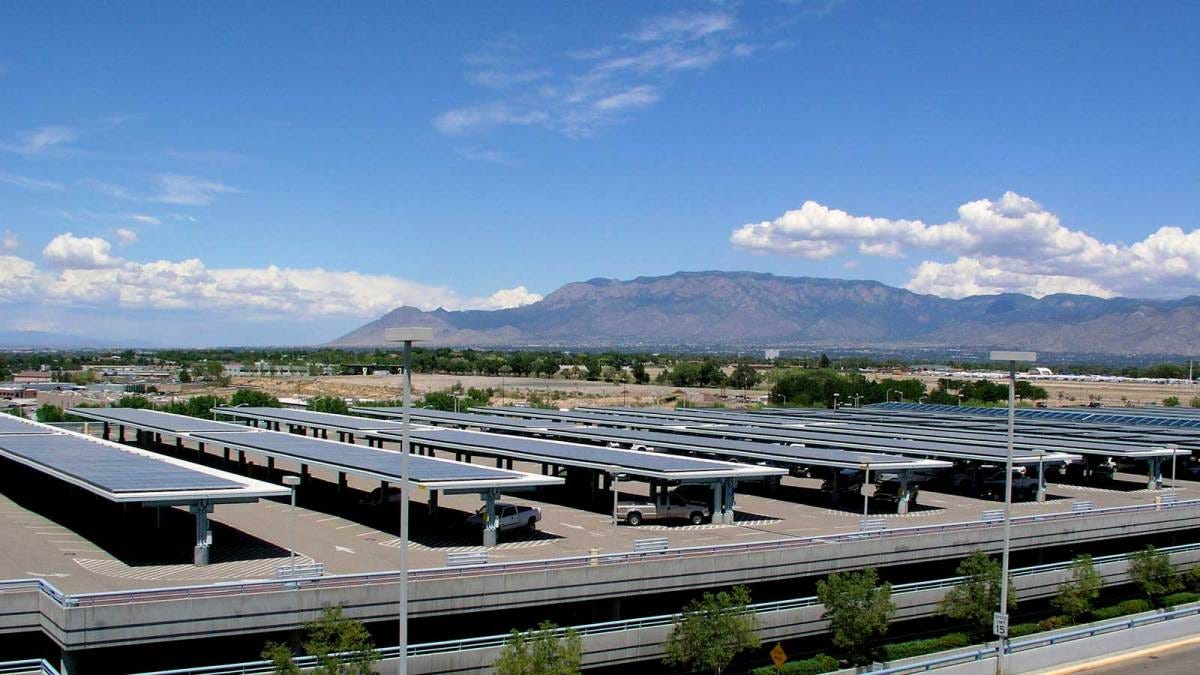
Sure, you need some solar and wind farms. But you can also put solar panels on top of already-built structures, like airport parking garages. In fact, put ’em everywhere! Image credit: City of Albuquerque via AP, File/via Yale Climate Communications.
See? States can do it if they want to. The secret to getting “firm” energy, even in the most energy-draining heat of July, is to combine solar, wind, and batteries. In New Mexico, solar panels soak up loads of sun during the day, store it in batteries, and discharge the stored energy at night. Wind helps with evening and overnight, too.
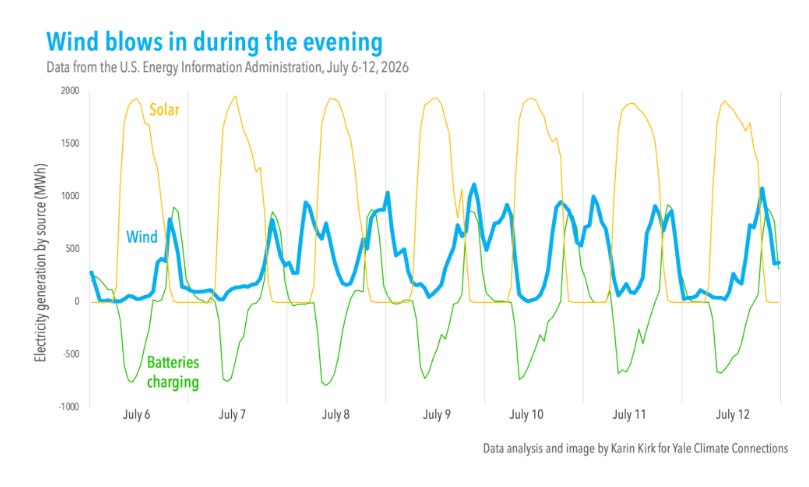
Even in high-demand July, Kirk writes, New Mexico is now getting 62% of their electricity from clean energy. Most months they do even better:
It’s worth noting that July’s heat drives the highest rates of fossil fuel use for PNM. About half the days in the past year saw renewables generating 70% or more of the daily electricity need, and in late spring of this year, renewables routinely met more than 80% of demand.
EV sales continue to rise. If you’ve been gagging every time you have to fill up your tank with $4+/gallon gas, you might be eyeing an EV. Don’t get too discouraged by news that EV sales are down, etc. Overall, globally, EV sales keeping moving up as the industry matures and people realize that EVs are superior to ICEs (internal combustion engines) in every way. Unless you like pollution and noise and lots of moving parts to fix, I guess. (Yes, I’m biased because I’m speaking from experience. The acceleration, people! The acceleration!)
A recent report from the International Energy Agency (which tends to offer cautious estimates) predicts continued growth in 2026, despite the US auto industry’s backsliding on EV ambitions:
Electric car sales are now expected to reach 29% of total car sales worldwide in 2026. In Australia, Brazil, India, Korea and Viet Nam – all sizeable electric car markets – sales have roughly doubled since the beginning of the energy crisis [i.e., since the Iran war], compared with the same period (March-June) in 2025. Together with strong second-quarter market momentum and policy support for EVs in Latin America, Southeast Asia and Europe, these trends support the expectation that electric car sales will grow around 10% this year, compared to 2025. The pace of recovery of the Chinese car market remains the main constraint on global sales growth. Electric car sales in the country are expected to reach similar levels as in 2025, though the EV sales share is expected to grow to more than 60% in 2026. [some bold original]
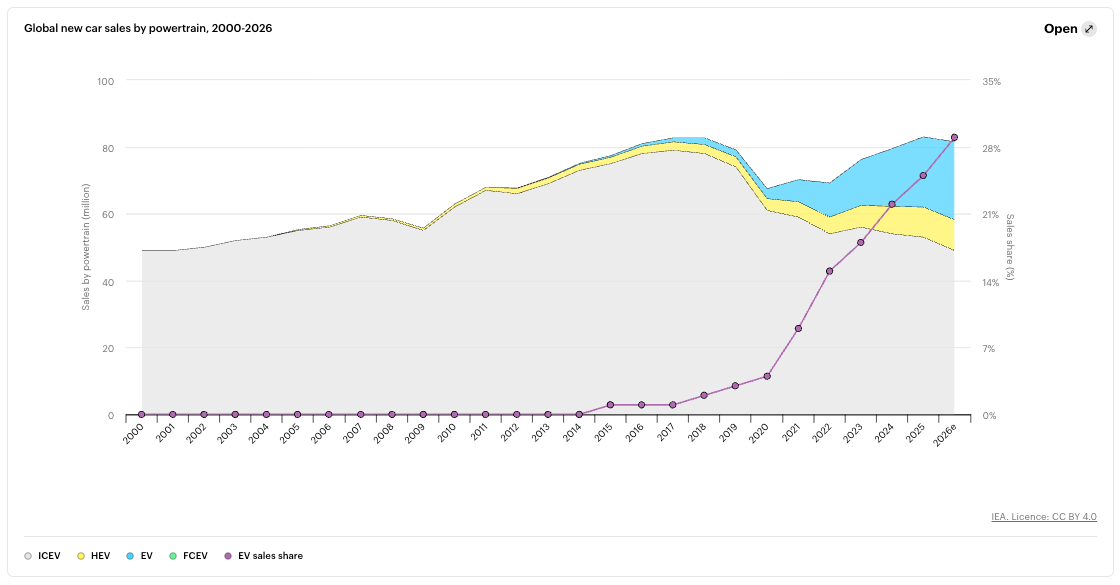
See that purple line? That’s the growth in new EV sales worldwide since 2000.
There’s lots more good clean energy news, but let’s move on to deep dives.
Two good essays to recommend to you today.
First, rumors of the IRA’s death are greatly exaggerated. As much as the current federal regime has attempted to gut the Inflation Reduction Act, a great deal of it remains intact.
Leah Stokes, a policy wonk and researcher who was involved in passing the IRA, explains in The Atlantic (free link) just what has and hasn’t endured. She begins by examining whether IRA benefits helped win votes for Democrats in the 2024 election. In fact, they did, despite the conventional wisdom on that question. She details how and when “policy feedback” works—and doesn’t. It all comes down to moving fast so people feel the benefits, which the IRA rollout both did and didn’t quite do.
As for clean energy buildout, the IRA actually continues to help enormously. When examining the results of manufacturing tax credits, for instance, Stokes and her team found that “of the 523 projects we looked at, only 37 had been canceled as of April, when we did our study.”
There’s more:
Even after the passage of [the One Big Beautiful Bill], U.S. solar capacity is expected to double over the next five years. Wind installations will surge this year, too, despite Trump doing his best to kill them. The long-term picture is murkier, but history suggests that these kinds of credits have a way of coming back from the dead. Congress has extended earlier rounds of clean-energy credits when they’ve expired, in some cases on a bipartisan basis, and has even applied some of them retroactively.
And more:
Meanwhile, the commercial-battery tax credits are still around. With these policies in place, America is on track this year for its biggest build-out of power generation in history, 93 percent of it clean. This is happening because of the IRA’s deepest legacy: It helped make clean energy cheaper.
Finally, Stokes acknowledges the real damage the current regime has done, dragging our progress and relegating the US to the status of laggard rather than leader. But she concludes:
Under Trump, we have fallen further behind, and time is not on our side. But a day will come when Trump is no longer the president, when passing another climate bill is a real possibility. When that time comes, lawmakers should remember the lesson of the IRA: Voters respond to benefits that they can actually see. Politicians should make sure those benefits materialize quickly—and that voters know who delivered them.
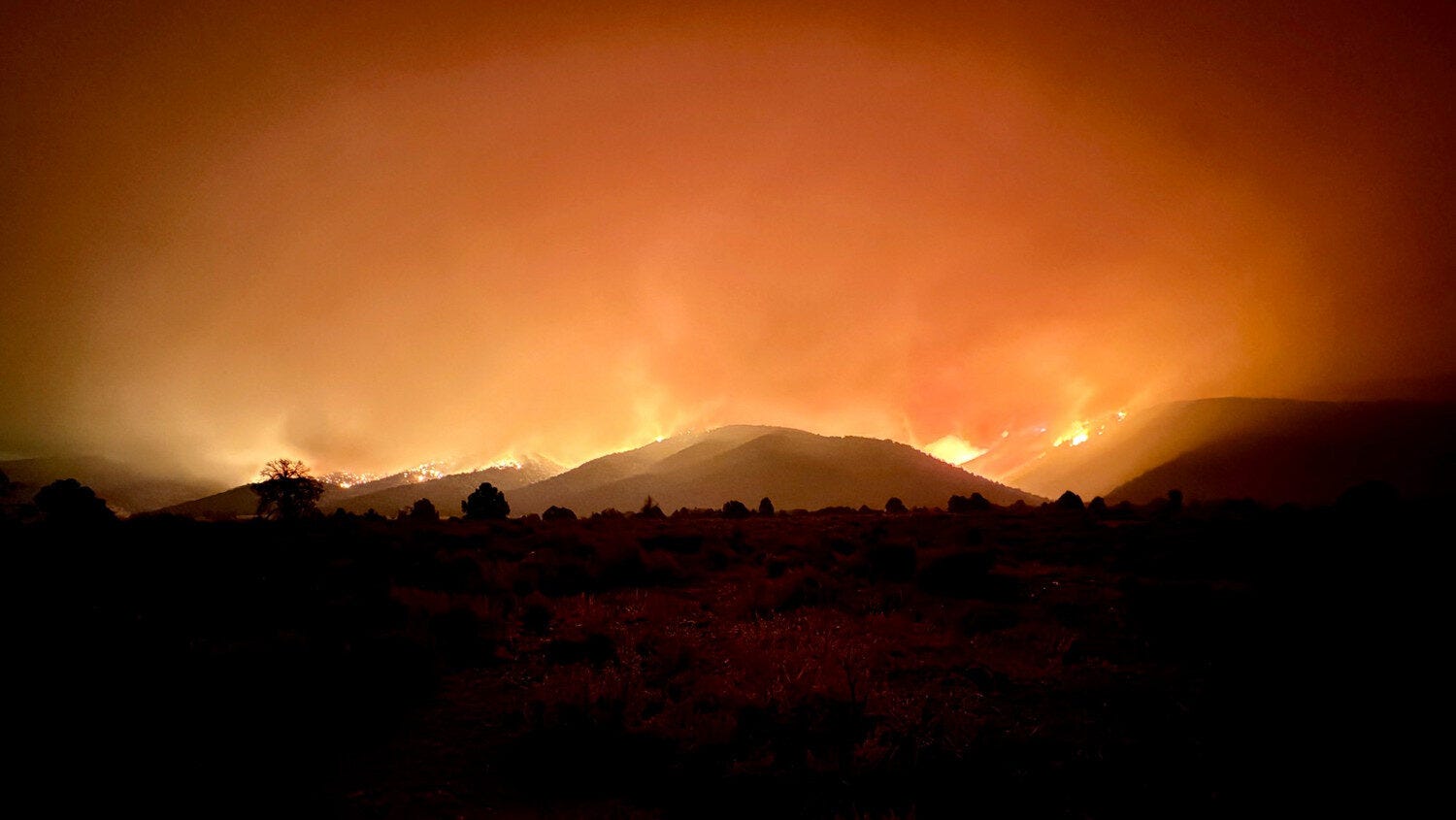
Fires in Utah in July. Image credit: Theo Maynard via kslnewsradio.com.
The deep dive second essay is more philosophical. Rebecca Solnit reflects on her recent time in New Mexico—yes, the same state now full of clean energy—where she experienced horrible air quality from wildfire smoke. This leads her to a philosophical, and indeed religious reflection on our human ability to feel when something is deeply off about the world. In my tradition, we call that sin, but Solnit reflects on the Buddhist concept of duhkha, often rendered as suffering. She writes that duhkha might mean
less pure suffering in the usual sense than the sense that things are out of tune, that something is broken, out of harmony or alignment, discordant. The smoky mornings brought that sense back to me. Maybe the right word is wrongness. If kha in the etymology above means sky, among other things, then we have a discordant, damaged sky.
The next question is how we respond to this feeling. Solnit wants to urge that we not merely descend into gloom, but—as all religious traditions urge—respond to suffering/duhkha/sin/wrongness with active care:
And these crises call for our active care for the thirsty deer, the burning trees, for those beings and places going up in smoke, those beings breathing smoke. For righting the wobbly wheel, truing the axle, fixing the sky.
Let’s look for those active care-taking folks next. These first two sightings are not about living ecosystems, but about financial ecosystems. They need restoration, too. So congrats to friend and reader Dan Terpstra, who has worked long and hard to make something rather enormous happen in his denomination: The Presbyterian Church (USA) has finally agreed to divest from fossil fuels.
Jane Ellen Nickel writes for the Third Act Faith newsletter:
After 12 years of effort by thousands of faithful Presbyterians on overtures calling for the removal of fossil fuel investments and Presbyteries voting to support it 147 times, the PC(USA) General Assembly recently approved overture CLJ-02, “Changing Course for a Green Future.” On the consent agenda, the PC(USA) approved the overture to remove the majority of its investments from the fossil fuel industry by 2030, or as soon as “prudent management” permits.
Another interesting financial ecosystem story: A guy in New York state who works for a company called Thermo-Fisher is suing the company (with the help of ClientEarth) on the grounds that by not bothering to create a fossil-free retirement fund as an option for employees, they are violating his religious beliefs.
Dr. Andrew Hartley, a statistical science director, has asked repeatedly that the company offer a fossil-fuel-free option in their retirement fund benefits portfolio. They have ignored his request. The most maddening part of the story:
Thermo Fisher’s stated mission is to make the world ‘healthier, cleaner, and safer.’ It has publicly acknowledged that ‘urgent action is needed to avoid the worst aspects of climate change.’
Yet every equity investment option in Thermo Fisher’s 401(k) plan puts money into companies that extract and burn oil, coal, and gas. That means Dr. Hartley faces a choice: compromise his faith or forfeit a meaningful part of his compensation.
I don’t know if this lawsuit will work, of course, but it’s an intriguing use of the 2023 religious accommodation ruling, Groff v. DeJoy. As the ClientEarth website observes:
A win in this case could establish the legal precedent that workers across the U.S. have a right to demand fossil-free retirement options that align with their beliefs — turning a single accommodation request into a nationwide pathway for cutting off one of the quietest but most significant financial lifelines to the fossil fuel industry.
Back to the world of land, water, plants—and cities. Dutch cities in particular. I enjoyed this lovely video about the city of Utrecht, Netherlands, where they have been working for seventeen years to make the city center greener, more pedestrian-and-bike friendly, and more beautiful. The knock-on effects include better water management (the Dutch are total pros at this, of course), healthier air, safer traffic patterns, and an overall nicer place to be. Good urban planning is a refugia strategy and a climate solution!
One more beautiful story today. I love the stories in which ruined land becomes a refugia space, full of life and beauty again. This story comes from Portugal, where a place called Paul de Toirões has been revitalized in only a few years. According to the Rewilding Europe website:
A decade ago, this former quarry in Portugal’s Greater Côa Valley was an industrial wasteland — a ravaged landscape of shafts, pits, and scars carved by man and machine. Today, from the air, the 300-hectare rewilding site reveals a vibrant mosaic of lakes, ponds, ditches, and wetlands, as birds, dragonflies, turtles, otters, and a host of other species return to recolonise newly formed habitats. Around the water bodies, native forest is regenerating, strengthening resilience and further boosting biodiversity.
So many great refugia elements to this story. Nature provided most of what was needed to rewild the place, either with remnant seeds and species or with rapid natural recovery. Rewilding Portugal partnered with nature by making some strategic adjustments, including softening water body edges, removing artificial drainage, and removing invasives.
Now people can enjoy the area as a wildlife refuge, and researchers continue to monitor and care for it. Best of all, the area is becoming part of a refugia corridor system:
The revival of Paul de Toirões boosts ecological connectivity across the Greater Côa Valley, creating a new ecological stepping stone for species moving through the landscape. Its expanding wetlands and regenerating forests complement other rewilding sites in the valley, advancing Rewilding Portugal’s efforts to build a large-scale wildlife corridor.
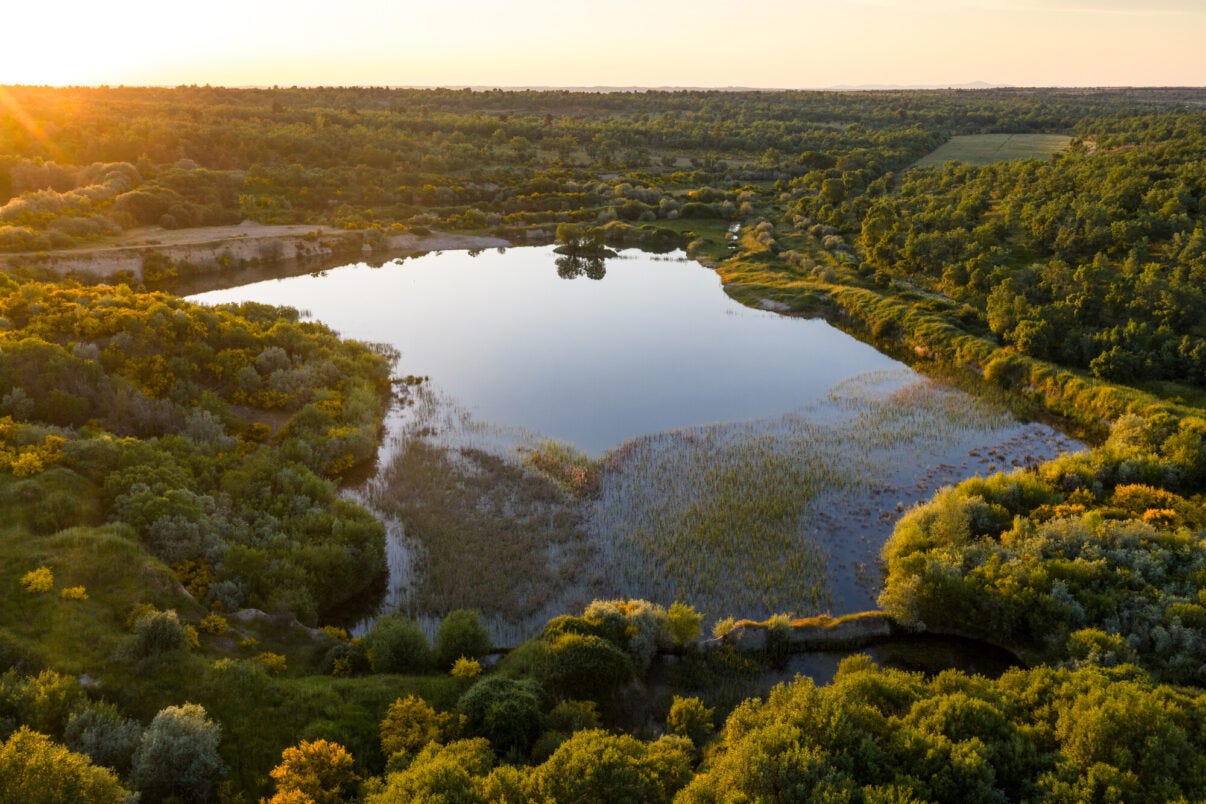
Paul de Toirões in Portugal, a former quarry, now rapidly recovering. Image credit: Marcus Westberg via rewildingeurope.com.
My friends over at BioLogos have released their new resource for groups who want to try outdoor worship, sometimes called Wild Church. Called “Worship with the Wild,” the resource would be a great first option for groups who want to stick closer to familiar worship expressions, but still want to try deepening their relationship with the more-than-human creation.
Worship with the Wild helps people encounter God outdoors through guided worship and reflection. This free, ready-to-use resource equips lay leaders to bring their small groups into God’s world, where participants can praise the Creator and grow closer to one another.

I’ll send you off with this sharply funny and somehow also melancholy song from the inimitable Elle Cordova. If you’re feeling a sense of dread as Big Tech looms over you and your community, you need to hear this one.
OK, that’s it for this week! Whatever you’re feeling as the seasons turn, I hope you will find joy and strength in community and in practicing care for all that is good and beloved. Thanks for reading. Till next time, be well.
No posts
Comments
Nothing yet. Say the first thing.
Sign in to join the conversation.