
Hello, Reframers,
I first met Shreya Bansal last year when she was selected for Reframing Disability’s StoryLab Mentorship Programme. During the nine-week programme I learned what a kind and wonderful person she is. So I interviewed her to introduce her to you all!
Shreya is also a member of our growing Global Directory of News Media Professionals and WhatsApp group. Join the directory if you are a disabled professional. All information is available on this page.
If you are an organisation looking for journalists, photographers, podcasters, videographers, etc., you’ll find professionals from the disability community in the directory.
Alexander Ogheneruemu, disability issues blogger from Nigeria says:
“I appreciate the substance of your newsletter, Priti. Never underestimate its potential to reframe the narrative. More power!”
If you’re reading this, you likely find value in this newsletter. Do you value it enough to pay a small sum to support this independent media?
Here are ways you can make a financial contribution:
International
A one time contribution of any amount, or through a custom monthly subscription via this link.
If you prefer PayPal, you can contribute at pritisalian@gmail.com.
Indian
Make a one-time or recurring contribution of any amount using this UPI QR Code:
For contributors in India, a one-time payment of ₹5,000 would be especially helpful. Twenty such contributions would allow me to hire someone part-time for four months.
International contributors, a one-time payment of £50 or $60 would support in the same way.
Organisations, a yearly subscription of £500 or $600 or a custom amount would let me pay to contributors and for the accessibility of the website and content.
Shreya Bansal is a reporter and media researcher based in New Delhi, India. Her work focuses on climate justice, labour rights, people’s movements and culture. She has worked with various newsrooms in India and across the globe, covering race, gender and disability. She has also contributed to media critique and analysis, focusing on ‘how stories are told.’ Shreya has a keen interest in developing a more ethical and sensitive news media. Her stories have won a special mention from the Laadli Media Awards for gender-sensitive reporting. Check out her portfolio and get to know her better.
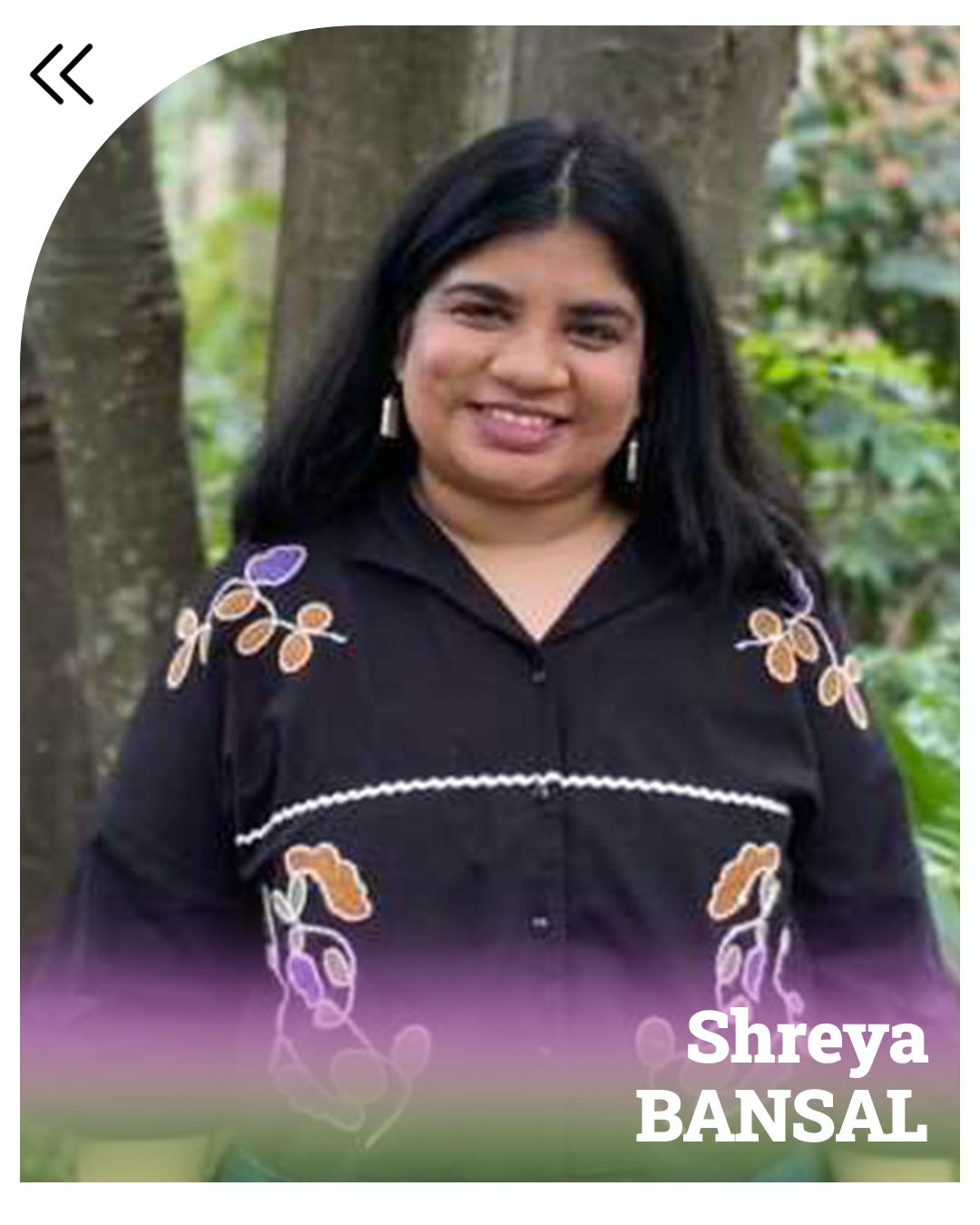
[Image Description: Shreya, an Indian woman with shoulder-length black hair, is standing in a forest with greenery around her. She is dressed in blue jeans and a black shirt with big colourful embroidery. The bottom of the photo bears purple and green streaks, with Shreya BANSAL written in white.]
My discovery of my mental health and my growth as a journalist have happened in parallel. I have psychosocial disabilities with signs of depression, anxiety and ADHD that are evolving conditions. Anyone who has experienced mental health issues knows how fragile and confusing the journey can be. In my early days of diagnosis, I went to multiple healthcare providers and got different opinions: sometimes anxiety, sometimes ADHD. A lot depended on how I articulated what I was experiencing, and at the time, these terms were used interchangeably. When I sought therapy, my therapist and I stopped focusing on labels and focused on the problem itself. Labels help at first, but later you realise everything shows up differently for different people.
Initially, there was a lot of self-blame – I thought of it as a personal failure, and tried to power through, especially because there were no open conversations about mental health in journalism. It felt as if mental health and journalism were mutually exclusive. Even now, there’s a strong narrative that if you talk about mental health or accommodations in newsrooms, you’ll be judged or not hired. So I haven’t been very open with editors.
Therapy helped me understand that these are shared problems and structural issues. In the absence of newsroom support, I created my own accommodations and practices that help me work efficiently (as shared towards the end of this interview).
Conversations around mental health in newsrooms were very limited, both as a journalist living it and as someone reporting on it. At the first newsroom I worked with, I once questioned a stereotypical mental health image used for a story, and my editor dismissed it, saying ‘You’re reading too much into it’. Another time, I shared that I’d been diagnosed with depression, and an editor asked, ‘Why are you depressed? You’re so young’. That duality of loving journalism, wanting to grow, but also needing to pause and seek help, was confusing.
100 percent! Take for example the story I was doing on media representation of mental health for Reframing Disability’s StoryLab mentorship. Every journalist who has sensitively reported on mental health told me the same thing: ‘I’ve gone through mental health challenges and so have my friends. It takes a certain kind of person and experience to write these stories’. I relate to that, because even thinking about these stories, or recognising the lack of sensitivity, comes from the need to add more sensitive stories and from being able to criticise what is wrong. These conversations aren’t happening in newsrooms, and they’re definitely not happening among readers consuming breaking news.
I trust myself to think carefully and sensitively about these stories. When I’m interviewing someone, I always ask if they’re okay with going on record with their experiences. It’s made me kinder in my journalistic practice: giving people space to postpone or to edit things out later. That’s not typical of fast-paced journalism, but I treat it as a more human process, and not just about ‘getting the story’.
I’ve also been able to connect with other journalists with psychosocial disabilities on a very personal level. The more I talk to them about this, the more I realise there are more than less of us; just not a lot of us are talking about it. When we meet, we talk about structural problems, about having gone through a diagnosis, about dealing with these issues in our personal lives but not being able to communicate any of it in newsrooms.
“I feel like I’m always close to situations like that. There’s always a risk, but luckily nothing to that extent has happened. That’s also because I pre-emptively have a plan for what I can do. Mostly, it’s been good communication that has helped me avoid or get out of these situations.
The other option is to painfully just get through it, but that’s something I can only do now. Earlier, there were many situations when I felt I would submit to what was happening with my brain or my body.
I have sought help, talked to friends, my parents, and my therapist, and asked: if a situation like this comes up, what can I do?
Even being at risk of these situations is painful. You’re constantly on edge thinking: Will this be seen as my failure as a journalist? Will this affect my relationship with editors? Will I be labelled a certain kind of journalist? So yes, it’s been very hard, but it’s also been solvable.
One key thing is to be clear about your needs, and ask for a realistic extension. I know it’s extremely hard to be vulnerable with someone who feels like a stranger, especially when your only relationship is a submission.
But instead of pushing through and not communicating at all, it’s better to say: this has come up. You don’t owe anyone detailed explanations about your personal life. Even saying you’re not feeling well, sharing what work is already done, and asking if you can submit by a revised time helps.
I learned this during journalism school, when my depression, anxiety, and ADHD first surfaced. I wouldn’t communicate with professors because I assumed they’d see me as a bad student. The feedback I got was: don’t assume people already think badly of you. Your work and your intention show.
Your disability isn’t working against you all the time, it’s part of you. You can acknowledge it and ask for extensions. What matters is being clear and communicating, instead of keeping people in the dark, where it can look like you’re avoiding the work.
One important thing they should know is that mental health diagnoses are real, and people live with them in very different ways. Mental health doesn’t always look the same.
If I have a track record of producing four stories a week, it shouldn’t become about: ‘Why aren’t you doing it now?’
I often feel the burden to prove that I’m depressed, to explain myself in detail, sometimes even graphically, just to be believed. That’s demeaning.
What would help is creating space early on, without requiring people to be vulnerable right at the start of a job or working relationship. I know freelance writers don’t always have that structure, though freelancing can offer flexibility in choosing who you work with.
Newsrooms could start by educating themselves about mental health and understanding that it’s not always visible, learning basic terms, and recognising how common it is. Many journalists in a position of power still see mental health as something rare or exceptional.
Journalists aren’t necessarily looking to newsrooms for complete mental health support. People have support elsewhere, or are struggling to find it. What we’re asking for is inclusion. With inclusion come better mental health stories, better work overall, and stronger newsrooms.
Right now, many journalists with experiences like mine leave journalism after a few years because they don’t find any space around mental health or disability. They keep switching jobs, hoping to find one editor or one newsroom that will listen, even when they want to do good work.
If newsrooms could at least start having these conversations, people would stay and help publications grow, instead of constantly knocking on doors asking, ‘Will you listen to me?’
Often, journalists assume a publication will be more inclusive because its work looks progressive, but when that doesn’t happen, it leads to disappointment, shame, and silence. This cycle of closed doors creates more harm, especially in a profession where journalists are already struggling, doing emotionally demanding work, and caring for others’ stories.
Editors don’t need to have all the answers. But they can create space, be supportive, or organise workshops so we learn and grow together.
Yes, definitely! I had honestly stopped talking about my own experience because it felt easier to just do the work and deal with things silently. But I do like talking about it. When I saw there was a space like StoryLab, I got really excited – I didn’t have second thoughts about applying. I wanted to connect with other people across roles: reporters, editors, people pitching stories. There’s often a lack of solidarity, and this felt different.
Now, I’m glad that the Global Directory of Disabled News Media Professionals exists, and that others want to have these conversations too, and I’m really looking forward to continuing the community with our WhatsApp group.
Just that there are solutions. What took me a long time to understand is that journalists dealing with mental health issues don’t have to see it as a break in their career, or as the opposite of being a journalist. Don’t stick to this idea that journalists are supposed to be strong all the time. It’s okay to be many things at once.
It’s okay to do the stories you want to do, even hard-hitting ones, while you’re going through something. You’ll find a way to do the work. It doesn’t have to mean that you can’t walk into a newsroom or can’t write as much because of a diagnosis.
Your pace might not match what you think everyone else in the industry is doing, but it will fit yours. And the story that comes out of it will still be good and just as strong. Your disability or mental health issues don’t have to be a barrier to the quality of your journalism.
Shreya has built small systems that protect her energy and help her work more efficiently. These accommodations may seem minor, but they make a big difference to her and might serve well for people living with similar disabilities.
Accept irregular workdays: Some days I work for two hours, other days for twelve, and both are valid depending on my emotional and mental state.
Create your own buffer time: Instead of asking for extensions, I build extra pockets of time into my day. For example, if a task takes two hours, I would keep aside four. Which means longer days, over-preparing, and starting much earlier than deadlines require.
Plan far ahead: When lead times are longer, I start thinking about deadlines a month earlier because my timeline is different from what’s considered normal turnaround time for a story. Advance planning is my best friend.
Work in a way that fits your brain, not industry rules: The idea that the hardest task must be done first doesn’t work for everyone. Your structure has to work for you.
Start with something fun: I place a lighter or enjoyable task between two hard ones to build momentum, because starting is often the hardest part for me.
Check in with your body regularly: I pause every hour to ground myself and notice how I’m feeling, instead of forcing myself to follow a rigid schedule.
Work early to reduce mental load: I start working right after I wake up, when there are fewer distractions, so my mental health doesn’t derail the rest of the day.
Choose written communication whenever required: I find it easier to have detailed conversations over email rather than on calls, even though calling is often seen as the journalistic norm.
Prepare before difficult calls: Before speaking to sources, I spend about 30 minutes grounding myself, doing exercises from therapy, and writing down questions so there’s no space for any intrusion that can put me into a spiral.
New report on disability funding in India: Despite nearly 10% of India’s registered nonprofits working in disability, the sector receives only an estimated 1% of Corporate Social Responsibility (CSR) funding.
Strategies Robbie Crow of the BBC uses as someone with ADHD to keep on top of his work.
Lygia Navarro’s dilemma on working (or quitting) with a chronic illness like long COVID.
New York Times editor and debut author Wendy Lu joins co-hosts Karina Sturm and Amy Zayed to talk about her middle-grade novel Casting April, a story about a 12-year-old girl with a tracheostomy tube who fights to prove she belongs in her school play. Listen to her conversation with the Global Disability News Network which ranges from the “disability gaze” in classrooms to the trauma parents carry, to what it’s like building a career in disability journalism.
Reframing Disability’s previous issues featured pieces on autism representation: A manifesto for interviewing autistic people and telling their stories and Communication, agency, and messiness: what systems keep missing about autism with Hari Srinivasan. Did you get a chance to read or listen to them?
Thanks for reading or listening to this issue! You’ll find me in your inbox again soon. Until then, reply to share your thoughts. I’m available on LinkedIn and Instagram as well, and Reframing Disability has an Instagram account too. Engage wherever you are active!
Warmly,
Priti
Comments
Nothing yet. Say the first thing.
Sign in to join the conversation.