
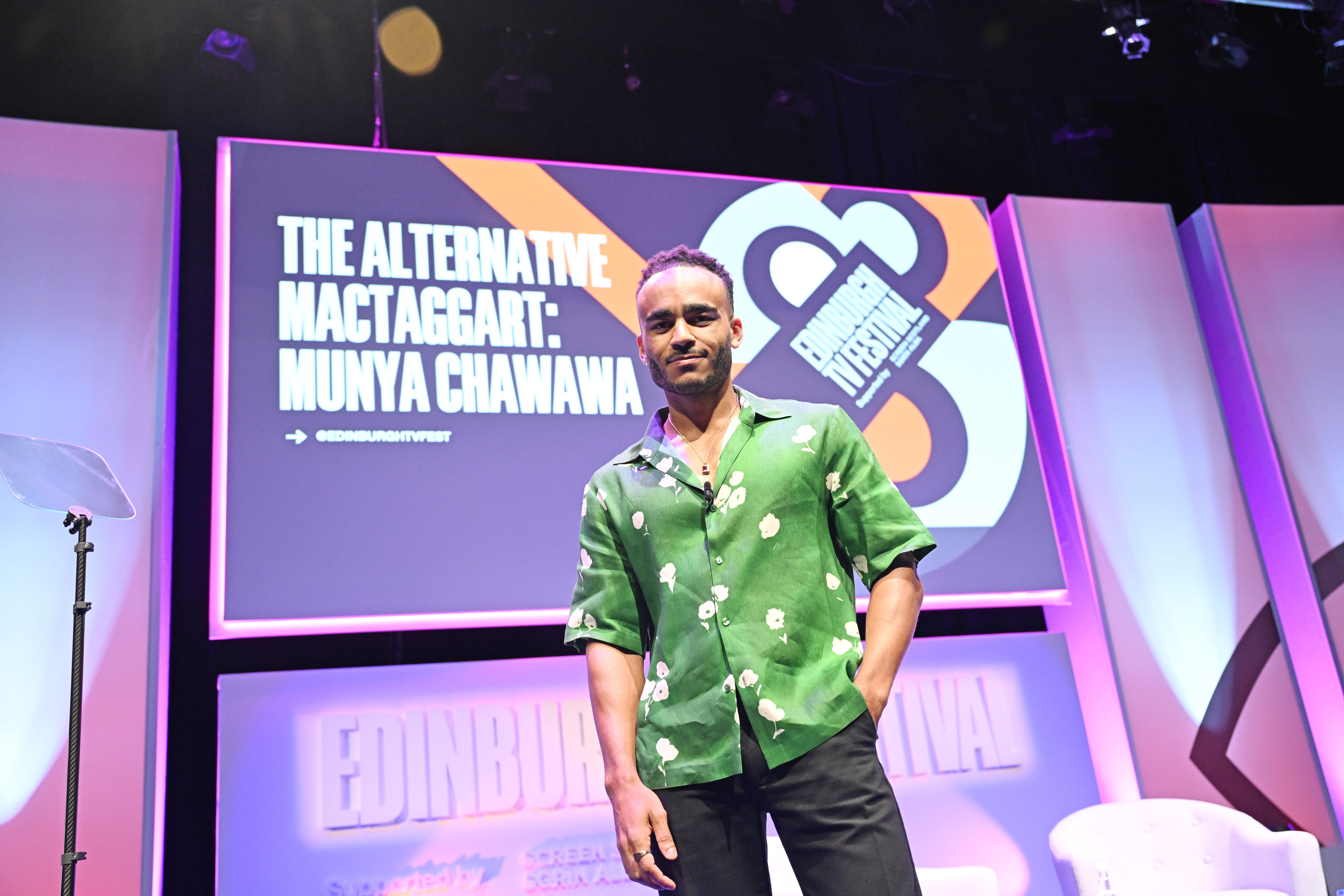
Launched in 1997, the Alternative MacTaggart offers bold perspectives on the future of television. This year’s speaker was Munya Chawawa - a satirical powerhouse known for viral sketches and sharp cultural commentary. If you would prefer to watch the lecture, you can find it on our YouTube.
Good afternoon, everyone - before I start: could you give me a little cheer if you’ve seen me on the internet before? If you haven’t, I’ll just say what you’re thinking: what in the JLS tribute act is going on? I look like that one guy on Love Island who cheats in Casa Amor every year. Someone once left an Instagram comment saying I look like Lewis Hamilton if he’d never passed his theory test…and that’s the last time I wished her Happy Mother’s Day. My name is Munya Chawawa – which I’m fully aware sounds mental. It’s an African name though, which is cool because African names have meaning. So, my name Munya Chawawa means: my parents wanted me to get bullied.
If you think you recognise me from the internet, you are correct. Across the last 7 years, I’ve built of a career from speedy online satire, covering everything from Tory lockdown parties to ChatGPT, Brat Summer to summer riots by the EDL. I know some people insist the EDL was disbanded and will never get back together, but you know: that’s what the Spice Girls said… Through a series of parodies, impersonations, political takedowns and a stint as the UK’s first posh drill rapper - I’ve been able to amass over 3 million followers & 1 billion views, which in turn have led to a Rolling Stone front cover, profile pieces in the New York Times, a record deal with Atlantic and relentless requests to appear on The Masked Singer.
However, let’s address the elephant in the room. At the mere whiff of the phrase ‘digital’, some of you may now be tempted to sit back, a surreptitious grin etching itself across your face. You know what this speech is about. Perhaps you’ll even attempt to bash out a sneaky Wordle, as your brain smugly summarises the speech before it’s even begun: Tiktokker with zero industry experience tells tele people how TV is totally over, totally irrelevant. If that’s you: firstly, today’s word is EXTOL, screw you. Secondly, your summary is correct apart from one crucial detail, one little secret you might not know: I too am a tele person, just like you. My career began in television, every skill I have was forged in television and crucially: despite having curated a voice and an audience all of my own, even after jumping through the various hoops laid out by execs and commissioners, I still find myself outside the gates of television - waiting to be let in.
I, like you, am pained to hear that traditional British television is in decline. To hear that after surviving the gruelling gauntlet of development, series now fizzle out after one night - doomed to an eternity lurking in the dark recesses of iPlayer, ITV X and whatever Channel 4’s calling theirs now: foursome? To know that in 2025, meticulously crafted traditionally produced shows must come to terms with that fact that the apex of their existence might be as a 5-second, pixelated repost on TikTok underlaid by the Jet2holiday theme song.
Like the horsemen of the apocalypse, the broadsheets bellow out unanimously: “traditional TV is dying”. And perhaps most devasting is the fact that much of it is self-inflicted. In the face of a rapidly changing landscape, British television has ignored evolution and the same, outdated gatekeepers have stuck to the same, outdated guns whilst yelling: “hey guys, remember this one?” like an out-of-touch dad doing the worm at a day rave.
British TV isn’t dying because of TikTok. It’s dying because it has lost its willingness to take risks, to throw caution to the wind and to gamble on great ideas. And whilst traditional television desperately drunk texts its ex with the promise of nostalgia and reboots of old favourites, the audience swipe through a selection of hot, new guys: Instagram, YouTube, & TikTok – all of whom wallow in the bounty of record viewing figures and retention rates.
‘Adapt or die’ – it’s the kind of thing David Attenborough would say whilst watching a baby penguin mauled to death by a polar bear. If television is to stand a chance – it’s time to ditch the safety of our national mantra: Keep Calm & Carry On, and instead, try an alternative: Pull Your Finger Out & Take a Bloody Chance! Given, it’s not the sort of thing your nan would willingly stitch into a tea cosy, but alas – this is an ode to trying something unusual, taking a gamble and reclaiming the risk traditional television was once defined by - because that’s what this generation is doing online, and they’re bloody smashing it.
So, Edinburgh, esteemed tele people: penguin or polar bear? And yes: I’m fully aware that sounds like a new gameshow hosted by Noel Edmunds on BBC One, but stick with me.
Firstly, it’s important to note that being brave, being provocative, was once woven into the DNA of British television; something I first experienced during my childhood in Zimbabwe. Unlike a deprived Rishi Sunak, we grew up with satellite tele, most of which – for some inexplicable reason, showed Jackie Chan’s entire cinematic catalogue on repeat. After the 419th time watching of him beat a man to death with a milk frother – I began channel hopping in search of new thrills and stumbled upon one labelled ‘The BBC’. For as much colonial ball-ache as Britain had put Zimbabwe through, it seemed even Robert Mugabe couldn’t resist a bit of Strictly.
The channel played shows from every broadcaster and the one playing on that fateful day was an ITV show called Ladette to Lady – where groups of unruly women were sent to finishing school to become quintessential British ladies. I instantly became the show’s number one fan, mainly because the contestants insisted on getting their boobs out, which as a young boy, I found to be utterly compelling viewing. Moreover, the show felt fresh, mischievous and risky. Would today’s commissioners risk their ratings on a show like that? It doesn’t matter, because over on TikTok, William Hanson - a British etiquette coach, delivers daily lessons to over 3 million followers. Online takes the risk, online gets the reward.
When the show ended, I was ravenous for the channel’s next offering – which turned out to be a Channel 4 show called Faking It. In the show, members of the public would train with a professional for 4 weeks before attempting to hoodwink a panel of experts into thinking were the real deal. There was no prize other than a batshit crazy LinkedIn update. The show was frivolous but immersive, simple but irresistible. Would today’s commissioners take that gamble? That’s fine - because on YouTube, Niko Omilana conducts his version, impersonating Apple employees, IKEA staff and politicians to over 55 million viewers. Online takes the risk, online gets the reward.
As the night drew to a close, I remained welded to the sofa, eyes bulging, ready for whatever madness this mysterious ‘BBC’ channel decided to belch onto the screen next. It was a BBC sketch show called Little Britain. Over the next hour, I witnessed two men transform themselves into a million different characters by switching personalities, accents and outfits; I’d never seen anything like it. And whilst I may not have understood the implications of some of the things they said and did, it was nice seeing someone my colour represented on screen. The show was outrageous, irreverent & stupid – but iconic. Even so, a commissioner recently told me that today - there was no appetite for sketch comedy, which was peculiar seeing as the sketch I posted the following day hit 20 million views in 48 hours; online takes the risk, online gets the reward.
Nevertheless, as a kid – I hopped off the sofa that day, having decided that British TV was cool, and despite being so young, I became a loyal viewer across evenings, weekends and even my school holidays. A stark contrast from today, where 16 – 24-year-olds spend on average just 17 minutes a day watching live broadcast. For me back then, tele was an adventure, a chance to hang with the cool kids of entertainment; for this generation now – tele is more a reluctant visit to an elderly relative, who insists on serving up stale Hobnobs from an old tin.
By the time I hit my 20s, my childhood obsession had turned to genuine ambition – I wanted to make tele. I earned my stripes: a researcher role on Obsessive Compulsive Cleaners – where I would be sent out to find hoarders, and on one occasion narrowly avoided being crushed to death by a tower of Enrique Iglesias CDs. A VO job on E4’s Sex Testers which involved shouting ‘gonorrhoea’ into a microphone with varying levels of enthusiasm… And eventually, a producer role on a 4Music show, which involved strapping celebs into electric underwear in a game called Quiz in my Pants – Jason Derulo hasn’t visited the UK since.
Eventually though, I hit a wall. I had big ideas, I wanted to make distinctive groundbreaking shows of my own, but every exec, every gatekeeper said the same thing: “you’re a nobody.” “you’re weird” “you don’t quite fit into the very neat box we need you in”. The first rejection. It’s this sentiment that drove me and no doubt countless others, onto social media. Television’s refusal to nurture talent birthed a generation of those determined to teach themselves. We built our own creative playgrounds on apps with zero barrier to entry. Instead of wasting our time and early ambition trying to get on someone else’s channel, we could start our own. Our own space to refine our voices, to create ideas with no consequence and no limit to our imagination. Where tele said no – social media projected in huge, shiny letters: YES.
Several years later and by the end of lockdown, I had built a profile through relentless Tory bashing – almost getting deported on several occasions, which was prettyyyy…Patel’s fault actually. But more than a profile, I had what felt like my own ‘BBC channel’ – one where I was commissioner, compliance team, researcher and exec producer. And yet, I still wanted what TV had.
And so, when I was eventually offered a non-scripted series by YouTube, I was intent on creating one of the platform’s first original TV shows. The resulting show was called Race Around Britain – a 4 x 30-minute comedy travelogue consisting of stunts, sketches and social experiments to find out what Britain knew about black culture. Racial tensions were high following the George Floyd protests, and in my mind, the best antidote was the unifying power of comedy. In the show, we tested contestants’ knowledge of cultural foods in a spoof cookery show called The Great British Jerk-Off, which might be difficult finding online after the new Online Safety Act. We recreated the pressure of the 2021 Euros penalties on black players by getting contributors to take shots in front of a full brass band, police dogs and two goalkeepers. And most notoriously, we tested the concept of white privilege by seeing whether 3 ladies named Karen could create a viral drill song in 24 hours – by the next day the track sat at 1 million views and had the streets singing “fresh drip from Debenhams, gang in Fiat 500s – revving ‘em”.
Race Around Britain was mischievous, it was novel and unexpected. As such, a few months after its release, I was awarded the National Comedy Award for Best New Comedian, an RTS, Edinburgh TV & Broadcast Digital Award for Best Presenter, and to our utter amazement: a BAFTA nomination for Best Comedy Entertainment show – the first time ever that a YouTube show has been nominated for a television BAFTA. I’ll give you a moment to applaud… [audience claps]
– we lost. But shortly before the awards The Guardian wrote: the choice between established talent and exciting newcomer is rarely as clear as between one of the all-time greats – Graham Norton, eight wins in this genre, five nominations – and Munya Chawawa, whose super fresh Race Around Britain makes YouTube a serious player. BAFTA probably will – and should – choose Chawawa. As crushing as it was not to win, the reality was, we had done it! We’d made a TV show just like the ones I’d been infatuated by the first time I watched the BBC channel. Now, surely – recognising me as one of its own, traditional television would welcome me home with open arms, the prodigal son.
A year later, across the period of a week, we sat across the tables from various commissioners and unveiled our shiny new deck for the sequel: Race Around Europe. To each meeting, we came armed with accolades, viewing figures & glistening audience insights, along with rigorously prepared small talk, each member equipped with a selection of charming weather-based anecdotes and the ability to share presentations from laptop to smart TV in 0.3 seconds; we were quite literally: pitch perfect. And so, you can imagine our utter dismay when the following week – all the channels came back with the news that they’d be passing on the series. “It’s just a bit risky for us”, “We’re looking for something a bit safer”, “Is there any way you could make it more similar to say Love Island or Traitors?” and perhaps most crucially - “It won’t connect with our audience”.
It was a gut punch of colossal proportions. We had brought to the table an idea, industry experience, an audience of over a million - with a BAFTA-nomination for added bonus - and still the answer was no. The show and all its potential died that week, not because of quality, but because of the systematic inability for TV gatekeepers to see value outside the bubble of their own familiarity. There was something pitiful about watching the commissioners sheltering their old, easily-spooked, traditional audience so fiercely, like Gollum clasping the ring - afraid that they might see something different, something new. Maybe it wouldn’t have worked for your audience – but what about mine? What about the 6 million who had enjoyed series 1? Maybe it wouldn’t have won over your 60-year-olds, but it would have brought a hell of a lot more 18-24s.
Traditional British TV was happy to cheer for the show’s success, but they certainly weren’t going to make it. The whole thing was like a depressing reunion, where you realise your mad mate who insisted on drinking his own piss out a shoe on night-outs, now runs a speed awareness course and plays golf at the weekends. TV just wasn’t fun anymore.
Like Shrek to his swamp – the following months I returned to my safe place, social media. I knew scrolling through brain rot was bad for me, but it was also soothing; the same comfort of a greasy kebab after being kicked out the club by a bouncer. And yes - whilst the apps were predominantly mind-numbing memes, curiously - every so often, something I hadn’t seen before was cropping up. A new type of creator: production savvy, ambitious, unpredictable. For some reason more and more creators seemed to be shifting from shaky selfie cam rants to carefully composed shots, audio mixed interviews and repeatable formats. TikTok and its users appeared to be doing their best impression of television. Meanwhile, YouTube – once confined only to search bars, had made its way onto the home screens of most smart TVs, beckoning in new audiences with its infinite catalogue – dating shows, cookery shows, property tours, ghost hunts, travelogues, celebrity interviews, sketch shows – all self-made, self-funded and oozing with originality. And it was clear this combination was being rewarded handsomely by viewers.
Exploring Haunted Abandoned Millionaire’s Mansion – 4.8 million views.
Craziest Way To Make Biryani – 9 million views.
I Slept With 100 Men in One Day – 11 million views; mum – a reminder, I’m just reading the titles of the videos.
Could it be that YouTube, something that was once no more than a virtual town square for crazy cat owners – had become a serious mainstream contender? The answer came in the form of Squid Game. Whatever doubts there were over the internet’s ability to outmatch television were settled when the first series dropped on Netflix. Given - Squid Game was a revolutionary Korean-language international streamer show, setting records for what audiences high-end drama could reach. After the first season, it sat at a colossal 265 million views. Debate settled. TV wins. Until a few months later, when a YouTuber named Mr. Beast recreated the show on his channel: 850 million views. The message was clear, anything you can do – we can do better.
And now – present day, evidence supports that theory more than ever. Broadcast reported that YouTube has overtaken ITV to become the second most-watched service in UK homes, behind only the BBC. Whilst traditional television attempts to please its diners by serving up the same comfortable family favourites night after night, digital provides an endless, risk-taking taster menu. It doesn’t take a genius to realise that competing in this instance, is simply impossible. Online is the bogeyman and it is coming for you. Squeezing your eyes shut and banking on The Inbetweeners or FRIENDS or Family Guy to bring in ratings isn’t going to work – these re-runs are nothing more than millennial lullabies that viewers stick on in the background or fall asleep to. They are not viewing figures so much as nostalgic glances backwards. To survive, tele must move forwards.
I can sense the room is tense – there are more clenched cheeks than the Masterchef Christmas party…Thankfully, I don’t believe it’s a case of kill or be killed – the key is actually: meaningful collaboration. Television has the expertise, the experience and the structures to turn internet talent into generational programming. Where creators have passion - TV can sculpt it into ideas. Where creators have ideas – TV can develop them into formats. Where creators have formats – TV can inject budget to elevate them to their full potential.
In instances where channels have dipped their toes in with this approach, the results are glowing. Whether it’s Poppy Cooks – a food creator who specialises exclusively in potatoes, landing a regular spot on Saturday kitchen, or Francis Bourgeois – a man who literally became famous by filming trains with a camera strapped to his head, being announced as the new host The Grand Tour – viewers are invested. Netflix commissioned ‘Inside’ series 2 – what is essentially the young generations Big Brother, made by a group of YouTubers. Audiences will follow good ideas and exciting talent, whatever screen they appear on.
But even beyond the most immediate choices, TV must task itself with looking for the hidden gems. For instance, the viral teenager who pitched a travel show to the BBC during work his experience. After getting rejected, he and his friends flew to Somaliland and made the show anyway and guess what? It’s great – but it’s not perfect. Recording a series in your bedroom will never be the same as one infused with the resource and know-how of the creative industry. In this instance – new talent was on a plate! A chance to freshen up a drying pipeline of familiar faces. The channel absolutely should be fostering that new talent, building the relationship and developing the concept, so that in 5 years times perhaps that young, aspirational documentarian is in a position to take the mantle and inject new life into a genre we hold so dearly.
And a disclaimer: astronomical figures with new talent and ideas might not be immediate. But it’s either television takes a chance and dedicates itself to developing the next generation of talent - or simply clings onto its old favourites until they are physically incapable of doing the job. Just ask yourself: do you really want to be sat in your living room watching an 85-year-old Simon Cowell smashing his big red buzzer? Putting an enthusiastic young person on TV might feel like a risk, but Ant and Dec were first on screen at age 13 and what did they get? 45 NTAs and a long-standing hosting gig where people come face to face with a shrivelled camel’s anus. Or some people insist on calling him: Nigel Farage. We must ask ourselves, if those two retired today: who have we been training up to fill their space? Either you’re actively building the next wave or beckoning your own extinction.
I mentioned earlier – despite everything - it feels like I find myself outside the gates of TV, waiting for permission to create. I have series – an original scripted comedy, imaginative unscripted formats - that I’m trying to build through the traditional means. But… after being wheeled out at Edinburgh, will I be forced through the sausage factory of channels more interested in their risk-averse traditional viewers than the next generation?
You might think: if digital is killing it, if creators are amassing millions of followers and dollars already, why are we still saying yes to TV shows? Is tele even worth it…?
Well, after quite literally 1 billion views on social media, I very rarely meet someone and tell them about my latest 60-second viral video. Instead, I’m far more likely to say – “did you manage to watch my series Race Around Britain?” or “Did you know I have a documentary about Kim Jong-Un?” – which admittedly, works less well as a chat-up line. The fact is: television matters. Or at least it still matters to me. In an age defined by swipes and fleeting moments on a phone, many of us pine for something more permanent, something that lasts, produced to the highest standard, a craft, a legacy. There is a world where the devil-may-care attitude of this new generation could infuse a new phase of exciting and unpredictable British TV. But it requires deep and meaningful collaboration – not cameos. In 5 years’ time, no one will say: television was doomed until we featured Munya Chawawa on The Wheel. Being on a show is not the same as letting us build our own: trust us, try us, champion us.
Let’s just be real: sameness is not exciting; surviving is not succeeding. Online creators have both the power to obliterate TV and simultaneously resuscitate it. Stood before us are two gladiators in the colosseum of entertainment. The OG – Russell Crowe, lays on the floor, gasping for breath, as the new kid - Paul Mescal wields both a blade and an outstretched hand above him. The crowd are baying for blood; it’s a battle to the death / ratings. But there is world in which: instead of fighting, Paul Mescal and Russell Crow skip off into the sunset, perhaps even make sweet love. So Edinburgh - take our hand or lose your head – you choose.
Comments
Nothing yet. Say the first thing.
Sign in to join the conversation.