
I must apologize for two things:
I promised that the next posts I do would be on the excellent Christmas film Stalking Santa and my focus on the Magdeburg Unicorn. However, I have something else that I need to discuss, especially since people are asking me for demonstrations and justifications. Priorities must supersede preferences.
It took four months for me to post my last post, and now I have not posted in around a month, and I have not posted consistently ever since my twins were born. I suppose I am not really at fault for that, because of multiple reasons (I did not post two years ago around the Christmas holiday season, either), but I still owe people who have subscribed a steady stream of content. Hopefully, my notes and posts on other platforms like BlueSky and LinkedIn have been enough. Go follow me at those links if you have missed me in the interim.
Enough about that. Now, let’s talk about the pragmatic, real, and functional uses of genAI tools in education and the workplace, why there needs to be a connection between workplace needs and education practices and tools, and how I have come to cultivate consistency between my education and my activities in the workplace.
As Confucius said two different times in the Analects (chapters 13 and 15), if your teachings follow your way of life, and when you maintain the highest sense of respect and ethics, people will listen to what you have to say even if it is a suggestion; if you do not do what you tell others to do, and if you are not respectful or mindful, no one will do what you suggest, even if you phrase it as an order.
I am not here to order anyone around, but apparently people listen to what I read and have to say, and so I ought to explain more how I am following what I have been writing about. And following what I have been writing about for the past two years has led me to cancel every AI subscription I had, except for one…

Before 2025, I had a somewhat complex system that I carved out for myself. My AI workflow almost always centered around ChatGPT, unless I had a specific reason to use Claude (a creative fiction or other narrative-heavy piece) or Perplexity (something I needed an AI generation for but NEEDED reliable footnotes). In any case, ChatGPT did reasonably well at my use cases for Claude and Perplexity, so if I wanted to take a bit extra effort and use my fallback tool, I could to.
I didn’t hurt that I was financially involved with OpenAI, for $20/month. I had an obligation, I felt, to use it to its full extent and get as much productivity out of it. This meant that I used its Canvas feature a lot, even when I could have probably used Claude more effectively (for example, to program websites).
When it came to images, I almost always used Ideogram, a system that used to be more open than it is. In fact, it almost entirely relied on open-source image generation models for a year or two. It still is more open than other generators, but not as much as it used to be. Again, however, I was paying for ChatGPT, so I used its image generator a fair amount as well.
Eventually, it became clear that SearchGPT (ChatGPT + Web Search) was mostly useful when using it as a search engine-adjacent capacity and was not really useful to “research” in the traditional sense. That was when I decided to use Perplexity to handle more formal research projects, and to go to Stanford STORM when I wanted hosts of links.
After you getting the problem here? I was silo-ing each part of my workflow and my productivity between various AI tools, and I had to go back and compare each result with the others. To make matters worse, I was losing sight of what I was doing. I would eventually spend HOURS looking at various AI tools and trying to get goals done with them. Eventually (because inevitably, mission creep erodes after long hours), I would shift my focus from working on my objectives to finishing my objectives with AI.
As many AI users found in the first few months of 2023, there was a tendency to somewhat let AI take over your life. AI was the answer to everything. If you wanted a new recipe: ask ChatGPT. If you needed to look for a car: ask ChatGPT. If you needed a template created: ask ChatGPT, etc. Luckily, I stopped this trend (my wife noticed it before I did, to her credit) soon after. However, in the middle of 2024 I began to notice that it came back. This could have been because so many of my projects revolved around generative AI tools; I was working a grant proposal and a grant project, and I was on my institution’s AI committee, etc. Still, there was much too much AI use going on, especially when we did not need it. This true for my wife, myself, and I noticed it in all of my workspaces, too. Colleagues would offload parts of their work that they could easily do themselves (they did it manually in 2022), recognize the issues that the AI output had, and then just shrug their shoulders and say it was the new norm.
In 2025, I discovered a tool that enabled AI use, particularly LLM use, but did not require it, and had an interface and atmosphere that facilitated human-AI collaboration rather than automated AI slop.
Technically, my first introduction to BoodleBox was in the end of 2024, when I appeared on Zach Kinzler’s SmarterCampus Podcast in one of its first episodes. I honestly have no idea how he found me, but he introduced me to an AI offering that he had just started working for: BoodleBox.
From November 2024 to January 2025, partially due to the holidays, I honestly did not think much of BoodleBox. I had heard about the tool briefly from Bauschard, but I did not think much of it, and in fact it just seemed to be a “wrapper” for other tools (to be fair, there were only three or four tools that were accessed in BoodleBox at the time). I did not even remember the name until I used the link that Zach gave me and thought, “Hey, this is the tool that Stephan was talking about!”
I need to stress here that I did not just use BoodleBox the same way that I had used ChatGPT. Its interface has a “Message Mode,” where you can take notes for yourself without having constant AI output. It also lets you divide your work into projects and share them with others. I wrote five pieces that go over the most salient points of why BoodleBox is my tool of choice, but the features of BoodleBox are not exactly the point here.
BoodleBox: Deliberately Built for CollaborAItion
·
June 24, 2025

When I first created this blog, I spent a week wondering what to call it. I even asked ChatGPT what to call it (although I did not use any of its suggestions). Then, like ray of hope from heaven, the word “CollaborAItion” entered my mind. Since that time, I have been searching for a tool or set of tools that would:
I was still not ready, though, to divorce myself from ChatGPT and my other tools. At first, I just used BoodleBox as a way to “second-guess” or “fact-check” what the other tools gave me, especially because BoodleBox had no Perplexity connection yet. Furthermore, it was a new tool on the market, and I was not sure if it would actually be as privacy-minded, education-minded, and workplace-ready as its providers claimed.
For the first four or five months, I used BoodleBox as one tool among many, but I gradually found that I was using BoodleBox first for some of my most important work; its Memory processes were more stable, it interpreted and extrapolated much more effectively and innovatively, and I could call a multiple bots in the same conversation. The Message Mode let me iterate on my own before reintroducing AI tools. Gradually, its human-centered process found me gravitating to it increasingly over the second trimester of 2025.
You will notice that I mention that BoodleBox has a Perplexity bot. You may wonder, “Reed, this just sounds like BoodleBox is a wrapper for other AI tools, even if it is just multiple ones. Isn’t this just building in redundancies?”
This was one of the reasons I was so tentative about them, as well. However, ultimately, I decided this: even if the “wrapper” aspect of BoodleBox meant that the behavior of the tool was different than the native tool (which, by the way, says more about the effectiveness of their Privacy policy than anything else), it was worth it for the human-centered approach that BoodleBox takes.
I chose to use BoodleBox instead of Claude (using Claude bots, but also using some open models) in order to write more creatively, especially if I wanted innovative outlines or structures. I chose to use BoodleBox Mistral and other tools instead of ChatGPT to write or edit code. I also chose it to brainstorm answers to complex behavioral and procedural questions, using custom bots that I created, and they worked more efficiently in BoodleBox than in ChatGPT’s CustomGPT instances.
This all resulted in the fact that, in January 2026, I cancelled all of my other genAI tool subscriptions. ChatGPT, gone. Perplexity, gone. I realized that they were becoming, essentially, digital racketeers. They were creating functionalities and uses that were “helpful” to the user, but only at problems or goals that they were implicitly training the user to want. Yes, for example, many models can “deep research” and formulate in tables automatically, and be “certain.,” at least in the text they generate. However, 5 years ago we would have looked at a computer output like that with deep mistrust (because we were listening to Weizenbaum and Postman then).
I decided to rely on BoodleBox because it was not claiming any massive capabilities. It is simply a chatbot that allows one to communicate with multiple models in a conversation, include other humans, chat with oneself, and share the output. And that’s all it needs to be. It is, in essence, the way that genAI models were meant to be integrated into public use in the first place. We were never meant to ask ChatGPT the deep, dark questions of the soul. And BoodleBox removes that essence from the digital environment.
Yes, there are some utilities that are present in other tools that I have lost by moving exclusively to BoodleBox. I do not have a “Canvas” functionality like ChatGPT or Claude has. I also do not have a “deep reasoning” capability, or a massive results list like Perplexity has natively. However, what I do have is far more important: the commitment to use human-centered practice in an increasingly AI-centered world.
I have not advertised for my webinars on these posts for a while now, but these upcoming ones are remarkably salient for our discussion today. The images below will lead you to the appropriate registration page.
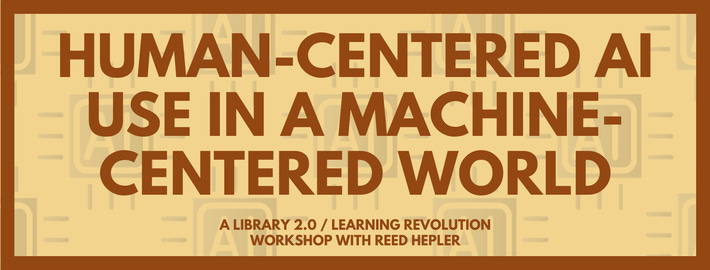
In an era where artificial intelligence increasingly shapes how we think, work, and relate to one another, this 90-minute workshop asks a fundamental question: How do we remain fully human while engaging with increasingly powerful machines? Drawing on the prophetic insights of Neil Postman's Technopoly and Joseph Weizenbaum's Computer Power and Human Reason, this workshop challenges the prevailing narrative that AI adoption is inevitable, neutral, and inherently progressive. Instead, we explore how to use AI tools deliberately, ethically, and in service of human flourishing—not merely technological efficiency.
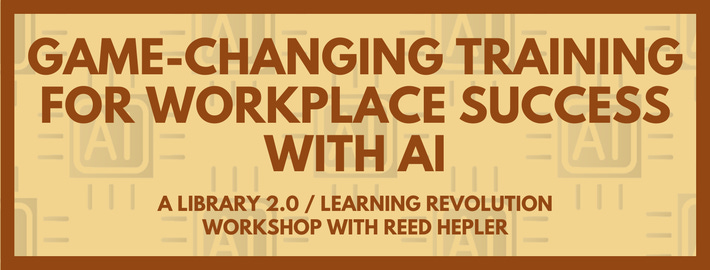
This 60-minute interactive workshop explores how artificial intelligence is transforming workplaces across disciplines, focusing on developing human-centered skills that remain valuable amid technological shifts. Rather than centering education around specific AI tools that may become obsolete, this session emphasizes preparing students with enduring perspectives and critical thinking approaches that will serve them throughout their careers.
Thanks for reading CollaborAItion! This post is public so feel free to share it.
No posts
Comments
Nothing yet. Say the first thing.
Sign in to join the conversation.