
I've been watching my Gen Z friends drop serious money on vinyl records lately, hunting for that "warm analog sound" while letting YouTube’s algorithm curate their next purchase through heavily compressed streams (I too, am guilty of this). There's something beautifully human about this—analog fetishism as a digital-native aesthetic choice, guided by the very AI recommendation engines they're supposedly escaping. It got me thinking about how we always seem to know exactly what "real" music sounds like, and how that definition inevitably involves yesterday's controversial technology.
We're living through another cycle of creative panic right now with AI music tools. The arguments feel achingly familiar: "This will destroy human creativity!" "Real musicians don't need machines!" "What about authenticity?" I've heard these exact words before, just aimed at different technologies. And honestly? That predictability isn't depressing—it's kind of hopeful. Because it reveals something fundamental about human nature: we always find a way to be creative, no matter what new tool shows up to "threaten" us.
Here's what I find most hopeful about our collective musical memory: every generation of creators has faced an existential technological threat, and every generation has not just survived but expanded what's possible. The camera didn't kill painting—it freed painters to explore abstraction. Synthesizers didn't replace orchestras—they created entirely new genres. Auto-Tune didn't destroy vocal authenticity—it became hyperpop.
The pattern is so consistent it's almost comforting. Luigi Russolo's noise machines caused literal riots in 1914. Jazz purists dismissed electric instruments as soulless in the 1930s. Bob Dylan got called "Judas" for plugging in at Newport in 1965. Queen printed "No Synthesizers" on their album covers through 1980, treating electronic instruments like musical contamination.
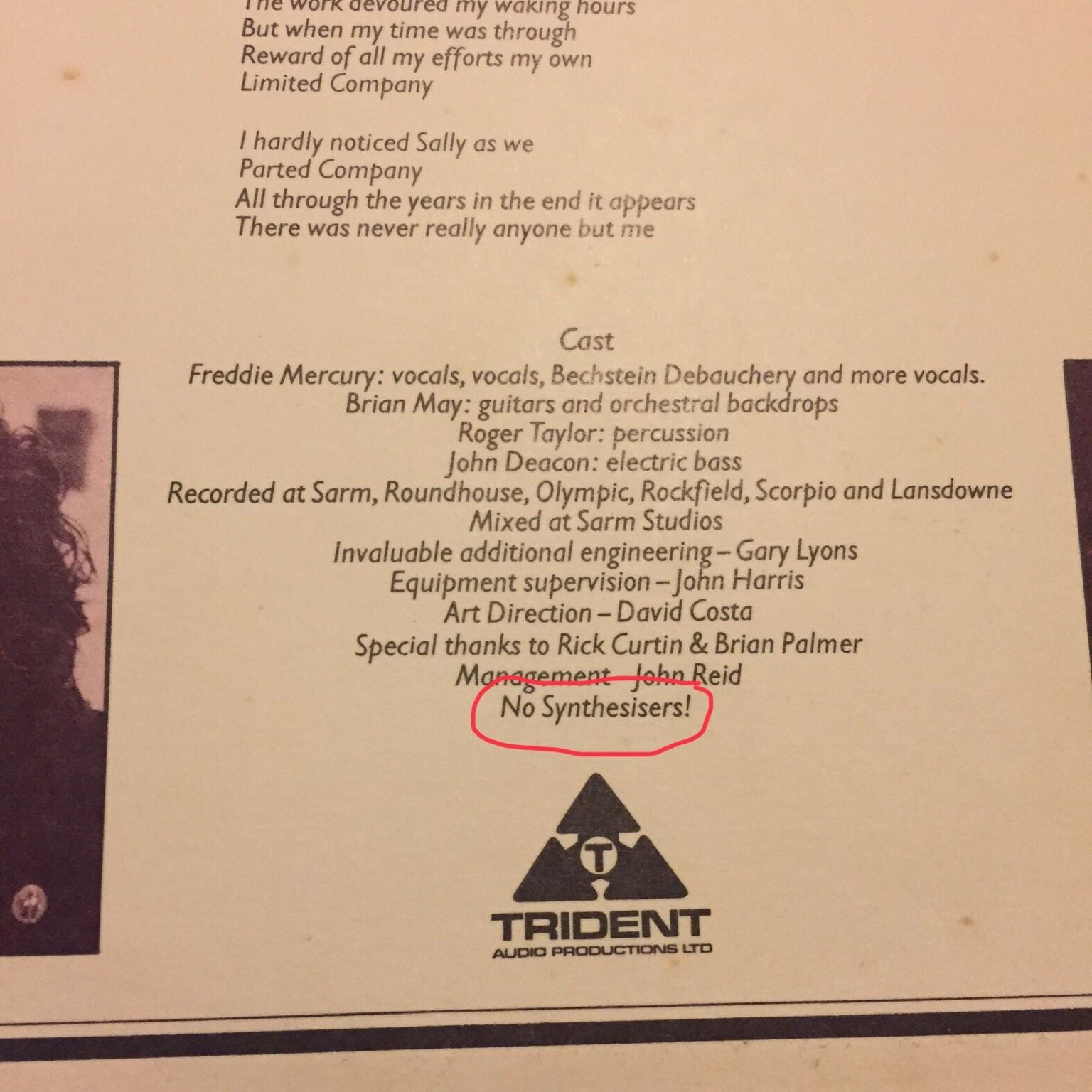
Each time, the resistance felt existential to the people living through it. Each time, the technology eventually became just another color on the creative palette. I have a friend who recently posted a photo of an older man in a "Drum Machines Have No Soul" sweater handing out stickers. His caption: "In the back of my mind, most anti-AI discourse feels like this." The cycle is so predictable we can meme it.
But here's what gives me hope: the research shows that most artists aren't actually using AI for full composition—they're using it for co-composition and sound design, maintaining creative control. Just like early synthesizer users weren't trying to replace orchestras, they were exploring new sonic possibilities. The human creative impulse doesn't disappear when new tools emerge. It adapts.
It took me a while to understand that these resistance cycles are rarely about the music itself. They're about economics, identity, and who gets to call themselves a "real" creator. The British Musicians' Union didn't try to ban synthesizers in 1982 because they sounded bad—they banned them because Barry Manilow decided to tour with a small ensemble instead of the orchestra he'd previously employed. Real musicians were losing real jobs to machines.
Sound familiar? Today's industry statement about AI music is almost identical: "Allowing the unauthorized use of copyrighted works to train generative AI models for commercial purposes will threaten the livelihoods of millions of American music creators." It's the same job protection anxiety, just with different technology. The 2023 Hollywood writers' strike echoed these exact concerns—writers worried that AI could "cease to exist" as an industry without proper regulations.
The anxiety is real and valid. I'll be honest—the AI music debates have made me reconsider how viable it is to sustain myself as a musician. But then again, making a living off music was always precarious in my experience. It's been feast or famine for as long as I can remember. I've become used to the instability of the path, which maybe makes me less panicked about AI than some of my peers.
But composer Arnold Schoenberg, writing about the pianola in the early 1900s, offered a different approach: rather than being drowned by waves of new technology, we could learn to surf them. The pianola freed composers from the constraints of human fingers—Igor Stravinsky used it to create pieces that would require three human pianists to replicate live.
There's something genuinely different this time that makes the panic feel more intense. Previous musical technologies were obviously technological—you could hear the synthesizer, the Auto-Tune, the drum machine. AI can create work that's indistinguishable from human creativity. When audiences can't tell the difference, it threatens both market value and professional identity in ways that previous innovations didn't.
The speed is different too. Synthesizer resistance played out over decades. The current AI music cycle has compressed into just a few years. When you're living through a transition this fast, it genuinely feels apocalyptic, even if the pattern is familiar.
There's another layer to this that feels uniquely exhausting. As researcher Kate Crawford argues, we should think about AI not as a battle between human and computer intelligence, but as a "gold rush...enclosing different fields of human knowing, feeling, and action—every type of available data—all caught in an expansionist logic of never-ending collection...a pillaging of public space."
The companies building these AI tools are often the same ones that own the platforms where we share our work. Meta trains AI on Instagram posts, then offers AI tools back to creators. Google ingests YouTube content to improve its models, then provides AI features to YouTubers. Reddit licenses user posts to AI companies while users create the content that makes the platform valuable. When technologies encroach on new aspects of our lives, Crawford notes, we are forced to reflect on what we value.
This circular extraction feels different from previous technological disruptions. I have my own frustrations with how some of these companies approach AI development, but the reality is that most of us are embedded in these systems whether we like it or not. When synthesizers emerged, Roland wasn't also controlling the radio stations. The platforms that host our creativity are now using that creativity to build tools that might compete with us.
But even here, humans are finding ways to adapt. Some artists are strategically using AI as an "amplifier" rather than a replacement. Others are defining themselves in opposition to it, turning resistance into its own aesthetic choice. Most are probably finding some middle ground, using these tools when they're helpful and ignoring them when they're not.
Technologies change our collective sense of what's possible and, in doing so, they change our sense of how things should be. - Jack Stilgoe, Aeon, 2023
What keeps me optimistic is how creative humans get when faced with new constraints or possibilities. I'll admit, my personality leans toward adopting new technologies early—when DAWs and software synthesizers first emerged, I experimented with them right away, mostly because I had limited resources and these tools were free or accessible. That early adoption taught me something: new tools don't replace creativity, they redirect it.
Take J Dilla, who used drum machines in the 1990s to create what's now called "Dilla time"—deliberately imperfect, off-grid beats that changed our collective sense of rhythm. Questlove, widely considered one of the world's best drummers, initially wanted to sound "more like a machine," then learned to emulate Dilla's "machined imperfections." The tool didn't replace human creativity—it expanded what human creativity could become.
But here's what gives me the most hope: drumming, as music researcher Jack Stilgoe notes in Aeon, is "tacit, creative skill that is impossible to completely transcribe or put into code." Each technology creates new sounds that become culturally valued—the 808 bass, trap hi-hats, Auto-Tune's robotic warble. These weren't bugs, they were features that humans discovered and embraced.
I keep thinking about this because it suggests something hopeful about our current moment. The AI tools that seem threatening today will likely become just another creative option tomorrow. Some artist in 2045 will probably be paying premium prices to access the earliest model checkpoint (to get that “vintage model sound”) while complaining about whatever new technology is disrupting music then.
The authenticity we're all chasing was never about the technology anyway. It was about human intention, creative vision, and the desire to connect with other people through sound. Those impulses don't disappear when new tools emerge—they just find new ways to express themselves.
Writing this piece, I keep coming back to something fundamental: the human drive to create transcends technological disruption. We've been through this cycle so many times—from player pianos to sampling to Auto-Tune—and music has not only survived but flourished.
As Stilgoe observes, "Technologies change our collective sense of what's possible and, in doing so, they change our sense of how things should be." A good music technology becomes a new source of creativity—it can be hacked and bent in ways its designers never foresaw. All innovation in art has generated new answers to the question of what counts as art.
The music will be fine. The humans making it will find a way. They always do.
Maybe that's the real lesson here: the thing we're trying to preserve was never under threat in the first place. Human creativity is remarkably resilient. It bends, adapts, and finds new forms of expression with each technological shift. The tools change, but the fundamental impulse to create and connect through sound remains constant.
That's not naive optimism—it's pattern recognition. And honestly? I find that pretty comforting 🌀
Crawford, Kate. "Atlas of AI: Power, Politics, and the Planetary Costs of Artificial Intelligence." Yale University Press, 2021. https://yalebooks.yale.edu/book/9780300264630/atlas-of-ai/
Stilgoe, Jack. "What drum machines can teach us about artificial intelligence." Aeon. https://aeon.co/essays/what-drum-machines-can-teach-us-about-artificial-intelligence
Pons, Jordi, Zack Zukowski, Julian D. Parker, CJ Carr, Josiah Taylor, and Zach Evans. "Music and Artificial Intelligence: Artistic Trends." arXiv preprint arXiv:2508.11694 (2024). https://arxiv.org/pdf/2508.11694
Coyle, Jake. "In Hollywood writers' battle against AI, humans win (for now)." Associated Press, 2023. https://apnews.com/article/hollywood-ai-strike-wga-artificial-intelligence-39ab72582c3a15f77510c9c30a45ffc8
Comments
Nothing yet. Say the first thing.
Sign in to join the conversation.