
This year’s El Niño is predicted to be the strongest El Niño event since reliable records began. “It may end up the strongest by a truly mind-blowing margin,” climate scientist Zeke Hausfather writes. “The models are forecasting something outside the envelope of anything we have ever observed.”
The US National Oceanic and Atmospheric Administration (NOAA) explains how it declares El Niño as follows:
NOAA declares an El Nino (Spanish for “little boy”) has formed when temperatures in the equatorial Pacific are 0.5°C above average for several consecutive months. Additionally, NOAA monitors the atmosphere above this region of the Pacific, looking for a pattern called the Walker Circulation, a massive east-to-west air flow driven by the temperature and pressure differences between the warm western and cool eastern oceans. When the Walker Circulation breaks down and warmer water shifts east toward South America, El Nino is declared.
On 11 June 2026, NOAA officially announced that El Niño has developed in the tropical Pacific.
During a recent press briefing, Hausfather said that it’s “not outside the realm of possibility” that combination of global heating and El Niño could result in global average temperatures in 2027 reaching 1.7°C above pre-industrial temperatures.
The last time the global temperature exceeded 1.5°C was in 2024 — the hottest year on record.
This is particularly bad news for the Amazon rainforest. The Brazilian meteorological agency has released a forecast that El Niño is expected to delay the rainy season, increase the risk of wildfires, and worsen drought in the Amazon.
Carlos Nobre of the University of São Paulo was among the first scientists to raise the alarm of an Amazon tipping point. “The Amazon has to be very prepared from now through the beginning of 2027, at least up to March, because this El Niño is very likely to induce a severe drought,” he told The Guardian.
A news feature in Nature highlights the risks of El Niño for the Amazon rainforest. “For the Amazon rainforest, the timing could hardly be worse,” journalist Quentin Septer writes.
El Niño events typically result in droughts in the Amazon basin. The most recent El Niño formed in June 2023 and lasted until June 2024. The Amazon saw severe drought, dried up rivers, and the worst fire season for more than two decades. Researchers are warning that this could push the Amazon past a tipping point, where the rainforest would be replaced by savanna and degraded woodland.
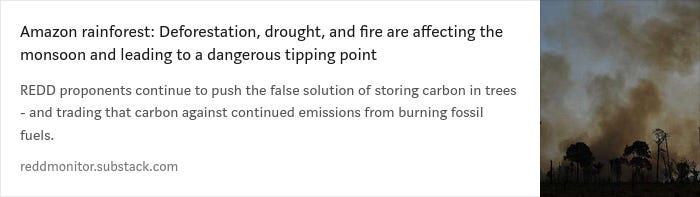
The 2023-2024 El Niño saw a massive spike in the area of forest burned, as well as vast areas of forest degradation — which makes the rainforest more vulnerable to fire.
Septer spoke to Bernardo Flores, a researcher on Amazon resilience at the Juruá Institute in Manaus. In 2025, Flores was lead author of a paper in Nature that warned of “unexpected ecosystem transitions” even in remote parts of the Amazon basin as a result of interactions between different disturbances, such as “frequent extreme hot drought and forest fires”.
Flores told Septer that,
“If this next El Niño really is as strong as we think it will be, it might result in things like huge wildfires in the Amazon, spreading across areas that were unimaginable before. We will see how much of the forest might die from it.”
Flores warns that if too much of the Amazon rainforest burns during the current El Niño, “it could basically cross the tipping point”.
“We may have already crossed the tipping point,” Flores adds. “We don’t know.”
Part of the concern about the current El Niño is that the Amazon rainforest has not recovered from previous droughts. Another major drought could further weaken the forest.
A 2026 study, led by Nico Wunderling at Goethe University in Frankfurt, modelled changes in the movement of moisture in the atmosphere to test the impacts of global heating and deforestation. The authors found that a tipping point could be reached with global heating of 1.5 to 1.9°C and deforestation of 22 to 28%.
About 17 or 18% of the Amazon rainforest has already been deforested. And Hausfather warns that with El Niño, global temperatures could reach 1.7°C in 2027.
“I don’t think that a single year, even if it would be a very strong El Niño, would be sufficient to pass the tipping point,” Wunderling tells Septer. But in the long run this is how a tipping point will be reached. “We will see more extreme events — due to El Niño, for instance. They will become more severe. And then the recovery time for the trees is just not enough.”
This, obviously, has important implications for REDD. “If you want to tackle the climate crisis, there are two things you can do,” Martin Simonneau of Cool Earth said in a 2025 interview with REDD-Monitor. “One, protect nature. Two, wean ourselves off fossil fuel. Don’t do them separately. Do them simultaneously. But don’t use rainforests or any other carbon sink as a way to offset your reliance on fossil fuel.”
While we must protect rainforests, we cannot trade the carbon stored in forests against continued burning of fossil fuels. The rainforests are severely impacted by the climate crisis. And to address the climate crisis we have to stop burning fossil fuels.
Comments
Nothing yet. Say the first thing.
Sign in to join the conversation.