
Every senior leader I know has the same dirty secret: they’re drowning in information but starving for signal.
We subscribe to newsletters. We bookmark tabs. We tell ourselves we’ll “catch up on the weekend.” We never do. The result? We walk into Monday meetings with opinions shaped by whatever algorithm fed us over breakfast — not by what actually matters to our business.
I decided to fix this. Not with another newsletter subscription. Not with a better RSS reader. With agents.
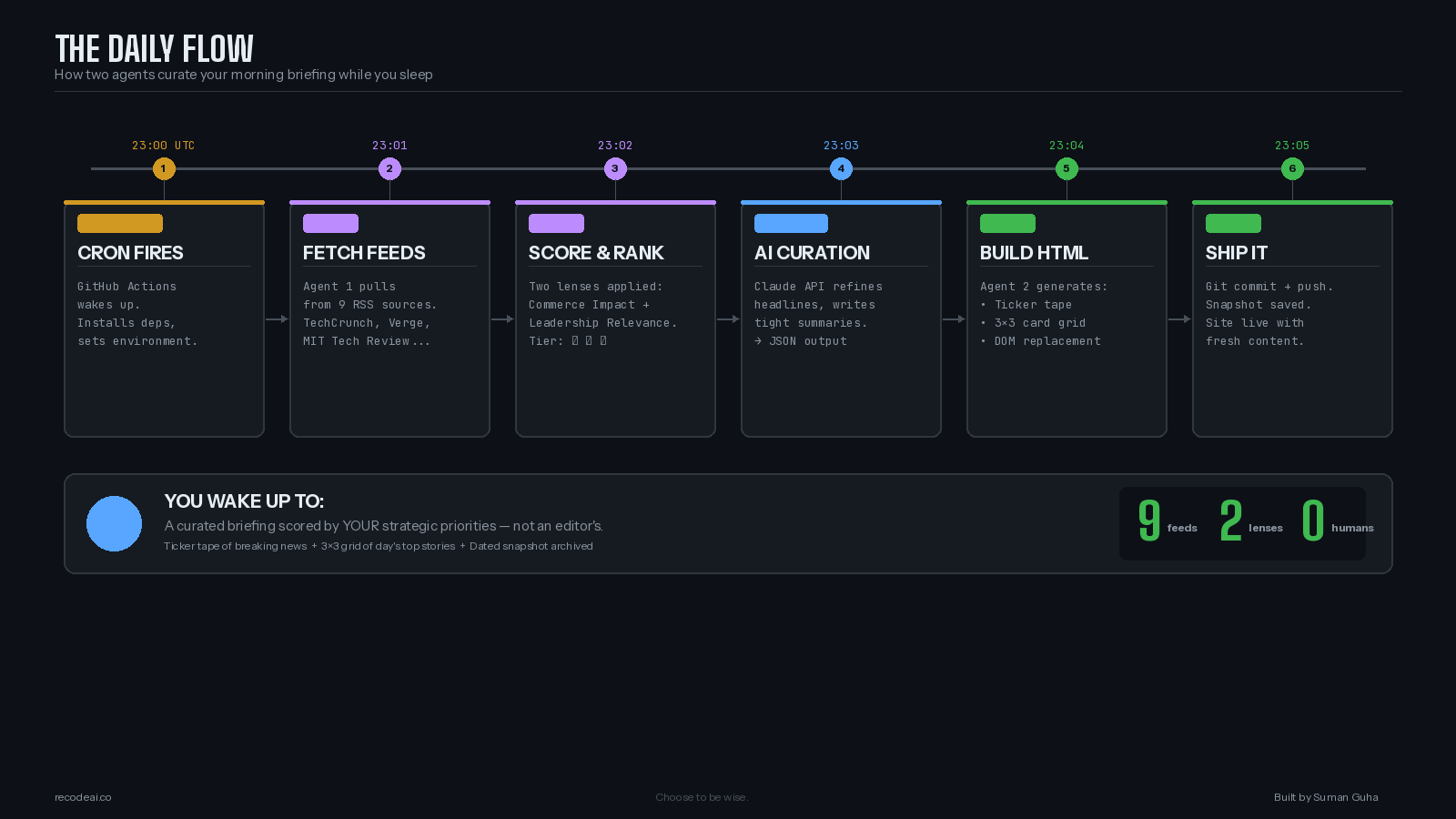
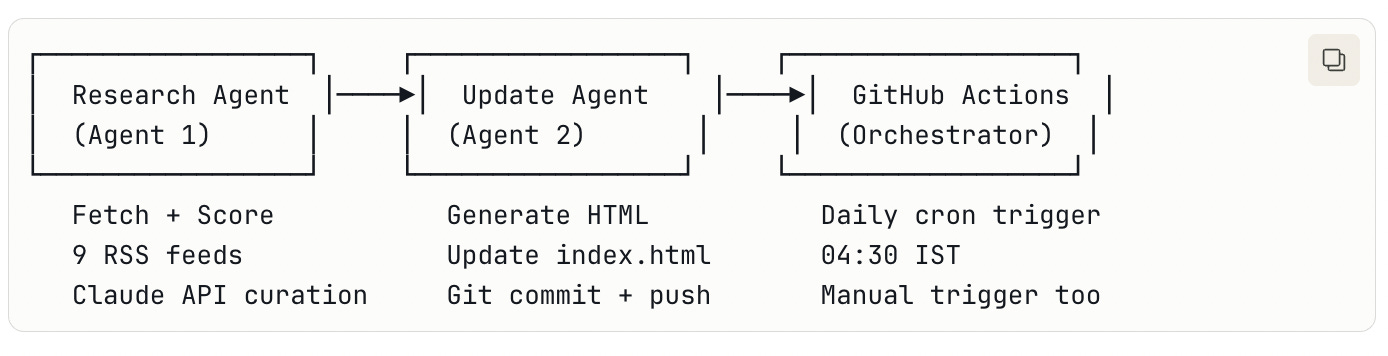
Here’s what I built 950 lines of code, this morning, and I spent about 44 mins, shipped to production:
Agent 1: The Research Brain
This agent pulls from two dozen RSS feeds. But here’s where it gets interesting: it doesn’t just aggregate. It scores every article through two lenses:
Commerce impact — Will this shift how people buy, sell, or discover products?
Leadership relevance — Does a CDO, CTO, or CPO need to know this today?
Each article gets classified into tiers: breaking, notable, or interesting. Then Claude’s API refines the headlines and writes tight summaries. The output is structured JSON clean, opinionated and machine-readable.
Agent 2: The Publisher
Agent 2 reads the research JSON, generates a ticker tape of top headlines and a 3×3 card grid of the day’s nine most important stories, surgically replaces the #firehose section of my site’s HTML, and pushes to GitHub with retry logic. A dated snapshot gets saved for history.
The Orchestrator: GitHub Actions
A cron job fires at 23:00 UTC (04:30 IST). Agent 1 runs. Agent 2 runs. The site updates. I wake up to a fresh, curated briefing that reflects my strategic priorities, not some editor’s idea of what “AI news” means.
This isn’t a side project flex. This is a mental model.
We’re entering an era where the leaders who build their own information infrastructure will outperform those who consume someone else’s. Think about that. Your competitive advantage isn’t just what you know, it’s how you know it, and whether your knowledge pipeline is aligned with your actual strategic priorities.
Here’s my framework, I like to call it The Curation Stack:
LayerOld WorldNew World Source Subscribe to what’s popularSelect feeds aligned to your domain Filter Skim everything, hope for the bestScore through strategic lenses Rank Recency biasPriority tiers: breaking → notable → interesting Deliver Inbox chaosAuto-published, waiting when you wake up Iterate Never Tune scoring weights weekly
Most people operate at Layer 1. They subscribe. The magic happens at Layers 2–4, and until now, those layers required a human analyst or a very expensive team. Not anymore.
Here’s what most “AI content” thought leaders won’t tell you: the hardest part of this build wasn’t the AI. It was the scoring logic.
Anyone can wire up an RSS parser and call an LLM. The 10x value comes from defining your lenses. What does “commerce impact” mean to your business? What makes something “leadership relevant” in your context? These are strategy questions disguised as decisions.
If you can’t articulate your scoring criteria in two sentences, you don’t have a curation pipeline. You have a prettier version of Google Alerts.
1. Agents work best when they have narrow, opinionated mandates. I didn’t build a “general AI news curator.” I built a system that sees the world through commerce and leadership. That specificity is what makes the output trustworthy enough to publish without review.
2. The two-agent pattern is underrated. Separating research from publishing isn’t just clean architecture; it’s a forcing function for data quality. Agent 1’s output has to be structured enough for Agent 2 to consume blindly. That contract keeps both honest.
3. The real unlock is sleeping through it. This sounds trivial. It isn’t. When your information pipeline runs while you sleep, you reclaim the cognitive space that “staying current” used to occupy. That space is worth more than any single article.
You don’t need to build this exact system. But ask yourself:
What are the strategic lenses your role demands?
Which 5–10 sources actually matter for those lenses?
What would change if your morning briefing were auto-generated, scored by your priorities, and waiting for you at 4:30 AM?
The tools are here. Claude’s API, GitHub Actions, and a few hundred lines of Python. The bottleneck isn’t technology. It’s clarity about what the signal means for you.
Choose to be wise. Build your own signal.
I’m building recodeai.co to give builders mental models for the AI decade. If this resonated, subscribe to stay in the loop. And if you want the code, it’s open. DM me.
What lenses would you score your news through? Drop a comment — I’m genuinely curious.
No posts
Comments
Nothing yet. Say the first thing.
Sign in to join the conversation.