
Hello there!
Thank you for being a partner, supporter, friend, or curious observer of our journey. Your attention and trust help us keep building the kind of carbon removal the market can rely on.
Here’s what defined 2025 at Recoal.
In Spring, Recoal was selected for Zurich’s KlimUp Program. The initiative by the City of Zurich and Bluelion supports startups creating measurable climate impact with grants of up to CHF 250,000.
This opportunity means a lot to us. It connects us with people and organizations in our hometown who share our belief that innovation can drive real climate action. The KlimUp jury recognized our work to transform wet biomass residues into hydrochar, a stable form of carbon that can be safely stored for centuries.
With this support, we are able to speed up our pilot activities, prepare for CO₂ credit certification, and strengthen the scientific foundation of our work.

In June, we received funding from the Swiss Climate Foundation as part of its first 2025 funding round. The foundation supports small and medium-sized companies in Switzerland and Liechtenstein that are reducing emissions and developing sustainable technologies.
This support helps us further develop our process that turns wet biomass residues into permanent carbon sinks through hydrothermal carbonization. It also connects us with a network of organizations that share a commitment to accelerating the green transition. We are thankful for this trust and partnership.

In July, Recoal reached an important milestone with official validation under the Rainbow Standard. Our project is now listed as “Validated” on the Rainbow Carbon Registry.
The Rainbow Standard, formerly known as Riverse, is one of the leading science-based carbon credit frameworks. Our process and monitoring system were reviewed and audited by Enviance, an accredited validation and verification body. Their assessment confirmed that our carbon removal method meets strict technical and procedural standards.
This validation gives us a solid foundation for verified carbon removal credits as we move toward the launch of our pilot plant in 2026.

In August, we were honored to receive second place at the Impact Accelerator Award during Rocket Day in Zurich, organized by EBP Ventures. The event brought together ten startups selected from sixty applicants, each working on solutions for a more sustainable future.
We appreciated the opportunity to collaborate with experts from across sectors and to receive constructive feedback that will help us improve. The experience strengthened our confidence in the path we are taking and gave us new ideas for the next steps.

In September, we announced that Recoal will be a founding and contributing partner of Climate Week Zurich 2026. The Climate Week will take place from May 4 to 9, 2026, and will bring together people from business, policy, and civil society to turn climate ambition into local action.
As part of the program, Recoal will host an excursion to our pilot storage facility and an office visit + apéro. Visitors will be able to see how our technology works and discuss how permanent carbon storage can support a net-zero world. We are looking forward to connecting with others who share the goal of making practical progress on climate.

We celebrated our 2nd birthday at our office in Zurich this past September. Part of the team came together in-person, others joined remotely, and we kept things simple.
We are grateful to our partners, supporters, and collaborators who have trusted us with their time, expertise, and capital in the past two years (and even before that). We’re looking forward to our future birthday cakes!

This year, we were happy to welcome two new colleagues to the Recoal team.
Sinh Nguyen joined us in the spring to lead our work in Monitoring, Reporting, and Verification (MRV).
Sinh brings a unique mix of experience across sustainability, business, entrepreneurship, and technological innovation. At Recoal, she focuses on ensuring that our CO₂ removals are transparent and credible, reinforcing the integrity of our environmental impact.
In September, Michaela Mazzotti joined as a Design Engineer.
Michaela combines technical expertise in plant design with experience in social work, connecting engineering precision with a strong sense of purpose. At Recoal, she develops design solutions that merge innovation with sustainability, helping us build technology that supports a livable future for generations to come.
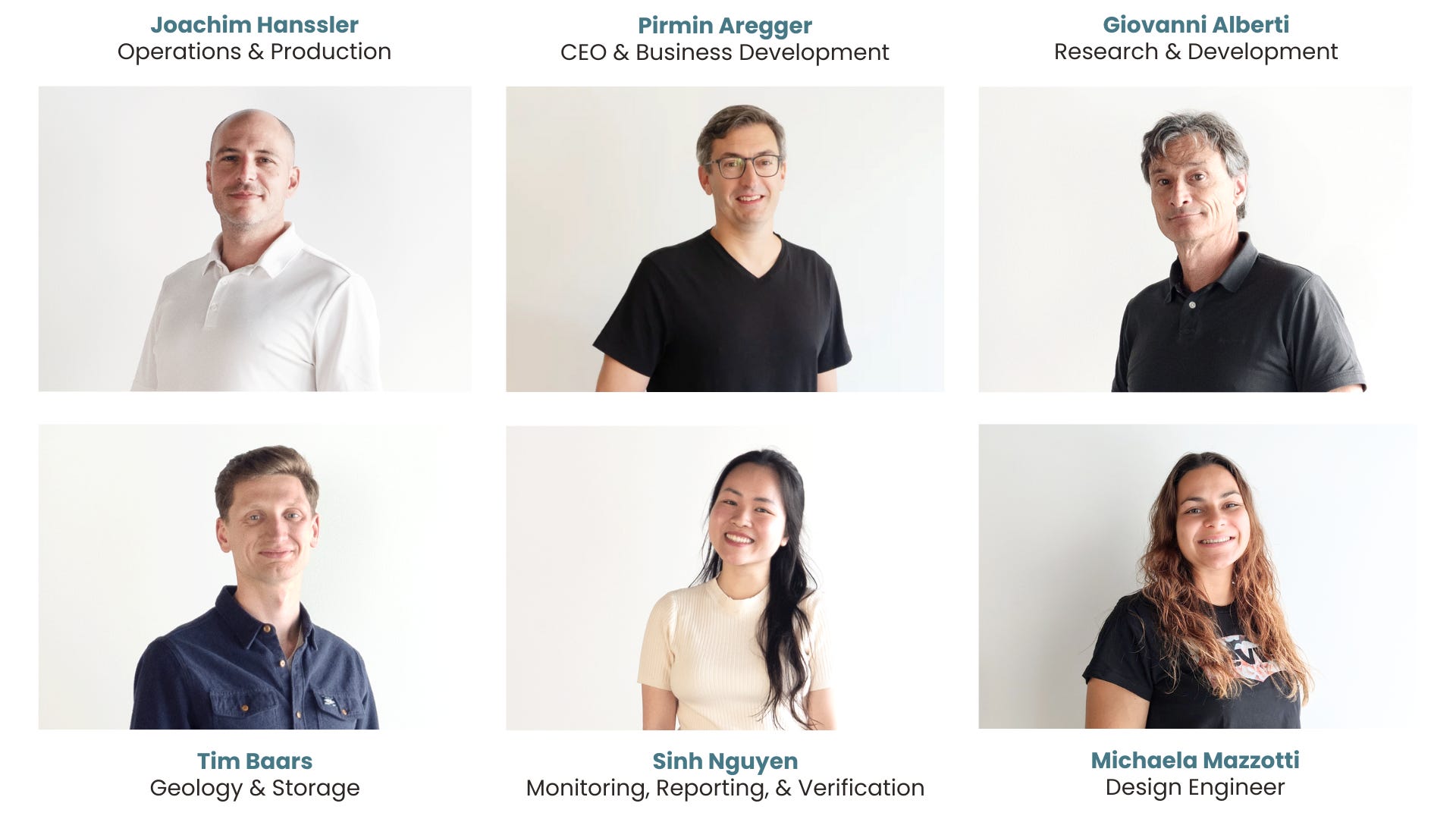
We are grateful to have Sinh and Michaela on board. Their skills, motivation, and perspectives strengthen our team as we continue to grow and refine our work.
We opened our Zurich office for an apéro with members of the Swiss Carbon Removal Platform (CDR Swiss). Our goal was to create space for real conversations across tech, policy, markets, and implementation, without a formal agenda. Personal stories and fun anecdotes were floating around the room freely as well.
Gotta say, it was a success!

We joined the Negative Emissions Platform (NEP), a coalition focused on durable, high-integrity CDR. To kick off our involvement, Sinh Nguyen from our team spent several days in Brussels meeting with EU institutions, NEP, and member organizations to discuss how policy can support scale without compromising integrity.
Besides the NEP, in 2025, Recoal participated through several networks and associations, including swisscleantech, DVNE, and CDR Swiss. We treat these as working spaces where coordination happens across policy, finance, standards, and infrastructure.

In late November and early December, our CEO Pirmin Aregger spent two weeks in Brazil representing Recoal as part of the Startup Camp organized by Innosuisse and Swissnex in Brazil. Our objective: test our assumptions in the field, speak directly with people who operate large biomass systems, and understand where our approach to carbon dioxide removal could make sense under Brazilian conditions.
Pirmin participated in several events that framed carbon removal within broader industrial and energy systems. Since Pirmin’s return, we have been following up on the connections made, sharing additional information, and continuing the discussions.

Earlier this month, a paper co-authored by our colleague Tim Baars was published in the International Journal of Greenhouse Gas Control. For us, this publication is not adjacent research but rather speaks directly to the core of Recoal’s methodology.
Recoal converts wet biomass residues through hydrothermal carbonization into hydrochar, a stable, coal-like carbon material. The climate value of that process depends on what happens next. Durable carbon dioxide removal only exists if the carbon is stored safely and for the long term. This paper focuses precisely on that question.

We have exciting news to share in early 2026! These include the announcement of our first off-take agreement, new investments, partnerships, and team members. And of course, the launch of our pilot plant in Switzerland!
We are grateful for your support as the Recoal baby from back in 2023 turns two years old and takes its bold steps forward.
Happy holidays from the Recoal team.
No posts
Comments
Nothing yet. Say the first thing.
Sign in to join the conversation.