
Folks using screen readers and anyone who prefers to listen — there’s an audio player bar just below this paragraph, with a play button on the far right. Please let me know if you have any trouble with it.
0:00
-14:29

It started in early March, sitting in front of an audience at Western Kentucky University when the moderator asked me what I thought about disability and technology – AI in particular and especially as it’s whipping its way through industries and homes, promising/threatening to change everything as we know it, did I have thoughts?
Oh ho ho, did I. So many. Too many. Where do I start?? Maybe it’s my perch as a millennial. I’ve now lived through several iterations of technologies that promised to make us happier, connected, and informed, and instead, often left us anxious, disconnected, and misinformed. Every time I spy a headline spotlighting some new expression of AI, I cannot stop myself clicking. And that would be about 50% of the headlines these days. (Or is that just the algorithm chasing me??) Like the article I read about South Korea using AI to make individual check-ins on their quickly expanding aging population. One woman’s life was saved, because an AI agent called to check in on her and recognized she needed immediate assistance. It alerted emergency crews who quickly showed up in the flesh. That sounds like a very good thing. And also, at one point in the article, it’s reported that the elderly users of this tech have been known to invite the AI agents over for lunch. One woman played the piano for it. Even as they know, of course, no one is there. The voice on the other end of the line will never come for lunch.
And I think I have good reason to distrust AI when it comes to meaningfully integrating disability into the world, from hiring platforms that filter out applications that include any disability-related language to AI models perpetuating disability tropes to the voice recognition apps that don’t register speech patterns that fall outside what has been established as “typical.” We can trace the ways AI privileges and promotes that which has been centered as normal.
Still, last year at an adaptive technology conference, I sat next to a man who worked for a company connecting disabled people with tools that could lessen reliance on human care workers. He pointed to the huge care worker shortage (which is to say nothing of what it’s like trying to find good, qualified, reliable care workers) and claimed their technologies could offer a little relief to this relentless quest. They could outfit a person’s living space with speakers and sensors and automation that meant their clients could spend longer stretches on their own – sometimes even whole nights.
Or we could try to find ways to pay care workers more? I thought. Aren’t we kind of missing out on something when human care is replaced by tech? And, by the way, how many people can afford these tools?
But I have been known to get tripped up by my own idealism. I am too prone to all-or-nothing thinking, I know. Maybe a hybrid could create some much needed ease? Surely that feels possible, too. I met a woman with CP at that same conference whose whole house was set up with Alexa speakers that responded to her voice commands – doors and lights and phones and appliances. Sometimes the speakers had trouble understanding her speech. She expected/hoped it would get better as the technology advanced. And overall, the increased independence it offered her felt so good. When you are disabled and used to needing to lean on other humans for care, it would seem that sometimes and for some of us, relying on tech instead can feel good. I know there are times when this has been true for me.
AI often presents itself to us as human, but it doesn’t see or think or care about us the way a human can. I suppose it makes sense then that this kind of trippy setup could take us down many winding roads – some mundane, some silly, some catastrophic, some useful, some heartbreaking.
And so, in front of that audience in Kentucky, I stumbled through my answer about disability and AI. I probably rambled for 10 (was it 15??) straight minutes naming the this, but also this, and oh yeah, this, too of it all. I think in the end, I wandered my way into a sort of landing place prioritizing guardrails and human connection. Fire is a powerful tool – can keep us alive, even – and also, it needs to be vigilantly, responsibly contained, etc, etc.
That was March. In the months since, my brain has not stopped roving, searching, wondering. I’ve had many conversations about AI with the people around me, from my friends with progressively low vision who feel wobbly and also curious about getting smart glasses to my doctor who is playing with the idea of having AI illustrate the children’s book he wrote (“DON’T DO IT, I shouted with wild eyes”). I’ve seen AI generated notetaking and captions imperfectly and meaningfully support my neurodivergent and deaf friends. I’ve continued reading articles and listening to podcasts where smart people grapple with all kinds of possible implications of these technologies. (Season 2 of Shell Game blew my mind.) I chatted with an AI agent connected to a biometrics device I started wearing on my wrist. (Yes, I did!) And I felt a squeeby chill when I was notified that an AI agent started following this substack. All of this happening at once.
I tried to capture in writing the giant swirl spinning in my head, first in a letter to you, then in a pitch to a larger publication. Writing is the best way I know to access my own thoughts, but the more I learned and wrote, the harder it felt to wrap my head around it all. I seem hard-wired to look for bottomlines, but the instinct felt even more obnoxious than usual. The intersection of disability (vast!) with AI (infinite!) felt way too big to take as a whole. (Not too dissimilar to what it felt like to write my masters thesis on Moby Dick of all things. What could I possibly add to this conversation? And how does anyone say anything of note about a subject whose depths seem to know no bottom?) I needed to find a doorway to narrow my focus or a branch to grab ahold of.

So I scrapped almost everything I’d written, all of my intellectual volleying, and started again. This time I tuned in to my body. It’s a move I’ve been trying to practice as a human and a writer. If you’ve been around here for a minute, you may know that I left my body when I was quite young. Just after my first birthday, before I had enough language to string sentences together, my body became a place of uncertainty, pain, sickness, a symbol of something scary or inspirational for the ones who witnessed me. And so I traded my complicated body for the world of my mind where I had more control, where I could polish every sentence until it gleamed, regardless of what my body said. Several decades later, a disembodied intellectualism has started to feel less appealing. Or feel too small? Or insufficient? Or maybe it’s just that a body will only be ignored for so long. Either way, eventually, as the motor of my brain overheated under the intense whirl, I dropped from my head into my body. I gathered a lump of visceral moments when my body has meaningfully intersected with AI, and as I took in the collection, I tried to arrange the pieces into a story. What I found surprised me.
As AI elbows its way into more of my life – sometimes against my will, sometimes with my own cautious curiosity, in some ways I can detect, and in others ways I haven’t yet sniffed out – I stumbled on one insight that has brought me increasing delight, and it is this: AI does not, in fact, have elbows. Next to AI, my body’s loopdeloop inefficiencies, refusal to optimize, and sheer mortality has started to feel like the zine, the mixtape, the snail mail, the homemade protest sign.

With access to this body, I have a line to a kind of knowing that, so far, can’t be replicated – not with billions of dollars or a limitless supply of tech bros. It’s not an infallible knowing. Bodies are unwieldy. That’s kind of the point. But there is a valuable and rare kind of knowledge, understanding, insight that comes from a body. We think and feel and ache and delight and reach out and cuddle and rejoice and grieve through our bodies. A disabled body in particular carries an entirely distinct, deeply needed kind of knowing. And, I don’t know, maybe I’m a bit of a brat, but something about the defiance of claiming that knowing as valuable, well – it’s highly motivating to me. Few ideas have shifted my own thinking on the worth of this painful, flourishing, paralyzed, limping along, living body of mine.
You can read the full piece I ended up writing here. It’s certainly not the only story or an attempt to represent all the stories, but it is one story of a living body mushed against nonliving intelligence to add to the pile as we try to make sense of a rapidly transforming world.

A Few More Things –
I’ll be joining my brilliant pal Abbie VanMeter on Tuesday, July 21st from 10:30-12 CT for a virtual conversation we’re calling “Uncovering Embodied Stories.” We’re interested in the ways storytelling about bodies (the ones we hear/tell as well as the ones that remain untold/unseen) shapes our lives and worlds. We’re hoping for an intimate chat and welcome audience participation, so come with your own stories and questions! You can find all the details and RSVP here! (There is a fee for joining, but we want everyone who is interested to be able to participate, so if the cost presents a barrier to attending for you, please do not hesitate to contact abbievanmeter@gmail.com!!)
Also, if you want to get to know Abbie, she just started her own Substack! It’s called “the (inter)personal trainer.” I really enjoyed this essay – “What Are We Making?”
Speaking of Substack, this essay by Lucy Webster on Disability Pride is stunning. Currently making plans to tattoo to my skin the entire paragraph that starts with “disabled bodies are astonishing.” Gah! I just reread it and my own disabled body exploded in goosebumps and gushed out a few tears, in recognition of something true.
And how’s this for a bit of good news? Our film Being Heumann is premiering as the opening-night film at the Toronto International Film Festival in September!! Honestly, I cannot put into words how beside-myself thrilled I am to be sharing this piece of scrappy disabled history with more people. For so many reasons and especially right now. Plus, you guys, it’s a fun movie!!
CHEWY QUESTIONS – If you want to continue to think through the ideas here, these questions are for you – please feel free to explore this in your personal writing, to talk about it with your people, or to join the conversation on Substack.
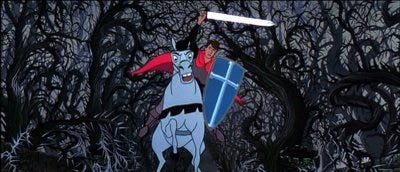
Are there subjects that get your brain really tangled? Like you don’t know how to think your way through the thicket? (The image in my head is Prince Phillip thrashing his sword around trying to fight his way through the thorny forest. Note: the movies you watch a hundred times as a child might turn out to shape the way you see the world forever and ever.) What would it feel like to step outside of the thorny headspace, even just for a few minutes, and drop into your body to see what it might have to say?

As a quick visual, a screen grab from the cartoon Sleeping Beauty of a Prince Phillip holding a big sword atop his trusty steed as he tries to fight his way threw a thorny forrest that only gets denser as he goes. Have you had any moments of intersection lately between your body and AI that feel worth noting? Embodied experiences we could add to a collected, textured map?
Thank you (thank you) (always) for being here.
xo
Rebekah
No posts
Comments
Nothing yet. Say the first thing.
Sign in to join the conversation.