
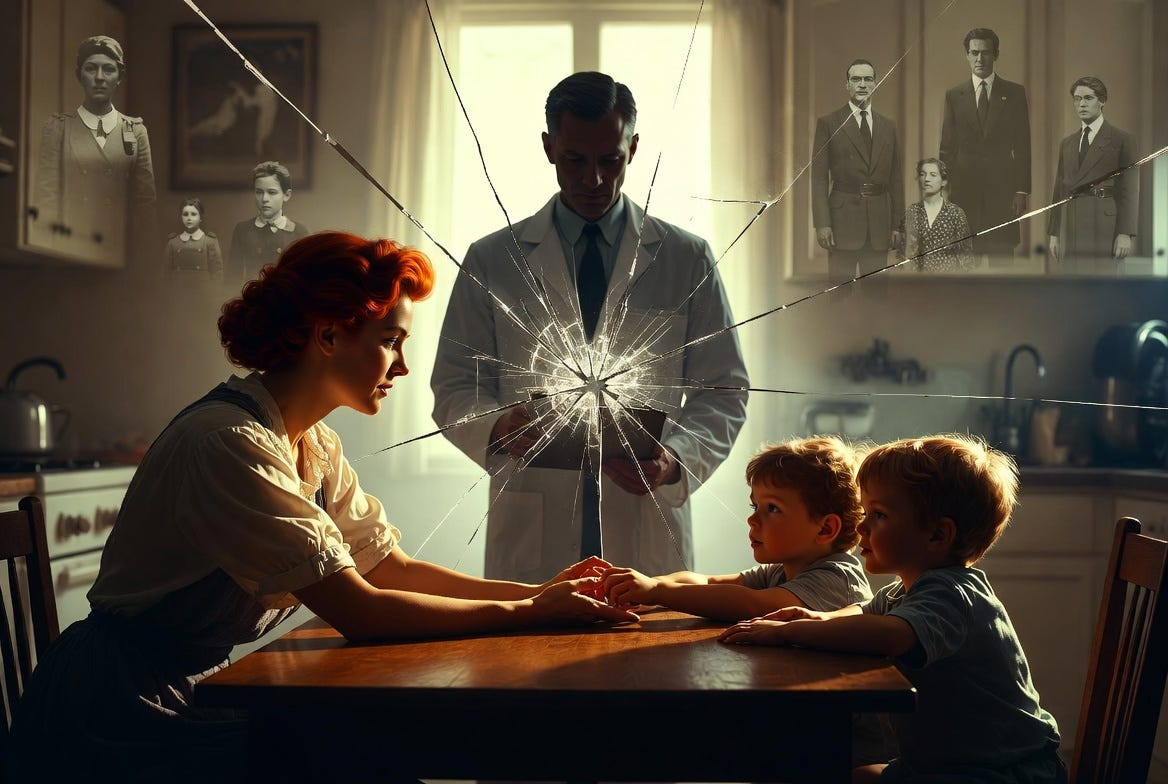
A woman named Shoshana Rubli sat down for her second session with a new therapist. Her second. By the end of it, she had her instructions: cut off all ties with her mother. She followed them, and she later told the Wall Street Journal why. It was an argument made from authority.
Sit with that detail, because it is what separates this from every other sad family story you have read. Not the tenth session. Not after months of careful work with both women in the room. The second hour. A licensed professional who had never met the mother and never heard her side prescribed the relational equivalent of amputation, and it was accepted on authority.
Elizabeth Bernstein’s WSJ report on this trend lit up my inbox this week, so I went and read the research underneath it, all of it, so you don’t have to. The numbers should stop every one of us in our tracks. And then, because I was raised to take the long view, we are going to talk about history, because the twentieth century already ran the experiment on what happens to societies full of severed families. Tomorrow morning I am releasing the full white paper with every study graded and sourced, along with the complete research document behind it: every citation, sample size, and methodology note, marked A through D by evidence quality, so you can check my work line by line. Consider this the argument, with receipts.
In 2020, Cornell sociologist Karl Pillemer published the first national survey on family estrangement in American history in his book Fault Lines. Sample of 1,340 adults. His findings: 27 percent of Americans are currently estranged from a family member. That works out to at least 67 million people, and Pillemer calls his own number an underestimate, because people lie to surveys about things they are ashamed of. Ten percent are estranged from a parent or a child, roughly 25 million Americans with an empty chair at the table. 85 percent of those rifts had lasted more than a year, and half involved four or more years of zero contact.
The newer data points the same direction. A 2024 Harris Poll conducted with psychologist Joshua Coleman found 35 percent of US adults estranged from an immediate family member. And the strongest study in the field, published by Ohio State’s Rin Reczek and colleagues in the Journal of Marriage and Family in 2023 using decades of national longitudinal data, found 26 percent of adult children have been estranged from their fathers and 6 percent from their mothers, with divorce as a major driver of the father numbers. Write that on your hand for the next time somebody tells you divorce is harmless to children. The bill comes due thirty years later.
And here is the detail the “cut them off for your peace” crowd never mentions: the peace does not show up in the research. The vast majority of estranged people in Pillemer’s survey reported distress, and he describes estrangement as a form of chronic stress. Even the UK’s most estrangement-sympathetic study, Cambridge’s Hidden Voices report, found 90 percent of estranged adults struggle through Christmas and 68 percent feel stigmatized. The critics in Bernstein’s reporting said it flat out: there is no scientific evidence that cutting off a close relative is inherently beneficial. The people living it are not thriving. They are grieving somebody who is still alive.
For decades, family therapy meant what it sounds like. You sat down, you did the hard work, you learned to communicate. The WSJ reports that a growing number of therapists have flipped the script and now encourage estrangement as self-care.
William Doherty, professor emeritus of family social science at the University of Minnesota and a therapist himself, told the Journal we are living in a culture that emphasizes fragility, where everything becomes trauma. His warning is worth memorizing: cutting off a parent should be “the tragic exception,” not standard practice.
He is not alone. Coleman, author of Rules of Estrangement, has documented this from inside the profession for years. He knows the territory personally, because his own daughter cut him off for two years before they reconciled, and by his own account he had once followed misguided therapeutic thinking himself. In a 2024 peer-reviewed paper on trauma narratives in parental estrangement, he lays out the core problem in plain terms: therapists routinely diagnose parents they have never met, hearing exactly one side of a two-sided story, with no way to verify anything, and some are prescribing permanence anyway. One researcher quoted by Bernstein put it even more bluntly: many therapists are trained to take the client’s account at face value and form conclusions from that single account.
Why now? University of Melbourne psychologist Nick Haslam published the answer in 2016 in a peer-reviewed paper on what he named concept creep. His research documents that the words abuse and trauma have formally expanded over recent decades, stretching outward to cover new categories and downward to cover milder and milder experiences. Abuse once meant physical harm; it grew to include verbal slights and passive neglect. Trauma once meant the battlefield; it grew to include disappointment. This is measured semantic history, tracked across decades of psychology literature. When everything is trauma, every imperfect parent is an abuser, and every abuser must be cut off. The logic closes neatly on itself, and the only casualty is the family.
Here is the part that should embarrass the profession: its own founders saw this coming. Murray Bowen, one of the fathers of family therapy, classified emotional cutoff as a symptom back in the 1970s. In Bowen’s framework, cutting off your family does not resolve dysfunction. It freezes it, and you carry it undigested into your marriage and your parenting. The discipline’s founding theory treats cutoff as the disease. Some of its current practitioners now prescribe it as the cure. A doctor who ordered surgery based on one person’s description of somebody else’s symptoms would lose his license. In some therapy offices, that is now called boundary work.
And ask the question nobody in this debate wants to ask out loud. When you separate a woman from her mother, her father, her sisters, and her aunts, who is left to give her advice? Who does she call when the marriage strains, when the baby will not sleep, when the job falls through, when she needs somebody who has known her for forty years instead of forty minutes? The therapist. The same professional who recommended the cutoff now occupies the only chair left at the table, and unlike your mama, that chair bills by the hour. I am not accusing any individual practitioner of scheming, because most sincerely believe they are helping. But in every other advisory profession we have a name for advice that deepens the client’s dependence on the advisor. We call it a conflict of interest. A lawyer who counseled you to fire your other lawyers, a financial planner who told you to stop consulting your accountant, would be brought before their boards. A therapist who removes your entire native advisory network in the second session is applauded for facilitating boundaries. Free counsel from people who love you gets replaced by paid counsel from a stranger, and the invoice arrives monthly.
Now the part my critics will skip and you should not. Real abuse exists, and some estrangements are survival. Rutgers researcher Kristina Scharp has documented through dozens of in-depth interviews that people do not seek distance from their families without reason, that the drivers include genuine abuse, addiction, and betrayal, and that estranged adult children usually hide their situation because they expect judgment. Her work deserves respect, and nobody serious is arguing that abused children owe their abusers a seat at Thanksgiving.
The parents’ accounts have their own credibility problem, and I will name it myself before somebody names it for me. Ohio State’s Sarah Schoppe-Sullivan studied 1,035 estranged mothers. Only 18 percent accepted any fault. Nearly 80 percent blamed an ex-husband or an in-law for turning the child against them. If therapists are wrong to build a case from only the child’s account, the estranged parents’ Facebook groups are equally wrong to build one from only the parents’. Anyone selling you a single villain is selling, period.
So my target is precise. It is the practice of a professional prescribing permanent family severance from one party’s account, sometimes within hours of meeting them, in a culture whose definitions of harm are provably inflating.
Now the history, and let me say plainly first what this section is not. I have spent years fighting antisemitism and standing with the Jewish community, and I do not play games with Holocaust comparisons. Your therapist is not a Nazi. A counseling office is not a regime. Anyone telling you otherwise is either selling something or has never read a history book past the dust jacket.
But this much is documented: every totalitarian movement of the twentieth century treated the family as an obstacle. Not a resource. An obstacle. Because the family is where competing loyalty lives.
The Nazi regime did not begin with camps. It began with loyalty transfer, and children were the primary target. Hitler boasted in a 1938 speech at Reichenberg that German youth would pass from the Jungvolk to the Hitler Youth to the party to the labor service to the army and belong to the movement for life. The slogan drilled into that generation translates to “You are nothing, your Volk is everything.” Hitler Youth membership became compulsory by law in 1939, and millions of German children spent their formative hours learning that their highest loyalty ran above their church and above their parents.
It worked. Historians who studied the surviving Gestapo files after the war, most notably Robert Gellately, found the secret police were not primarily catching dissidents through surveillance. They were flooded with voluntary denunciations from ordinary citizens, including family members reporting family members. Parents in the Reich learned to watch their words at their own dinner tables, because a child repeating a father’s joke at a Hitler Youth meeting could end that father’s freedom. The state had inserted itself between parent and child and made itself the senior partner.
The Soviets ran the same play with less subtlety, building a literal martyr cult around Pavlik Morozov, a thirteen-year-old celebrated across the USSR for denouncing his own father. Statues, songs, school curricula. A generation raised on the story of a boy whose great virtue was betraying his family for the state.
Different regimes, opposite ends of the spectrum, identical instinct: the family is the rival. Break the vertical bond between generations and the individual stands alone before the movement, with nothing older than the movement to measure it against.
The deepest analysis of this belongs to Hannah Arendt, the German-Jewish thinker who fled the Reich and spent her career explaining it. In The Origins of Totalitarianism (1951), Arendt argued that totalitarian movements did not primarily recruit true believers. They recruited the atomized: people severed from family, community, church, and class, with no thick loyalties left. Terror, she wrote, rules absolutely only over people isolated from one another. Loneliness was the soil. The regime was just the crop.
The differences are as instructive as the similarities, so here they are, stated as carefully as I can.
First, the direction of force. The Reich broke families top-down, with law, terror, and compulsory membership. Our estrangement boom is bottom-up and voluntary. Nobody is compelled into a cutoff. It arrives dressed as self-care, chosen freely. You cannot repeal a culture.
Second, the destination of loyalty. The totalitarians severed family bonds in order to redirect them upward, to the party and the leader. Our version has no Führer waiting at the end of it, but do not tell me the loyalty evaporates, because vacuums do not stay empty. The adult child is not conscripted into a movement; she is deposited into an apartment with a phone, a wellness subscription, and a standing weekly appointment with the one advisor she has left, the same one who suggested the exits. The trusted counsel that used to come free from people who changed her diapers now comes hourly from a stranger with a billing portal. Ours is not the Nazi disease but a stranger one, hyper-individualism rather than hyper-collectivism, the opposite ideology arriving at the same empty chair.
Third, intent. The regimes knew what they were doing. The therapist recommending a cutoff in the second session almost certainly believes she is helping. Haslam’s concept creep means many practitioners sincerely see severe harm where an earlier generation of clinicians saw ordinary friction. Sincerity does not fix the outcome, but it changes the moral ledger, and I will not pretend otherwise.
So no, nobody is goose-stepping through a counseling conference. The honest claim is narrower and, to me, scarier. The tyrants needed decades of terror, law, and martyr cults to produce lonely, atomized populations severed from their parents. We are producing one voluntarily, 67 million estrangements deep, and calling it wellness. Arendt would not have called our therapists totalitarians. She would have looked at our loneliness numbers and asked what such a population is being prepared for, even if nobody is doing the preparing.
Scripture treats the bond between generations as load-bearing for a whole society, which is exactly why regimes target it. “Honour thy father and thy mother: that thy days may be long upon the land which the LORD thy God giveth thee.” (Exodus 20:12, KJV) Notice the promise is not private. It is territorial. Long days upon the land. The commandment ties the durability of a people to the durability of its families, and every twentieth-century tyrant proved the principle by attacking it from the other side. The data has finally caught up to the commandment.
There is a hopeful footnote in the research, and it points home. Pillemer interviewed 100 people who reconciled, some after 10, 20, even 30 years, and he describes repair, not severance, as the engine for personal growth. Repair is hard. Repair is possible. And repair, according to the actual evidence, is where the healing lives.
The full white paper drops tomorrow morning: the prevalence studies, the therapy-practice research, the clinical ethics, the reconciliation data, every source graded. The complete research document comes with it, links and all, because I do not ask you to trust me. I ask you to check me. If you have been waiting to hand something substantial to the skeptic in your life, that is the document.
If this piece connected dots for you, share it. Somebody in your circle is carrying an estrangement in silence, on one side of it or the other, and the heaviest part of it is the silence. And if you want everything I publish, subscribe and pull up a chair. This kitchen table has room.
Peace in the chaos. Grounded in Christ and way too much coffee. ☕ Rebekah Winter Haven, Florida. At the kitchen table. Obviously.
P.S. Paid subscribers: Capitol Cappuccino continues this week as usual, and the white paper lands in your inbox first. I read the bills so you don’t have to, and you still get the receipts.
Comments
Nothing yet. Say the first thing.
Sign in to join the conversation.