
My daughter Revie, is the smallest player on her team and every few weeks she wonders out loud if she will grow. She is fourteen and the likelihood of her getting much taller is slim but I remind her that her athleticism is that much more spectacular because she’s smaller than the other girls.
Because pushing yourself beyond what is innate is how one learns to make space for herself without waiting for someone to give it to her.
Because the things we often feel are handicaps have great capacity to become doorways to self-discovery— challenges to respond to with words and action and the kind of effort that is required to become self-made.
Without tension, there is no mastery. No work ethic. No pride in one’s ability to push forward, pull back, overcome. Confidence and personal power grow based on one’s willingness to refuse defeat regardless of circumstance, to stand up and say, I AM HERE. THE FRONT WOMAN OF MY OWN LIFE.
***
When my oldest daughter, who is now seventeen, woke up one day with a stutter, her words suddenly stuck in her throat when she attempted to expel them, I was afraid.
I did not share this with her. Instead, I held my hands over fear’s mouth and said, “don’t you dare project.” But of course I was worried. She was eight years old and already outspoken — her voice a blooming thing that needed water. I was terrified that the sharpness of her words, which suddenly took her great effort to expel, would become dulled by their difficulty.
She was given an IEP and started speech therapy immediately but speech therapy doesn’t do a whole lot as far as fluency in concerned and while she was given the tools to navigate it, her stutter, which was on the more severe side, did not improve.
At the time we weren’t sure if it was temporary or “persistent” which is very rare — especially in girls — affecting between .2% and .4% of women worldwide. We were told if she still had it post puberty, it would likely stay. (And so it was.)
Several months after her stutter’s onset, I got a call from her second-grade teacher. Earlier that day, Fable had asked him if she could have some time to speak directly to her peers about something that was important to her. He agreed, inviting her to the front of the class at the end of the day where she explained why she suddenly talked differently.
“This is how I talk now,” she said. “But it doesn’t mean I’m going to stop talking. So whatever questions you have for me, ask them now. Anything you want to say about my stutter, please say it to my face. And one more thing: please do not finish my sentences for me. It will take me longer to get my words out but they are my words and I will take my time to deliver them myself.”
Her teacher was stunned, not only by her willingness to validate her “handicap” but by the way the class responded. No one cracked jokes. Laughed or made fun. Instead, she was given a kind of respect that was directly related to the way she respected herself in that moment. She had confronted, with confidence, the very thing about her that statistically, was supposed to make her feel insecure.
And whatever fear I momentarily had, went away. Replaced instead by pride, awe and a new lens from which to view my children and myself.
That was the day she claimed her fucking voice. And in doing so, gave every other child (and adult) in that room permission to do the same.
“This is going to become my superpower, just watch,” she later told me.
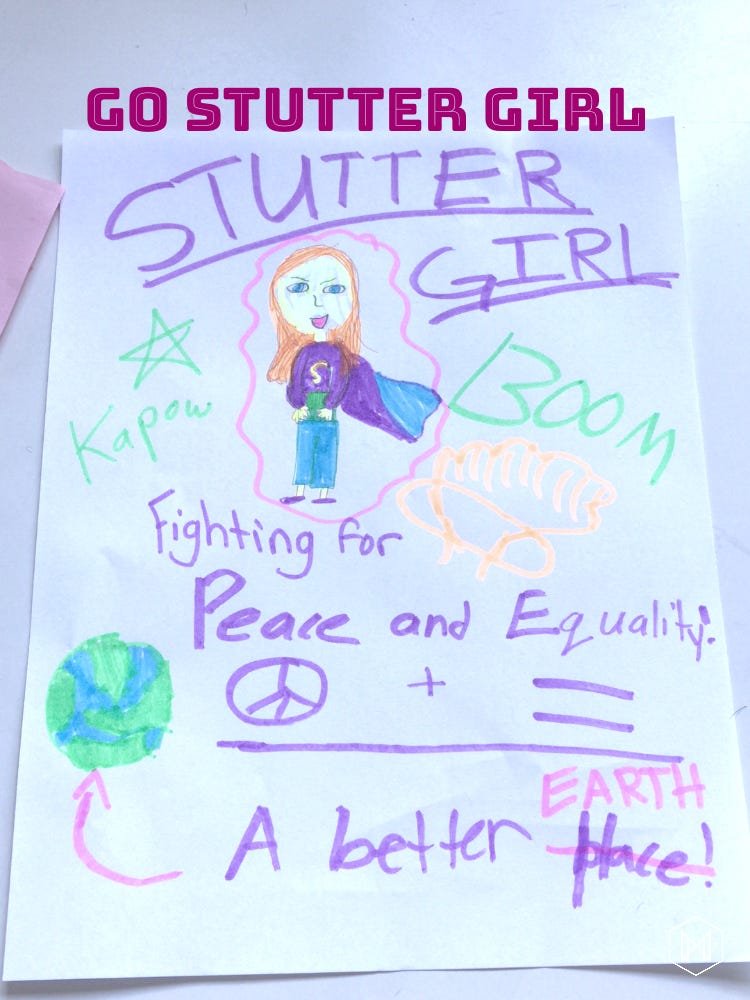
And she was right.
Comments
Nothing yet. Say the first thing.
Sign in to join the conversation.