
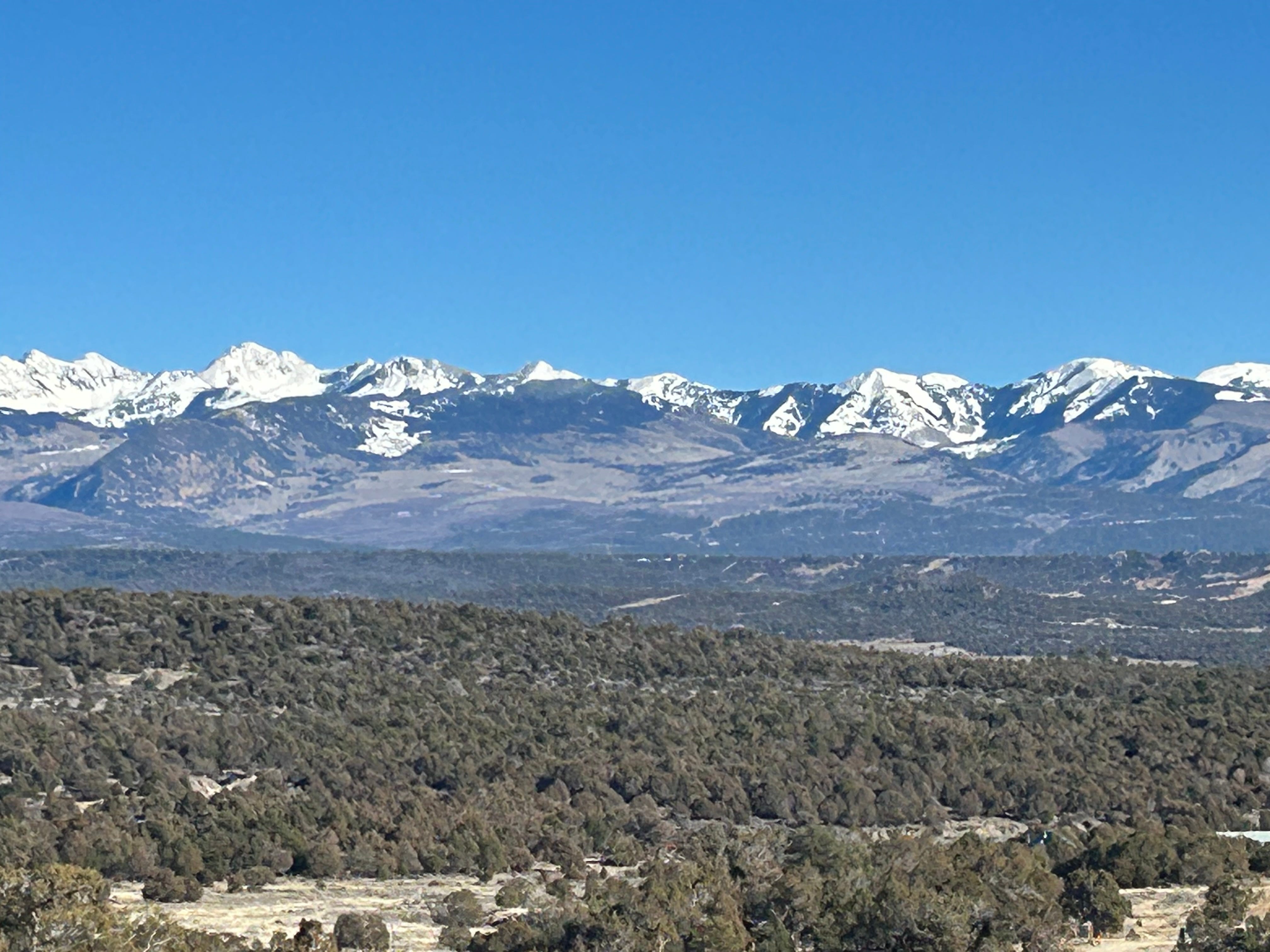
Piñon-Juniper Forest Near My Home: The La Plata Mountains in Winter
It is winter in the high desert where I live in southwest Colorado. The piñon and juniper forests quietly hold the land. The mountains watch from a distance. At night, the stars do too. This landscape invites a turning inward.
Piñon and juniper endure. They know how to stay when conditions don’t soften. Wide-spaced and slow-growing, they are adapted to scarcity and hold ground that looks unforgiving, until you learn how much life it actually sustains.
In winter’s stillness, my body recalls many forests I have known—each with its own wisdom and offering a different way of belonging. This connection is what I call eco-somatic memory, one way nervous system resilience is restored in relationship with the land.
I remember the dense intimacy of the East Coast woods of my childhood, where light filters in fragments. There, the nervous system learns containment—how to be closely held, how to live with shadow and partial light. I recall the trembling of aspen leaves, and the dark steadiness of spruce and fir in Colorado’s high country, now covered in snow, teaching me responsiveness to movement, breath, and weather.
Moving through these forests in imagination—a stored, dreamlike intelligence— brings me more fully into the forests around me now.
This is how the nervous system survives unhealed ruptures: remembering regulation and carrying it forward.
I remember this now because so many of us are trying to navigate traumatized and unjust human systems—families, institutions, spiritual communities, leadership circles—where rupture is real and repair is not guaranteed.
Speaking the truth has consequences, and those consequences live in the body. Our chests tighten. We brace for the next misattunement. And still, the body remembers another way. It can relearn how to breathe.
An overwhelmed nervous system does not recover through better arguments, but by returning to the conditions in which it evolved—canopy and leaf cover, birdsong and shadow, weather and rhythm, the profound yet subtle language of trees.
The slow rearranging of institutions often happens too late. We do not have to wait for an apology or a policy to reconnect with ourselves. With the forest's help, we can trust our perception when connections falter, even if others cannot or will not see it.
The human nervous system evolved within living ecosystems, not in meeting rooms or hierarchical structures that prioritize explanation over repair.
Before the advent of language, regulation came from the natural rhythms and cycles of the environment: stillness and movement, the changing seasons, and the presence of other beings.
In the forest, our breath slows, our muscles relax, and our emotions flow freely without the need for a narrative. The body remembers: I belong to life.
Trees do not judge participation or belonging; they provide beauty, nourishment, and connection. In such an environment, the nervous system finds a state of balance.
The forest embodies the essence of interconnection—a living web of feedback and care, where even disturbances and collapses elicit responses and opportunities for renewal.
Discussing rupture can have consequences in certain places, where accountability may be perceived as an attack. In these environments, the nervous system remains on high alert. However, in these moments, we can choose to turn to another mirror or another teacher for guidance.
In the forest, sap collects where the bark has split. Moss finds a home in scar tissue. Roots redirect toward what supports the whole. Repair is not an exceptional event here; it is continuous, responsive, and alive.
Systems of exploitation, domination, and control shape modern civilization. Recognizing this is important. It is part of the process of healing and learning how not to become what harmed us.
It is easy to let grief or vigilance manifest as a defensive posture. However, the forest teaches us another way: we can observe what is happening without becoming part of it. We can hold the truth without dominating others with it. This approach is not about bypassing harm; it is about refusing to let harm dictate our operating system.
Trees exist in constant relationship with one another while remaining fully themselves. They share nutrients and support each other, compete for resources, yield when needed, and warn others in their community. Their authority comes from presence, not from the need to prove themselves.
Leadership forms in the body before it ever manifests outwardly. Before taking on a role of authority, it lives in the nervous system’s capacity to regulate itself in relationship.
When that capacity is underdeveloped or overwhelmed, leadership begins to fracture. Unregulated leaders do not simply feel overwhelmed; they project their overwhelm onto others. What appears to be corrective action can disguise itself as connection, and power can masquerade as guidance.
This behavior is not a moral failing; it is a pattern of nervous system dysregulation.
No amount of spiritual or intellectual language can correct this dysregulation. Only regulation can do that. Nature, particularly the forest, helps by restoring our bodies to a natural rhythm defined by cycles, cooperative exchange, and honest consequences.
In this context, the nervous system learns that survival is not about domination, but reciprocity. This is why learning to regulate in relationship with the land matters.
While human institutions may talk about reciprocity, forests embody it. In nature, nothing is taken without consequence—whether through nourishment, compost, or shade. The exchange isn’t mythological; it’s something we actively participate in.
This is the kind of leadership our systems urgently need—not symbolic gestures of reciprocity, but lived experience. It requires building internal capacity before expressing it publicly.
Trees can bend, and storms will eventually pass. Still, a tree does not confuse flexibility with weakness.
This is the posture leadership is being asked to take now: releasing rigid certainty and moral superiority, and learning instead how to respond in real time—with nervous system literacy that shows up not as theory, but as choice, pacing, care, and restraint.
Befriend a tree. Sit with your back against its trunk. Feel the bark holding you. Notice its quiet steadiness. Gently ask yourself:
What truth needs my attention?
What does my body require to stay connected to that truth?
Forests create belonging through participation, not conformity. You belong because you are part of the web.
Many human systems cannot repair themselves quickly enough to keep pace with the nervous systems they contain.
So the forest teaches—every time a human body steps back under the canopy and remembers how to breathe.
As a thank-you for being here, I’m offering a free, self-paced 7-day journey in Wild Remembering. This is a gentle invitation to slow down, listen more deeply, and reconnect through guided eco-somatic meditation practices that are grounded in the land, the body, and the soul.
If this resonates with you as a supportive next step, you’re welcome to participate here:
No posts
Comments
Nothing yet. Say the first thing.
Sign in to join the conversation.