
I have been writing less often because I am deep in book research that both needs to get done and that happens to be one of the most mesmerizing projects I’ve ever immersed myself in. I haven’t said a lot about what I’m working on, in part because it’s a pretty radical departure from any book I’ve previously written, and also because it’s precious to me right now, a project that still feels private and thrilling and makes me curious and eager every time I think about it which is now pretty much 24 hours a day. (For other writers reading that appraisal with incredulity, I should add that I have never felt this way about an in-process book before, and maybe that’s because this is such a different kind of work, or maybe it’s because it’s still very early going, and there are a couple of years in front of me during which I am quite sure I’ll feel all the familiar high-pressure, big-failing, this-is-excruciating feelings).
In any case, my book is about a group of women, and covers a century. For some years of that century, my subjects were imprisoned in concentration camps, and today is the 80th anniversary of the day that some of them were liberated by British soldiers from Bergen Belsen concentration camp.
For the past few weeks, I have been having the vertiginous experience of listening to dozens of people describe — in audio, video and written testimony, and through my own reporting with survivors — the experience of having been imprisoned in the camps, while also reading William Shirer’s The Rise and Fall of the Third Reich for the first time. (Yes, Shirer is dated, and I will be reading Richard Evans’ Third Reich trilogy next, but for my purposes Shirer is important because he was a political correspondent in Berlin from 1934-1940, so his account is closer to first-hand than the historians who came after). Being immersed in the history of this time and place from two directions simultaneously — the testimonies of survivors describing their lives before and during their imprisonment, next to the account of Hitler’s rise to the top of Germany’s political system — has been elucidating and awful.
And of course it’s all taking place against the backdrop of life here in the United States, where we are all seeing similar split screens: views of a Trump administration openly defying the judicial branch in the Oval Office and joking with his rich friends about how much money they made on his tariff plays, alongside videos of men and women being snatched from their homes, as Mahmoud Khalil was in March; from sidewalks, as Rumeysa Ozturk was a few weeks ago; and from citizenship interviews, as Mohsen Madawi was on Monday. There’s Trump braying to reporters about winning his golf tournament in Florida, right next to the coverage of the 238 men shipped to a prison in El Salvador, some of whom were taken mistakenly, most of whom have no criminal records, and all of whom had a right to due process, regardless of their immigration status.
To consider these events in the context of Third Reich history is de rigeur at this point, and I fear that it can be both clichéed and reductive. But the resonances made me jump when I read this passage yesterday in Shirer, part of his description of how the conservative, monarchist German judiciary operated during the Weimar Republic, between the wars, when elements of Germany society were furious about the terms of the Versailles Treaty and the imposition of Republican democratic governance, and the courts were sympathetic to this position:
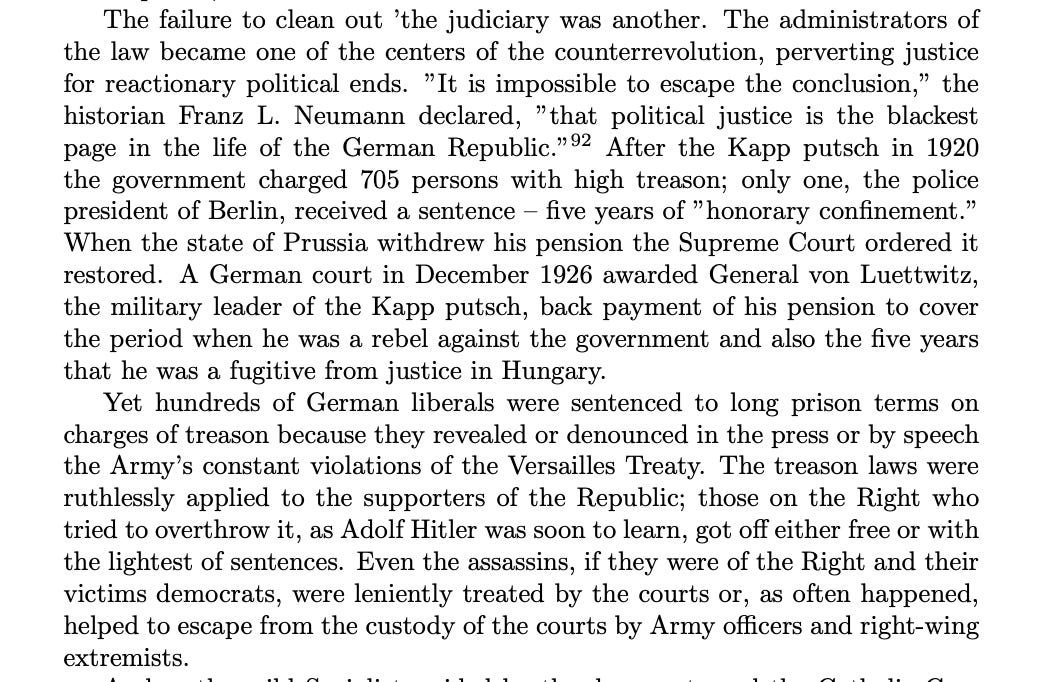
This likely leapt off the page at me specifically because I was also seeing headlines about Trump’s oft-stated desire to offer monetary reimbursements to January 6 rioters he has already pardoned and released.
The impulse to make amends toward people who have been punished or inconvenienced in any way for having challenged the state on conservative terms is not unique to either Weimar or to Trump; as Jamele Hill noted of Trump’s reparations desires for J6 protesters, “for America, this tracks…Abraham Lincoln compensated slave owners $300 for each slave that was freed for ‘loss of property.’”
But it also feels — no matter how hackneyed or incomplete the comparisons between Trump and Hitler may be — like it would be a dishonest omission not to notice, in the course of my book research, the echoes.
Our government is bending over backwards to support and lionize protesters who sought to overturn election results, harm members of Congress and kill a vice-president, in the same days that the Secretary of State is claiming that the only grounds for detaining and expelling a graduate student are his “current or expected beliefs” (emphasis mine) which it deems counter to the country’s foreign policy aims. They are trying to deport pro-Palestinian protesters for allegedly reinforcing antisemitic sentiment, while Elon Musk throws Sieg Heils and the administration removes books about Holocaust history in its purge of the Naval Academy library. Today the White House sent out a list of the purportedly “Sick Criminals” they have deported, listing their alleged crimes, many of which involved sexual assault; yet the same administration has undertaken an affirmative action program of its own, hiring as many people accused of sexual misconduct of having covered it up as they can find to work in Trump’s cabinet; the president himself has been found liable for sexual abuse and has been accused by more than a dozen women of assault; under his presidency, Andrew Tate, accused of rape, strangulation and sex trafficking was released from Romania where he was being held, reportedly thanks to pressure applied by the Trump administration, and promptly welcomed in Florida.
Meanwhile, human beings with families, loved ones, emotional and cultural and economic and professional responsibilities and ties to their homes and communities in the United States, are being held in monstrous prisons, in detention centers in Louisiana, are at risk of missing the birth of their first child, are being denied medicine and forced to kneel while having their heads shaved. At the prison in El Salvador where the 238 men were taken, prison rooms hold eighty and are outfitted only with “metal bunks, with no sheets, pillows or mattresses…an open toilet, a cement basin and plastic bucket for washing and a large jug for drinking water.” It’s a a description that is nearly word-for-word what some of the women I’m writing about describe about a cells where they were initially held after their own deportations from their homes in Germany in 1942.
Lots of people reasonably bridle at easy comparisons of grotesque cruelty and suffering; I understand why, and believe that specificity is important. That description of a cell, for example, is nothing like the conditions that greeted British liberators 80 years ago today when they arrived at Bergen Belsen and found 55,000 emaciated prisoners, many suffering from typhus, tens of thousands of bodies littering the ground, piled in mountains; there were no toilets for prisoners at Belsen, no places to wash, almost no clean drinking water, since the dead had been piled in the cisterns.
But maybe because I’ve been reading and listening to so much about people who experienced those specific conditions, in that specific time and place, I feel acutely aware of the humanity, the pain, the grief, the loss and the fear of those now suffering in their own specific ways in this time and this place.
No posts
Comments
Nothing yet. Say the first thing.
Sign in to join the conversation.