
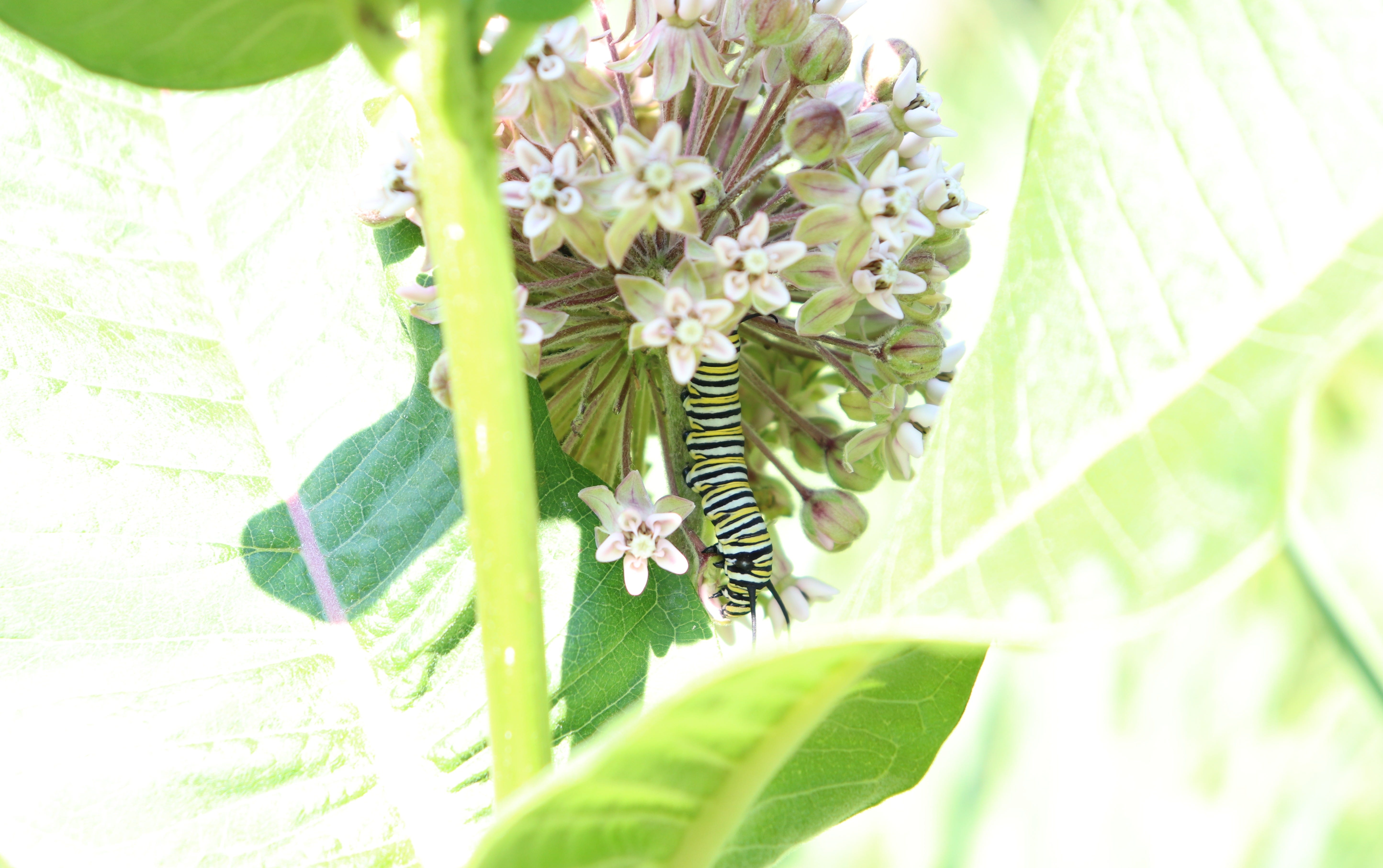
Happy Strawberry Moon!
Is this the cutest moon name of them all? Do we all imagine a strawberry glowing in the sky? I hope so. Strawberries are one of the great gifts of North America to the rest of the world. We have a tiny, delicious species Fragaria virginiana, the Wild Strawberry, who spreads to all but the coldest and driest parts of the US and Canada. And we have a large, fairly flavorless west coast species, Fragaria chiloensis, the Beach Strawberry, who hugs the entirety of the Pacific coast, from the Bering Strait down through Patagonia. It’s those two distant cousins that were brought to France, of all places, to form the berries we eat for breakfast today.
Apparently, Louis the XIV loved strawberries. There were a couple (very meh) European species but France had been eating F. virginiana since it had been introduced in the early 1600s. In 1714 Amédée François Frézier, a French spy, sent by Louis to Chile, returned with 5 plants of F. chiloensis. The fruits had been cultivated by the Mapuche people for centuries and while they grew giant, whitish fruits at home, in France, they were barren, likely because they are dioecious and Frézier had only imported female plants.
50 years later, Louis XIV financed a 17 year old to collect every strawberry in Europe for Versailles, but still, little came of it. It wasn’t till a decade later, when nameless French farmers began planting all the various species together that the two North American strawberries hybridized, and Frézier found the giant, delicious fruits in a market. The aforementioned 17 year old (Duchesne, now significantly older) named the hybrid after a pineapple, Fragaria x ananassa and that, my dears, is what we buy in farmer’s markets today.
✤
Last month’s garden-side chat was Liriodendriferous! THANK YOU for sharing your Tulip Tree knowledge and celebrating perhaps the best tree with me. Notes, for those who asked, will be out tomorrow.
I am laser focused right now on making my front yard into a hummingbird sanctuary. We have a couple zipping around the Monarda but I want MORE. I’ve been researching for years, what they want out of life and how to make them healthy and happy. If you also recognize that life is just better with hummingbirds, please come to the Hummingbird Garden-side Chat this month where we will dive deep into ecology, evolution, and landscape requirements of these tiny flying jewels.
Garden-side Chat: July 23rd, 6PM EST.
This newsletter is and always will be free for everyone. But if you’d like to join our monthly, virtual chats please become a supporter by clicking below. It’s $50 which gets you into all chats for a year!
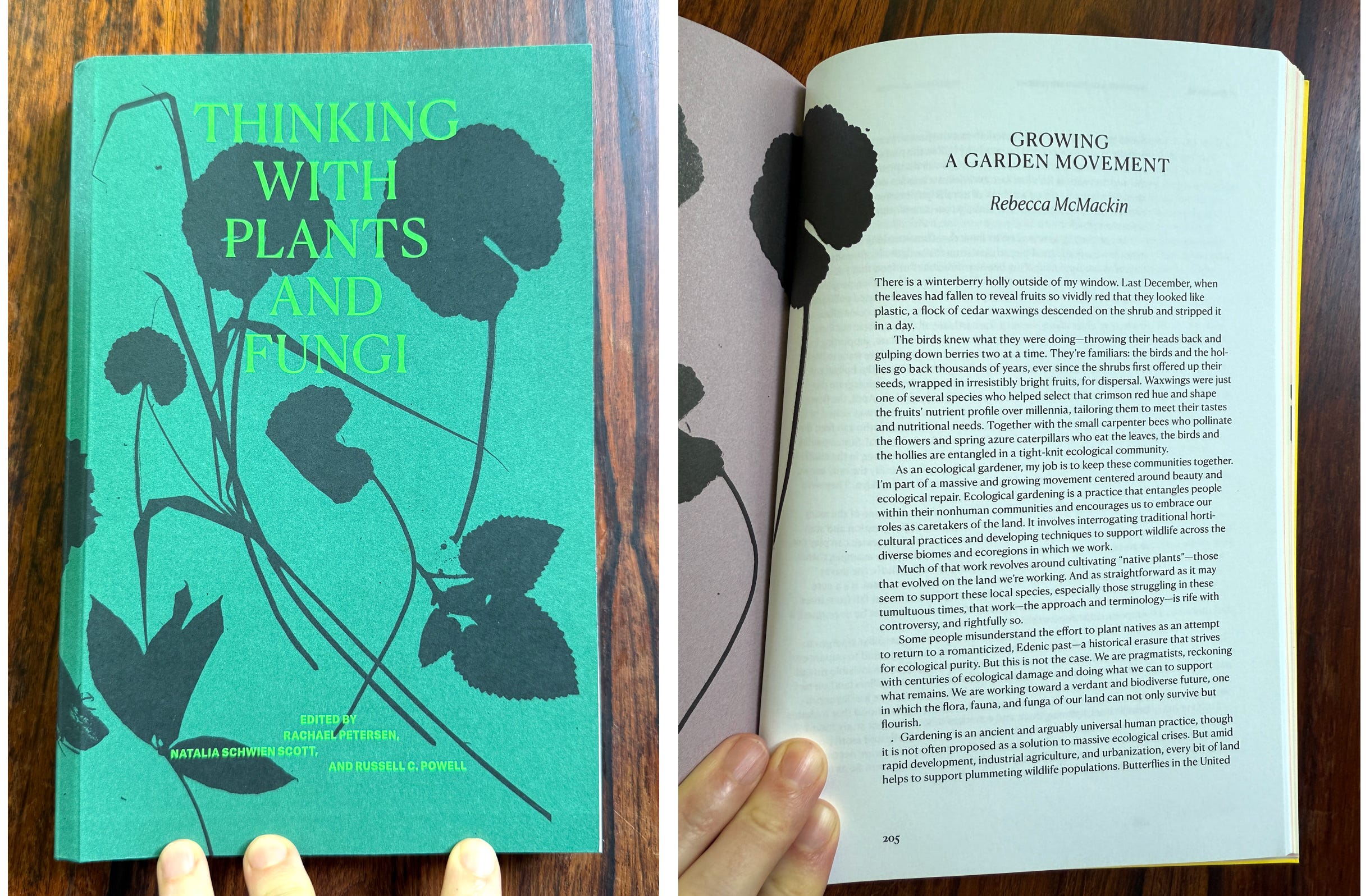
One of the most fascinating books I have ever read was just officially published and I am honored to say I have a chapter in it. The book is Thinking with Plants and Fungi and it’s the physical manifestation of a symposium put on by the Harvard Divinity School last year. If you’re the type of gardener who really thinks about plants, about life on Earth, and how we fit in, I vow that you will love this. Even the intro is marvelous! Did you know that the word “occult” was coined by Thomas Aquinas 700 years ago and he was talking about plants specifically? There are essays by Zoë Schlanger, Giovanni Aloi, Guliana Furci, and Monica Gagliano. My chapter is about promoting the use of native plants without also promoting nativism. It’s the result of a year-long fellowship and amazing to see it in print. Definitely also read Banu Subramaniam’s piece arguing against plant nativity.
Bill Cullina, author of some of the most helpful native plant books ever written, is doing a fun series on social media where he writes about a different native plant every day for 2026. It’s often unusual information, as much of his knowledge is from a lifetime of propagation and research. Enjoy!
A new native seed source just launched for the mid-Atlantic! The Mid-Atlantic Regional Online Marketplace (aka ROMP) is a network of seed suppliers growing local ecotype plants. You can use the website to sell the seeds you grow, buy the seed you need, or list seed you’re looking for. It’s a similar network to one long established in the northeast.
The Landscape Performance Series is a large database of landscape projects that are searchable by feature. Looking for recent projects on shoreline restoration? Carbon sequestration? Habitat creation? There are hundreds with photos, full case studies, and performance information. It’s helpful to browse but you can also submit your projects here.
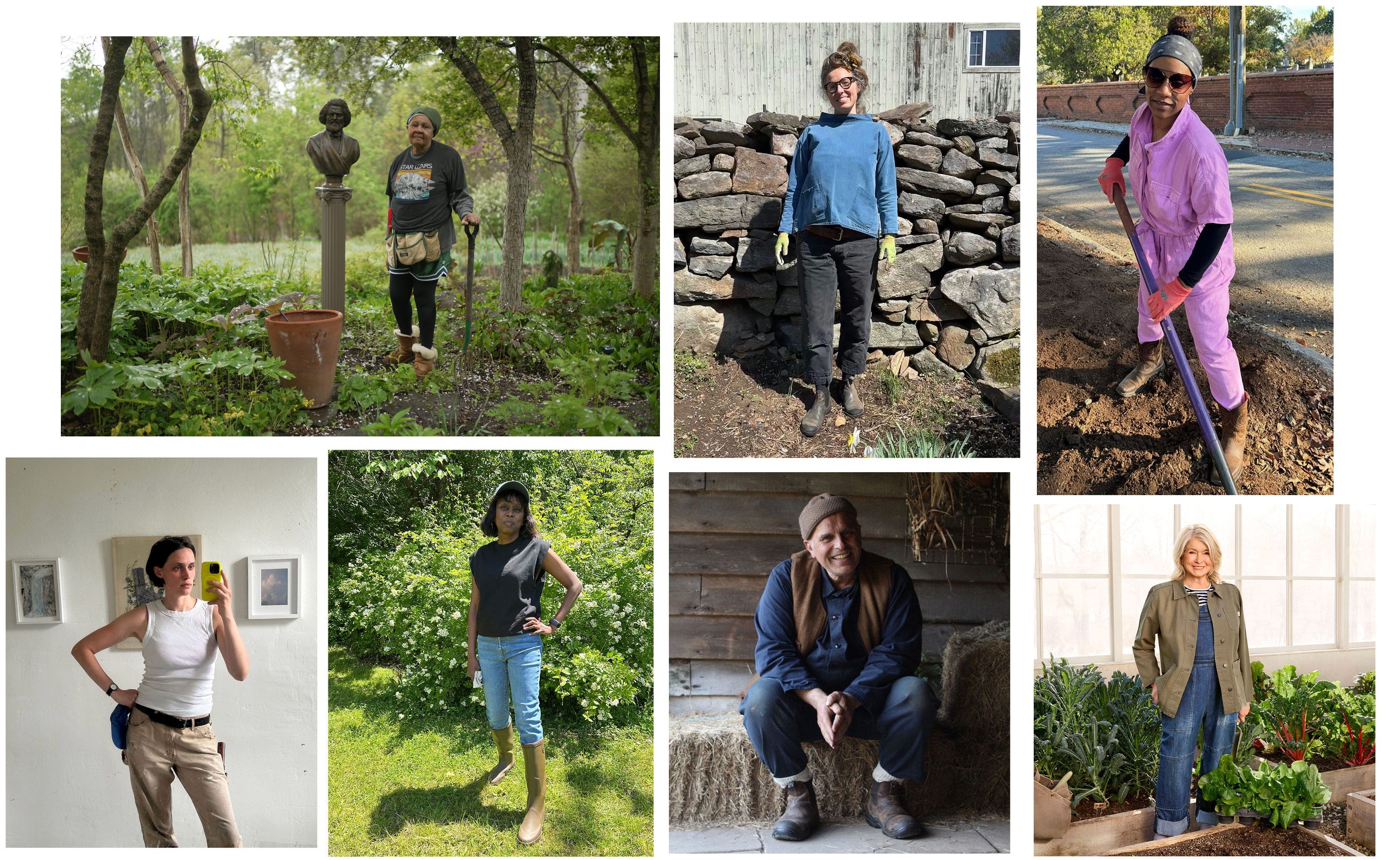
Jamaica Kincaid plants peonies and okra wearing her son’s hand-me-downs while Fergus Garrett only wears pants from Pakistan. Georgia Hilmer wears Dickies and Wambui Ippolito switches between Aigle or Wellington boots depending on the weather. Pamela Anderson is all about baskets and Martha Stewart, to no one’s surprise, prefers her own line of clothing. Abra Lee rocks a bright pink jumpsuit because she’s cooler than all of us and APPARENTLY Rebecca McMackin wears her formal Carhartts with the gold hardware topped with anything from Gamine. 40 gardeners were profiled to document their favorite fits in this shockingly helpful piece from NY Magazine’s Secret Strategist. Yes, don’t worry, there are lots of links.
And because gardening is so chic right now, Vogue featured the arborists of Central Park in a sweet and not-really-about fashion exploration of what they do all day and why they work with trees. For one: they’re always looking up. It was inspired by a viral IG video on Magnolias and the whole things is super wholesome.
Native plant sales are up and continue to rise. While there isn’t a ton of good research, what we do have is optimistic. Get ready for a data dump! Grist reported that Prairie Nursery sales increased 7% last year, while Prairie Moon Nursery tripled business over the last 7 years. A survey from 2022 reported that US homeowners are divided into thirds, with roughly equal percentages of us averse to, curious about, or enthusiastic for native plants. That’s pretty amazing considering that 37% of American’s don’t believe in evolution! Even still, those averse still spent a quarter of their plant budget on native plants just because they’re just pretty and reliable. A new study shows that conventional nurseries are still growing 63% non-native species (10% of which are known to be ecologically harmful). Of the native plants they did offer, 75% were cultivars. When you look at all US nurseries, 44% of the plants they grow are native, up from just 33% six years ago. A survey of Nursery Management Magazine subscribers, which includes everyone from propagators to botanical gardens, found that 46% of plant inventories were native, with most respondents reporting increased demand in the last 5 years. Both growers and buyers prioritize environmental benefits and adaptability, while buyers also find native plants surprisingly beautiful. The biggest challenge with stocking native plants is availability, but nurseries found they take less chemical inputs to grow. Because this survey was funded by Proven Winners, they asked about native cultivars (AKA “nativars”) and found that a quarter of buyers only want straight species. Phew! What does all that mean? People, we are not a trend. This is a slow burn as we increase ecological awareness and shift the whole industry. Nice work everyone!
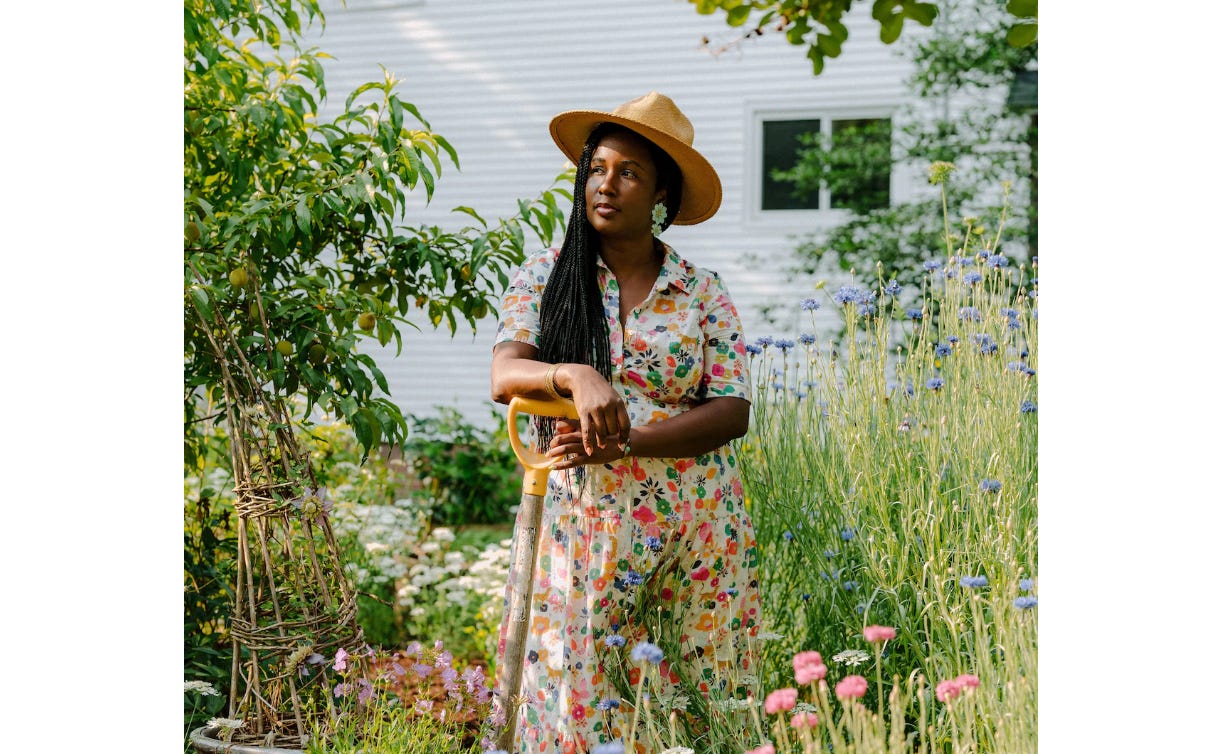
Urban flower farmers have a new strategy when it comes to land access: borrow their neighbors’. Micro flower farming has become a viable career in cities where land is hard to come by. The Washington Post profiled 3 heartwarming operations in San Diego, Norfolk, and Memphis all of which started by gardeners approaching neighbors and offering to transform their yards into a floral bonanza. How could they say no? It sounds like few of them did and all of the gardeners now have successful, hyper-local cut flower operations spread across their neighborhoods. Of course it’s not always easy: they have to replace stolen plants and schlep wheelbarrows full of compost from house to house. But they’ve filled their communities with flowers and delighted everyone with birds and butterflies. I’m hopeful that we’ll see more of this soon. (paywall free link)
We’ve known for decades that gardens add to the value of homes. Real estate agents often recommend planting foundation shrubs and resodding before listing a property, which can up a sale price by >10%. Our wild ecological gardens however, have never once been part of that calculation. But that seems to be shifting. The New York Times reports that native plant gardens might actually be good, great even, for home sales. Despite the concerns of listing agents, a Maryland ecological gardener sold his home for $20k above asking, with the buyer requesting a list of plants. And a home in suburban New Jersey with a meadow for a front yard sold for 30% above asking - the buyer was, of course, an avid gardener. The times, they are a-changing!
It’s only logical that, as insects disappear, those who eat them will follow. But it’s always jarring to see the data. The Long Point Bird Observatory in Ontario has been tracking wildlife populations since the 1970s and reported that insects populations have decreased by 60% in that time. Local tree swallows, who lay eggs timed for peak insect abundance, have also been dwindling. Researchers could see that years with far less insects resulted in less eggs and smaller birds. What can we do? Garden like hell, protect biodiversity, and as usual, bring down capitalism.
It just blows my mind that there are now caterpillars on the Today Show. The good folks at Plan It Wild were invited on to talk host plants, chickadees and encourage people to joint the Less Lawn More Life Challenge. Have you signed up yet? It’s not too late to join 30k people to shrink your lawn today!
Want to get rid of mosquitoes? Start a club. The Washington Post wrote a helpful piece on mosquito management that covers all the basics (get rid of standing water, make a Bucket of DOOM, plant native plants, and don’t spray anything except your body). But the author highlights the most important step: talk to your neighbors. Imagine you kill all the mosquitoes in your yard, they will simply fly in from next door. The only effective management strategies are communal. Check out the Itty Bitty Mosquito Population Committee to see how it’s done. (paywall-free link) (H/T Linda H!)
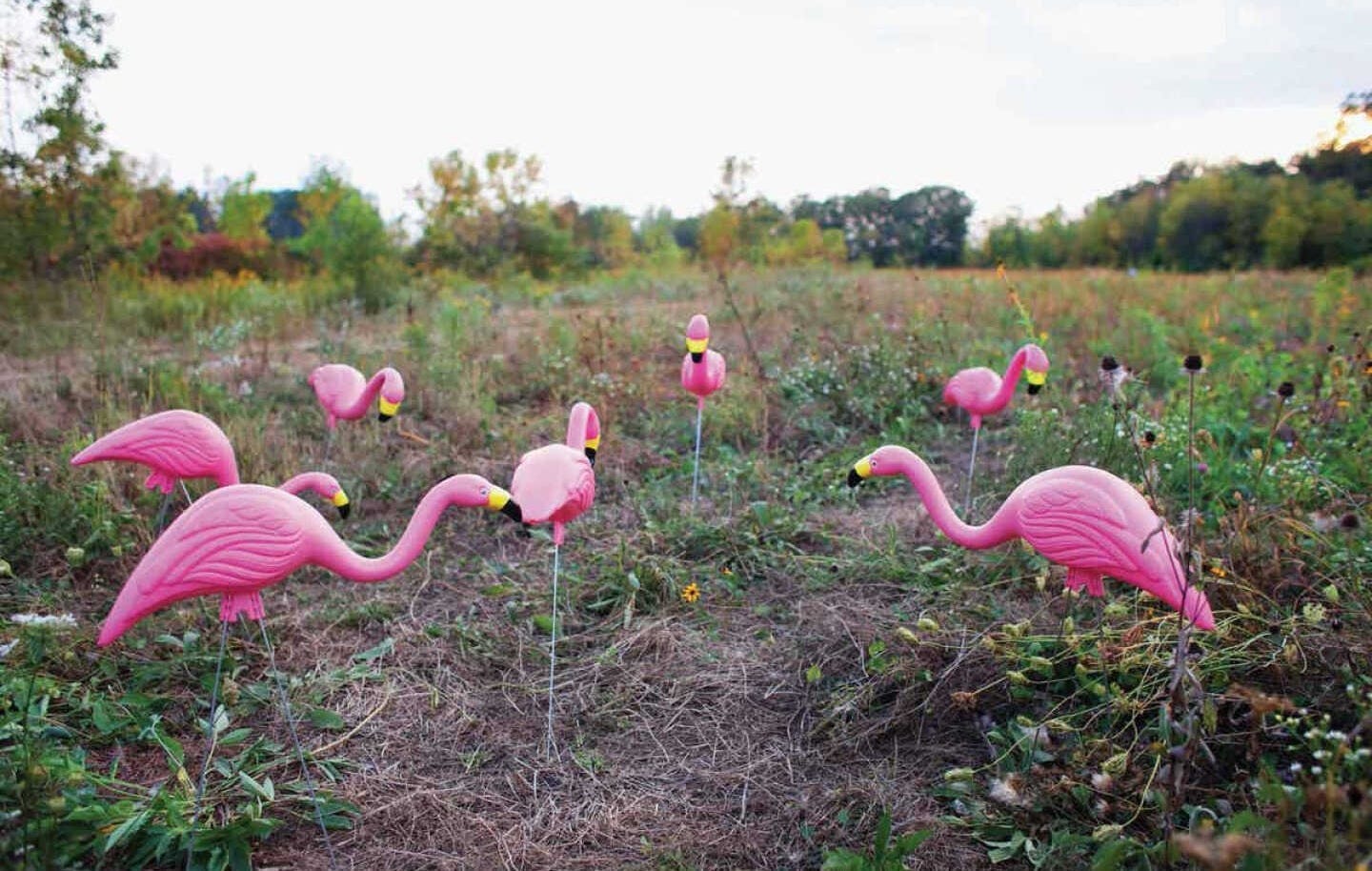
I hope your June was gay as could be! It’s hard to figure out exactly how to celebrate Pride with gardens because its all so thoroughly queer. I’ve gone with camp of the pinkest variety: flamingos! The first plastic lawn flamingo was made in a MA factory in 1957. His name was Diego. You can’t deny it, these tacky birds are part of our collective garden culture and some of us secretly adore them. Kirk Gordon begins his 3 part series on flamingos describing the moment when he first opened his original Featherstone specimen: “This ancestral chanting—Kokomo, kokomo—carried me hypnotically to the backyard where, with the ritual precision of a spear fisherman, I plunged the metal spokes deep into the snow.” Gordon’s thesis is that the flamingos represent a “miniaturized distillation of our nation’s ideals around land ownership, conformity, and collective life” all appropriately played out on the stage of the American lawn. The whole piece is a fun, critical look at yard art and lawn ornament that runs from Gertrude Jekyll to John Waters. I dare you not to love it. No one is immune to kitsch.
The New York Times published a heartbreaking story about a gardener in one of the richest areas of New York, who passed away when he froze to death outside his tent encampment. The author, Rukmini Callimachi, marks the contrast between how well Boxwood is wrapped and protected for winter, and how exposed and neglected the people who do the work are. I don’t know which trillionaire Francisco Camey was working for when he froze, but they should be exposed and shamed. No one, much less the hyper wealthy, should hire people for less than a living wage. I never hire crews without enquiring about labor practices and hope you consider doing the same. Every ecological garden practice MUST also support the people who live, use, and work on the land. There is no way around it.
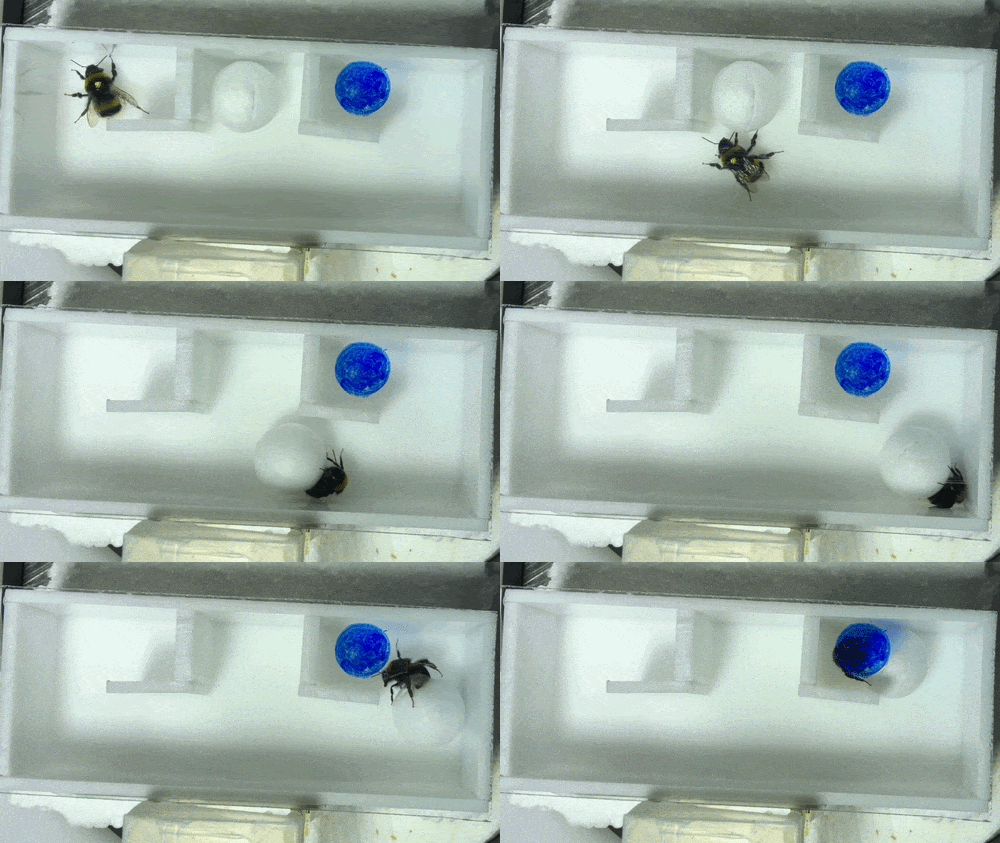
Bumblebees like to solve puzzles. It’s why complicated, lock-and-key flowers like Baptisias, Gentians, and Lupines so often partner with bumblebees as pollinators, restricting access only those who can unravel a riddle before entry. Many of us were delighted but not surprised when research came out recently showing that bumblebees will play with round balls for fun. A new study has now documented that they will even use those balls as a stepping stool to reach a reward when they aren’t able to fly. Researchers are excited because this shows not only tool use but the ability to plan for the future as well, the first instance documented for invertebrates.
The American lawn depends entirely on “noise and poison’ says Edwina von Gal at the Perfect Earth’s “Killer Lawns” conference last month. Researchers and science reporters weighed in on the dangers of turf care and Melissa Ozawa pulled takeaways for Gardenista:
US turf care is a $21 billion business that dumps 80 million pounds of pesticides on the ground annually.
Turf pesticides are associated with Parkinson’s disease. If you live within a mile of a golf course, your chance of getting it increases by 126%. Children are uniquely vulnerable because they’re close to the ground, roll around, and put everything in their mouths.
Many landscaping companies sneak in herbicides when they claim to apply fertilizers, which also can contain PFAS and microplastics.
Want to go organic? Start with the Perfect Earth turf guide here.
I truly believe that Richard Dawkins, with his selfish-gene hypothesis, has done mind-boggling levels of damage by convincing nearly everyone that self-interest runs the world. Charles Darwin even argued that empathy and cooperation are also primary drivers of evolution alongside competition. But still today, there’s a whole industry of nay-sayers who pop up to chide when anyone suggests that species sometimes work together, and that could benefit everyone. That competition is “natural’ is taken as fact, while cooperation is considered anthropomorphization - somehow sentimental, feminized, and requiring preposterous levels of “evidence” before we’re allowed to accurately describe what is clearly going on all around us. Well, there’s a new study to show how and why plants work together. Researchers looked at diverse Mediterranean plant communities made up of drought-adapted, small flowering plants. When plants lived in low density populations, some otherwise conservative species used their resources to enrich soil health, benefiting other, struggling plants and maintaining diversity. Researchers dubbed this the “helper trait.” However, when all plants were packed closely together, those generous plants switched tactics, using more of their energy to grow themselves. Obviously planet Earth is not entirely warm and fuzzy but this study shows that diverse communities do work together when conditions are right, sometimes with no apparent personal gain. There’s a lovely book that delves into this topic further if you’re into it: Sweet in Tooth and Claw.
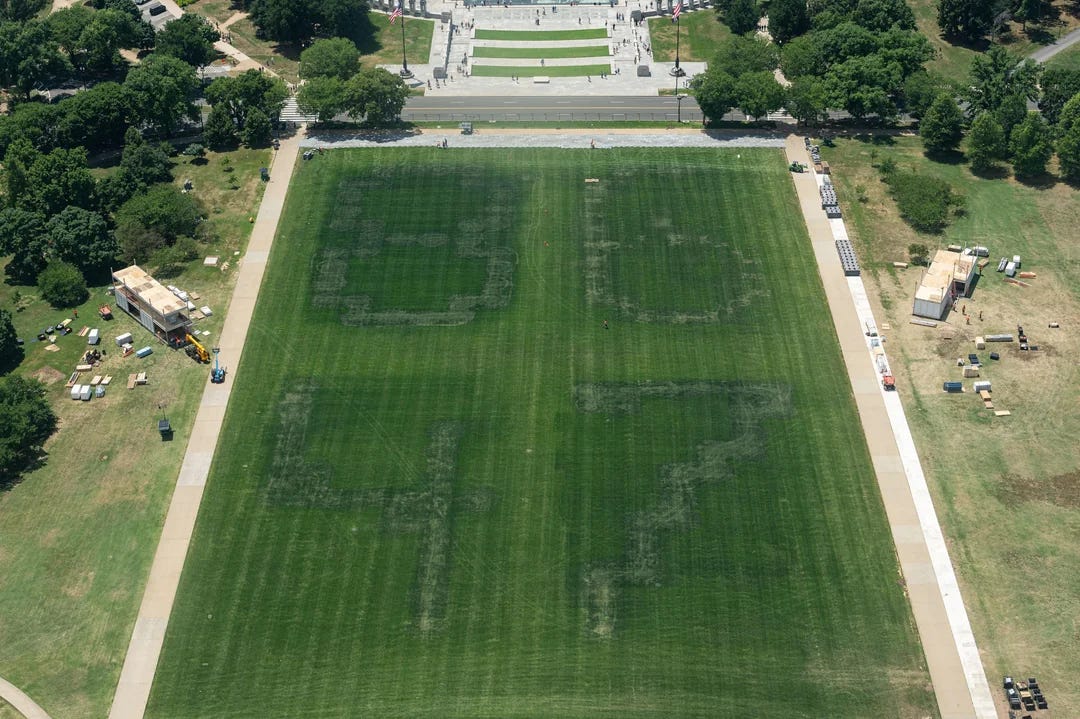
I am always so joyful when horticulture makes its way into national politics. Two weeks ago, some rogue used herbicide to write “8647” in giant letters on the National Mall. I can’t tell you what that code means but search engines will, and the Trump administration was understandably displeased. They immediately dispatched the police to comb the lawn with guns and magnifying glasses. They painted over the numbers with green paint, which only made the numbers more visible. I await, with bated breath, to see if they resod.
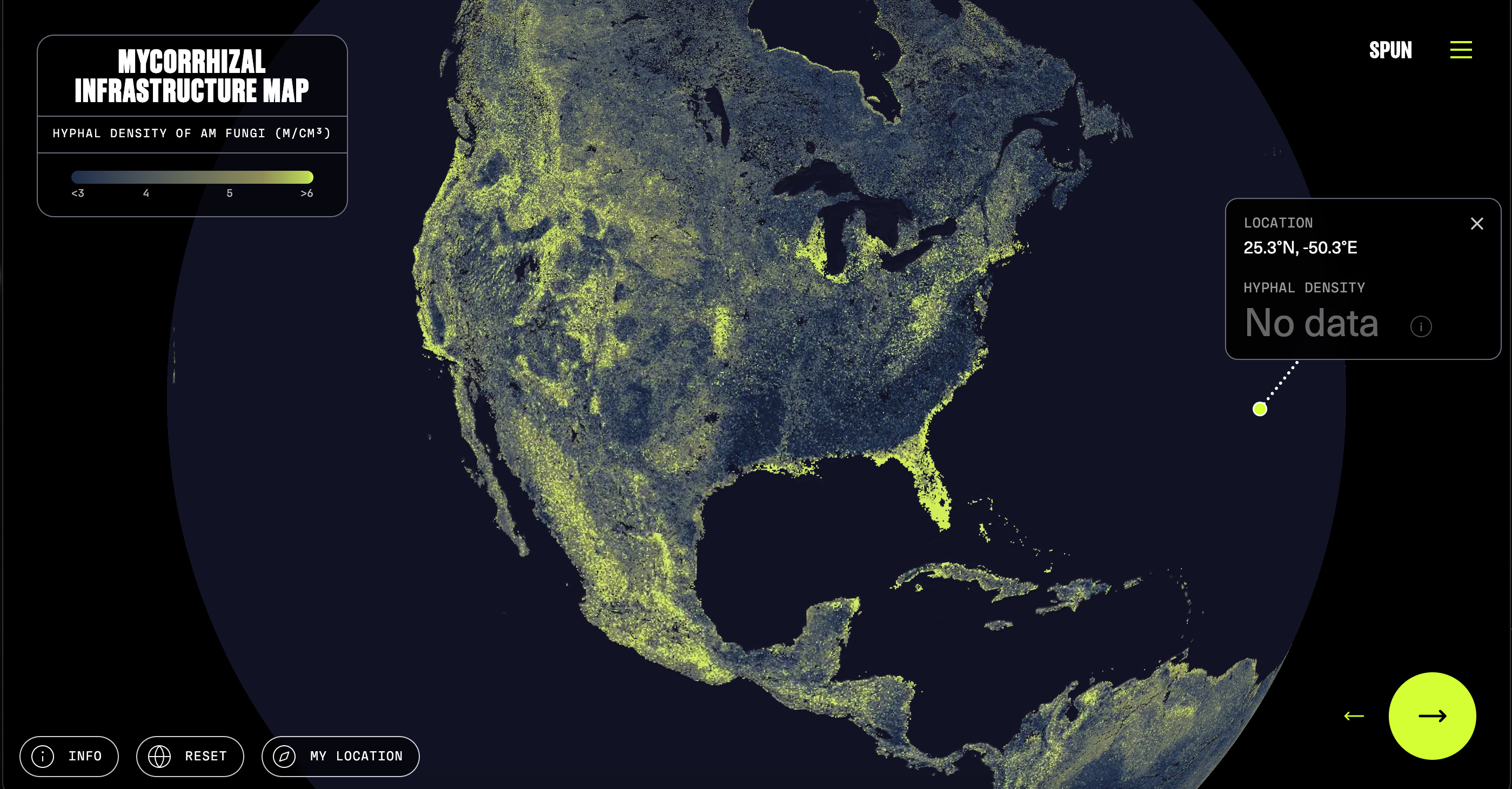
The Society for the Protection of Underground Networks (aka SPUN) has launched a new webtool mapping the density of arbuscular mycorrhizal networks all over the world. Massive is an understatement: a teaspoon of soil can contain 32’ of hyphae which adds up to 110 quadrillion km of fungal networks when laid end to end. Why is this important? Oh, you know, just that life on Earth depends on them and they move 11% of human CO2 emissions into the soils each year. A surprise to me is that 40% of all arbuscular fungal biomass is found in grasslands. You can see the density in the Florida Everglades above. Croplands often take over grasslands but they lose roughly half of their mycorrhizae in the process. Hopefully, this map will spur broader conservation efforts. More here.
Science round up:
A study of >500 tree communities from multiple continents found that “mast years” (when trees produce bumper crops of fruits and nuts) are almost always 2 to 3 years apart.
Mosquitoes exposed to artificial light at night stayed active and biting months later in the autumn than mosquitoes living in natural light conditions.
When their classrooms were filled with plants, eighth grade students in Taiwan reported that their learning environment was friendlier, more attractive and comfortable. Students in plant-y classrooms also took less sick days and misbehaved less.
A review of 54 studies found that urbanization makes for less arthropod pests and more fungal diseases.
As Beech trees decline, they produce less fine root hairs, which alters soil ecology, decreasing ectomycorrhizal fungi and encouraging more saprophytic fungi.
As mountain lions returned to a California preserve, deer pressure dropped. While the deer didn’t all necessarily leave or get eaten, they did behave differently, allowing young woody plants to thrive.
Water quality researchers in Montana found more herbicide, insecticide, and fungicide hotspots downstream from suburban communities than from agricultural areas.
Stem nesting bees in Australia have a greater ability to withstand extreme heat than ground nesting bees.
The top 10% of global consumers are responsible for 47–56% of biodiversity loss.
Masturbation is widespread in bird species of all genders.
Congratulations readers! You’re finally at the end of this epic edition. The reward this month is super dirty. There’s a French biochemist who’s been trying to kill soil for 15 years. He’s tried everything, heat, pressure, even gamma rays, and his jars of soil continue to respire, breathing in oxygen and releasing CO₂. He’s now concluded that soil is essentially a zombie, undead and active even when entirely sterile. During metabolism, sugar is broken down into smaller carbon molecules, from which electrons are liberated and then consume oxygen. This is known as the Krebs Cycle and it’s always been thought to happen exclusively within the confines of a cell. Everyone is now debating how this could possibly be real. Some researchers think enzymes might be hanging around in the soil, breaking down carbon outside of cells, while others retort that enzymes couldn’t function for that long. It’s seems as if it’s time to question whether this critical metabolic process is possible without life itself, perhaps even predating it! And how wonderful to look down at our feet, at the soil in our gardens, and marvel at how it works to sustain us. 🤎
Chanticleer: Adventures in Ecological Horticulture
July 15, PA
In person and open to the public
I am overjoyed to lecture for Chanticleer this summer. If you needed an excuse to visit the most romantic gardens of the region, this is it. I’ll be speaking on cultivating habitat in ornamental landscapes, from city lots to pleasure gardens. Hope to see you there!
July 17, PA
In person, virtual and open to the public
The Woody Pants Conference looks fantastic this year and I think it might be a record for most women speaking at a tree symposium (3, there are 3. It’s a low bar, ok?). There are lectures con community-oriented forestry, the anachronistic Osage Orange, death, and Magnolia math.
ELA Annual Conference and Marketplace
August 27 & 28, RI
In person, virtual and open to the public
The Ecological Landscape Alliance has supported northeast ecological gardening for decades, as well as thrown some of the best symposia of all time. It’s truly my favorite for meeting and connecting with other practitioners. Their annual conference is pricy! ($400 for members) but it’s massive, with two days of dozens of talks, delicious food, and the latest and greatest tools and plants. The whole shebang is co-keynoted by my favorite arborist, Christoper Roddick, speaking on just how and why everyone should work in horticulture for a few decades. See you there!
No posts
Comments
Nothing yet. Say the first thing.
Sign in to join the conversation.